Migration and Fundamental Rights Bulletin - 1/2026
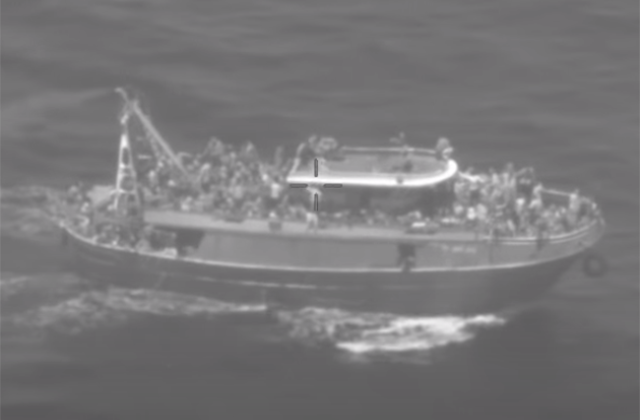
Many people continue to die at sea while attempting dangerous journeys to reach Europe. Search and rescue capacities remain insufficient. Among those rescued, many are exposed to harm, particularly when brought on land in Libya. In FRA’s report on preventing and responding to deaths at sea (2023), FRA recommended that the European Border and Coast Guard collectively ensures that sufficient and appropriate naval assets are deployed in open sea areas where risk analyses indicate that shipwrecks are more likely to occur. FRA’s 2025 update on search and rescue (SAR) operations notes that SAR capacity at sea remains inadequate.
According to data communicated by the International Organisation for Migration (IOM) on 1 March 2026, in 2025, at least 36 people died or went missing leaving the EU for the United Kingdom in 2025, including 1 child. In the same period, 3,409 people were reported dead or missing on sea routes to Europe in the Mediterranean or via Atlantic Ocean crossings to the Spanish Canary Islands, including at least 137 children.
The first six weeks of 2026 have been the deadliest start of the year in the Mediterranean since IOM began collecting data in 2014. IOM’s Missing Migrants Project shows that in January 2026 at least 459 migrants died or were reported missing after attempting the crossing from North Africa to Europe, with many incidents occurring during journeys undertaken in bad sea conditions.
In the Central Mediterranean, civil society organisations continue to partly fill the gap with their life-saving operations. A March 2026 SOS MEDITERRANÉE report provides an overview of civil society SAR operations in the Central Mediterranean over the past ten years and the difficulties non-governmental organisations (NGOs) face (see section 2).
In some instances, Member States are seen as delaying rescue operations. For example, in March 2025, the United Nations Human Rights Committee issued interim measures to prevent imminent and irreparable harm to the right to life and the prohibition of torture and other forms of ill-treatment enshrined in Articles 6 and 7 of the International Covenant on Civil and Political Rights (ICCPR). It requested Malta to urgently coordinate a SAR operation for 32 individuals who had been in distress for four days near the Miskar gas platform, and to ensure their disembarkation in a place of safety.
Following the capsizing of a migrant boat near Lampedusa in April 2026, leaving at least 70 people dead or missing, the Parliamentary Assembly of the Council of Europe calls for the urgent creation of a European search and rescue corps to save lives.
In the Central Mediterranean, in 2025, the Libyan authorities picked up some 27,116 migrants and refugees, bringing them back to Libya, compared to 21,762 people in 2024, according to IOM’s 11-17 January 2026 weekly update. Migrants and refugees in Libya are exposed to widespread abuse, as a 2026 UN report jointly issued by the Office of the UN High Commissioner for Human Rights and the UN Support Mission in Libya documented. The report calls for a moratorium on returns to Libya until adequate human rights safeguards are in place. It also recommends applying strict due diligence rules to any funding, training or operational cooperation with Libyan entities and suspending assistance where serious human rights violations persist.
In November 2025, 13 SAR organisations issued a note on their decision to suspend operational communication with the Libyan Joint Rescue Coordination Centre, established in Tripoli in 2024. The Court of Rome (decision No. 2015/2025, published on 7 February 2025) upheld an appeal by the civil society organisation Sea-Watch against the detention of its vessel Sea-Watch 5 by the Italian authorities. Sea-Watch had carried out a rescue operation in the Libyan SAR zone without formal coordination or authorisation. The court underlined that the Italian authorities could not impose sanctions based solely on Libyan reports alleging lack of cooperation.
In the 2025 case S.S. and Others v. Italy, the ECtHR held that Italy lacked jurisdiction over migrants rescued by the Libyan coastguards in international waters. The court noted that all the reports in its possession show that refugees and migrants in Libya were at risk of torture, slavery and discrimination, and it nonetheless held that Italy could not be held responsible for the alleged ill-treatment, due the lack of effective control over the persons concerned.
In a 2025 report on externalised asylum and migration policies and human rights law, the Council of Europe Commissioner for Human Rights criticised the Memorandum of Understanding between Italy and Libya, with its application lacking transparency. The Memorandum was automatically renewed for three years in November 2025, according to media reports.
Member States continue discussions on how to reduce incentives for migrants to undertake dangerous journeys. The Council of the EU explored in a note the ‘place of safety arrangements’ outside the EU, building on the October 2025 Pact for the Mediterranean. The 2023 Italy-Albania Protocol tested such an approach by establishing centres for asylum applicants rescued by Italy in international waters and coming from a safe country of origin. Under the Protocol, Italian authorities would examine asylum claims in these centres applying Italian asylum law. In a statement, UNHCR agreed to monitor the Protocol’s application. Various difficulties, including fundamental rights considerations, hindered its application. In March 2025, Italy changed its legislation and used the centres for pre-removal detention (Law-decree of 28 March 2025, No. 37). In June 2025, the office of Italy’s Supreme Court of Cassation published an analysis of the Italy–Albania Protocol, highlighting vague language and potential incompatibilities of the Protocol with the Italian Constitution. The court submitted a preliminary reference to the Court of Justice of the EU (CJEU, Case C-414/25, Sedrata).