eu-charter

EU Charter of Fundamental Rights

Article 23 - Equality between women and men

Article 23 - Equality between women and men

Equality between women and men must be ensured in all areas, including employment, work and pay. The principle of equality shall not prevent the maintenance or adoption of measures providing for specific advantages in favour of the under-represented sex.

Explanations

  • Text:

    The first paragraph has been based on Articles 2 and 3(2) of the EC Treaty, now replaced by Article 3 of the Treaty on European Union and Article 8 of the Treaty on the Functioning of the European Union which impose the objective of promoting equality between men and women on the Union, and on Article 157(1) of the Treaty on the Functioning of the European Union. It draws on Article 20 of the revised European Social Charter of 3 May 1996 and on point 16 of the Community Charter on the rights of workers.

    It is also based on Article 157(3) of the Treaty on the Functioning of the European Union and Article 2(4) of Council Directive 76/207/EEC on the implementation of the principle of equal treatment for men and women as regards access to employment, vocational training and promotion, and working conditions.

    The second paragraph takes over in shorter form Article 157(4) of the Treaty on the Functioning of the European Union which provides that the principle of equal treatment does not prevent the maintenance or adoption of measures providing for specific advantages in order to make it easier for the under-represented sex to pursue a vocational activity or to prevent or compensate for disadvantages in professional careers. In accordance with Article 52(2), the present paragraph does not amend Article 157(4).

    Source:
    Official Journal of the European Union C 303/17 - 14.12.2007
    Preamble - Explanations relating to the Charter of Fundamental Rights:
    These explanations were originally prepared under the authority of the Praesidium of the Convention which drafted the Charter of Fundamental Rights of the European Union. Although they do not as such have the status of law, they are a valuable tool of interpretation intended to clarify the provisions of the Charter.

Case Law References

National Constitutional Law

57 results found

  • Sweden / Instrument of Government
    Country:
    Sweden

    Chapter 1 - Basic principles of the form of government:

    Article 2 (…) The public institutions shall combat discrimination of persons on grounds of gender, colour, national or ethnic origin, linguistic or religious affiliation, functional disability, sexual orientation, age or other circumstance affecting the individual (…).

    Chapter 2 - Fundamental rights and freedoms:

    Article 13 No act of law or other provision may imply the unfavourable treatment of anyone on grounds of gender, unless the provision forms part of efforts to promote equality between men and women or relates to compulsory military service or other equivalent official duties.

  • ACT No. 365/2004 Coll. on Equal Treatment in Certain Areas and Protection against Discrimination, and on amending and supplementing certain other laws as amended (Antidiscrimination Act)
    Country:
    Slovakia

    Article I§ 1 ScopeThis Act provides for the application of the principle of equal treatment and lays down the means of legal protection in a case of violation of this principle. § 2 Basic provisions(1) Adherence to the principle of equal treatment shall lay in the prohibition of discrimination on grounds of sex, religion or belief, race, nationality or ethnic origin, disability, age, sexual orientation, marital or family status, colour, language, political affiliation or other conviction, national or social origin, property, lineage or any other status. (2) While adhering to the principle of equal treatment, observance shall also be paid to good morals for the purpose of broadening of protection against discrimination. (3) Adherence to the principle of equal treatment shall also rest in adoption of measures for the protection against discrimination.

  • Act to establish equality for men and women (Second Equality Act - 2. GleiBG)
    Country:
    Germany

    Dated 24 June 1994Section 1 - Scope. This Act shall apply to persons employed in federal administrative bodies of the Republic and in federal corporations, establishments and foundations under the public law, and in federal courts. "Administrations" within the meaning of this Act shall include public enterprises managed under federally-owned administration, and other federal public undertakings. Section 2 - Purpose of the Act.In order to bring about equality for men and women in the federal administrations and courts specified under section 1, women shall be afforded advancement under the terms of this Act, with due attention to the precedence of suitability, capability and occupational performance (Article 33, subsection (2) of the Constitution). Another aim of such advancement is to increase the numbers of women taking into account the obligatory aims proposed, in so far as in certain areas women are employed in smaller numbers than men. In the same way, the compatibility of family and profession for both men and women shall be promoted. p>

  • Algemene wet gelijke behandeling (AWGB)
    Country:
    Netherlands

    Preambule : Alzo Wij in overweging genomen hebben, dat het wenselijk is om, mede in verband met artikel 1 van de Grondwet, ter bevordering van de deelneming op gelijke voet aan het maatschappelijk leven bescherming te bieden tegen discriminatie op grond van godsdienst, levensovertuiging, politieke gezindheid, ras, geslacht, nationaliteit, hetero- of homoseksuele gerichtheid of burgerlijke staat, dat het daarom wenselijk is behoudens wettelijke uitzonderingen onderscheid op deze gronden te verbieden en dat het in verband met de handhaving van dit verbod wenselijk is een Commissie gelijke behandeling in te stellen

  • Basic Law for the Federal Republic of Germany
    Country:
    Germany

    Article 3 (2) Men and women shall have equal rights. The state shall promote the actual implementation of equal rights for women and men and take steps to eliminate disadvantages that now exist.

  • Bundes-Verfassungsgesetz (B-VG)
    Country:
    Austria

    Artikel 7(2) Bund, Länder und Gemeinden bekennen sich zur tatsächlichen Gleichstellung von Mann und Frau. Maßnahmen zur Förderung der faktischen Gleichstellung von Frauen und Männern insbesondere durch Beseitigung tatsächlich bestehender Ungleichheiten sind zulässig.(3) Amtsbezeichnungen können in der Form verwendet werden, die das Geschlecht des Amtsinhabers oder der Amtsinhaberin zum Ausdruck bringt. Gleiches gilt für Titel, akademische Grade und Berufsbezeichnungen.

  • Consolidation Act No. 756 21 August 2003 Consolidation Act on Equal Pay to Men and Women
    Country:
    Denmark

    1. (1) No discrimination on the ground of sex as regards pay may take place in contravention of this Act. This applies to both direct and indirect discrimination. (2) Indirect discrimination exists where a provision, a criterion or a practise which is seemingly neutral places a substantially bigger number of persons of one gender in a less favourable position unless this provision, criterion or practise is expedient and necessary or can be justified by objective non-gender related factors. (3) Any employer shall give men and women equal pay, including equal pay conditions, for the same work or work given the same value.

  • Consolidation Act on Equal Treatment of Men and Women as regards Access to Employment and Maternity Leave, etc
    Country:
    Denmark

    1. (1) For the purpose of this Act equal treatment of men and women means that no discrimination may take place on the ground of gender. This applies to both direct discrimination and indirect discrimination, in particular by reference to pregnancy or to marital or family status.2) Indirect discrimination exists where a provision, a criterion or a practise which is seemingly neutral places a substantially bigger number of persons of one gender in a less favourable position unless this provision, criterion or practise is expedient and necessary or can be justified by objective non-gender related factors.2. Any employer shall observe the principle of equal treatment of men and women in connection with recruitment, transfers and promotions.

  • Constitution
    Country:
    France

    Article 1 (2) La loi favorise l'égal accès des femmes et des hommes aux mandats électoraux et fonctions électives, ainsi qu'aux responsabilités professionnelles et sociales.

  • Constitution
    Country:
    France

    Article 1 (2) Statutes shall promote equal access by women and men to elective offices and posts as well as to position of professional and social responsibility.

  • Constitution of Finland
    Country:
    Finland

    Section 6 Equality (...) Equality of the sexes is promoted in societal activity and working life, especially in the determination of pay and the other terms of employment, as provided in more detail by an Act.

  • Constitution of Ireland
    Country:
    Ireland

    Article 40.1. All citizens shall, as human persons, be held equal before the law.
    this shall not be held to mean that the state shall not in its enactments have due regard to differences of capacity, physical and moral, and of social function. Article 45.2. The state shall, in particular, direct its policy towards securing:–
    i that the citizens (all of whom, men and
    women equally, have the right to an
    adequate means of livelihood) may
    through their occupations find the means
    of making reasonable provision for their
    domestic needs. Article 9.1.3. No person may be excluded from Irish nationality and citizenship by reason of the sex of such person.Article16.1.3. No law shall be enacted placing any citizen under disability or incapacity for membership of Dáil Éireann on the ground of sex or disqualifying any citizen or other person from voting at an election for members of Dáil Éireann on that ground. 

  • Constitution of Malta
    Country:
    Malta

    Article 14The State shall promote the equal right of men and women to enjoy all economic, social, cultural, civil and political rights and for this purpose shall take appropriate measures to eliminate all forms of discrimination between the sexes by any person, organisation or enterprise; the State shall in particular aim at ensuring that women workers enjoy equal rights and the same wages for the same work as men.

  • Constitution of the Hellenic Republic
    Country:
    Greece

    Article 4 (2) Greek men and Greek women have equal rights and obligations.[…] Article 22 (1) […] All workers, irrespective of sex or other distinctions, shall be entitled to equal pay for work of equal value. […]

  • Constitution of the Italian Republic
    Country:
    Italy

    Art. 3. All citizens have equal social dignity and are equal before the law, without distinction of sex, race, language, religion, political opinion, personal and social conditions. Art. 29. (...) Marriage is based on the moral and legal equality of the spouses within the limits laid down by law to guarantee the unity of the family. Art. 37. Working women are entitled to equal rights and, for comparable jobs, equal pay as men. Working conditions must allow women to fulfil their essential role in the family and ensure appropriate protection for the mother and child. (...) Art. 48. Any citizen, male or female, who has attained majority, is entitled to vote. (...) Art. 51. Any citizen of either sex is eligible for public offices and elected positions on equal terms, according to the conditions established by law. To this end, the Republic shall adopt specific measures to promote equal opportunities between women and men. (...) Art. 117. (...) Regional laws shall remove any hindrances to the full equality of men and women in social, cultural and economic life and promote equal access to elected offices for men and women. (...)

  • Constitution of the Republic of Austria
    Country:
    Austria

    Article 7(2) The Federation, Laender and municipalities subscribe to the de-facto equality of men and women. Measures to promote factual equality of women and men, particularly by eliminating actually existing inequalities, are admissible.(3) Official designations can be applied in such a way as to indicate the sex of the officer holder. The same holds good for titles, academic degrees and descriptions of occupations.

  • Constitution of the Republic of Bulgaria
    Country:
    Bulgaria

    Article 6 (1) All persons are born free and equal in dignity and rights.(2) All citizens shall be equal before the law. There shall be no privileges or restriction of rights on the grounds of race, national or social origin, ethnic self-identity, sex, religion, education, opinion, political affiliation, personal or social status or property status. Article 14 The family, motherhood and children shall enjoy the protection of the State and society. Art. 46. (1) Matrimony shall be a free union between a man and a woman. Only a civil marriage shall be legal. (2) Spouses shall have equal rights and obligations in matrimony and the family [...]

  • Constitution of the Republic of Croatia
    Country:
    Croatia

    Article 3
    Freedom, equal rights, national and gender equality(...) are the highest values of the constitutional order of the Republic of Croatia and the ground for interpretation of the Constitution.

  • Constitution of the Republic of Estonia
    Country:
    Estonia

    Article 12. Everyone is equal before the law. No one may be discriminated against on the basis of nationality, race, colour, sex, language, origin, religion, political or other views, property or social status, or on other grounds.
    Article 27. (…) Spouses have equal rights.(…)

  • Constitution of the Republic of Latvia
    Country:
    Latvia

    91. All human beings in Latvia shall be equal before the law and the courts.Human rights shall be realised without discrimination of any kind.

EU Law

19 results found

  • Directive (EU) 2019/1158 of the European Parliament and of the Council of 20 June 2019 on work-life balance for parents and carers and repealing Council Directive 2010/18/EU

    .

  • Directive 2006/54/EC of the European Parliament and of the Council of 5 July 2006 on the implementation of the principle of equal opportunities and equal treatment of men and women in matters of employment and occupation (recast)

    Preamble 


    (5) Articles 21 and 23 of the Charter of Fundamental Rights of the European Union also prohibit any discrimination on grounds of sex and enshrine the right to equal treatment between men and women in all areas, including employment, work and pay.


    (6) Harassment and sexual harassment are contrary to the principle of equal treatment between men and women and constitute discrimination on grounds of sex for the purposes of this Directive. These forms of discrimination occur not only in the workplace, but also in the context of access to employment, vocational training and promotion. They should therefore be prohibited and should be subject to effective, proportionate and dissuasive penalties.

    (7) In this context, employers and those responsible for vocational training should be encouraged to take measures to combat all forms of discrimination on grounds of sex and, in particular, to take preventive measures against harassment and sexual harassment in the workplace and in access to employment, vocational training and promotion, in accordance with national law and practice.

    (8) The principle of equal pay for equal work or work of equal value as laid down by Article 141 of the Treaty and consistently upheld in the case-law of the Court of Justice constitutes an important aspect of the principle of equal treatment between men and women and an essential and indispensable part of the acquis communautaire, including the case-law of the Court concerning sex discrimination. It is therefore appropriate to make further provision for its implementation.


    (11) The Member States, in collaboration with the social partners, should continue to address the problem of the continuing gender-based wage differentials and marked gender segregation on the labour market by means such as flexible working time arrangements which enable both men and women to combine family and work commitments more successfully. This could also include appropriate parental leave arrangements which could be taken up by either parent as well as the provision of accessible and affordable child-care facilities and care for dependent persons.


    (26) In the Resolution of the Council and of the Ministers for Employment and Social Policy, meeting within the Council, of 29 June 2000 on the balanced participation of women and men in family and working life , Member States were encouraged to consider examining the scope for their respective legal systems to grant working men an individual and non‐transferable right to paternity leave, while maintaining their rights relating to employment.

    Article 2: Definitions

    1.   For the purposes of this Directive, the following definitions shall apply:

    (a) ‘direct discrimination’: where one person is treated less favourably on grounds of sex than another is, has been or would be treated in a comparable situation;

    (b) ‘indirect discrimination’: where an apparently neutral provision, criterion or practice would put persons of one sex at a particular disadvantage compared with persons of the other sex, unless that provision, criterion or practice is objectively justified by a legitimate aim, and the means of achieving that aim are appropriate and necessary;

    (c) ‘harassment’: where unwanted conduct related to the sex of a person occurs with the purpose or effect of violating the dignity of a person, and of creating an intimidating, hostile, degrading, humiliating or offensive environment;

    (d) ‘sexual harassment’: where any form of unwanted verbal, non-verbal or physical conduct of a sexual nature occurs, with the purpose or effect of violating the dignity of a person, in particular when creating an intimidating, hostile, degrading, humiliating or offensive environment;

    (e)‘pay’: the ordinary basic or minimum wage or salary and any other consideration, whether in cash or in kind, which the worker receives directly or indirectly, in respect of his/her employment from his/her employer;

    (f) ‘occupational social security schemes’: schemes not governed by Council Directive 79/7/EEC of 19 December 1978 on the progressive implementation of the principle of equal treatment for men and women in matters of social security (16) whose purpose is to provide workers, whether employees or self-employed, in an undertaking or group of undertakings, area of economic activity, occupational sector or group of sectors with benefits intended to supplement the benefits provided by statutory social security schemes or to replace them, whether membership of such schemes is compulsory or optional.

    2.   For the purposes of this Directive, discrimination includes:

    (a) harassment and sexual harassment, as well as any less favourable treatment based on a person's rejection of or submission to such conduct;

    (b) instruction to discriminate against persons on grounds of sex;

    (c) any less favourable treatment of a woman related to pregnancy or maternity leave within the meaning of Directive 92/85/EEC.

    CHAPTER 1: Equal pay

    Article 4: Prohibition of discrimination

    For the same work or for work to which equal value is attributed, direct and indirect discrimination on grounds of sex with regard to all aspects and conditions of remuneration shall be eliminated.

    In particular, where a job classification system is used for determining pay, it shall be based on the same criteria for both men and women and so drawn up as to exclude any discrimination on grounds of sex.

    CHAPTER 2 : Equal treatment in occupational social security schemes

    Article 5: Prohibition of discrimination

    Without prejudice to Article 4, there shall be no direct or indirect discrimination on grounds of sex in occupational social security schemes, in particular as regards:

    (a) the scope of such schemes and the conditions of access to them;

    (b) the obligation to contribute and the calculation of contributions;

    (c) the calculation of benefits, including supplementary benefits due in respect of a spouse or dependants, and the conditions governing the duration and retention of entitlement to benefits.

    Article 7: Material scope

    1.   This Chapter applies to:

    (a) occupational social security schemes which provide protection against the following risks:

    (i) sickness,

    (ii)invalidity,

    (iii) old age, including early retirement,

    (iv) industrial accidents and occupational diseases,

    (v) unemployment;

    (b) occupational social security schemes which provide for other social benefits, in cash or in kind, and in particular survivors' benefits and family allowances, if such benefits constitute a consideration paid by the employer to the worker by reason of the latter's employment.

    2.   This Chapter also applies to pension schemes for a particular category of worker such as that of public servants if the benefits payable under the scheme are paid by reason of the employment relationship with the public employer. The fact that such a scheme forms part of a general statutory scheme shall be without prejudice in that respect.

    CHAPTER 3 : Equal treatment as regards access to employment, vocational training and promotion and working conditions

    Article 14: Prohibition of discrimination

    1.   There shall be no direct or indirect discrimination on grounds of sex in the public or private sectors, including public bodies, in relation to:

    (a) conditions for access to employment, to self-employment or to occupation, including selection criteria and recruitment conditions, whatever the branch of activity and at all levels of the professional hierarchy, including promotion;

    (b) access to all types and to all levels of vocational guidance, vocational training, advanced vocational training and retraining, including practical work experience;

    (c) employment and working conditions, including dismissals, as well as pay as provided for in Article 141 of the Treaty;

    (d) membership of, and involvement in, an organisation of workers or employers, or any organisation whose members carry on a particular profession, including the benefits provided for by such organisations.

    2.   Member States may provide, as regards access to employment including the training leading thereto, that a difference of treatment which is based on a characteristic related to sex shall not constitute discrimination where, by reason of the nature of the particular occupational activities concerned or of the context in which they are carried out, such a characteristic constitutes a genuine and determining occupational requirement, provided that its objective is legitimate and the requirement is proportionate.

  • LGBTIQ Equality Strategy - 2020-2025

    .

  • Regulation (EU) 2021/817 of the European Parliament and of the Council of 20 May 2021 establishing Erasmus+: the Union Programme for education and training, youth and sport and repealing Regulation (EU) No 1288/2013

    (64) This Regulation respects the fundamental rights and observes the principles recognised in particular by the Charter of Fundamental Rights of the European Union (the ‘Charter’). In particular, this Regulation seeks to ensure full respect for the right to equality between women and men and the right to non-discrimination based on sex, racial or ethnic origin, religion or belief, disability, age or sexual orientation, and to promote the application of Articles 21 and 23 of the Charter. In line with Article 13 of the Charter, it should also be ensured that academic freedom is respected by the countries receiving funds under the Programme.

    [...]

    Article 2

    Definitions

    (25) ‘people with fewer opportunities’ means people who, for economic, social, cultural, geographical or health reasons, due to their migrant background, or for reasons such as disability or educational difficulties or for any other reason, including a reason that could give rise to discrimination under Article 21 of the Charter of Fundamental Rights of the European Union, face obstacles that prevent them from having effective access to opportunities under the Programme;

  • Directive (EU) 2022/2381 of the European Parliament and of the Council of 23 November 2022 on improving the gender balance among directors of listed companies and related measures

    Article 1

    Purpose

    This Directive aims to achieve a more balanced representation of women and men among the directors of listed companies by establishing effective measures that aim to accelerate progress towards gender balance, while allowing listed companies sufficient time to make the necessary arrangements for that purpose.

  • Directive (EU) 2022/2041 of the European Parliament and of the Council of 19 October 2022 on adequate minimum wages in the European Union

    [...]

    (3) Article 31 of the Charter of Fundamental Rights of the European Union (4) (the ‘Charter’) provides for the right of every worker to working conditions which respect his or her health, safety and dignity. Article 27 of the Charter provides for the right of workers to information and consultation. Article 28 of the Charter provides for the right of workers and employers, or their respective organisations, in accordance with Union law and national laws and practices, to negotiate and conclude collective agreements at the appropriate levels. Article 23 of the Charter provides for the right to equality between women and men in all areas, including employment, work and pay.

    [...]

  • Council Directive 2000/78/EC of 27 November 2000 establishing a general framework for equal treatment in employment and occupation

    Preamble  

    (2) The principle of equal treatment between women and men is well established by an important body of Community law, in particular in Council Directive 76/207/EEC of 9 February 1976 on the implementation of the principle of equal treatment for men and women as regards access to employment, vocational training and promotion, and working conditions(5).

    (3) In implementing the principle of equal treatment, the Community should, in accordance with Article 3(2) of the EC Treaty, aim to eliminate inequalities, and to promote equality between men and women, especially since women are often the victims of multiple discrimination.

    (4) The right of all persons to equality before the law and protection against discrimination constitutes a universal right recognised by the Universal Declaration of Human Rights, the United Nations Convention on the Elimination of All Forms of Discrimination against Women, United Nations Covenants on Civil and Political Rights and on Economic, Social and Cultural Rights and by the European Convention for the Protection of Human Rights and Fundamental Freedoms, to which all Member States are signatories. Convention No 111 of the International Labour Organisation (ILO) prohibits discrimination in the field of employment and occupation.

    (6) The Community Charter of the Fundamental Social Rights of Workers recognises the importance of combating every form of discrimination, including the need to take appropriate action for the social and economic integration of elderly and disabled people.

    (8) The Employment Guidelines for 2000 agreed by the European Council at Helsinki on 10 and 11 December 1999 stress the need to foster a labour market favourable to social integration by formulating a coherent set of policies aimed at combating discrimination against groups such as persons with disability. They also emphasise the need to pay particular attention to supporting older workers, in order to increase their participation in the labour force.

    (10) On 29 June 2000 the Council adopted Directive 2000/43/EC(6) implementing the principle of equal treatment between persons irrespective of racial or ethnic origin. That Directive already provides protection against such discrimination in the field of employment and occupation.

    (11) Discrimination based on religion or belief, disability, age or sexual orientation may undermine the achievement of the objectives of the EC Treaty, in particular the attainment of a high level of employment and social protection, raising the standard of living and the quality of life, economic and social cohesion and solidarity, and the free movement of persons.

    (12) To this end, any direct or indirect discrimination based on religion or belief, disability, age or sexual orientation as regards the areas covered by this Directive should be prohibited throughout the Community. This prohibition of discrimination should also apply to nationals of third countries but does not cover differences of treatment based on nationality and is without prejudice to provisions governing the entry and residence of third-country nationals and their access to employment and occupation.

    Article 1: Purpose

    The purpose of this Directive is to lay down a general framework for combating discrimination on the grounds of religion or belief, disability, age or sexual orientation as regards employment and occupation, with a view to putting into effect in the Member States the principle of equal treatment.

    Article 2: Concept of discrimination

    1. For the purposes of this Directive, the "principle of equal treatment" shall mean that there shall be no direct or indirect discrimination whatsoever on any of the grounds referred to in Article 1.

    2. For the purposes of paragraph 1:

    (a) direct discrimination shall be taken to occur where one person is treated less favourably than another is, has been or would be treated in a comparable situation, on any of the grounds referred to in Article 1;

    (b) indirect discrimination shall be taken to occur where an apparently neutral provision, criterion or practice would put persons having a particular religion or belief, a particular disability, a particular age, or a particular sexual orientation at a particular disadvantage compared with other persons unless:

    (i) that provision, criterion or practice is objectively justified by a legitimate aim and the means of achieving that aim are appropriate and necessary, or

    (ii) as regards persons with a particular disability, the employer or any person or organisation to whom this Directive applies, is obliged, under national legislation, to take appropriate measures in line with the principles contained in Article 5 in order to eliminate disadvantages entailed by such provision, criterion or practice.

    3. Harassment shall be deemed to be a form of discrimination within the meaning of paragraph 1, when unwanted conduct related to any of the grounds referred to in Article 1 takes place with the purpose or effect of violating the dignity of a person and of creating an intimidating, hostile, degrading, humiliating or offensive environment. In this context, the concept of harassment may be defined in accordance with the national laws and practice of the Member States.

    Article 5: Reasonable accommodation for disabled persons

    In order to guarantee compliance with the principle of equal treatment in relation to persons with disabilities, reasonable accommodation shall be provided. This means that employers shall take appropriate measures, where needed in a particular case, to enable a person with a disability to have access to, participate in, or advance in employment, or to undergo training, unless such measures would impose a disproportionate burden on the employer. This burden shall not be disproportionate when it is sufficiently remedied by measures existing within the framework of the disability policy of the Member State concerned.

    Article 9: Defence of rights

    1. Member States shall ensure that judicial and/or administrative procedures, including where they deem it appropriate conciliation procedures, for the enforcement of obligations under this Directive are available to all persons who consider themselves wronged by failure to apply the principle of equal treatment to them, even after the relationship in which the discrimination is alleged to have occurred has ended.

    2. Member States shall ensure that associations, organisations or other legal entities which have, in accordance with the criteria laid down by their national law, a legitimate interest in ensuring that the provisions of this Directive are complied with, may engage, either on behalf or in support of the complainant, with his or her approval, in any judicial and/or administrative procedure provided for the enforcement of obligations under this Directive.

    3. Paragraphs 1 and 2 are without prejudice to national rules relating to time limits for bringing actions as regards the principle of equality of treatment.

  • Directive 2010/41/EU of the European Parliament and of the Council of 7 July 2010 on the application of the principle of equal treatment between men and women engaged in an activity in a self-employed capacity and repealing Council Directive 86/613/EEC

    Article 4 - Principle of equal treatment
    ‘1. The principle of equal treatment means that there shall be no discrimination whatsoever on grounds of sex in the public or private sectors, either directly or indirectly, for instance in relation to the establishment, equipment or extension of a business or the launching or extension of any other form of self-employed activity.
    2. In the areas covered by paragraph 1, harassment and sexual harassment shall be deemed to be discrimination on grounds of sex and therefore prohibited. A person’s rejection of, or submission to, such conduct may not be used as a basis for a decision affecting that person.
    3. In the areas covered by paragraph 1, an instruction to discriminate against persons on grounds of sex shall be deemed to be discrimination.‘
    Article 5 - Positive action
    ‘Member States may maintain or adopt measures within the meaning of Article 157(4) of the Treaty on the Functioning of the European Union with a view to ensuring full equality in practice between men and women in working life, for instance aimed at promoting entrepreneurship initiatives among women.‘
    Article 6 - Establishment of a company
    ‘Without prejudice to the specific conditions for access to certain activities which apply equally to both sexes, the Member States shall take the measures necessary to ensure that the conditions for the establishment of a company between spouses, or between life partners when and in so far as recognised by national law, are not more restrictive than the conditions for the establishment of a company between other persons.‘
    Article 7 - Social protection
    ‘1. Where a system for social protection for self-employed workers exists in a Member State, that Member State shall take the necessary measures to ensure that spouses and life partners referred to in Article 2(b) can benefit from a social protection in accordance with national law.
    2. The Member States may decide whether the social protection referred to in paragraph 1 is implemented on a mandatory or voluntary basis.‘

  • Directive 2012/29/EU of the European Parliament and of the Council of 25 October 2012 establishing minimum standards on the rights, support and protection of victims of crime, and replacing Council Framework Decision 2001/220/JHA

    Preamble:

    (14) In applying this Directive, children's best interests must be a primary consideration, in accordance with the Charter of Fundamental Rights of the European Union and the United Nations Convention on the Rights of the Child adopted on 20 November 1989. Child victims should be considered and treated as the full bearers of rights set out in this Directive and should be entitled to exercise those rights in a manner that takes into account their capacity to form their own views.
    (16) Victims of terrorism have suffered attacks that are intended ultimately to harm society. They may therefore need special attention, support and protection due to the particular nature of the crime that has been committed against them. Victims of terrorism can be under significant public scrutiny and often need social recognition and respectful treatment by society. Member States should therefore take particular account of the needs of victims of terrorism, and should seek to protect their dignity and security.’
    ‘(38) [...] A main task of these services and their staff, which play an important role in supporting the victim to recover from and overcome potential harm or trauma as a result of a criminal offence, should be to inform victims about the rights set out in this Directive so that they can take decisions in a supportive environment that treats them with dignity, respect and sensitivity. The types of support that such specialist support services should offer could include providing shelter and safe accommodation, immediate medical support, referral to medical and forensic examination for evidence in cases of rape or sexual assault, short and long-term psychological counselling, trauma care, legal advice, advocacy and specific services for children as direct or indirect victims.’
    ‘(52) Measures should be available to protect the safety and dignity of victims and their family members from secondary and repeat victimisation, from intimidation and from retaliation, such as interim injunctions or protection or restraining orders.’

    (66) This Directive respects fundamental rights and observes the principles recognised by the Charter of Fundamental Rights of the European Union. In particular, it seeks to promote the right to dignity, life, physical and mental integrity, liberty and security, respect for private and family life, the right to property, the principle of non-discrimination, the principle of equality between women and men, the rights of the child, the elderly and persons with disabilities, and the right to a fair trial.

    Article 18 - Right to protection
    ‘Without prejudice to the rights of the defence, Member States shall ensure that measures are available to protect victims and their family members from secondary and repeat victimisation, from intimidation and from retaliation, including against the risk of emotional or psychological harm, and to protect the dignity of victims during questioning and when testifying. When necessary, such measures shall also include procedures established under national law for the physical protection of victims and their family members.’

International Law

8 results found

Publications and data

  • Report / Paper / Summary
    16
    December
    2020
    All language versions now available
    20 July 2021
    The EU is founded on the values of democracy, rule of law and respect for human rights. Yet these values, and discussions on fundamental rights at the EU and Member State level, can seem remote in people’s daily lives. With this in mind, FRA explored what people understand, know and experience with respect to their fundamental rights in practice. The resulting data provide comprehensive and comparable evidence on these aspects.
  • Report / Paper / Summary
    24
    June
    2020
    Summary version now available
    07 December 2020
    FRA’s Fundamental Rights Survey collected data from 35,000 people about their experiences, perceptions and opinions on a range of issues that are variously encompassed by human rights. This report presents a small selection of the survey results. It focuses on findings with respect to respondents’ opinions about human – or fundamental rights; their views and perceptions on the functioning of democratic societies – as a pillar on which human rights can flourish; and on their thoughts on and engagement with public services that have a duty to enforce human rights law and to protect people’s rights.
  • Report / Paper / Summary
    3
    March
    2026
    Violence against women remains widespread in the European Union (EU). This joint report by the EU Agency for Fundamental Rights (FRA) and the European Institute for Gender Equality (EIGE) presents detailed findings from the EU gender-based violence survey. It offers in-depth analysis of the scale, nature and drivers of violence and exposes the structural gender inequality. Building on the 2024 publication, EU gender-based violence survey - Key results, and following up on FRA’s 2014 report, Violence against women: an EU-wide survey, this report tracks trends over the last decade across the EU. Eurostat, FRA, and EIGE jointly conducted the survey. It is based on over 100,000 interviews covering all 27 EU Member States.
  • Report / Paper / Summary
    24
    February
    2026
    The start of Russia’s war of aggression against Ukraine on 24 February 2022 shocked the global community and gave rise to a
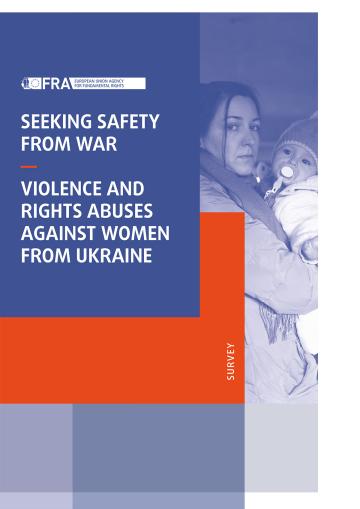
    series of urgent fundamental rights challenges across Europe. While much attention has focused on the scale of devastation and its wider impact on all Ukrainians, the war has also inflicted profound personal harm. This report sheds light on the violence, sexual harassment and exploitation experienced by women displaced from Ukraine. Drawing on a survey and in-depth interviews with women from Ukraine, the report documents the prevalence, forms and patterns of gender-based violence and sets out practical measures to improve safety, access to justice and support.
  • Report / Paper / Summary
    4
    December
    2025
    Artificial Intelligence comes with both benefits and risks. Safe AI use that accounts for fundamental rights is thus crucial. While the 2024 EU AI Act was a milestone in this regard, its broad definitions regarding AI systems and high-risk AI could introduce loopholes for fundamental rights compliance. This report offers an empirical basis for much-needed practical guidance on the Act’s implementation. Based on interviews with AI developers, sellers, and users, FRA addresses challenges of its use in critical domains, like asylum, education, and employment. Our findings help guide next steps in realising the AI Act’s potential to ensure responsible innovation.
  • Report / Paper / Summary
    25
    November
    2024
    This report presents key results of the EU gender-based violence survey based on data from all 27 Member States. The report focuses on the overall prevalence of physical violence or threats and/or sexual violence by any perpetrator, violence perpetrated by women’s intimate partners and by other people (non-partners) and women’s experiences of sexual harassment at work.
  • Fundamental Rights Report
    5
    June
    2024
    FRA’s Fundamental Rights Report 2024 analyses the year’s developments in fundamental rights. It focuses on the most pressing fundamental rights concerns facing Europe in 2023: the cost-of-living crisis, rights concerns at the EU’s external borders and migration, and threats to democracy. Re-structured, this year’s new approach is a shorter and sharper analysis. It also presents FRA’s opinions on these developments, including a summary of the evidence supporting these opinions.