eu-charter

EU Charter of Fundamental Rights

Article 51 - Field of application

Article 51 - Field of application

1. The provisions of this Charter are addressed to the institutions, bodies, offices and agencies of the Union with due regard for the principle of subsidiarity and to the Member States only when they are implementing Union law. They shall therefore respect the rights, observe the principles and promote the application thereof in accordance with their respective powers and respecting the limits of the powers of the Union as conferred on it in the Treaties.
2. The Charter does not extend the field of application of Union law beyond the powers of the Union or establish any new power or task for the Union, or modify powers and tasks as defined in the Treaties.

Explanations

  • Text:

    The aim of Article 51 is to determine the scope of the Charter. It seeks to establish clearly that the Charter applies primarily to the institutions and bodies of the Union, in compliance with the principle of subsidiarity. This provision was drafted in keeping with Article 6(2) of the Treaty on European Union, which required the Union to respect fundamental rights, and with the mandate issued by the Cologne European Council. The term ‘institutions’ is enshrined in the Treaties. The expression ‘bodies, offices and agencies’ is commonly used in the Treaties to refer to all the authorities set up by the Treaties or by secondary legislation (see, e.g., Articles 15 or 16 of the Treaty on the Functioning of the European Union).

    As regards the Member States, it follows unambiguously from the case-law of the Court of Justice that the requirement to respect fundamental rights defined in the context of the Union is only binding on the Member States when they act in the scope of Union law (judgment of 13 July 1989, Case 5/88 Wachauf [1989] ECR 2609; judgment of 18 June 1991, Case C-260/89 ERT [1991] ECR I-2925; judgment of 18 December 1997, Case C-309/96 Annibaldi [1997] ECR I-7493). The Court of Justice confirmed this case-law in the following terms: ‘In addition, it should be remembered that the requirements flowing from the protection of fundamental rights in the Community legal order are also binding on Member States when they implement Community rules ...’ (judgment of 13 April 2000, Case C-292/97 [2000] ECR I-2737, paragraph 37 of the grounds). Of course this rule, as enshrined in this Charter, applies to the central authorities as well as to regional or local bodies, and to public organisations, when they are implementing Union law.

    Paragraph 2, together with the second sentence of paragraph 1, confirms that the Charter may not have the effect of extending the competences and tasks which the Treaties confer on the Union. Explicit mention is made here of the logical consequences of the principle of subsidiarity and of the fact that the Union only has those powers which have been conferred upon it. The fundamental rights as guaranteed in the Union do not have any effect other than in the context of the powers determined by the Treaties. Consequently, an obligation, pursuant to the second sentence of paragraph 1, for the Union's institutions to promote principles laid down in the Charter may arise only within the limits of these same powers.

    Paragraph 2 also confirms that the Charter may not have the effect of extending the field of application of Union law beyond the powers of the Union as established in the Treaties. The Court of Justice has already established this rule with respect to the fundamental rights recognised as part of Union law (judgment of 17 February 1998, C-249/96 Grant [1998] ECR I-621, paragraph 45 of the grounds). In accordance with this rule, it goes without saying that the reference to the Charter in Article 6 of the Treaty on European Union cannot be understood as extending by itself the range of Member State action considered to be ‘implementation of Union law’ (within the meaning of paragraph 1 and the above-mentioned case-law).

    Source:
    Official Journal of the European Union C 303/17 - 14.12.2007
    Preamble - Explanations relating to the Charter of Fundamental Rights:
    These explanations were originally prepared under the authority of the Praesidium of the Convention which drafted the Charter of Fundamental Rights of the European Union. Although they do not as such have the status of law, they are a valuable tool of interpretation intended to clarify the provisions of the Charter.

Case Law References

National Constitutional Law

4 results found

  • Constitution of the Republic of Croatia
    Country:
    Croatia
  • De Belgische Grondwet
    Country:
    Belgium

    Artikel 191. Iedere vreemdeling die zich op het grondgebied van België bevindt, geniet de bescherming verleend aan personen en aan goederen, behoudens de bij de wet gestelde uitzonderingen.

  • La Constitution Belge
    Country:
    Belgium

    Article 191; Tout étranger qui se trouve sur le territoire de la Belgique jouit de la protection accordée aux personnes et aux biens, sauf les exceptions établies par la loi

  • The Belgian Constitution
    Country:
    Belgium

    Article 191. All foreigners on Belgian soil benefit from the protection provided to persons andproperty, except for those exceptions provided for by the law.

EU Law

3 results found

International Law

0 results found

Publications and data

  • Fundamental Rights Report
    5
    June
    2024
    The year 2023 brought both progress and setbacks in terms of fundamental rights protection. FRA’s Fundamental Rights Report 2023 reviews developments in the field, identifying both achievements and remaining areas of concern. This publication presents FRA’s opinions on the main developments in the thematic areas covered and a synopsis of the evidence supporting these opinions. In so doing, it provides a compact but informative overview of the main fundamental rights challenges confronting the EU and its Member States.
  • Fundamental Rights Report
    5
    June
    2024
    FRA’s Fundamental Rights Report 2024 analyses the year’s developments in fundamental rights. It focuses on the most pressing fundamental rights concerns facing Europe in 2023: the cost-of-living crisis, rights concerns at the EU’s external borders and migration, and threats to democracy. Re-structured, this year’s new approach is a shorter and sharper analysis. It also presents FRA’s opinions on these developments, including a summary of the evidence supporting these opinions.
  • Report / Paper / Summary
    29
    May
    2024
    Ahead of the EU elections, this report explores the political participation of people with disabilities. Although some Member States removed restrictions on the right to vote and to stand for elections, barriers still exist. This report is an update of new developments following FRA’s last report published in 2014. It sets out ways forward to ensure people with disabilities have equal opportunities, in line with the EU Charter of Fundamental Rights and the Convention on the Rights of Persons with Disabilities.
  • Report / Paper / Summary
    12
    December
    2023
    Russia’s invasion of Ukraine forced millions of people to flee. Arriving in EU countries, they received protection in EU law under the Temporary Protection Directive. Many have begun to build a new life in their host country and enrich our societies in new ways. Local authorities took the lead in ensuring access to fundamental rights under temporary protection. This report explores the measures to ensure access to housing, education, employment and healthcare in 26 cities and regional authorities across 12 EU Member States. Despite unprecedented coordination and cooperation to overcome challenges, many uncertainties remain. Longer-term solutions will be needed after the directive expires in March 2025. Based on the information collected, the report identifies 12 priority actions and builds on FRA’s bulletins and survey findings on experiences of people displaced from Ukraine.
  • Periodic updates / Series
    18
    October
    2023
    Civil society organisations struggle to maintain an environment safe from threats and attacks. FRA’s sixth annual update on civic space explores the challenges for organisations across the EU. While there has been significant development since FRA began monitoring the situation in 2018, civil society organisations remain under immense pressure. Abusive lawsuits and attacks against those involved in migrant search and rescue at sea are just some of the challenges identified. This report presents ways forward to protect civil society and human rights.
  • Periodic updates / Series
    29
    September
    2023
    Russia’s invasion of Ukraine posed new challenges for the EU. Millions were forced to flee the war. As a result of the scale of people’s displacement, the EU activated for the first time the Temporary Protection Directive (TPD). More than 1.3 million children sought international protection in the EU. This bulletin explores the respect, protection and fulfilment of the fundamental rights of displaced children and ways to safeguard their rights. The third in a series, this bulletin builds on the evidence in FRA’s Bulletin #1 and #2 on the experiences of displaced people seeking safety in the EU.
  • Report / Paper / Summary
    13
    September
    2023
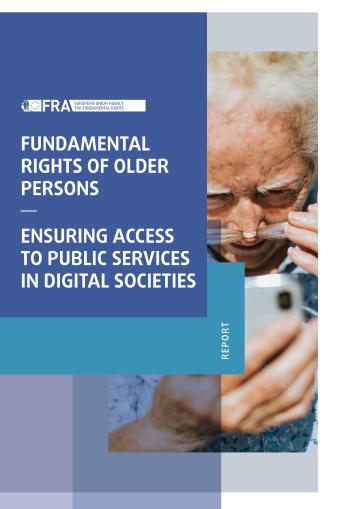
    Europe’s ageing population is ever-increasing, and our societies are becoming more digitalised. Many public services are now available online, with many more services in the process of being digitalised. But the digitalisation of public services poses a risk of exclusion for older persons. In this new report, FRA explores the impact of digitalisation on the fundamental rights of older persons. The report maps the current legislation, policies and practices fostering digital inclusion. It provides an overview of the laws at the national level that provide for equal access to public services, both online and offline. The findings show how Member States safeguard older person’s rights to access services undergoing digitalisation. It outlines how Member States can support digital skills and ensure older people can fully participate in public life.

  • Fundamental Rights Report
    8
    June
    2023
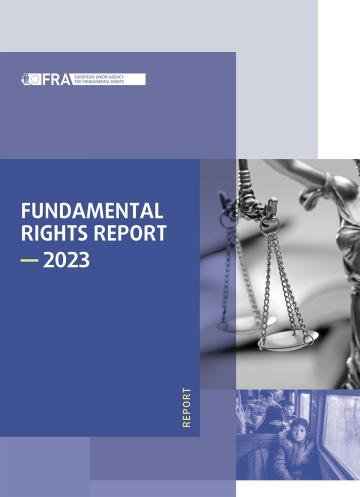
    FRA’s Fundamental Rights Report 2023 reviews major developments in the field in 2022, identifying both achievements and areas of concern. It also presents FRA’s opinions on these developments, including a synopsis of the evidence supporting these opinions.
  • Report / Paper / Summary
    19
    July
    2022
    Civil society is a key component of Europe’s fundamental rights architecture. From supporting people affected by the pandemic to helping those fleeing the war in Ukraine, civil society plays a crucial role in upholding people’s rights. In so doing, it contributes to a healthy rule of law culture. FRA’s civic space report provides an overview of the many ways in which civil society contributes to the checks and balances that underpin the rule of law.
  • Opinion / Position Paper
    6
    December
    2021
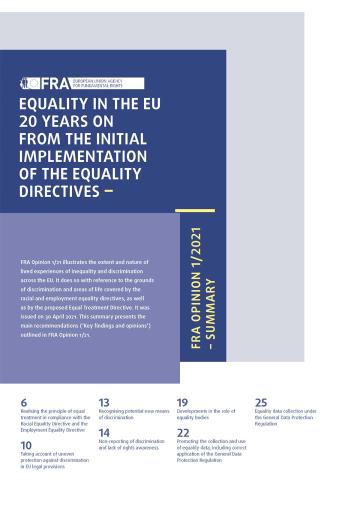
    FRA Opinion 1/21 illustrates the extent and nature of lived experiences of inequality and discrimination across the EU. It does so with reference to the grounds of discrimination and areas of life covered by the racial and employment equality directives, as well as by the proposed Equal Treatment Directive. It was issued on 30 April 2021. This summary presents the main recommendations (‘Key findings and opinions’) outlined in FRA Opinion 1/21.