Displaying 1 - 20 of 23
  • In brief / Factsheet
    22
    May
    2026
    This factsheet examines the "right to be forgotten" within the context of EU law and the European Convention on Human Rights. It emphasizes the intersections of these legal frameworks, with particular attention to case law from the Court of Justice of the European Union (CJEU) and the European Court of Human Rights (ECtHR).
  • In brief / Factsheet
    1
    September
    2025
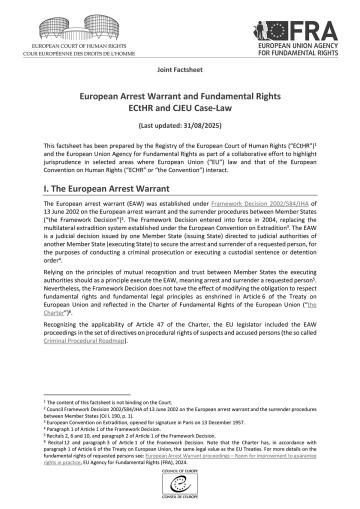
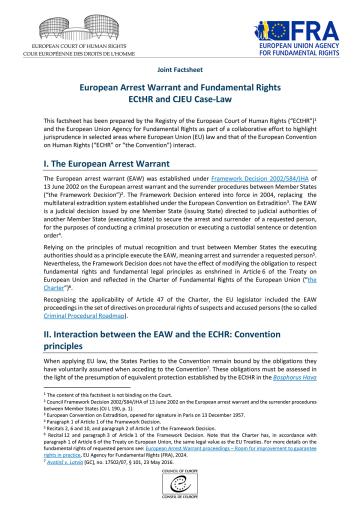
    This factsheet focuses on the European arrest warrant and EU Member States obligations to respect fundamental rights. EU law and the European Convention on Human Rights sometimes overlap. The publication clarifies where there are similar principles in different legislation and provides examples of case law. In collaboration, the EU Agency for Fundamental Rights and the European Court of Human Rights produced this short publication. It is designed to aid lawyers and policymakers in understanding and applying the jurisprudence in this area. The August 2025 version now contains recent case-law developments.
  • In brief / Factsheet
    27
    May
    2025
    This factsheet focuses on the European arrest warrant and EU Member States obligations to respect fundamental rights. EU law and the European Convention on Human Rights sometimes overlap. The publication clarifies where there are similar principles in different legislation and provides examples of case law. In collaboration, the EU Agency for Fundamental Rights and the European Court of Human Rights produced this short publication. It is designed to aid lawyers and policymakers in understanding and applying the jurisprudence in this area. The 2025 version now contains recent case-law developments.
  • In brief / Factsheet
    30
    October
    2024
    This factsheet examines the "right to be forgotten" within the context of EU law and the European Convention on Human Rights. It emphasizes the intersections of these legal frameworks, with particular attention to case law from the Court of Justice of the European Union (CJEU) and the European Court of Human Rights (ECtHR).
  • In brief / Factsheet
    18
    June
    2024
    This factsheet focuses on the European arrest warrant and EU Member States obligations to respect fundamental rights. EU law and the European Convention on Human Rights sometimes overlap. The publication clarifies where there are similar principles in different legislation and provides examples of case law. In collaboration, the EU Agency for Fundamental Rights and the European Court of Human Rights produced this short publication. It is designed to aid lawyers and policymakers in understanding and applying the jurisprudence in this area.
  • In brief / Factsheet
    18
    June
    2024
    La présente fiche thématique a été préparée par le Greffe de la Cour européenne des droits de l’homme (« Cour EDH ») et l’Agence des droits fondamentaux de l’Union européenne dans le cadre d’une collaboration visant à présenter la jurisprudence dans des domaines choisis dans lesquels le droit de l’Union européenne et de la Convention européenne des droits de l’homme (« CEDH » ou « Convention EDH ») interagissent.
  • Report / Paper / Summary
    26
    March
    2024
    The European Arrest Warrant (EAW) allows Member States to implement judicial decisions issued in another Member State. It applies to decisions such as arrests for the purpose of criminal prosecutions or the execution of custodial sentences. After being in force for over 20 years, FRA’s findings provide evidence for an assessment of the legislation in practice. This report looks at the fundamental rights challenges that people face who are requested through an EAW. It provides a unique insight into their experiences and those of the professionals involved. FRA’s findings indicate that shared challenges exist across EU Member States. They must increase efforts to ensure that people are able to take part in criminal proceedings and receive a fair trial.
  • Report / Paper / Summary
    21
    June
    2022
    Every child has a right to be protected even when they are accused or suspected of committing a crime. The basic principles of justice apply to adults and children alike. But children face specific obstacles during criminal proceedings, such as a lack of understandable information about their rights, limited legal support and poor treatment. The report looks at the practical implementation of Directive (EU) 2016/800 on procedural safeguards for children who are suspects or accused persons in criminal proceedings in nine Member States – Austria, Belgium, Bulgaria, Germany, Estonia, Italy, Malta, Poland and Portugal.
  • Report / Paper / Summary
    31
    March
    2021
    This report looks at the practical implementation of the presumption of innocence in criminal proceedings, and related rights, in 9 EU Member States (Austria, Belgium, Bulgaria, Cyprus, Germany, Italy, Lithuania, Poland and Portugal). Article 48 of the EU Charter of Fundamental Rights guarantees the presumption of innocence – but, as FRA’s research underscores, it can be undermined in many ways.

  • Report / Paper / Summary
    11
    December
    2019
    Η παρούσα έκθεση εξετάζει πέντε βασικές πτυχές των συνθηκών κράτησης στα κράτη μέλη της ΕΕ: το μέγεθος των
    κελιών, τον χρόνο που οι κρατούμενοι μπορούν να περνούν έξω από τα κελιά τους, συμπεριλαμβανομένων των εξω-
    τερικών χώρων, τις συνθήκες υγιεινής, την πρόσβαση στην υγειονομική περίθαλψη και το αν οι κρατούμενοι προστα-
    τεύονται από τη βία. Για καθεμία από αυτές τις πτυχές των συνθηκών κράτησης, η έκθεση συνοψίζει καταρχάς τα ελά-
    χιστα πρότυπα σε διεθνές και ευρωπαϊκό επίπεδο. Στη συνέχεια εξετάζει πώς τα εν λόγω πρότυπα μετουσιώνονται σε
    εθνικούς νόμους και άλλους κανόνες των κρατών μελών της ΕΕ.
  • Report / Paper / Summary
    11
    December
    2019
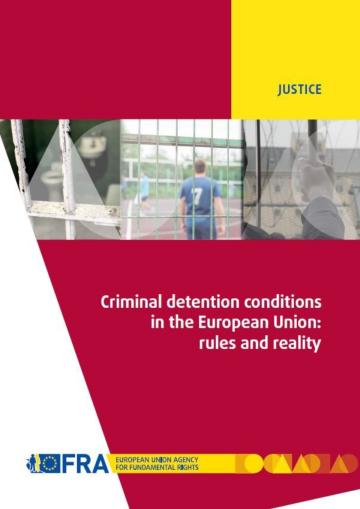
    This report looks at five core aspects of detention conditions in EU Member States: the size of cells; the amount of time detainees can spend outside of these cells, including outdoors; sanitary conditions; access to healthcare; and whether detainees are protected from violence. For each of these aspects of detention conditions, the report first summarises the minimum standards at international and European levels. It then looks at how these standards are translated into national laws and other rules of the EU Member States.
  • Report / Paper / Summary
    27
    September
    2019
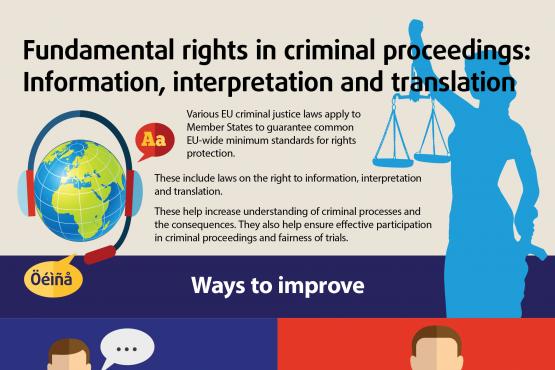
    Protecting the rights of anyone suspected or accused of a crime is an essential element of the rule of law. Courts, prosecutors and police officers need certain powers to enforce the law – but trust in the outcomes of their efforts will quickly erode without effective safeguards. Such safeguards take on various forms, and include the right to certain information and to a lawyer.
  • Report / Paper / Summary
    10
    November
    2016
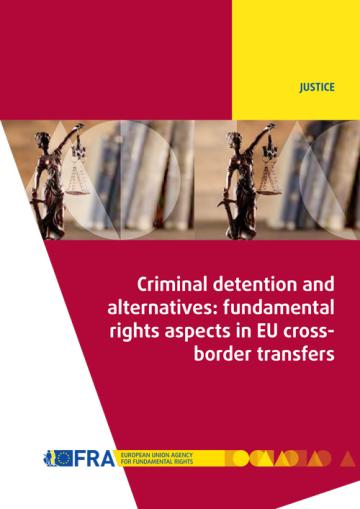
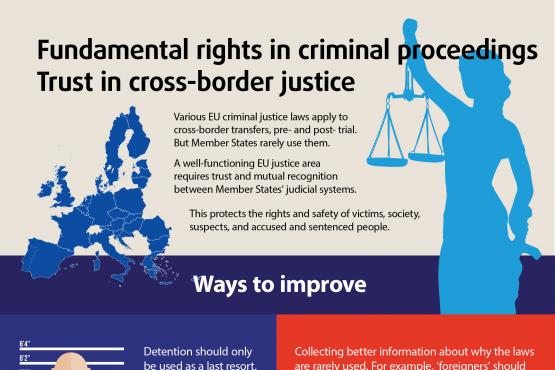
    EU Member States have largely implemented, and started applying, three instruments on transferring prison sentences, probation measures and alternative sanctions, as well as pre-trial supervision measures, to other Member States. This report provides an overview of their first experiences with these measures, highlighting both best practices and shortcomings.
  • Report / Paper / Summary
    10
    November
    2016
    Protecting the human rights of individuals subject to criminal proceedings is an essential element of the rule of law. Persons who are suspected or accused of crimes in countries other than their own are particularly vulnerable, making appropriate procedural safeguards especially crucial. This report reviews Member States’ legal frameworks, policies and practices regarding the important rights provided in these directives, including with respect to individuals whose needs may require additional attention, such as persons with disabilities and children.
  • Handbook / Guide / Manual
    22
    June
    2016
    Der Zugang zur Justiz ist ein bedeutendes Element der Rechtsstaatlichkeit. Einzelne erhalten so die
    Möglichkeit, sich gegen eine Verletzung ihrer Rechte zu schützen, im Falle unerlaubter Handlungen
    Rechtsbehelfe geltend zu machen, die Exekutive zur Verantwortung zu ziehen und sich selbst in
    Strafsachen zu verteidigen. Dieses Handbuch fasst die zentralen Grundsätze des europäischen
    Rechts im Bereich des Zugangs zur Justiz zusammen.
  • Handbook / Guide / Manual
    22
    June
    2016
    Access to justice is an important element of the rule of law. It enables individuals to protect themselves against infringements of their rights, to remedy civil wrongs, to hold executive power accountable and to defend themselves in criminal proceedings. This handbook summarises the key European legal principles in the area of access to justice, focusing on civil and criminal law.
  • Handbook / Guide / Manual
    22
    June
    2016
    L’accès à la justice est un élément important de l’État de droit. Il permet aux individus de se protéger
    contre toute atteinte à leurs droits, d’introduire des recours contre les fautes civiles, de demander au
    pouvoir exécutif de rendre des comptes et de se défendre dans les procédures pénales. Ce manuel
    résume les grands principes juridiques européens en matière d’accès à la justice, en s’intéressant
    plus particulièrement au droit civil et au droit pénal.
  • Opinion / Position Paper
    21
    December
    2015
    The proposal to establish a possible legislative instrument supplementing the existing European Criminal Records Information System with information on third-country nationals convicted in the EU raises a number of fundamental rights issues.
Displaying 1 - 20 of 23