Asylum

Asylum, migration and borders

The increase in migration has presented opportunities and challenges across Europe. FRA encourages rights-compliant responses.

We provide practical expertise on this complex issue. This includes regular updates, focus papers and toolkits. We also outline policy alternatives and best practices.

    Publications and Data

    Publications and Data

    Displaying results 41 - 50 of 239
    Report / Paper / Summary
    6
    September
    2023
    Integration and social inclusion are important aspects of EU migration and asylum policy. The fundamental rights of long-term residents in the EU are explored through this report, focussing on the Long-Term Residence Directive. EU long-term resident status includes rights to move and reside in other EU Member States. This report examines the reasons behind the low uptake of EU long-term resident permits, despite them typically giving more rights than national long-term resident permits.
    Report / Paper / Summary
    6
    July
    2023
    Following yet another recent tragic shipwreck and loss of life in the Mediterranean, this short report sets out examples of actions the EU could take to meet its obligations to protect the right to life and prevent more deaths at sea. As part of the work that the EU Agency for Fundamental Rights (FRA) does on upholding fundamental rights in asylum and return procedures, this report calls for better protection for shipwreck survivors, and prompt and independent investigations. It sets out measures that EU Member States should take to improve search and rescue efforts and provide legal pathways to safety to prevent deaths at sea.
    Report / Paper / Summary
    14
    June
    2023
    In responding to Russia’s war against Ukraine, the EU activated its Temporary Protection Directive (TPD) for people who fled the country, allowing them to settle in the EU and to access basic public services and the labour market. By spring 2023, more than 4.5 million people had made use of the TPD or similar national protection schemes in the EU. In 2022, the European Union Agency for Fundamental Rights conducted an online survey among people displaced from Ukraine. Eurofound has analysed the survey results on their experiences when seeking to access employment. This paper highlights the main barriers that displaced people encountered and suggests ways to facilitate their inclusion.
    Fundamental Rights Report
    8
    June
    2023
    Russia’s unprovoked war of aggression against Ukraine has resulted in massive internal and external population displacement. The European Union (EU) rapidly activated its Temporary Protection Directive for the first time since it was adopted in 2001. This entitled nearly 4 million people to legal residence and access to work, housing and legal assistance, education and healthcare.
    Fundamental Rights Report
    8
    June
    2023
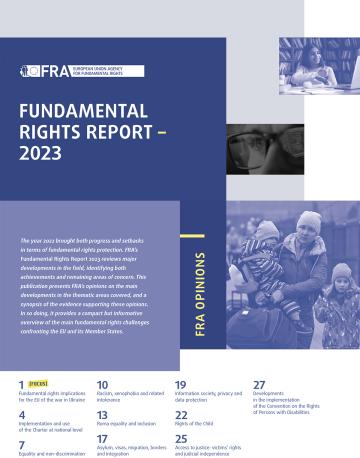
    FRA’s Fundamental Rights Report 2023 reviews major developments in the field in 2022, identifying both achievements and areas of concern. It also presents FRA’s opinions on these developments, including a synopsis of the evidence supporting these opinions.
    Fundamental Rights Report
    8
    June
    2023
    The year 2022 brought both progress and setbacks in terms of fundamental rights protection. FRA’s Fundamental Rights Report 2023 reviews major developments in the field, identifying both achievements and remaining areas of concern. This publication presents FRA’s opinions on the main developments in the thematic areas covered, and a synopsis of the evidence supporting these opinions.
    Periodic updates / Series
    30
    May
    2023
    Over the span of nearly eight years, there have been developments in showing respect for the human rights of those who arrive at the EU’s borders. Russia’s war of aggression against Ukraine has shown how a large and sudden influx of people can be managed effectively and respectfully. Notwithstanding the improvements, the growing number of people crossing or attempting to enter the EU pose a wide range of fundamental rights challenges.

    In this bulletin, FRA takes stock of concerns and improvements regarding the fundamental rights of migrants, asylum seekers and refugees. It highlights the EU Member States’ legal and practical responses. It identifies key trends, promising practices, long-standing and emerging patterns, and persistent concerns.
    Handbook / Guide / Manual
    1
    March
    2023
    This manual is designed to help institutions, organisations and individuals to train guardians of unaccompanied children or to deliver ‘train-the-trainers’ courses. It can be used in a range of training contexts, such as professional and academic training, on-the-job training and continuing training. The manual is based on human and fundamental rights principles and ethical standards and recognises that the child and the guardian have their own personal stories, resources and capacities. It enhances guardians’ confidence to promote the child’s rights and best interests. It also enhances their confidence to act independently and impartially in relation to different state
    officials, service providers and other community members.
    Report / Paper / Summary
    28
    February
    2023
    12 new language versions available
    17 December 2024
    Russia’s military aggression against Ukraine triggered scenes not seen in Europe for decades. It has since caused death, immense destruction, and unspeakable suffering. It also set in motion a mass movement of people not seen since World War II. To protect them, the EU activated the Temporary Protection Directive for the first time. In doing so, all EU Member States must offer protection to those displaced from Ukraine.
    Report / Paper / Summary
    2
    February
    2023
    Many cities throughout the European Union hosted people fleeing Russia’s war of aggression against Ukraine. The EU currently faces the largest displacement of people in Europe since World War II. Since February 2022, over seven million people came to the EU. The arrival of such large numbers of people thrust cities and local governments to the forefront of the EU and its Member States’ relief work. This short publication provides a snapshot of cities’ initiatives to address this humanitarian crisis.