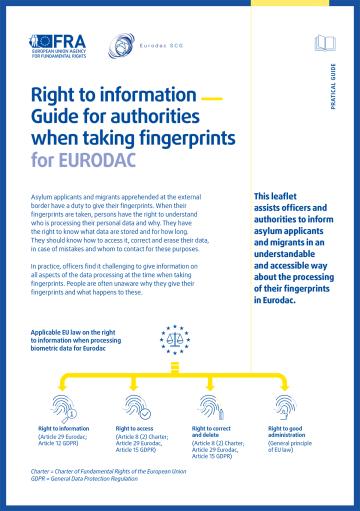
Este folleto ayuda a los funcionarios y a las autoridades a informar a los solicitantes de asilo y a los inmigrantes, de un modo comprensible y accesible, sobre el tratamiento de sus huellas dactilares en Eurodac.
Over 2.5 million people applied for international protection in the 28 EU Member States in 2015 and 2016. Many of those who were granted some form of protection are young people, who are likely to stay and settle in the EU. The EU Agency for Fundamental Rights interviewed some of them, as well as professionals working with them in 15 locations across six EU Member States: Austria, France, Germany, Greece, Italy and Sweden. This report presents the result of FRA’s fieldwork research, focusing on young people between the
ages of 16 and 24.
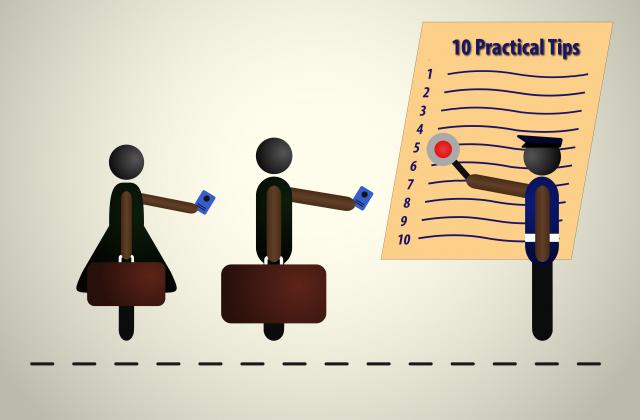
Based on its findings and research FRA provides practical guidance to support the implementation of fundamental rights in the EU Member States. This series contains practical guidance on: Initial-reception facilities at external borders; Apprehension of migrants in an irregular situation; Guidance on how to reduce the risk of refoulement in external border management when working in or together with third countries; Fundamental rights implications of the obligation to provide fingerprints for Eurodac; Twelve operational fundamental rights considerations for law enforcement when processing Passenger Name Record (PNR) data and Border controls and fundamental rights at external land borders.
Child rights come first. Measures to ensure child protection and participation apply to all children in the EU. This brochure guides you to relevant FRA reports and tools that can support you when promoting and protecting the rights of all children in the EU.
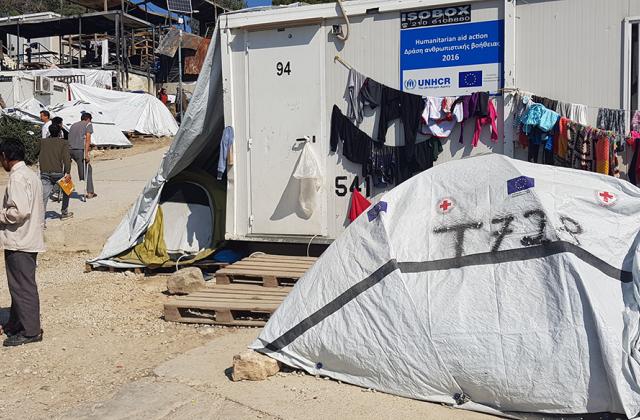
The EU Agency for Fundamental Rights has been regularly collecting data on asylum and
migration since September 2015. This report focuses on the fundamental rights situation
of people arriving in Member States and EU candidate countries particularly affected by
migration. It addresses fundamental rights concerns between 1 July and 30 September 2019.
Individuals who are not entitled to stay in the European Union are typically subject to being returned to their home countries. This includes children who are not accompanied by their parents or by another primary caregiver. But returning such children, or finding another durable solution, is a delicate matter, and doing so in full compliance with fundamental rights protections can be difficult. This focus paper therefore aims to help national authorities involved in return-related tasks, including child-protection services, to ensure full rights compliance.
FRA’s second EU Minorities and Discrimination survey (EU-MIDIS II) collected information from over 25,000 respondents with different ethnic minority and immigrant backgrounds across all 28 EU Member States. The main findings from the survey, published in 2017, pointed to a number of differences in the way women and men with immigrant backgrounds across the European Union (EU) experience how their rights are respected. This report summarises some of the most relevant survey findings in this regard, which show the need for targeted, gender-sensitive measures that promote the integration of – specifically – women who are immigrants or descendants of immigrants.
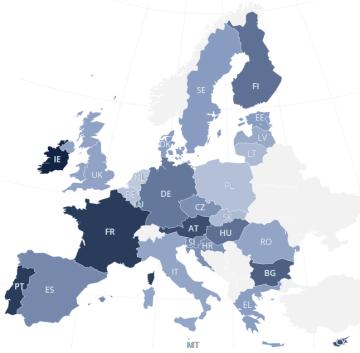
The EU Agency for Fundamental Rights has been regularly collecting data on migration since September 2015. This report focuses on the fundamental rights situation of people arriving in Member States and EU candidate countries particularly affected by migration movements. It addresses fundamental rights concerns between 1 April and 30 June 2019.
The EU Return Directive (2008/115/EC) in Article 8 (6) introduced an important fundamental rights safeguard for third-country nationals ordered to leave the EU because they do not or no longer fulfil the conditions for entry and/or stay. According to the directive, Member States must provide for an effective forced-return monitoring system.
This report is the EU Fundamental Rights Agency’s fourth on the topic of severe labour exploitation. Based on interviews with 237 exploited workers, it paints a bleak picture of severe exploitation and abuse. The workers include both people who came to the EU, and EU nationals who moved to another EU country. They were active in diverse sectors, and their legal status also varied.


 Handbook / Guide / Manual9June2026
 Handbook / Guide / Manual8October2025
 Opinion / Position Paper23July2025