Highlights

  • Handbook / Guide / Manual
    8
    octobre
    2025
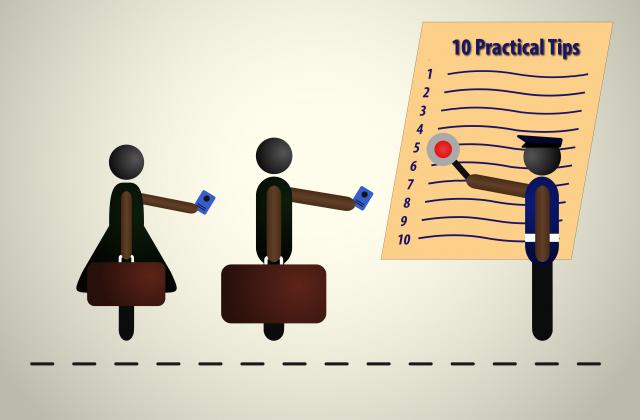
    The Entry/Exit System (EES), launching in 2025, will register non-EU nationals crossing the EU’s external borders. This FRA guidance helps border guards apply the new rules in line with EU fundamental rights. It offers practical tips on informing people, collecting biometric data and supporting people with specific needs. Based on fieldwork at 10 border crossing points in 6 Member States, the guidance will ensure rights are respected under the new system. A separate guidance publication for managers accompanies this publication.
  • Opinion / Position Paper
    23
    juillet
    2025
    This position paper examines how the EU can counter the instrumentalisation of migrants while also upholding fundamental rights. Instrumentalisation refers to countries outside the EU using migration to exert political pressure. This position paper defines the phenomenon, provides examples, and outlines legal obligations under EU law. It provides legal analysis and warns that some responses risk undermining fundamental rights at the EU’s external borders, including the right to asylum. To counter instrumentalisation and uphold fundamental rights, the position paper proposes practical measures for Member States to take, such as sanctions, border controls, and cooperation with private operators.
  • Periodic updates / Series
    20
    juin
    2025
    The EU Agency for Fundamental Rights regularly collects data on the operations of NGO vessels involved in search and rescue in the Mediterranean. This includes any legal proceedings against them, as well as any difficulties in disembarking migrants in safe ports. This paper provides an overview of criminal investigations and other legal proceedings initiated by European Union (EU) Member States against civil society organisations deploying search and rescue vessels and aircraft in the Mediterranean and/or against individual crew members. The latest update covers the period from 2018 up until 1 June 2025.
  • Page
    This page describes the activities of the EU Agency for Fundamental Rights (FRA) on migration and asylum. It also explains how these activities can help the European Union (EU) and its Member States to implement the Pact on Migration and Asylum in a fundamental rights-compliant manner.
    Produits
    30
    mai
    2016
    En 2015, l’Union européenne (UE) et ses États membres ont introduit et poursuivi
    de nombreuses initiatives destinées à protéger et renforcer les droits fondamentaux.
    Le « Rapport sur les droits fondamentaux 2016 » de la FRA résume et analyse
    les principales évolutions, et présente les avis de la FRA, dans le domaine
    des droits fondamentaux dans l’UE entre janvier et décembre 2015. Le rapport,
    qui relève à la fois les progrès réalisés et les obstacles persistants, donne un
    aperçu des principales questions qui influencent les débats en matière de droits
    fondamentaux dans l’UE.
    30
    mai
    2016
    Ce « Focus » examine de façon approfondie les questions de l’asile et de la
    migration dans l’Union européenne (UE) en 2015. Il se penche sur l’efficacité des mesures prises ou proposées par l’UE et
    ses États membres pour gérer cette situation, en se concentrant en particulier sur le respect des droits fondamentaux.
    The Fundamental Rights Forum (FRF) is organised by the EU Agency for Fundamental Rights (FRA) in cooperation with various partners. Refugee Protection is one of the three themes for the FRF which will take place in Vienna from 20-23 June 2016.
    6
    avril
    2016
    FRA’s opinions highlight general fundamental rights implications to be considered when applying the safe countries of origin concept. They should be read together with the relevant safeguards the Asylum Procedures Directive establishes. These safeguards provide for minimum guarantees that must also fully apply to applicants originating from countries on the proposed EU common list of safe countries of origin.
    17
    mars
    2016
    L’exploitation de la main d’oeuvre n’est pas un phénomène isolé ou marginal. Toutefois,
    en dépit de leur omniprésence dans la vie quotidienne, les formes graves d’exploitation
    au travail et leurs effets préjudiciables sur les ressortissants des pays tiers et les citoyens
    de l’UE - en tant que travailleurs, mais également en tant que consommateurs - n’ont pas
    à ce jour suscité beaucoup d’intérêt de la part des chercheurs. Ce rapport
    identifie les facteurs de risque qui contribuent à ce type d’exploitation et discute des
    moyens d’améliorer la situation, tout en soulignant les défis auxquels sont confrontés les
    institutions et les États membres de l’UE pour veiller à ce que le droit à des conditions de
    travail décentes des travailleurs provenant de l’UE ou de pays tiers soit réellement appliqué.
    Periodic updates / Series
    27
    janvier
    2016
    In view of the increasing numbers of refugees, asylum seekers and migrants entering the EU, the European Commission asked FRA to collect data about the fundamental rights situation of people arriving in those Member States that have been particularly affected by large migration movements.
    21
    décembre
    2015
    The proposal to establish a possible legislative instrument supplementing the existing European Criminal Records Information System with information on third-country nationals convicted in the EU raises a number of fundamental rights issues.
    This infographic outlines FRA's work along a simplified version of the EU migration flow. Each item is hyperlinked so you can find out more on each topic.
    20
    novembre
    2015
    Les enfants sont des titulaires de droits à part entière. Ils sont bénéficiaires de tous les droits
    fondamentaux et de l’homme, et sont sujets de réglementations particulières compte tenu de leurs
    caractéristiques spécifiques. Ce manuel a pour but de montrer comment le droit et la jurisprudence
    européens s’adaptent aux intérêts et besoins particuliers des enfants.
    22
    octobre
    2015
    Processing biometric data for immigration, asylum and border management purposes has become common. This focus paper looks at measures authorities can take to enforce the obligation of newly arrived asylum seekers and migrants in an irregular situation to provide fingerprints for inclusion in Eurodac.
    16
    octobre
    2015
    This report explores the key features of guardianship systems put in place to cater for the needs of all children in need of protection, including child victims and those at risk of becoming victims of trafficking in human beings or of other forms of exploitation. The research covers four specific areas, namely the type of guardianship systems in place, the profile of appointed guardians, the appointment procedures, and the tasks of the guardians.
    9
    octobre
    2015
    For asylum and return (i.e. expulsion) procedures to be implemented effectively, people need to be at the disposal of the authorities so that any measure requiring their presence can be taken without delay. To achieve this, EU Member States may decide to hold people in closed facilities. Less intrusive measures, which are usually referred to as alternatives to detention, reduce the risk that deprivation of liberty is resorted to excessively.
    Periodic updates / Series
    28
    septembre
    2015
    In view of the increasing numbers of refugees, asylum seekers and migrants entering the EU, the European Commission asked FRA to collect data about the fundamental rights situation of people arriving in those Member States that have been particularly affected by large migration movements. The countries covered in 2015 are Austria, Bulgaria, Croatia, Germany, Greece, Hungary, Italy and Slovenia.
    Report / Paper / Summary
    3
    septembre
    2015
    The right to health is a basic social right. However, its understanding and application differs
    across the European Union (EU) Member States, which results in different healthcare services
    being offered to migrants in an irregular situation. This summary looks into the potential costs of providing migrants in
    an irregular situation with timely access to health screening and treatment, compared to
    providing medical treatment only in emergency cases.
    3
    septembre
    2015
    This report aims to estimate the economic cost of providing timely access to screening and treatment for migrants in an irregular situation, compared with providing treatment only in emergency cases. It presents an economic model to calculate such costs for two medical conditions: hypertension and prenatal care. To better illustrate its application in practice, the model is applied to three European Union (EU) Member States – Germany, Greece and Sweden.
    25
    juin
    2015
    Les États Membres et les institutions de l’Union européenne (UE) ont introduit en 2014 un nombre de mesures juridiques et politiques pour garantir la protection des droits fondamentaux dans l’UE. Malgré ces efforts, beaucoup reste à accomplir, et il est clair que dans certains domaines la situation est alarmante : le nombre de migrants sauvés ou appréhendés en mer alors qu’ils essayaient de rejoindre les frontières de l’UE a quadruplé par rapport à 2013 ; plus d’un quart des enfants dans l’UE encourent un risque de pauvreté ou d’exclusion sociale ; et un nombre croissant de partis politiques recourent dans leurs campagnes à une rhétorique xénophobe et hostile aux immigrés, ce qui peut potentiellement augmenter le risque de certaines personnes d’être victimes de criminalité ou de crimes de haine.
    Report / Paper / Summary
    19
    juin
    2015
    La situation aux points de passage frontaliers terrestres de l’UE a bénéficié de moins d’attention
    que celle aux frontières maritimes méridionales de l’Europe, où la vie des migrants est menacée.
    Bien que les recherches de terrain de la FRA aient révélé que les contrôles aux frontières s’effectuent,
    dans l’ensemble, de façon routinière et sans incident, les voyageurs peuvent rencontrer des
    difficultés ayant une incidence sur leurs droits fondamentaux, qui ne devraient pas être négligées.
    An estimated 3,280 persons died at sea in 2014 while attempting to reach a haven in Europe, and the number of those rescued or apprehended at sea quadrupled compared with 2013. The number of displaced persons worldwide reached Second World War levels in 2014. Many move on from where they first arrive, with Germany and Sweden together receiving almost half of the asylum applications submitted in the EU.
    2
    juin
    2015
    Worker exploitation is not an isolated or marginal phenomenon. But despite its pervasiveness in everyday life, severe labour exploitation and its adverse effects on third-country nationals and EU citizens - as workers, but also as consumers - have to date not received much attention from researchers.