The events that took place in France and Belgium in January 2015 had tremendous impact across the European Union (EU) and beyond. In the immediate aftermath of the events in Paris, FRA collected responses across Europe, focusing on Jewish and Muslim community organisations, political leaders, civil society and the media. The current paper provides an overview of this material and should be regarded as a snapshot of a rapidly changing situation.
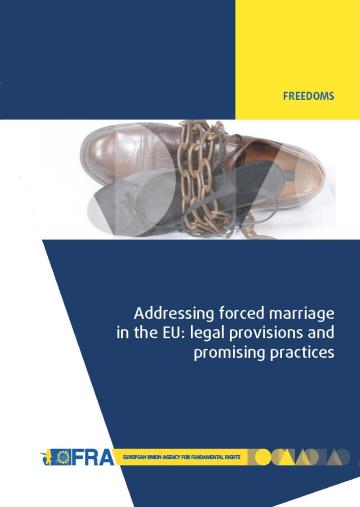
Primarily using data and information collected from five EU Member States, this paper briefly describes the phenomenon of forced marriage and selected legislative measures taken to address it. It lists promising practices
for the prevention of forced marriage and for supporting victims. The paper covers only one among many forms of violence against women analysed by FRA in its Violence against women: an EU-wide survey. Main results report (2014).
Az Emberi Jogok Európai Egyezménye (EJEE) és az európai uniós jog egyre fontosabb keretet biztosít a külföldiek jogainak védelméhez. A menekültügyre, határokra és bevándorlásra vonatkozó európai uniós joganyag gyorsan fejlődik.
This thematic situation report examines the effectiveness of responses by public authorities, civil society organisations and others to counter racism, discrimination, intolerance and extremism in Greece and Hungary. The report goes on to make proposals for fighting racist crime, increasing trust in the police, and combating extremism throughout the EU.
EU-MIDIS Data in Focus report 4 focuses on the experiences of police stops of the 23 500 individuals with an ethnic minority or immigrant background interviewed as part of the survey. The report also contains results showing levels of trust in the police from the EU-MIDIS Survey.
When used as an investigation technique in the context of law enforcement, ethnic profiling is often referred to as “criminal profiling”. This type of profiling uses indicators such as physical features, appearance or behaviour to give a “suspect description”. Profiling becomes unlawful when it is discriminatory.


 Report / Paper / Summary12December2023
 Report / Paper / Summary6September2023
 Report / Paper / Summary19November2019