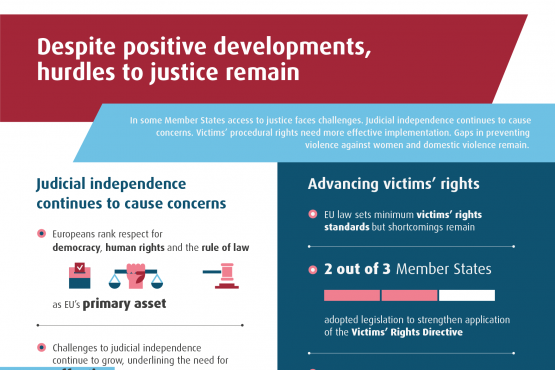
Fundamental Rights Report 2019: In some Member States access to justice faces challenges. Judicial independence continues to cause
concerns. Victims’ procedural rights need more effective implementation. Gaps in preventing
violence against women and domestic violence remain.
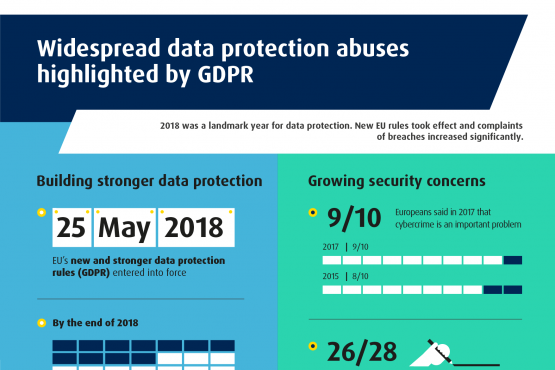
Fundamental Rights Report 2019: 2018 was a landmark year for data protection. New EU rules took effect and complaints of breaches increased significantly.
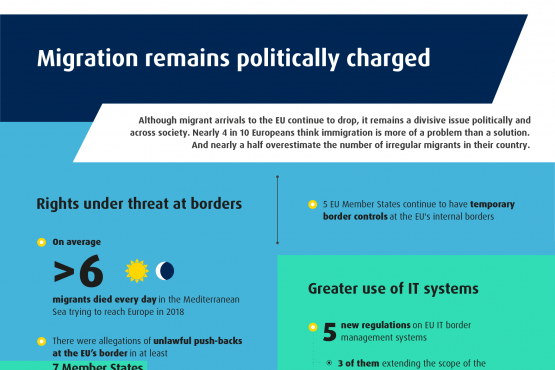
Fundamental Rights Report 2019: Although migrant arrivals to the EU continue to drop, it remains a divisive issue politically and
across society. Nearly 4 in 10 Europeans think immigration is more of a problem than a solution.
And nearly a half overestimate the number of irregular migrants in their country.
Fundamental Rights Report 2019: Ethnic minorities and migrants continue to face harassment and discrimination across the EU,
despite longstanding EU laws against racism.
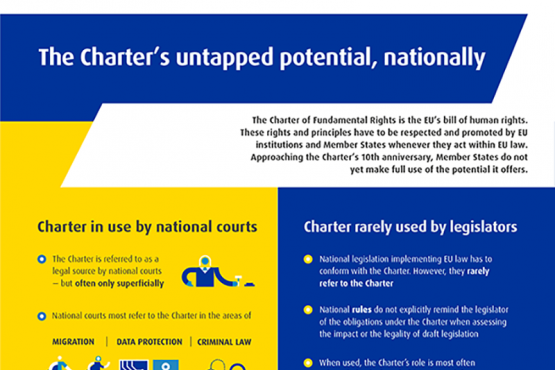
Fundamental Rights Report 2019: The Charter of Fundamental Rights is the EU’s bill of human rights. These rights and principles have to be respected and promoted by EU institutions and Member States whenever they act within EU law. Approaching the Charter’s 10th anniversary, Member States do not yet make full use of the potential it offers.
In 2018, some 2,299 people are estimated to have died or gone missing at sea while crossing the sea to reach Europe to escape war or persecution or to pursue a better life. This is on average more than six people per day. Before mid-2017, a significant share of migrants in distress at sea have been rescued by civil society vessels deployed with a humanitarian mandate to reduce fatalities and bring rescued migrants to safety. In 2018, however, authorities in some Member States viewed civil society-deployed rescue vessels with hostility. As a reaction, they seized rescue vessels, arrested crew members, and initiated legal procedures against them (more than a dozen altogether). In some cases, rescue vessels were blocked in harbours due to flag issues.
This technical report presents in detail all the stages
of the survey and the relevant information needed to
assess the quality and reliability of the data, as well
as considerations for interpreting the survey results.
The following chapters of the report cover the procedures
used in the development and administration
of the survey.
The Consolidated Annual Activity Report (CAAR) 2018 provides an overview of the activities and achievements of the European Union Agency for Fundamental Rights (FRA) in that year. It follows the guidelines established by the European Commission.
Le Rapport d’activité annuel consolidé 2018 fournit une
vue d’ensemble des activités et des réalisations de
l’Agence des droits fondamentaux de l’Union européenne (FRA) au cours de cette année. Il respecte les
lignes directrices établies par la Commission
européenne.
Στόχος του οδηγού με τίτλο Παιδιά που στερούνται τη γονική φροντίδα σε κράτος μέλος της
ΕΕ διαφορετικό από το δικό τους είναι η ενίσχυση της απόκρισης όλων των φορέων που είναι
αρμόδιοι για την προστασία των παιδιών. Η προστασία αυτών των κοριτσιών και αγοριών είναι
ύψιστης σημασίας και συνιστά υποχρέωση των κρατών μελών της ΕΕ, η οποία απορρέει τόσο
από το διεθνές όσο και από το ευρωπαϊκό νομικό πλαίσιο. Ο οδηγός επικεντρώνεται στα παιδιά
θύματα εμπορίας ανθρώπων και στα παιδιά που διατρέχουν κίνδυνο, υλοποιώντας μια δράση
που προβλέπεται στην Ανακοίνωση του 2017 για την εντατικοποίηση της δράσης της ΕΕ για την
καταπολέμηση της εμπορίας ανθρώπων, και λαμβάνει υπόψη τα προσδιορισθέντα πρότυπα,
όσον αφορά για παράδειγμα την έμφυλη διάσταση του συγκεκριμένου εγκλήματος.
Children deprived of parental care found in another EU Member State other than their own aims to strengthen the response of all relevant actors for child protection. The protection of those girls and boys is paramount and an obligation for EU Member States, derived from the international and European legal framework. The guide includes a focus on child victims of trafficking and children at risk, implementing an action set forth in the 2017 Communication stepping up EU action against trafficking in human beings, and takes into account identified patterns, including with respect to the gender specificity of the crime.
Menores privados del cuidado parental al encontrarse en un Estado miembro de la Unión Europea
distinto del suyo tiene por objeto reforzar la respuesta de todos los agentes pertinentes en la
protección de menores. La protección de esos niños y niñas es fundamental, así como una obligación
para los Estados miembros de la Unión Europea (UE) que emana del marco jurídico internacional
y europeo. La guía se centra en los menores víctimas de la trata y en riesgo, por lo que aplica una
medida expuesta en la Comunicación de 2017 sobre la intensificación de la actuación de la UE contra
la trata de seres humanos, y tiene en cuenta los patrones identificados, como los relativos a la
especificidad del delito respecto del género.
Juhendi „Vanemliku hoolitsuseta lapsed, kes leitakse ELi liikmesriigist, mis ei ole nende
päritoluliikmesriik“ eesmärk on tõhustada kõigi lastekaitsega tegelevate üksuste tegevust. Selliste
tüdrukute ja poiste kaitsmine on väga tähtis. See on ka ELi liikmesriikide kohustus, mis tuleneb
rahvusvahelisest ja Euroopa õigusraamistikust. Juhendis pööratakse eritähelepanu inimkaubanduse
lapsohvritele ja ohus olevatele lastele ning sellega viiakse ellu meede, mis nähti ette 2017. aasta
teatises inimkaubanduse vastaste ELi meetmete tugevdamise kohta, võttes arvesse kindlakstehtud
mustreid, sealhulgas kuritegevuse soolist eripära.
Kotijäsenvaltionsa ulkopuolella EU:ssa ilman vanhempiaan oleskelevat lapset -käsikirjan
tarkoituksena on tehostaa lastensuojelusta vastaavien tahojen toimintaa heidän kohdatessaan
tällaisia lapsia. Näiden tyttöjen ja poikien suojelu on ensiarvoisen tärkeää. Se on myös EU:n
jäsenvaltioiden velvollisuus kansainvälisen ja eurooppalaisen lainsäädännön nojalla. Oppaassa
keskitytään ihmiskaupan lapsiuhreihin ja vaarassa oleviin lapsiin komission vuonna 2017
antamassa, ihmiskaupan vastaisten toimien tehostamista koskevassa tiedonannossa vahvistetun
tavoitteen mukaisesti. Siinä käsitellään myös tämän rikollisuuden muodon tunnistettuja malleja ja
sukupuolispesifisiä piirteitä.
Le présent guide Enfants privés de protection parentale et devant être protégés dans un État
membre de l’UE autre que le leur vise à renforcer la réponse de l’ensemble des acteurs concernés en
matière de protection des enfants. La protection de ces filles et garçons est capitale et constitue une
obligation pour les États membres de l’UE, qui découle du cadre juridique international et européen.
Ce guide, qui met en oeuvre une action clé de la communication de 2017 visant à renforcer l’action
de l’UE en matière de lutte contre la traite des êtres humains, met particulièrement l’accent sur les
enfants victimes de la traite et sur les enfants vulnérables et tient compte des schémas recensés,
notamment en ce qui concerne les spécificités liées au genre de cette infraction.