eu-charter

Carta drepturilor fundamentale a Uniunii Europene

Articolul 52 - Întinderea și interpretarea drepturilor și principiilor

Articolul 52 - Întinderea și interpretarea drepturilor și principiilor

(1) Orice restrângere a exercițiului drepturilor și libertăților recunoscute prin prezenta cartă trebuie să fie prevăzută de lege și să respecte substanța acestor drepturi și libertăți. Prin respectarea principiului proporționalității, pot fi impuse restrângeri numai în cazul în care acestea sunt necesare și numai dacă răspund efectiv obiectivelor de interes general recunoscute de Uniune sau necesității protejării drepturilor și libertăților celorlalți. (2) Drepturile recunoscute prin prezenta cartă care fac obiectul unor dispoziții prevăzute de tratate se exercită în condițiile și cu respectarea limitelor stabilite de acestea. (3) În măsura în care prezenta cartă conține drepturi ce corespund unor drepturi garantate prin Convenția europeană pentru apărarea drepturilor omului și a libertăților fundamentale, înțelesul și întinderea lor sunt aceleași ca și cele prevăzute de convenția menționată. Această dispoziție nu împiedică dreptul Uniunii să confere o protecție mai largă. (4) În măsura în care prezenta cartă recunoaște drepturi fundamentale, așa cum rezultă acestea din tradițiile constituționale comune statelor membre, aceste drepturi sunt interpretate în conformitate cu tradițiile menționate. (5) Dispozițiile prezentei carte care conțin principii pot fi puse în aplicare prin acte legislative și de punere în aplicare adoptate de instituțiile, organele, oficiile și agențiile Uniunii, precum și prin acte ale statelor membre în cazurile în care acestea pun în aplicare dreptul Uniunii, în exercitarea competențelor lor respective. Invocarea lor în fața instanței judecătorești se admite numai în scopul interpretării și controlului legalității unor astfel de acte. (6) Legislațiile și practicile naționale trebuie să fie luate în considerare pe deplin, după cum se precizează în prezenta cartă. (7) Instanțele judecătorești ale Uniunii și ale statelor membre țin seama de explicațiile redactate în vederea orientării interpretării prezentei carte.

Explicaţii

  • Text:

    Obiectul articolului 52 este de a stabili domeniul de aplicare a drepturilor şi a principiilor din cartă şi adoptarea de norme pentru interpretarea acestora. Alineatul (1) se referă la regimul restrângerilor. Formula utilizată este inspirată din jurisprudenţa Curţii de Justiţie: `[…] în conformitate cu o jurisprudenţă consacrată, este posibil să se impună restrângeri ale exerciţiului drepturilor fundamentale, în special în cadrul unei organizări comune a pieţei, cu condiţia ca aceste restrângeri să răspundă efectiv unor obiective de interes general urmărite de Comunitate şi să nu constituie, în comparaţie cu scopul urmărit, o intervenţie disproporţionată şi intolerabilă care ar aduce atingere chiar substanţei acestor drepturi` (hotărârea din 13 aprilie 2000, cauza C-292/97, punctul 45). Menţionarea intereselor generale ale Uniunii acoperă atât obiectivele menţionate la articolul 3 din Tratatul privind Uniunea Europeană, cât şi alte interese protejate de dispoziţiile specifice din tratate, cum ar fi articolul 4 alineatul (1) din Tratatul privind Uniunea Europeană, articolul 35 alineatul (3) din Tratatul privind funcţionarea Uniunii Europene şi articolele 36 şi 346 din acelaşi tratat.

    Alineatul (2) conţine o trimitere la drepturi care sunt deja garantate în mod expres prin Tratatul de instituire a Comunităţii Europene şi recunoscute prin cartă şi care se găsesc de acum înainte în tratate (în special cele care decurg din cetăţenia Uniunii). În alineatul menţionat anterior se precizează că aceste drepturi se supun în continuare condiţiilor şi limitelor aplicabile dreptului Uniunii pe care se întemeiază şi care sunt prevăzute în tratate. Carta nu modifică regimul drepturilor conferite de Tratatul CE şi reluate de tratate.
    Alineatul (3) este destinat să asigure coerenţa necesară între cartă şi CEDO, impunând norma potrivit căreia, în măsura în care drepturile din prezenta cartă corespund şi drepturilor garantate prin CEDO, înţelesul şi domeniul de aplicare ale acestora, inclusiv restrângerile admise, sunt identice cu cele prevăzute de CEDO. Rezultă, în special, faptul că, la stabilirea restrângerilor acestor drepturi, legislatorul trebuie să respecte aceleaşi norme privind restrângerile instituite de CEDO, care devin astfel aplicabile drepturilor menţionate la acest alineat, fără a aduce atingere autonomiei dreptului Uniunii şi Curţii de Justiţie a Uniunii Europene.
    Trimiterea la CEDO se referă atât la Convenţie, cât şi la protocoalele la aceasta. Înţelesul şi domeniul de aplicare a drepturilor garantate sunt determinate nu doar de textul acestor instrumente, ci şi de jurisprudenţa Curţii Europene a Drepturilor Omului şi a Curţii de Justiţie a Uniunii Europene. Ultima teză din alineat are scopul de a permite asigurarea unei protecţii mai extinse de către Uniune. În orice caz, nivelul protecţiei asigurate de cartă nu poate fi niciodată inferior celui garantat prin CEDO.
    Carta nu împiedică statele membre să se prevaleze de articolul 15 din CEDO, care autorizează derogările de la drepturile prevăzute în aceasta din urmă în caz de război sau de alt pericol public care ameninţă viaţa naţiunii, în cazul în care adoptă măsuri în domeniile apărării naţionale în caz de război şi al menţinerii ordinii, în conformitate cu responsabilităţile lor recunoscute la articolul 4 alineatul (1) din Tratatul privind Uniunea Europeană şi la articolele 347 şi 72 din Tratatul privind funcţionarea Uniunii Europene.
    Lista drepturilor care, în stadiul actual şi fără a exclude evoluţia dreptului, a legislaţiei şi a tratatelor, pot fi considerate a corespunde drepturilor din CEDO în înţelesul alineatului (3) este redată în continuare. Aceasta nu include drepturile care se adaugă drepturilor din CEDO.
    1. Articolele cartei al căror înţeles şi domeniu de aplicare sunt aceleaşi cu cele ale articolelor corespondente din CEDO:
    - articolul 2 corespunde articolului 2 din CEDO;
    - articolul 4 corespunde articolului 3 din CEDO;
    - articolul 5 alineatele (1) şi (2) corespund articolului 4 din CEDO;
    - articolul 6 corespunde articolului 5 din CEDO;
    - articolul 7 corespunde articolului 8 din CEDO;
    - articolul 10 alineatul (1) corespunde articolului 9 din CEDO;
    - articolul 11 corespunde articolului 10 din CEDO, fără a aduce atingere restricţiilor care pot fi impuse de dreptul Uniunii capacităţii statelor membre de a institui regimurile de autorizare menţionate la articolul 10 alineatul (1) a treia teză din CEDO;
    - articolul 17 corespunde articolului 1 din Protocolul adiţional la CEDO;
    - articolul 19 alineatul (1) corespunde articolului 4 din Protocolul suplimentar nr. 4;
    - articolul 19 alineatul (2) corespunde articolului 3 din CEDO, în interpretarea Curţii Europene a Drepturilor Omului;
    - articolul 48 corespunde articolului 6 alineatele (2) şi (3) din CEDO;
    - articolul 49 alineatele (1) (cu excepţia ultimei teze) şi (2) corespund articolului 7 din CEDO.
    2. Articolele al căror înţeles este aceleaşi cu cel al articolelor corespondente din CEDO, dar al căror domeniu de aplicare este mai extins:
    - articolul 9 acoperă acelaşi domeniu ca şi articolul 12 din CEDO, dar domeniul său de aplicare poate fi extins la alte forme de căsătorie după instituirea acestora prin legislaţia naţională;
    - articolul 12 alineatul (1) corespunde articolului 11 din CEDO, dar domeniul său de aplicare este extins la nivelul Uniunii Europene;
    - articolul 14 alineatul (1) corespunde articolului 2 din Protocolul adiţional la CEDO, dar domeniul său de aplicare este extins la accesul la formarea profesională şi continuă;
    - articolul 14 alineatul (3) corespunde articolului 2 din Protocolul adiţional la CEDO în ceea ce priveşte drepturile părinţilor;
    - articolul 47 alineatele (2) şi (3) corespund articolului 6 alineatul (1) din CEDO, dar limitările plângerilor privind drepturile şi obligaţiile cu caracter civil sau acuzaţiile de natură penală nu se aplică în ceea ce priveşte dreptul Uniunii şi punerea în aplicare a acestuia;
    - articolul 50 corespunde articolului 4 din Protocolul nr. 7 la CEDO, dar domeniul de aplicare a acestuia este extins la nivelul Uniunii Europene între instanţele statelor membre;
    - în cele din urmă, în domeniul de aplicare a dreptului Uniunii, cetăţenii Uniunii Europene nu pot fi consideraţi străini datorită interzicerii oricărei discriminări bazate pe cetăţenie. Restrângerile prevăzute la articolul 16 din CEDO în ceea ce priveşte drepturile străinilor nu le sunt deci aplicabile în acest cadru.
    Regula de interpretare de la alineatul (4) se întemeiază pe formularea articolului 6 alineatul (3), din Tratatul privind Uniunea Europeană şi ia în considerare în mod adecvat abordarea urmărită de Curtea de Justiţie cu privire la tradiţiile constituţionale comune (de exemplu hotărârea din 13 decembrie 1979 în cauza 44/79, Hauer, Rec. 1979, p. 3727; hotărârea din 18 mai 1982 în cauza 155/79, AM&S, Rec. 1982, p. 1575). Potrivit acestei norme, în locul abordării rigide de tipul `cel mai mic numitor comun`, drepturile în cauză conţinute în cartă trebuie interpretate într-un mod care să ofere un nivel ridicat de protecţie, adaptat dreptului Uniunii şi în armonie cu tradiţiile constituţionale comune.
    Alineatul (5) clarifică deosebirea dintre `drepturi` şi `principii` existentă în cartă. În temeiul acestei deosebiri, drepturile subiective trebuie respectate, în timp ce principiile trebuie urmate [articolul 51 alineatul (1)]. Principiile pot fi puse în aplicare prin intermediul actelor legislative sau executive (adoptate de Uniune în cadrul competenţelor sale şi de către statele membre numai în cazul în care pun în aplicare dreptul Uniunii); acestea dobândesc, prin urmare, o importanţă deosebită pentru instanţe numai deoarece aceste acte sunt interpretate sau controlate. Cu toate acestea, principiile nu dau naştere unor drepturi imediate pentru acţiuni pozitive din partea instituţiilor Uniunii sau a autorităţilor statelor membre, fapt care corespunde atât jurisprudenţei Curţii de Justiţie [a se vedea în special jurisprudenţa privind `principiul precauţiunii` care este prevăzut la articolul 191 alineatul (2) din Tratatul privind funcţionarea Uniunii Europene: hotărârea Tribunalului de Primă Instanţă din 11 septembrie 2002 în cauza T-13/99, Pfizer/Consiliu, Rec. 2002, p. II-3305, cu numeroase citate din jurisprudenţa anterioară şi o serie de hotărâri privind articolul 33 (ex-39) referitoare la principiile dreptului agricol: de exemplu, hotărârea Curţii de Justiţie din 11 martie 1987 în cauza C-265/85, Van den Berg, Rec. 1987, p. 1155: examinarea principiului asanării pieţei şi a încrederii legitime], cât şi abordării urmate de sistemele constituţionale ale statelor membre în privinţa `principiilor`, în special în domeniul dreptului social. Cu titlu de exemplu, cităm, dintre exemplele de principii recunoscute prin cartă, articolele 25, 26 şi 37. În anumite cazuri, un articol din cartă poate conţine elemente care aparţin atât unui drept, cât şi unui principiu: de exemplu articolele 23, 33 şi 34.
    Alineatul (6) face trimitere la diversele articole din cartă care, în spiritul subsidiarităţii, fac trimitere la legislaţii şi practici interne.

    Source:
    Jurnalul Oficial al Uniunii Europene C 303/17 - 14.12.2007
    Preamble - Explanations relating to the Charter of Fundamental Rights:
    Explicaţiile redate în continuare au fost redactate iniţial sub autoritatea prezidiului Convenţiei care a elaborat Carta drepturilor fundamentale a Uniunii Europene. Acestea au fost actualizate sub autoritatea prezidiului Convenţiei Europene, având în vedere adaptarea de către respectiva Convenţie a textului cartei (în special la articolele 51 şi 52), precum şi evoluţia dreptului Uniunii. Cu toate că aceste explicaţii nu au valoare juridică în sine, acestea constituie un preţios instrument de interpretare destinat clarificării dispoziţiilor cartei.

Jurisprudență

Dreptul constituțional național

25 results found

  • Basic Law for the Federal Republic of Germany
    Țara:
    Germany

    Article 19 (1) Insofar as, under this Basic Law, a basic right may be restricted by or pursuant to a law, such law must apply generally and not merely to a single case. In addition, the law must specify the basic right affected and the Article in which it appears. (2) In no case may the essence of a basic right be affected. (3) The basic rights shall also apply to domestic artificial persons to the extent that the nature of such rights permits.

  • Constitution of Finland
    Țara:
    Finland

    Section 23 Basic rights and liberties in situations of emergency Such provisional exceptions to basic rights and liberties that are compatible with Finland's international human rights obligations and that are deemed necessary in the case of an armed attack against Finland or in the event of other situations of emergency, as provided by an Act, which pose a serious threat to the nation may be provided by an Act or by a Government Decree to be issued on the basis of authorisation given in an Act for a special reason and subject to a precisely circumscribed scope of application. The grounds for provisional exceptions shall be laid down by an Act, however. Government Decrees concerning provisional exceptions shall without delay be submitted to the Parliament for consideration. The Parliament may decide on the validity of the Decrees.

  • Constitution of the Republic of Bulgaria
    Țara:
    Bulgaria

    Art. 57.
    (1) The fundamental civil rights shall be irrevocable.
    (2) Rights shall not be abused, nor shall they be exercised to the detriment of the rights or the legitimate interests of others.
    (3) Following a proclamation of war, martial law or a state of emergency the exercise of individual civil rights may be temporarily curtailed by law, except for the rights established by Art. 28, Art. 29, Art. 31 paras 1, 2 and 3, Art. 32 para 1, and Art. 37.

  • Constitution of the Republic of Croatia
    Țara:
    Croatia

    Article 3
    Freedom, equal rights, national and gender equality, peace-making, social justice, respect for human rights, inviolability of ownership, conservation of nature and the environment, the rule of law and a democratic multiparty system are the highest values of the constitutional order of the Republic of Croatia and the ground for interpretation of the Constitution.

    Article 16
    Freedoms and rights may only be curtailed by law in order to protect the freedoms and rights of others, the legal order, and public morals and health.
    Any restriction of freedoms or rights shall be proportionate to the nature of the need to do so in each individual case.

    Article 17
    Individual constitutionally-guaranteed freedoms and rights may be curtailed during a state of war or any clear and present danger to the independence and unity of the Republic of Croatia or in the event of any natural disaster. Such curtailment shall be decided upon by the Croatian
    Parliament by a two-thirds majority of all representatives or, if the Croatian Parliament is unable to convene, by the President of the Republic.
    The extent of such restrictions must be adequate to the nature of the threat, and may not result
    in the inequality of citizens with respect to race, colour, gender, language, religion, national or social origin.
    Even in cases of clear and present danger to the existence of the state, no restrictions may be imposed upon the provisions of this Constitution stipulating the right to life, prohibition of torture, cruel or unusual treatment or punishment, and concerning the legal definitions of criminal offences and punishment, and the freedom of thought, conscience and religion.

  • Constitution of the Republic of Estonia
    Țara:
    Estonia

    Article 11. Rights and freedoms may only be circumscribed in accordance with the Constitution. Such circumscription must be necessary in a democratic society and may not distort the nature of the rights and freedoms circumscribed.

  • Constitution of the Republic of Latvia
    Țara:
    Latvia

    116. The rights of persons set out in Articles ninety-six, ninety-seven, ninety-eight, one hundred, one hundred and two, one hundred and three, one hundred and six, and one hundred and eight of the Constitution may be subject to restrictions in circumstances provided for by law in order to protect the rights of other people, the democratic structure of the State, and public safety, welfare and morals. On the basis of the conditions set forth in this Article, restrictions may also be imposed on the expression of religious beliefs.

  • Constitution of the Republic of Poland
    Țara:
    Poland

    Constitution of the Republic of PolandArticle 31.3. Any limitation upon the exercise of constitutional freedoms and rights may by imposed only by statute, and only when necessary in a democratic state for the protection of its security or public order, or to protect the natural environment, health or public morals, or the freedoms and rights of other persons. Such limitations shall not violate the essence of freedoms and rights.

  • Czechia / Charter of Fundamental Rights and Freedoms
    Țara:
    Czechia

    Article 4 (...) (2) Limitations may be placed upon the fundamental rights and freedoms only by law and under the conditions prescribed in this Charter of Fundamental Rights and Freedoms. (3) Any statutory limitation upon the fundamental rights and freedoms must apply in the same
    way to all cases which meet the specified conditions. (4) When employing the provisions concerning limitations upon the fundamental rights and freedoms, the essence and significance of these rights and freedoms must be preserved. Such limitations shall not be misused for purposes other than those for which they were enacted.

  • De Belgische Grondwet
    Țara:
    Belgium

    Artikel 10. (...) De Belgen zijn gelijk voor de wet; zij alleen zijn tot de burgerlijke en militaire bedieningen benoembaar, behoudens de uitzonderingen die voor bijzondere gevallen door een wet kunnen worden gesteld. (....) Artikel 11bis (...) De wet, het decreet of de in artikel 134 bedoelde regel organiseren de aanwezigheid van personen van verschillend geslacht binnen de bestendige deputaties van de provincieraden, de colleges van burgemeester en schepenen, de raden voor maatschappelijk welzijn, de vaste bureaus van de openbare centra voor maatschappelijk welzijn en in de uitvoerende organen van elk ander interprovinciaal, bovengemeentelijk, intercommunaal of binnengemeentelijk territoriaal orgaan.
    Het voorgaande lid is niet van toepassing wanneer de wet, het decreet of de in artikel 134 bedoelde regel de rechtstreekse verkiezing organiseren van de bestendig afgevaardigden van de provincieraden, van de schepenen, van de leden van de raad voor maatschappelijk welzijn, van de leden van het vast bureau van de openbare centra voor maatschappelijk welzijn of van de leden van de uitvoerende organen van elk ander interprovinciaal, bovengemeentelijk, intercommunaal of binnengemeentelijk territoriaal orgaan. Artikel 12. De vrijheid van de persoon is gewaarborgd. Niemand kan worden vervolgd dan in de gevallen die de wet bepaalt en in de vorm die zij voorschrijft. Artikel 15. De woning is onschendbaar; geen huiszoeking kan plaats hebben dan in de gevallen die de wet bepaalt en in de vorm die zij voorschrijft. Artikel 16. Niemand kan van zijn eigendom worden ontzet dan ten algemenen nutte, in de gevallen en op de wijze bij de wet bepaald en tegen billijke en voorafgaande schadeloosstelling. Artikel 21. (...) Het burgerlijk huwelijk moet altijd aan de huwelijksinzegening voorafgaan, behoudens de uitzonderingen door de wet te stellen, indien daartoe redenen zijn. Artikel 22. Ieder heeft recht op eerbiediging van zijn privé-leven en zijn gezinsleven, behoudens in de gevallen en onder de voorwaarden door de wet bepaald. Artikel 29. Het briefgeheim is onschendbaar.
    De wet bepaalt welke agenten verantwoordelijk zijn voor de schending van het geheim der aan de post toevertrouwde brieven. Artikel 31. Geen voorafgaand verlof is nodig om vervolgingen in te stellen tegen openbare ambtenaren wegens daden van hun bestuur, behoudens wat ten opzichte van de ministers en de leden van de Gemeenschaps- en Gewestregeringen is bepaald. Artikel 32. Ieder heeft het recht elk bestuursdocument te raadplegen en er een afschrift van te krijgen, behoudens in de gevallen en onder de voorwaarden bepaald door de wet, het decreet of de regel bedoeld in artikel 134. Artikel 117. De leden van de Gemeenschaps- en Gewestparlement worden gekozen voor vijf jaar. De Raden worden om de vijf jaar geheel vernieuwd.
    De verkiezingen voor de Gemeenschaps- en Gewestparlementen vinden plaats op dezelfde dag die samenvalt met die van de verkiezingen voor het Europese Parlement.
    In uitvoering van een wet bedoeld in artikel 118, § 2, vierde lid, kan een decreet of een in artikel 134 bedoelde regel, aangenomen overeenkomstig artikel 118, § 2, vierde lid, afwijken van het eerste en het tweede lid. Artikel 170 (...) § 2. Geen belasting ten behoeve van de gemeenschap of het gewest kan worden ingevoerd dan door een decreet of een in artikel 134 bedoelde regel.
    De wet bepaalt ten aanzien van de in het eerste lid bedoelde belastingen, de uitzonderingen waarvan de noodzakelijkheid blijkt. § 3. Geen last of belasting kan door de provincie of het bovengemeentelijk bestuur worden ingevoerd dan door een beslissing van haar raad.
    De wet bepaalt ten aanzien van de in het eerste lid bedoelde belastingen, de uitzonderingen waarvan de noodzakelijkheid blijkt.
    De wet kan de in het eerste lid bedoelde belastingen geheel of gedeeltelijk afschaffen.
    § 4. Geen last of belasting kan door de agglomeratie, de federatie van gemeenten en de gemeente worden ingevoerd dan door een beslissing van hun raad.
    De wet bepaalt ten aanzien van de in het eerste lid bedoelde belastingen, de uitzonderingen waarvan de noodzakelijkheid blijkt. Artikel 172. Inzake belastingen kunnen geen voorrechten worden ingevoerd.
    Geen vrijstelling of vermindering van belasting kan worden ingevoerd dan door een wet. Artikel 173. Behalve voor de provincies, de polders en wateringen en de gevallen uitdrukkelijk uitgezonderd door de wet, het decreet en de regelen bedoeld in artikel 134, kan van de burgers geen retributie worden gevorderd dan alleen als belasting ten behoeve van de Staat, de gemeenschap, het gewest, de agglomeratie, de federatie van gemeenten of de gemeente. Article 185. Vreemde troepen mogen niet dan krachtens een wet tot de dienst van de Staat worden toegelaten, het grondgebied bezetten of er doorheen trekken. Artikel 186.Militairen kunnen niet van hun graden, ererechten en pensioenen worden ontzet dan op de wijze bij de wet bepaald. Artikel 191. Iedere vreemdeling die zich op het grondgebied van België bevindt, geniet de bescherming verleend aan personen en aan goederen, behoudens de bij de wet gestelde uitzonderingen.

  • Declaration des Droits de l’Homme et du Citoyen du 26 août 1789
    Țara:
    France

    Article 4 La liberté consiste à pouvoir faire tout ce qui ne nuit pas à autrui : ainsi, l'exercice des droits naturels de chaque homme n'a de bornes que celles qui assurent aux autres Membres de la Société la jouissance de ces mêmes droits. Ces bornes ne peuvent être déterminées que par la Loi.

  • Grundgesetz für die Bundesrepublik Deutschland
    Țara:
    Germany

    Artikel 19 (1) Soweit nach diesem Grundgesetz ein Grundrecht durch Gesetz oder auf Grund eines Gesetzes eingeschränkt werden kann, muß das Gesetz allgemein und nicht nur für den Einzelfall gelten. Außerdem muß das Gesetz das Grundrecht unter Angabe des Artikels nennen. (2) In keinem Falle darf ein Grundrecht in seinem Wesensgehalt angetastet werden. (3) Die Grundrechte gelten auch für inländische juristische Personen, soweit sie ihrem Wesen nach auf diese anwendbar sind.

  • Konstytucja Rzeczypospolitej Polskiej
    Țara:
    Poland

    Art. 31.3. Ograniczenia w zakresie korzystania z konstytucyjnych wolności i praw mogą być ustanawiane tylko w ustawie i tylko wtedy, gdy są konieczne w demokratycznym państwie dla jego bezpieczeństwa lub porządku publicznego, bądź dla ochrony środowiska, zdrowia i moralności publicznej, albo wolności i praw innych osób. Ograniczenia te nie mogą naruszać istoty wolności i praw.

  • La Constitution Belge
    Țara:
    Belgium

    Article 10. (...) Les Belges sont égaux devant la loi; seuls ils sont admissibles aux emplois civils et militaires, sauf les exceptions qui peuvent être établies par une loi pour des cas particuliers.(...) Article 11bis. (...) La loi, le décret ou la règle visée à l'article 134 organisent la présence de personnes de sexe différent au sein des députations permanentes des conseils provinciaux, des collèges des bourgmestre et échevins, des conseils de l'aide sociale, des bureaux permanents des centres publics d'aide sociale et dans les exécutifs de tout autre organe territorial interprovincial, supracommuna intercommunal ou intracommunal. Article 12. La liberté individuelle est garantie.
    Nul ne peut être poursuivi que dans les cas prévus par la loi, et dans la forme qu'elle prescrit. Article 15. Le domicile est inviolable; aucune visite domiciliaire ne peut avoir lieu que dans les cas prévus par la loi et dans la forme qu'elle prescrit. Article 16. Nul ne peut être privé de sa propriété que pour cause d'utilité publique, dans les cas et de la manière établis par la loi, et moyennant une juste et préalable indemnité. Article 21. (...) Le mariage civil devra toujours précéder la bénédiction nuptiale, sauf les exceptions à établir par la loi, s'il y a lieu. Article 22. Chacun a droit au respect de sa vie privée et familiale, sauf dans les cas et conditions fixés par la loi.
    L'alinéa qui précède ne s'applique pas lorsque la loi, le décret ou la règle visée à l'article 134 organisent l'élection directe des députés permanents des conseils provinciaux, des échevins, des membres du conseil de l'aide sociale, des membres du bureau permanent des centres publics d'aide sociale ou des membres des exécutifs de tout autre organe territorial interprovincial, supracommunal intercommunal ou intracommunal. Article 29.Le secret des lettres est inviolable.
    La loi détermine quels sont les agents responsables de la violation du secret des lettres confiées à la poste. Article 31. Nulle autorisation préalable n'est nécessaire pour exercer des poursuites contre les fonctionnaires publics, pour faits de leur administration, sauf ce qui est statué à l'égard des ministres et des membres des Gouvernements de communauté et de région. Article 32. Chacun a le droit de consulter chaque document administratif et de s'en faire remettre copie, sauf dans les cas et conditions fixés par la loi, le décret ou la règle visée à l'article 134. Article 117. Les membres des Parlements de Communauté et de région sont élus pour une période de cinq ans. Les Parlements de Communauté et de région sont intégralement renouvelés tous les cinq ans.
    Les élections pour les Parlements de communauté et de région ont lieu le même jour et coïncident avec les élections pour le Parlement européen.
    En exécution d'une loi visée à l'article 118, § 2, alinéa 4, un décret ou une règle visée à l'article 134, adopté conformément à l'article 118, § 2, alinéa 4, peut déroger aux alinéas 1er et 2. Article 170 § 2. Aucun impôt au profit de la communauté ou de la région ne peut être établi que par un décret ou une règle visée à l'article 134.
    La loi détermine, relativement aux impositions visées à l'alinéa 1er, les exceptions dont la nécessité est démontrée. § 3. Aucune charge, aucune imposition ne peut être établie par la province ou la collectivité supracommunale que par une décision de son conseil.
    La loi détermine, relativement aux impositions visées à l'alinéa 1er, les exceptions dont la nécessité est démontrée.
    La loi peut supprimer en tout ou en partie les impositions visées à l'alinéa 1er.
    § 4. Aucune charge, aucune imposition ne peut être établie par l'agglomération, par la fédération de communes et par la commune que par une décision de leur conseil.
    La loi détermine, relativement aux impositions visées à l'alinéa 1er, les exceptions dont la nécessité est démontrée. Article 172. Il ne peut être établi de privilège en matière d'impôts.
    Nulle exemption ou modération d'impôt ne peut être établie que par une loi. Article 173. Hors les provinces, les polders et wateringues et les cas formellement exceptés par la loi, le décret et les règles visées à l'article 134, aucune rétribution ne peut être exigée des citoyens qu'à titre d'impôt au profit de l'Etat, de la communauté, de la région, de l'agglomération, de la fédération de communes ou de la commune. Article 185. Aucune troupe étrangère ne peut être admise au service de l'Etat, occuper ou traverser le territoire qu'en vertu d'une loi. Article 186. Les militaires ne peuvent être privés de leurs grades, honneurs et pensions que de la manière déterminée par la loi. Article 191. Tout étranger qui se trouve sur le territoire de la Belgique jouit de la protection accordée aux personnes et aux biens, sauf les exceptions établies par la loi.

  • Latvijas Republikas Satversme
    Țara:
    Latvia

    116. Personas tiesības, kas noteiktas Satversmes deviņdesmit sestajā, deviņdesmit septītajā, deviņdesmit astotajā, simtajā, simt otrajā, simt trešajā, simt sestajā un simt astotajā pantā, var ierobežot likumā paredzētajos gadījumos, lai aizsargātu citu cilvēku tiesības, demokrātisko valsts iekārtu, sabiedrības drošību, labklājību un tikumību. Uz šajā pantā minēto nosacījumu pamata var ierobežot arī reliģiskās pārliecības paušanu.

  • Luxembourg / Constitution of the Grand Ducal of Luxembourg
    Țara:
    Luxembourg

    Art. 37. Toute limitation de l’exercice des libertés publiques doit être prévue par la loi et respecter leur contenu essentiel. Dans le respect du principe de proportionnalité, des limitations ne peuvent être apportées que si elles sont nécessaires dans une société démocratique et répondent effectivement à des objectifs d’intérêt général ou au besoin de protection des droits et libertés d’autrui.

  • Netherlands / Constitution of the Kingdom of the Netherlands
    Țara:
    Netherlands

    Article 93 Provisions of treaties and of resolutions by international institutions which may be binding on all persons by virtue of their contents shall become binding after they have been published.

  • Portugal / Constitution of the Portuguese Republic
    Țara:
    Portugal

    Article 16 (Scope and interpretation of fundamental rights) (1) The fundamental rights contained in this Constitution shall not exclude any other fundamental rights provided for in the laws or resulting from applicable rules of international law. (2) The provisions of this Constitution and of laws relating to fundamental rights shall be construed and interpreted in harmony with the Universal Declaration of Human Rights.
    ...
    Article 18 (Legal force) (1) The constitutional precepts with regard to rights, freedoms and guarantees are directly applicable and are binding on public and private entities. (2) Rights, freedoms and guarantees may be restricted by law in only those cases expressly provided for in this Constitution; restrictions shall be limited to the extent necessary to safeguard other rights or interests protected by this Constitution. (3) Laws restricting rights, freedoms and guarantees shall be general and abstract in character, shall not have retroactive effect and shall not limit, in extent or scope, the essential content of the constitutional provisions.

  • Slovakia / Constitution of the Slovak Republic
    Țara:
    Slovakia

    Article 13 (...) (2) Limits to basic rights and freedoms may be set only by law under conditions laid down in this Constitution. (3) Legal restrictions of basic rights and freedoms must apply equally to all cases which meet prescribed conditions. (4) When restricting basic rights and freedoms, attention must be paid to their essence and meaning. These restrictions may only be used for the prescribed purpose.

  • Slovenia / Constitution of the Republic of Slovenia
    Țara:
    Slovenia

    Article 15 (Exercise and Limitation of Rights) Human rights and fundamental freedoms shall be exercised directly on the basis of the Constitution. The manner in which human rights and fundamental freedoms are exercised may be regulated by law whenever the Constitution so provides or where this is necessary due to the particular nature of an individual right or freedom. Human rights and fundamental freedoms shall be limited only by the rights of others and in such cases as are provided by this Constitution. Judicial protection of human rights and fundamental freedoms, and the right to obtain redress for the violation of such rights and freedoms, shall be guaranteed. No human right or fundamental freedom regulated by legal acts in force in Slovenia may be restricted on the grounds that this Constitution does not recognise that right or freedom or recognises it to a lesser extent.

  • Suomen perustuslaki
    Țara:
    Finland

    23 § Perusoikeudet poikkeusoloissa Perusoikeuksista voidaan säätää lailla tai laissa erityisestä syystä säädetyn ja soveltamisalaltaan täsmällisesti rajatun valtuuden nojalla annettavalla valtioneuvoston asetuksella sellaisia tilapäisiä poikkeuksia, jotka ovat välttämättömiä Suomeen kohdistuvan aseellisen hyökkäyksen samoin kuin muiden kansakuntaa vakavasti uhkaavien, laissa säädettyjen poikkeusolojen aikana ja jotka ovat Suomen kansainvälisten ihmisoikeusvelvoitteiden mukaisia. Lailla on kuitenkin säädettävä tilapäisten poikkeusten perusteet. Tilapäisiä poikkeuksia koskevat valtioneuvoston asetukset on saatettava viipymättä eduskunnan käsiteltäviksi. Eduskunta voi päättää asetusten voimassaolosta.

Legislația UE

5 results found

  • Regulation (EU) 2024/1083 of the European Parliament and of the Council of 11 April 2024 establishing a common framework for media services in the internal market and amending Directive 2010/13/EU

    Preamble 


    (15) This Regulation does not affect the freedom of expression and information guaranteed to individuals under the Charter. The European Court of Human Rights has observed that in such a sensitive sector as the audiovisual media sector, in addition to its negative duty of non-interference, the public powers have a positive obligation to put in place an appropriate legislative and administrative framework to guarantee effective media pluralism


    (20) In order to avoid circumvention of the protection of journalistic sources and confidential communications and guarantee adequate respect for one’s private and family life, home and communications in accordance with the Charter, safeguards should also apply to persons who, because of their regular private or professional relationship with media service providers or members of their editorial staff, are likely to have information that could identify journalistic sources or confidential communications. That should include persons living in a close relationship in a joint household and on a stable and continuous basis and persons who are or have been professionally involved in the preparation, production or dissemination of programmes or press publications and who are only targeted due to their close links with media service providers, journalists or other members of the editorial staff. The protection of journalistic sources and confidential communications should also benefit the staff of media service providers, such as the technical staff, including cybersecurity experts, who could be targeted given the important support role they provide to journalists in their daily work, which requires solutions to ensure the confidentiality of journalists’ work, and the resulting likelihood that they have access to information concerning journalistic sources or confidential communications.

    (21) Protecting journalistic sources and confidential communications is consistent with and contributes to the protection of the fundamental right enshrined in Article 11 of the Charter. It is also crucial for safeguarding the ‘public watchdog’ role of media service providers and, in particular investigative journalists in democratic societies and for upholding the rule of law. In light thereof, ensuring an adequate level of protection for journalistic sources and confidential communications requires that measures for obtaining such information be authorised by an authority that can independently and impartially assess whether it is justified by an overriding reason of public interest, such as a court, a judge, a prosecutor acting in a judicial capacity, or another such authority with competence to authorise those measures in accordance with national law. It also requires that surveillance measures be subject to regular review by such an authority to ascertain whether the conditions justifying the use of the measure in question continue to be fulfilled. That requirement is also met where the purpose of the regular review is to verify whether the conditions justifying an extension of the authorisation for the use of the measure have been fulfilled.


    (26) Intrusive surveillance software should only be deployed where it is justified by an overriding reason of public interest, it is provided for in Union or national law, it is in compliance with Article 52(1) of the Charter as interpreted by the Court of Justice and with other Union law, it has been authorised ex ante or, in exceptional and urgent cases, subsequently confirmed by a judicial authority or an independent and impartial decision-making authority, it occurs in investigations of offences listed in Article 2(2) of Council Framework Decision 2002/584/JHA (9) punishable in the Member State concerned by a custodial sentence or a detention order of a maximum period of at least three years or in investigations of other serious offences punishable in the Member State concerned by a custodial sentence or a detention order of a maximum period of at least five years, as determined by the national law of that Member State, and provided that no other less restrictive measure would be adequate and sufficient to obtain the information sought. According to the principle of proportionality, limitations can be made to an individual’s rights and freedoms only if they are necessary and genuinely meet objectives of general interest recognised by the Union. Thus, as regards specifically the deployment of intrusive surveillance software, it is necessary to ascertain whether the offence in question attains a threshold of seriousness as laid down in this Regulation, whether, following an individual assessment of all the relevant circumstances in a given case, the investigation and prosecution of that offence merit the particularly intrusive interference with fundamental rights and economic freedoms consisting in the deployment of intrusive surveillance software, whether there is sufficient evidence that the offence in question has been committed, and whether the deployment of intrusive surveillance software is relevant for the purpose of establishing the facts related to the investigation and prosecution of that offence.


    (77) This Regulation respects the fundamental rights and observes the principles recognised by the Charter, in particular Articles 7, 8, 11, 16, 47, 50 and 52 thereof. Accordingly, this Regulation should be interpreted and applied with due respect for those rights and principles. In particular, nothing in this Regulation should be interpreted as interfering with the freedom of information, editorial freedom or the freedom of the press as enshrined in national constitutional law that is consistent with the Charter or as incentivising Member States to introduce requirements for the editorial content of press publications.

    Article 4: Rights of media service providers 

    4.   By way of derogation from paragraph 3, points (a) and (b), of this Article, Member States may take a measure referred to therein, provided that it:

    (a) is provided for by Union or national law;

    (b) is in compliance with Article 52(1) of the Charter and other Union law;

    (c) is justified on a case-by-case basis by an overriding reason of public interest and is proportionate; and

    (d) is subject to prior authorisation by a judicial authority or an independent and impartial decision-making authority or, in duly justified exceptional and urgent cases, is subsequently authorised by such an authority without undue delay.

    8.   Member States shall ensure that media service providers, their editorial staff or any persons who, because of their regular or professional relationship with a media service provider or its editorial staff, might have information related to or capable of identifying journalistic sources or confidential communications have a right to effective judicial protection, in line with Article 47 of the Charter, in cases regarding breaches of paragraphs 3 to 7 of this Article.

    Article 6: Duties of media services providers

    3.   Without prejudice to national constitutional law consistent with the Charter, media service providers providing news and current affairs content shall take measures that they deem appropriate with a view to guaranteeing the independence of editorial decisions. In particular, such measures shall aim to:

    (a) guarantee that editorial decisions can be taken freely within the established editorial line of the media service provider concerned; and

    (b) ensure that any actual or potential conflicts of interest that might affect the provision of news and current affairs content are disclosed.

  • Directive 2014/59/EU of the European Parliament and of the Council of 15 May 2014 establishing a framework for the recovery and resolution of credit institutions and investment firms

    (24) Where an institution does not present an adequate recovery plan, competent authorities should be empowered to require that institution to take measures necessary to redress the material deficiencies of the plan. That requirement may affect the freedom to conduct a business as guaranteed by Article 16 of the Charter. The limitation of that fundamental right is however necessary to meet the objectives of financial stability. More specifically, such a limitation is necessary in order to strengthen the business of institutions and avoid institutions growing excessively or taking excessive risks without being able to tackle setbacks and losses and to restore their capital base. The limitation is proportionate because it permits preventative action to the extent that it is necessary to address the deficiencies and therefore complies with Article 52 of the Charter.

    [...]

    (49) The limitations on the rights of shareholders and creditors should be in accordance with Article 52 of the Charter. The resolution tools should therefore be applied only to those institutions that are failing or likely to fail, and only when it is necessary to pursue the objective of financial stability in the general interest. In particular, resolution tools should be applied where the institution cannot be wound up under normal insolvency proceedings without destabilising the financial system and the measures are necessary in order to ensure the rapid transfer and continuation of systemically important functions and where there is no reasonable prospect for any alternative private solution, including any increase of capital by the existing shareholders or by any third party sufficient to restore the full viability of the institution. In addition, when applying resolutions tools and exercising resolution powers, the principle of proportionality and the particularities of the legal form of an institution should be taken into account.

    [...]

    (88) In accordance with Article 47 of the Charter, the parties concerned have a right to due process and to an effective remedy against the measures affecting them. Therefore, the decisions taken by the resolution authorities should be subject to a right of appeal.

  • Regulation (EU) 2021/1232 of the European Parliament and of the Council of 14 July 2021 on a temporary derogation from certain provisions of Directive 2002/58/EC as regards the use of technologies by providers

    Article 1

    Subject matter and scope

    1. This Regulation lays down temporary and strictly limited rules derogating from certain obligations laid down in Directive 2002/58/EC, with the sole objective of enabling providers of certain number-independent interpersonal communications services (‘providers’) to use, without prejudice to Regulation (EU) 2016/679, specific technologies for the processing of personal and other data to the extent strictly necessary to detect online child sexual abuse on their services and report it and to remove online child sexual abuse material from their services.

    2. This Regulation does not apply to the scanning of audio communications.

  • Directive (EU) 2022/2381 of the European Parliament and of the Council of 23 November 2022 on improving the gender balance among directors of listed companies and related measures

    Article 1

    Purpose

    This Directive aims to achieve a more balanced representation of women and men among the directors of listed companies by establishing effective measures that aim to accelerate progress towards gender balance, while allowing listed companies sufficient time to make the necessary arrangements for that purpose.

  • Directive (EU) 2018/1972 of the European Parliament and of the Council of 11 December 2018 establishing the European Electronic Communications Code

    (5) This Directive creates a legal framework to ensure freedom to provide electronic communications networks and services, subject only to the conditions laid down in this Directive and to any restrictions in accordance with Article 52(1) of the Treaty on the Functioning of the European Union (TFEU), in particular measures regarding public policy, public security and public health, and consistent with Article 52(1) of the Charter of Fundamental Rights of the European Union (the ‘Charter’).

    (6) This Directive is without prejudice to the possibility for each Member State to take the necessary measures to ensure the protection of its essential security interests, to safeguard public policy and public security, and to permit the investigation, detection and prosecution of criminal offences, taking into account that any limitation to the exercise of the rights and freedoms recognised by the Charter, in particular in Articles 7, 8 and 11 thereof, such as limitations regarding the processing of data, are to be provided for by law, respect the essence of those rights and freedoms and be subject to the principle of proportionality, in accordance with Article 52(1) of the Charter.

Drept internațional

0 results found

Produse

  • Report / Paper / Summary
    4
    November
    2021
    This report outlines to what extent legal aid is available to those held in pre-removal detention in the 27 EU Member States, and in North Macedonia and Serbia, during procedures related to their return. These involve decisions on return, on detention pending removal, the removal itself and on bans on entry. The report also examines when people are entitled to free legal aid and how this aid is funded, as well as who provides representation and various factors that limit the scope of legal aid.
  • Fundamental Rights Report
    10
    June
    2021
    FRA’s Fundamental Rights Report 2021 reviews major developments in the field in 2020, identifying both achievements and areas of concern. It also presents FRA’s opinions on these developments, including a synopsis of the evidence supporting these opinions. This year’s focus chapter explores the impact of the COVID-19 pandemic on fundamental rights. The remaining chapters cover: the EU Charter of Fundamental Rights; equality and non-discrimination; racism, xenophobia and related intolerance; Roma equality and inclusion; asylum, borders and migration; information society, privacy and data protection; rights of the child; access to justice; and the implementation of the Convention on the Rights of Persons with Disabilities.
  • Handbook / Guide / Manual
    17
    December
    2020
    Finnish, Latvian and Romanian versions now available
    28 November 2024
    Convenția Europeană a Drepturilor Omului și dreptul Uniunii Europene oferă un cadru din ce în ce mai important pentru protecția drepturilor străinilor. Legislația Uniunii Europene în materie de azil, frontiere și imigrație se dezvoltă rapid. Există o jurisprudență
    impresionantă a Curții Europene a Drepturilor Omului referitoare în special la articolele 3, 5, 8 și 13 din Convenție. Curtea de Justiție a Uniunii Europene este din ce în ce mai solicitată să se pronunțe cu privire la interpretarea dispozițiilor dreptului
    Uniunii Europene în acest domeniu. Cea de a treia ediție a acestui manual, actualizată până în iulie 2020, prezintă într-un mod accesibil această legislație a Uniunii Europene și corpusul de jurisprudență a celor două instanțe europene.
  • Fundamental Rights Report
    11
    June
    2020
    FRA’s Fundamental Rights Report 2020 reviews major developments in the field in 2019, identifying both achievements and areas of concern. It also presents FRA’s opinions on these developments, including a synopsis of the evidence supporting these opinions. This year’s focus chapter explores how to unlock the full potential of the EU Charter of Fundamental Rights.
  • Report / Paper / Summary
    24
    February
    2017
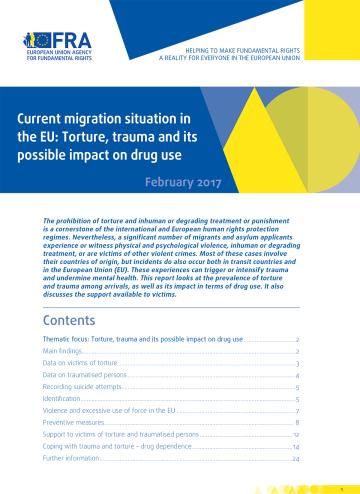
    This report looks at the prevalence of torture
    and trauma among arrivals, as well as its impact in terms of drug use. It also
    discusses the support available to victims.
  • Handbook / Guide / Manual
    22
    June
    2016
    Access to justice is an important element of the rule of law. It enables individuals to protect themselves against infringements of their rights, to remedy civil wrongs, to hold executive power accountable and to defend themselves in criminal proceedings. This handbook summarises the key European legal principles in the area of access to justice, focusing on civil and criminal law.