eu-charter

EU-stadgan om de grundläggande rättigheterna

Artikel 6 - Rätt till frihet och säkerhet

Artikel 6 - Rätt till frihet och säkerhet

Var och en har rätt till frihet och personlig säkerhet.

Förklaringar

  • Text:

    Rättigheterna i artikel 6 motsvarar dem som garanteras i artikel 5 i Europakonventionen och har i enlighet med artikel 52.3 i stadgan samma innebörd och räckvidd. Härav följer att de lagliga begränsningarna av dessa rättigheter inte får överskrida de gränser som sätts genom lydelsen av artikel 5 i Europakonventionen:
    `1. Var och en har rätt till frihet och personlig säkerhet. Ingen får berövas friheten utom i följande fall och i den ordning som lagen föreskriver
    a) när någon är lagligen berövad friheten efter fällande dom av behörig domstol,
    b) när någon är lagligen arresterad eller på annat sätt berövad friheten, antingen därför att han underlåtit att uppfylla en domstols lagligen meddelade föreläggande eller i syfte att säkerställa ett fullgörande av någon i lag föreskriven skyldighet,
    c) när någon är lagligen arresterad eller på annat sätt berövad friheten för att ställas inför behörig rättslig myndighet såsom skäligen misstänkt för att ha begått ett brott, eller när det skäligen anses nödvändigt att hindra honom från att begå ett brott eller att undkomma efter att ha gjort detta,
    d) när en underårig genom ett lagligen meddelat beslut är berövad friheten för att undergå skyddsuppfostran eller för att ställas inför behörig rättslig myndighet,
    e) när någon är lagligen berövad friheten för att förhindra spridning av smittosam sjukdom eller därför att han är psykiskt sjuk, alkoholmissbrukare, missbrukare av droger eller lösdrivare,
    f) när någon är lagligen arresterad eller på annat sätt berövad friheten för att förhindra att han obehörigen reser in i landet eller som ett led i ett förfarande som rör hans utvisning eller utlämning.
    2. Var och en som arresteras skall utan dröjsmål och på ett språk som han förstår underrättas om skälen för åtgärden och om varje anklagelse mot honom.
    3. Var och en som är arresterad eller på annat sätt berövad friheten i enlighet med vad som sagts under punkt 1 c skall utan dröjsmål ställas inför domare eller annan ämbetsman, som enligt lag får fullgöra dömande uppgifter, och skall vara berättigad till rättegång inom skälig tid eller till frigivning i avvaktan på rättegång. För frigivning får krävas att garantier ställs för att den som friges inställer sig till rättegången.
    4. Var och en som är arresterad eller på annat sätt berövad friheten skall ha rätt att begära att domstol snabbt prövar lagligheten av frihetsberövandet och beslutar att frige honom, om frihetsberövandet inte är lagligt.
    5. Var och en som arresterats eller på annat sätt berövats friheten i strid med bestämmelserna i denna artikel skall ha rätt till skadestånd.`
    Rättigheterna i artikel 6 måste respekteras, i synnerhet när Europaparlamentet och rådet antar lagstiftningsakter på området straffrättsligt samarbete på grundval av artiklarna 82, 83 och 85 i fördraget om Europeiska unionens funktionssätt, särskilt för att föreskriva gemensamma minimibestämmelser beträffande brottsrubricering och straffpåföljder samt vissa aspekter av processrätten.

    Source:
    Europeiska unionens officiella tidning C 303/17 - 14.12.2007
    Preamble - Explanations relating to the Charter of Fundamental Rights:
    Förklaringarna utarbetades ursprungligen på initiativ av presidiet för det konvent som utarbetade Europeiska unionens stadga om de grundläggande rättigheterna. De har uppdaterats på initiativ av Europeiska konventets presidium mot bakgrund av de justeringar av stadgetexten som gjorts av det senare konventet (särskilt artiklarna 51 och 52) samt unionsrättens vidare utveckling. Även om förklaringarna inte i sig har rättslig status, utgör de ett värdefullt tolkningsverktyg avsett att klargöra stadgans bestämmelser.

Rättspraxis

Nationell statsrätt

42 results found

  • Το Σύνταγμα της Ελλάδας
    Land:
    Greece

    Άρθρο 5 (1). Kαθένας έχει δικαίωμα να αναπτύσσει ελεύθερα την πρoσωπικότητά τoυ και να συμμετέχει στην κoινωνική, oικoνoμική και πoλιτική ζωή της Xώρας, εφόσoν δεν πρoσβάλλει τα δικαιώματα των άλλων και δεν παραβιάζει τo Σύνταγμα ή τα χρηστά ήθη. (2). Όλoι όσoι βρίσκoνται στην Eλληνική Eπικράτεια απoλαμβάνoυν την απόλυτη πρoστασία της ζωής, της τιμής και της ελευθερίας τoυς, χωρίς διάκριση εθνικότητας, φυλής, γλώσσας και θρησκευτικών ή πoλιτικών πεπoιθήσεων. Eξαιρέσεις επιτρέπoνται στις περιπτώσεις πoυ πρoβλέπει τo διεθνές δίκαιo. Aπαγoρεύεται η έκδoση αλλoδαπoύ πoυ διώκεται για τη δράση τoυ υπέρ της ελευθερίας. (3). H πρoσωπική ελευθερία είναι απαραβίαστη. Kανένας δεν καταδιώκεται oύτε συλλαμβάνεται oύτε φυλακίζεται oύτε με oπoιoνδήπoτε άλλo τρόπo περιoρίζεται, παρά μόνo όταν και όπως oρίζει o νόμoς. (4). Απαγορεύονται ατομικά διοικητικά μέτρα που περιορίζουν σε οποιονδήποτε Έλληνα την ελεύθερη κίνηση ή εγκατάσταση στη Χώρα, καθώς και την ελεύθερη έξοδο και είσοδο σ’ αυτήν. Τέτοιου περιεχομένου περιοριστικά μέτρα είναι δυνατόν να επιβληθούν μόνο ως παρεπόμενη ποινή με απόφαση ποινικού δικαστηρίου, σε εξαιρετικές περιπτώσεις ανάγκης και μόνο για την πρόληψη αξιόποινων πράξεων, όπως νόμος ορίζει. (5). Καθένας έχει δικαίωμα στην προστασία της υγείας και της γενετικής του ταυτότητας. Νόμος ορίζει τα σχετικά με την προστασία κάθε προσώπου έναντι των βιοϊατρικών παρεμβάσεων. Άρθρο 6(1). Kανένας δεν συλλαμβάνεται oύτε φυλακίζεται χωρίς αιτιoλoγημένo δικαστικό ένταλμα, πoυ πρέπει να επιδoθεί τη στιγμή πoυ γίνεται η σύλληψη ή η πρoφυλάκιση. Eξαιρoύνται τα αυτόφωρα εγκλήματα. (2). Όπoιoς συλλαμβάνεται για αυτόφωρo έγκλημα ή με ένταλμα πρoσάγεται στoν αρμόδιo ανακριτή τo αργότερo μέσα σε είκoσι τέσσερις ώρες από τη σύλληψη, αν όμως η σύλληψη έγινε έξω από την έδρα τoυ ανακριτή, η πρoσαγωγή γίνεται μέσα στoν απoλύτως αναγκαίo χρόνo για τη μεταγωγή τoυ. O ανακριτής oφείλει, μέσα σε τρεις ημέρες από την πρoσαγωγή, είτε να απoλύσει τoν συλληφθέντα είτε να εκδώσει ένταλμα φυλάκισης. H πρoθεσμία αυτή παρατείνεται για δύo ημέρες, αν τo ζητήσει αυτός πoυ έχει πρoσαχθεί, ή σε περίπτωση ανώτερης βίας πoυ βεβαιώνεται αμέσως με απόφαση τoυ αρμόδιoυ δικαστικoύ συμβoυλίoυ. (3). Όταν περάσει άπρακτη καθεμία από τις δύo αυτές πρoθεσμίες, κάθε δεσμoφύλακας ή άλλoς, είτε πoλιτικός υπάλληλoς είτε στρατιωτικός, στoν oπoίo έχει ανατεθεί η κράτηση εκείνoυ πoυ έχει συλληφθεί, oφείλει να τoν απoλύσει αμέσως. Oι παραβάτες τιμωρoύνται για παράνoμη κατακράτηση και υπoχρεoύνται να επανoρθώσoυν κάθε ζημία πoυ έγινε στoν παθόντα και να τoν ικανoπoιήσoυν για ηθική βλάβη με χρηματικό πoσό, όπως νόμoς oρίζει. (4). Nόμoς oρίζει τo ανώτατo όριo διάρκειας της πρoφυλάκισης, πoυ δεν μπoρεί να υπερβεί τo ένα έτoς στα κακoυργήματα και τoυς έξι μήνες στα πλημμελήματα. Σε εντελώς εξαιρετικές περιπτώσεις τα ανώτατα αυτά όρια μπoρoύν να παραταθoύν για έξι και τρεις μήνες, αντίστoιχα, με απόφαση τoυ αρμόδιoυ δικαστικoύ συμβoυλίoυ. Απαγορεύεται η υπέρβαση των ανώτατων ορίων της προφυλάκισης με τη διαδοχική επιβολή του μέτρου αυτού για επί μέρους πράξεις της ίδιας υπόθεσης.

  • КОНСТИТУЦИЯ на Република България
    Land:
    Bulgaria

    Ние, народните представители от Седмото Велико Народно събрание, в стремежа си да изразим волята на българския народ [...] като издигаме във върховен принцип правата на личността, нейното достойнство и сигурност [...] Чл.30. (1) Всеки има право на лична свобода и неприкосновеност.
    (2) Никой не може да бъде задържан, подлаган на оглед, обиск или на друго посегателство върху личната му неприкосновеност освен при условията и по реда, определени със закон.
    (3) В изрично посочените от закона неотложни случаи компетентните държавни органи могат да задържат гражданин, за което незабавно уведомяват органите на съдебната власт. В срок от 24 часа от задържането органът на съдебната власт се произнася по неговата законосъобразност.

EU-rätt

13 results found

  • 2002/584/JHA: Council Framework Decision of 13 June 2002 on the European arrest warrant and the surrender procedures between Member States

    Preamble 

    (12) This Framework Decision respects fundamental rights and observes the principles recognised by Article 6 of the Treaty on European Union and reflected in the Charter of Fundamental Rights of the European Union(7), in particular Chapter VI thereof. Nothing in this Framework Decision may be interpreted as prohibiting refusal to surrender a person for whom a European arrest warrant has been issued when there are reasons to believe, on the basis of objective elements, that the said arrest warrant has been issued for the purpose of prosecuting or punishing a person on the grounds of his or her sex, race, religion, ethnic origin, nationality, language, political opinions or sexual orientation, or that that person's position may be prejudiced for any of these reasons.

    Article 27: Possible prosecution for other offences

    2. Except in the cases referred to in paragraphs 1 and 3, a person surrendered may not be prosecuted, sentenced or otherwise deprived of his or her liberty for an offence committed prior to his or her surrender other than that for which he or she was surrendered.


  • Directive (EU) 2024/1346 of the European Parliament and of the Council of 14 May 2024 laying down standards for the reception of applicants for international protection

    Preamble 


    (31) Applicants who are in detention should be treated with full respect for human dignity and their reception should be specifically designed to meet their needs in that situation. In particular, Member States should ensure that Article 24 of the Charter and Article 37 of the 1989 United Nations Convention on the Rights of the Child are applied.


    (38) In applying this Directive, Member States should seek to ensure full respect for the principles of the best interests of the child and of family unity, in accordance with the Charter, the 1989 United Nations Convention on the Rights of the Child, the European Convention for the Protection of Human Rights and Fundamental Freedoms and, where applicable, the Council of Europe Convention on Preventing and Combating Violence against Women and Domestic Violence.


    (75) This Directive respects the fundamental rights and observes the principles recognised in particular by the Charter. In particular, this Directive seeks to ensure full respect for human dignity and to promote the application of Articles 1, 4, 6, 7, 18, 21, 24 and 47 of the Charter and has to be implemented accordingly.

    Article 19: General rules on material reception conditions and health care

    2.   Member States shall ensure that material reception conditions and health care received in accordance with Article 22 provide an adequate standard of living for applicants, which guarantees their subsistence, protects their physical and mental health and respects their rights under the Charter.

    Article 21: Reception conditions in a Member State other than the one in which the applicant is required to be present

    From the moment applicants have been notified of a decision to transfer them to the Member State responsible in accordance with Regulation (EU) 2024/1351, they shall not be entitled to the reception conditions set out in Articles 17 to 20 of this Directive in any Member State other than the one in which they are required to be present in accordance with Regulation (EU) 2024/1351. This shall be without prejudice to the need to ensure a standard of living in accordance with Union law, including the Charter, and international obligations.

  • Directive 2011/36/EU of the European Parliament and of the Council of 5 April 2011 on preventing and combating trafficking in human beings and protecting its victims, and replacing Council Framework Decision 2002/629/JHA

    Preamble 
    (1) Trafficking in human beings is a serious crime, often committed within the framework of organised crime, a gross violation of fundamental rights and explicitly prohibited by the Charter of Fundamental Rights of the European Union. Preventing and combating trafficking in human beings is a priority for the Union and the Member States.


    (8) Children are more vulnerable than adults and therefore at greater risk of becoming victims of trafficking in human beings. In the application of this Directive, the child’s best interests must be a primary consideration, in accordance with the Charter of Fundamental Rights of the European Union and the 1989 United Nations Convention on the Rights of the Child.

    (10) This Directive is without prejudice to the principle of non-refoulement in accordance with the 1951 Convention relating to the Status of Refugees (Geneva Convention), and is in accordance with Article 4 and Article 19(2) of the Charter of Fundamental Rights of the European Union.


    (33) This Directive respects fundamental rights and observes the principles recognised in particular by the Charter of Fundamental Rights of the European Union and notably human dignity, the prohibition of slavery, forced labour and trafficking in human beings, the prohibition of torture and inhuman or degrading treatment or punishment, the rights of the child, the right to liberty and security, freedom of expression and information, the protection of personal data, the right to an effective remedy and to a fair trial and the principles of the legality and proportionality of criminal offences and penalties. In particular, this Directive seeks to ensure full respect for those rights and principles and must be implemented accordingly.

    Article 1: Subject matter

    This Directive establishes minimum rules concerning the definition of criminal offences and sanctions in the area of trafficking in human beings. It also introduces common provisions, taking into account the gender perspective, to strengthen the prevention of this crime and the protection of the victims thereof.

  • Regulation (EU) No 656/2014 of the European Parliament and of the Council of 15 May 2014 establishing rules for the surveillance of the external sea borders in the context of operational cooperation coordinated by Frontex

    Preamble 


    (19) This Regulation respects the fundamental rights and observes the principles recognised by Articles 2 and 6 of the Treaty on European Union (TEU) and by the Charter, in particular respect for human dignity, the right to life, the prohibition of torture and of inhuman or degrading treatment or punishment, the prohibition of trafficking in human beings, the right to liberty and security, the right to the protection of personal data, the right to asylum and to protection against removal and expulsion, the principles of non-refoulement and non-discrimination, the right to an effective remedy and the rights of the child. This Regulation should be applied by Member States and the Agency in accordance with those rights and principles.

  • Directive (EU) 2016/800 of the European Parliament and of the Council of 11 May 2016 on procedural safeguards for children who are suspects or accused persons in criminal proceedings

    Preamble

    (31) Member States should be able to derogate temporarily from the obligation to provide assistance by a lawyer in the pre-trial phase for compelling reasons, namely where there is an urgent need to avert serious adverse consequences for the life, liberty or physical integrity of a person, or where immediate action by the investigating authorities is imperative to prevent substantial jeopardy to criminal proceedings in relation to a serious criminal offence, inter alia, with a view to obtaining information concerning the alleged co-perpetrators of a serious criminal offence, or in order to avoid the loss of important evidence regarding a serious criminal offence. During a temporary derogation for one of those compelling reasons, the competent authorities should be able to question children without the lawyer being present, provided that they have been informed of their right to remain silent and can exercise that right, and that such questioning does not prejudice the rights of the defence, including the right not to incriminate oneself. It should be possible to carry out questioning, to the extent necessary, for the sole purpose of obtaining information that is essential to avert serious adverse consequences for the life, liberty or physical integrity of a person, or to prevent substantial jeopardy to criminal proceedings. Any abuse of this temporary derogation would, in principle, irretrievably prejudice the rights of the defence.‘
     

    (33) Confidentiality of communication between children and their lawyer is key to ensuring the effective exercise of the rights of the defence and is an essential part of the right to a fair trial. Member States should therefore respect the confidentiality of meetings and other forms of communication between the lawyer and the child in the context of the assistance by a lawyer provided for in this Directive, without derogation.

    (35) Children who are suspects or accused persons in criminal proceedings should have the right to an individual assessment to identify their specific needs in terms of protection, education, training and social integration, to determine if and to what extent they would need special measures during the criminal proceedings, the extent of their criminal responsibility and the appropriateness of a particular penalty or educative measure.

    Article 3: Definitions
    For the purposes of this Directive the following definitions apply:
    (1) ‘child’ means a person below the age of 18;
    (2) ‘holder of parental responsibility’ means any person having parental responsibility over a child;  [...]
    With regard to point (1) of the first paragraph, where it is uncertain whether a person has reached the age of 18, that person shall be presumed to be a child.


    Article 4: Right to information
    1.   Member States shall ensure that when children are made aware that they are suspects or accused persons in criminal proceedings, they are informed promptly about their rights [...].


    Article 5 - Right of the child to have the holder of parental responsibility informed
    1.   Member States shall ensure that the holder of parental responsibility is provided, as soon as possible, with the information that the child has a right to receive in accordance with Article 4.

    Article 6: Assistance by a lawyer
    2.   Member States shall ensure that children are assisted by a lawyer in accordance with this Article in order to allow them to exercise the rights of the defence effectively.


    Article 10: Limitation of deprivation of liberty
    1.   Member States shall ensure that deprivation of liberty of a child at any stage of the proceedings is limited to the shortest appropriate period of time. Due account shall be taken of the age and individual situation of the child, and of the particular circumstances of the case.
    2.   Member States shall ensure that deprivation of liberty, in particular detention, shall be imposed on children only as a measure of last resort. Member States shall ensure that any detention is based on a reasoned decision, subject to judicial review by a court. Such a decision shall also be subject to periodic review, at reasonable intervals of time, by a court, either ex officio or at the request of the child, of the child's lawyer, or of a judicial authority which is not a court. Without prejudice to judicial independence, Member States shall ensure that decisions to be taken pursuant to this paragraph are taken without undue delay. 
     

    Article 11: Alternative measures
    Member States shall ensure that, where possible, the competent authorities have recourse to measures alternative to detention (alternative measures).
     

    Article 12: Specific treatment in the case of deprivation of liberty
    1.   Member States shall ensure that children who are detained are held separately from adults, unless it is considered to be in the child's best interests not to do so.
    2.   Member States shall also ensure that children who are kept in police custody are held separately from adults, unless:
    (a) it is considered to be in the child's best interests not to do so; or
    (b) in exceptional circumstances, it is not possible in practice to do so, provided that children are held together with adults in a manner that is compatible with the child's best interests.
    3.   Without prejudice to paragraph 1, when a detained child reaches the age of 18, Member States shall provide for the possibility to continue to hold that person separately from other detained adults where warranted, taking into account the circumstances of the person concerned, provided that this is compatible with the best interests of children who are detained with that person.
    4.   Without prejudice to paragraph 1, and taking into account paragraph 3, children may be detained with young adults, unless this is contrary to the child's best interests.
    5.   When children are detained, Member States shall take appropriate measures to:
    (a) ensure and preserve their health and their physical and mental development;
    (b) ensure their right to education and training, including where the children have physical, sensory or learning disabilities;
    (c) ensure the effective and regular exercise of their right to family life;
    (d) ensure access to programmes that foster their development and their reintegration into society; and
    (e) ensure respect for their freedom of religion or belief.
    The measures taken pursuant to this paragraph shall be proportionate and appropriate to the duration of the detention.
    Points (a) and (e) of the first subparagraph shall also apply to situations of deprivation of liberty other than detention. The measures taken shall be proportionate and appropriate to such situations of deprivation of liberty.
    Points (b), (c), and (d) of the first subparagraph shall apply to situations of deprivation of liberty other than detention only to the extent that is appropriate and proportionate in the light of the nature and duration of such situations.
    6.   Member States shall endeavour to ensure that children who are deprived of liberty can meet with the holder of parental responsibility as soon as possible, where such a meeting is compatible with investigative and operational requirements. This paragraph shall be without prejudice to the nomination or designation of another appropriate adult pursuant to Article 5 or 15.
     

  • Regulation (EU) 2023/1543 of the European Parliament and of the Council of 12 July 2023 on European Production Orders and European Preservation Orders for electronic evidence in criminal proceedings and for the execution of custodial sentences

    Preamble 


    (13) The respect for private and family life and the protection of natural persons regarding the processing of personal data are fundamental rights. In accordance with Article 7 and Article 8(1) of the Charter, everyone has the right to respect for their private and family life, home and communications and to the protection of personal data concerning them.

    (46) The principle of ne bis in idem is a fundamental principle of law in the Union, as recognised by the Charter and developed by the case law of the Court of Justice of the European Union. Where the issuing authority has grounds to believe that parallel criminal proceedings could be ongoing in another Member State, it should consult the authorities of that Member State in accordance with Council Framework Decision 2009/948/JHA . In any case, a European Production Order or a European Preservation Order is not to be issued where the issuing authority has grounds to believe that this would be contrary to the ne bis in idem principle.

    Article 1: Subject matter

    1. This Regulation lays down the rules under which an authority of a Member State, in criminal proceedings, may issue a European Production Order or a European Preservation Order and thereby order a service provider offering services in the Union and established in another Member State, or, if not established, represented by a legal representative in another Member State, to produce or to preserve electronic evidence regardless of the location of the data. This Regulation is without prejudice to the powers of national authorities to address service providers established or represented on their territory for the purpose of ensuring that they comply with national measures similar to those referred to in the first subparagraph.

    2. The issuing of a European Production Order or of a European Preservation Order may also be requested by a suspect or an accused person, or by a lawyer on that person’s behalf within the framework of applicable defence rights in accordance with national criminal procedural law.

    3. This Regulation shall not have the effect of modifying the obligation to respect the fundamental rights and legal principles as enshrined in the Charter and in Article 6 TEU, and any obligations applicable to law enforcement authorities or judicial authorities in this respect shall remain unaffected. This Regulation applies without prejudice to fundamental principles, in particular the freedom of expression and information, including the freedom and pluralism of the media, respect for private and family life, the protection of personal data, as well as the right to effective judicial protection.

  • Directive 2013/48/EU of the European Parliament and of the Council of 22 October 2013 on the right of access to a lawyer in criminal proceedings and in European arrest warrant proceedings

    Preamble 

    (1) Article 47 of the Charter of Fundamental Rights of the  European Union (the Charter), Article 6 of the European  Convention for the Protection of Human Rights and  Fundamental Freedoms (the ECHR) and Article 14 of the International Covenant on Civil and Political Rights (the ICCPR) enshrine the right to a fair trial. Article 48(2) of the Charter guarantees respect for the rights of the defence.


    (12) This Directive lays down minimum rules concerning the right of access to a lawyer in criminal proceedings and in proceedings for the execution of a European arrest warrant pursuant to Council Framework Decision 2002/584/JHA of 13 June 2002 on the European arrest warrant and the surrender procedures between Member States (European arrest warrant proceedings) and the right to have a third party informed upon deprivation of liberty and to communicate with third persons and with consular authorities while deprived of liberty. In doing so, it promotes the application of the Charter, in particular Articles 4, 6, 7, 47 and 48 thereof, by building upon Articles 3, 5, 6 and 8 ECHR, as interpreted by the European Court of Human Rights, which, in its case-law, on an ongoing basis, sets standards on the right of access to a lawyer. That case-law provides, inter alia, that the fairness of proceedings requires that a suspect or accused person be able to obtain the whole range of services specifically associated with legal assistance. In that regard, the lawyers of suspects or accused persons should be able to secure without restriction, the fundamental aspects of the defence.

    (52) This Directive upholds the fundamental rights and principles recognised by the Charter, including the prohibition of torture and inhuman and degrading treatment, the right to liberty and security, respect for private and family life, the right to the integrity of the person, the rights of the child, integration of persons with disabilities, the right to an effective remedy and the right to a fair trial, the presumption of innocence and the rights of the defence. This Directive should be implemented in accordance with those rights and principles.

    Article 1: Subject matter

    This Directive lays down minimum rules concerning the rights of suspects and accused persons in criminal proceedings and of persons subject to proceedings pursuant to Framework Decision 2002/584/JHA (‘European arrest warrant proceedings’) to have access to a lawyer, to have a third party informed of the deprivation of liberty and to communicate with third persons and with consular authorities while deprived of liberty.

    Article 11: Legal aid

    This Directive is without prejudice to national law in relation to legal aid, which shall apply in accordance with the Charter and the ECHR.

     
  • Directive 2012/13/EU of the European Parliament and of the Council of 22 May 2012 on the right to information in criminal proceedings

    Preamble 


    (5) Article 47 of the Charter of Fundamental Rights of the European Union (hereinafter ‘the Charter’) and Article 6 of the European Convention for the Protection of Human Rights and Fundamental Freedoms (hereinafter ‘the ECHR’) enshrine the right to a fair trial. Article 48(2) of the Charter guarantees respect for the rights of the defence.

    (6) Article 6 of the Charter and Article 5 ECHR enshrine the right to liberty and security of person. Any restrictions on that right must not exceed those permitted in accordance with Article 5 ECHR and inferred from the case-law of the European Court of Human Rights.


    (14) This Directive relates to measure B of the Roadmap. It lays down common minimum standards to be applied in the field of information about rights and about the accusation to be given to persons suspected or accused of having committed a criminal offence, with a view to enhancing mutual trust among Member States. This Directive builds on the rights laid down in the Charter, and in particular Articles 6, 47 and 48 thereof, by building upon Articles 5 and 6 ECHR as interpreted by the European Court of Human Rights. In this Directive, the term ‘accusation’ is used to describe the same concept as the term ‘charge’ used in Article 6(1) ECHR.


    Article 1: Subject matter

    This Directive lays down rules concerning the right to information of suspects or accused persons, relating to their rights in criminal proceedings and to the accusation against them. It also lays down rules concerning the right to information of persons subject to a European Arrest Warrant relating to their rights.

  • Treaty on the Functioning of the European Union - Article 82 (ex Article 31 TEU) - Article 83 (ex Article 31 TEU) - Article 85 (ex Article 31 TEU)

    Article 82 (ex Article 31 TEU)

    1. Judicial cooperation in criminal matters in the Union shall be based on the principle of mutual recognition of judgments and judicial decisions and shall include the approximation of the laws and regulations of the Member States in the areas referred to in paragraph 2 and in Article 83. The European Parliament and the Council, acting in accordance with the ordinary legislative procedure, shall adopt measures to: (a) lay down rules and procedures for ensuring recognition throughout the Union of all forms of judgments and judicial decisions; (b) prevent and settle conflicts of jurisdiction between Member States; (c) support the training of the judiciary and judicial staff; (d) facilitate cooperation between judicial or equivalent authorities of the Member States in relation to proceedings in criminal matters and the enforcement of decisions.

    2. To the extent necessary to facilitate mutual recognition of judgments and judicial decisions and police and judicial cooperation in criminal matters having a cross-border dimension, the European Parliament and the Council may, by means of directives adopted in accordance with the ordinary legislative procedure, establish minimum rules. Such rules shall take into account the differences between the legal traditions and systems of the Member States. They shall concern: (a) mutual admissibility of evidence between Member States; (b) the rights of individuals in criminal procedure; (c) the rights of victims of crime; (d) any other specific aspects of criminal procedure which the Council has identified in advance by a decision; for the adoption of such a decision, the Council shall act unanimously after obtaining the consent of the European Parliament. Adoption of the minimum rules referred to in this paragraph shall not prevent Member States from maintaining or introducing a higher level of protection for individuals.

    3. Where a member of the Council considers that a draft directive as referred to in paragraph 2 would affect fundamental aspects of its criminal justice system, it may request that the draft directive be referred to the European Council. In that case, the ordinary legislative procedure shall be suspended. After discussion, and in of a consensus, the European Council shall, within four months of this suspension, refer the draft back to the Council, which shall terminate the suspension of the ordinary legislative procedure. Within the same timeframe, in of disagreement, and if at least nine Member States wish to establish enhanced cooperation on the basis of the draft directive concerned, they shall notify the European Parliament, the Council and the Commission accordingly. In such a case, the authorisation to proceed with enhanced cooperation referred to in Article 20(2) of the Treaty on European Union and Article 329(1) of this Treaty shall be deemed to be granted and the provisions on enhanced cooperation shall apply.


    Article 83 (ex Article 31 TEU)

    1. The European Parliament and the Council may, by means of directives adopted in accordance with the ordinary legislative procedure, establish minimum rules concerning the definition of criminal offences and sanctions in the areas of particularly serious crime with a cross-border dimension resulting from the nature or impact of such offences or from a special need to combat them on a common basis. These areas of crime are the following: terrorism, trafficking in human beings and sexual exploitation of women and children, illicit drug trafficking, illicit arms trafficking, money laundering, corruption, counterfeiting of means of payment, computer crime and organised crime. On the basis of developments in crime, the Council may adopt a decision identifying other areas of crime that meet the criteria specified in this paragraph. It shall act unanimously after obtaining the consent of the European Parliament.

    2. If the approximation of criminal laws and regulations of the Member States proves essential to ensure the effective implementation of a Union policy in an area which has been subject to harmonisation measures, directives may establish minimum rules with regard to the definition of criminal offences and sanctions in the area concerned. Such directives shall be adopted by the same ordinary or special legislative procedure as was followed for the adoption of the harmonisation measures in question, without prejudice to Article 76.

    3. Where a member of the Council considers that a draft directive as referred to in paragraph 1 or 2 would affect fundamental aspects of its criminal justice system, it may request that the draft directive be referred to the European Council. In that case, the ordinary legislative procedure shall be suspended. After discussion, and in of a consensus, the European Council shall, within four months of this suspension, refer the draft back to the Council, which shall terminate the suspension of the ordinary legislative procedure. Within the same timeframe, in of disagreement, and if at least nine Member States wish to establish enhanced cooperation on the basis of the draft directive concerned, they shall notify the European Parliament, the Council and the Commission accordingly. In such a case, the authorisation to proceed with enhanced cooperation referred to in Article 20(2) of the Treaty on European Union and Article 329(1) of this Treaty shall be deemed to be granted and the provisions on enhanced cooperation shall apply.

    ...

    Article 85 (ex Article 31 TEU)

    1. Eurojust's mission shall be to support and strengthen coordination and cooperation between national investigating and prosecuting authorities in relation to serious crime affecting two or more Member States or requiring a prosecution on common bases, on the basis of operations conducted and information supplied by the Member States' authorities and by Europol. In this context, the European Parliament and the Council, by means of regulations adopted in accordance with the ordinary legislative procedure, shall determine Eurojust's structure, operation, field of action and tasks. These tasks may include: (a) the initiation of criminal investigations, as well as proposing the initiation of prosecutions conducted by competent national authorities, particularly those relating to offences against the financial interests of the Union; (b) the coordination of investigations and prosecutions referred to in point (a); (c) the strengthening of judicial cooperation, including by resolution of conflicts of jurisdiction and by close cooperation with the European Judicial Network. These regulations shall also determine arrangements for involving the European Parliament and national Parliaments in the evaluation of Eurojust's activities.

    2. In the prosecutions referred to in paragraph 1, and without prejudice to Article 86, formal acts of judicial procedure shall be carried out by the competent national officials.

  • Communication on a New Pact on Migration and Asylum

    Migration has been a constant feature of human history with a profound impact on European society, its economy and its culture. With a well-managed system, migration can contribute to growth, innovation and social dynamism. Key societal challenges faced by the world today – demography, climate change, security, the global race for talent, and inequality – all have an impact on migration. Policy imperatives such as free movement in the Schengen area, safeguarding fundamental rights, ensuring security, and filling skills gaps, all call for an effective migration policy. The task facing the EU and its Member States, while continuing to address urgent needs, is to build a system that manages and normalises migration for the long term and which is fully grounded in European values and international law.

    ...

Internationell rätt

5 results found

  • European Convention on Human Rights - Article 5

    Article 5 – Right to liberty and security

    1 Everyone has the right to liberty and security of person. No one shall be deprived of his liberty save in the following cases and in accordance with a procedure prescribed by law:

    a the lawful detention of a person after conviction by a competent court;

    b the lawful arrest or detention of a person for non-compliance with the lawful order of a court or in order to secure the fulfilment of any obligation prescribed by law;

    c the lawful arrest or detention of a person effected for the purpose of bringing him before the competent legal authority on reasonable suspicion of having committed an offence or when it is reasonably considered necessary to prevent his committing an offence or fleeing after having done so;

    d the detention of a minor by lawful order for the purpose of educational supervision or his lawful detention for the purpose of bringing him before the competent legal authority;

    e the lawful detention of persons for the prevention of the spreading of infectious diseases, of persons of unsound mind, alcoholics or drug addicts or vagrants;

    f the lawful arrest or detention of a person to prevent his effecting an unauthorised entry into the country or of a person against whom action is being taken with a view to deportation or extradition.

    2 Everyone who is arrested shall be informed promptly, in a language which he understands, of the reasons for his arrest and of any charge against him.

    3 Everyone arrested or detained in accordance with the provisions of paragraph 1.c of this article shall be brought promptly before a judge or other officer authorised by law to exercise judicial power and shall be entitled to trial within a reasonable time or to release pending trial. Release may be conditioned by guarantees to appear for trial. 4 Everyone who is deprived of his liberty by arrest or detention shall be entitled to take proceedings by which the lawfulness of his detention shall be decided speedily by a court and his release ordered if the detention is not lawful. 5 Everyone who has been the victim of arrest or detention in contravention of the provisions of this article shall have an enforceable right to compensation.

  • Convention on the Rights of Persons with Disabilities - Article 14

    Article 14 – Liberty and security of person

    1. States Parties shall ensure that persons with disabilities, on an equal basis with others: a) Enjoy the right to liberty and security of person; b) Are not deprived of their liberty unlawfully or arbitrarily, and that any deprivation of liberty is in conformity with the law, and that the existence of a disability shall in no justify a deprivation of liberty.

    2. States Parties shall ensure that if persons with disabilities are deprived of their liberty through any process, they are, on an equal basis with others, entitled to guarantees in accordance with international human rights law and shall be treated in compliance with the objectives and principles of the present Convention, including by provision of reasonable accommodation.

  • International Covenant on Civil and Political Rights

    Article 9

    1. Everyone has the right to liberty and security of person. No one shall be subjected to arbitrary arrest or detention. No one shall be deprived of his liberty except on such grounds and in accordance with such procedure as are established by law.

    2. Anyone who is arrested shall be informed, at the time of arrest, of the reasons for his arrest and shall be promptly informed of any charges against him.

    3. Anyone arrested or detained on a criminal charge shall be brought promptly before a judge or other officer authorized by law to exercise judicial power and shall be entitled to trial within a reasonable time or to release. It shall not be the general rule that persons awaiting trial shall be detained in custody, but release may be subject to guarantees to appear for trial, at any other stage of the judicial proceedings, and, should occasion arise, for execution of the judgement.

    4. Anyone who is deprived of his liberty by arrest or detention shall be entitled to take proceedings before a court, in order that that court may decide without delay on the lawfulness of his detention and order his release if the detention is not lawful.

    5. Anyone who has been the victim of unlawful arrest or detention shall have an enforceable right to compensation.


    Article 10

    1. All persons deprived of their liberty shall be treated with humanity and with respect for the inherent dignity of the human person.

    2. (a) Accused persons shall, save in exceptional circumstances, be segregated from convicted persons and shall be subject to separate treatment appropriate to their status as unconvicted persons; (b) Accused juvenile persons shall be separated from adults and brought as speedily as possible for adjudication.

    3. The penitentiary system shall comprise treatment of prisoners the essential aim of which shall be their reformation and social rehabilitation. Juvenile offenders shall be segregated from adults and be accorded treatment appropriate to their age and legal status.

  • Human Rights Committee, General Comment No. 35 - Article 9: Liberty and Security of person
  • UN General Assembly Resolution 70/175 (2015) - United Nations Standard Minimum Rules for the Treatment of Prisoners (the Nelson Mandela Rules)

Produkter

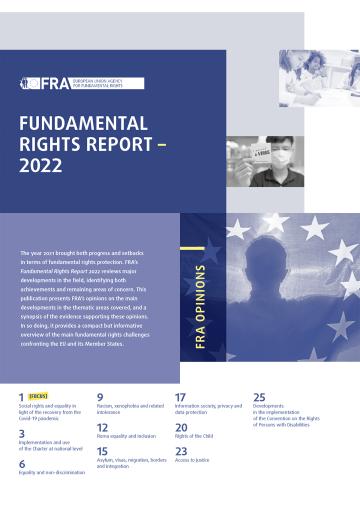
  • Fundamental Rights Report
    8
    June
    2022
    År 2021 innebar både framgångar och motgångar för skyddet av de grundläggande rättigheterna. FRA:s Rapport om grundläggande rättigheter 2022 innehåller en granskning av de viktigaste händelserna på området och pekar ut både framsteg och återstående problemområden. I publikationen presenteras FRA:s yttranden om den huvudsakliga utvecklingen på de berörda tematiska områdena, tillsammans med en översikt över det underlag som ligger till grund för dessa yttranden.
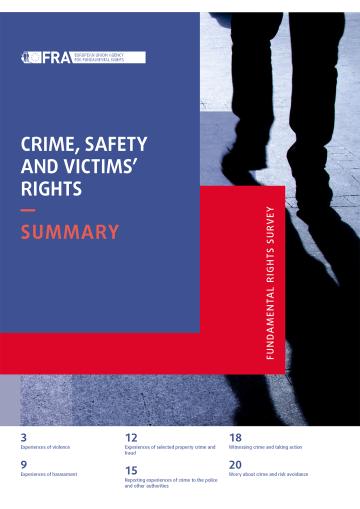
  • Report / Paper / Summary
    8
    March
    2021
    Den här sammanfattningen innehåller de viktigaste
    lärdomarna från FRA:s andra huvudrapport, som
    baseras på undersökningen om grundläggande
    rättigheter. I undersökningen samlades data in från
    runt 35 000 människor om deras erfarenheter av,
    inställning till och åsikter om en mängd frågor som
    på olika sätt rör de mänskliga rättigheterna.
  • Periodic updates / Series
    21
    July
    2026
    This is the second bulletin in FRA’s new quarterly series monitoring the situation of migrants, asylum seekers and refugees. It covers key developments and ongoing concerns from 1 April to 30 June 2026.

    Following regular reporting on fundamental rights issues related to migration and asylum from 2015 to 2023, FRA resumed the series in 2026 under the EU's 2024 Asylum and Migration Management Regulation, ahead of the June 2026 implementation of the EU Migration and Asylum Pact. The first bulletin, published in April 2026, covered developments from 1 January 2025 to 31 March 2026.
  • Periodic updates / Series
    21
    April
    2026
    From 2015 to 2023, FRA regularly published bulletins on fundamental rights issues related to migration and asylum. As part of the EU's 2024 Asylum and Migration Management Regulation, FRA is now restarting this reporting ahead of the June 2026 implementation of the EU Migration and Asylum Pact. This first bulletin in the new series takes stock of the situation of migrants, asylum seekers and refugees as of March 2026. It looks at key developments between January 2025 and the end of March 2026, as well as ongoing problems and new areas of concern.
  • Report / Paper / Summary
    14
    April
    2026
    In response to increased arrivals of asylum seekers, in 2015 the European Commission introduced the hotspot approach. Under this approach, the European Commission and EU agencies supported Greece and Italy in identifying, registering and fingerprinting newly arrived people. FRA regularly visited the initial reception facilities hosting them. This report looks back at the lessons learnt from 10 years of FRA visits. It identifies recurring risks to rights and highlights practical measures and promising practices to prevent or address them. These ‘lessons learnt’ can inform the implementation of the 2024 Pact on Migration and Asylum in line with the EU Charter of Fundamental Rights.
  • Report / Paper / Summary
    4
    December
    2025
    Artificial Intelligence comes with both benefits and risks. Safe AI use that accounts for fundamental rights is thus crucial. While the 2024 EU AI Act was a milestone in this regard, its broad definitions regarding AI systems and high-risk AI could introduce loopholes for fundamental rights compliance. This report offers an empirical basis for much-needed practical guidance on the Act’s implementation. Based on interviews with AI developers, sellers, and users, FRA addresses challenges of its use in critical domains, like asylum, education, and employment. Our findings help guide next steps in realising the AI Act’s potential to ensure responsible innovation.
  • Report / Paper / Summary
    27
    November
    2025
    This report looks at the breadth and depth of violence and neglect faced by people with disabilities living in institutions. It highlights the shortcomings by EU Member States in preventing violence and protecting those who are at a higher risk of experiencing it, in line with the UN Convention on the Rights of Persons with Disabilities. Based on research across all EU Member States and FRA observer candidate countries, the report calls for better protection, stronger prevention of violence, and clear accountability. It urges the EU and its Member States to implement their obligations around equality and fundamental rights.
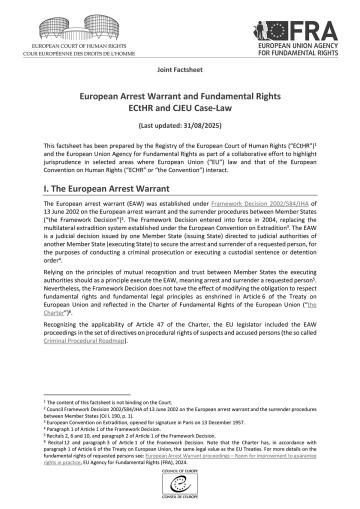
  • In brief / Factsheet
    1
    September
    2025
    This factsheet focuses on the European arrest warrant and EU Member States obligations to respect fundamental rights. EU law and the European Convention on Human Rights sometimes overlap. The publication clarifies where there are similar principles in different legislation and provides examples of case law. In collaboration, the EU Agency for Fundamental Rights and the European Court of Human Rights produced this short publication. It is designed to aid lawyers and policymakers in understanding and applying the jurisprudence in this area. The August 2025 version now contains recent case-law developments.
  • Opinion / Position Paper
    23
    July
    2025
    This position paper examines how the EU can counter the instrumentalisation of migrants while also upholding fundamental rights. Instrumentalisation refers to countries outside the EU using migration to exert political pressure. This position paper defines the phenomenon, provides examples, and outlines legal obligations under EU law. It provides legal analysis and warns that some responses risk undermining fundamental rights at the EU’s external borders, including the right to asylum. To counter instrumentalisation and uphold fundamental rights, the position paper proposes practical measures for Member States to take, such as sanctions, border controls, and cooperation with private operators.
  • In brief / Factsheet
    27
    May
    2025
    This factsheet focuses on the European arrest warrant and EU Member States obligations to respect fundamental rights. EU law and the European Convention on Human Rights sometimes overlap. The publication clarifies where there are similar principles in different legislation and provides examples of case law. In collaboration, the EU Agency for Fundamental Rights and the European Court of Human Rights produced this short publication. It is designed to aid lawyers and policymakers in understanding and applying the jurisprudence in this area. The 2025 version now contains recent case-law developments.