FRA’s Fundamental Rights Report 2020 reviews major developments in the field in 2019, identifying both achievements and areas of concern. It also presents FRA’s opinions on these developments, including a synopsis of the evidence supporting these opinions. This year’s focus chapter explores how to unlock the full potential of the EU Charter of Fundamental Rights.
The Coronavirus pandemic continues to interrupt everyday life in the EU in unprecedented ways. But the way it affects our societies is shifting. As governments gradually lift some of the measures put in place to contain the spread of COVID-19, new fundamental rights concerns arise: how to ensure that the rights to life and health are upheld as daily life transitions to a ‘new normal’. This Bulletin looks at declarations of states of emergency, or equivalent, and how they came under scrutiny. It considers the impact on fundamental rights in important areas of daily life, and includes a thematic focus on the processing of users’ data to help contain COVID-19, particularly by contact-tracing apps. It covers the period 21 March – 30 April 2020.
The EU Agency for Fundamental Rights has been regularly collecting data on migration since September 2015. This report focuses on the fundamental rights situation of people arriving in Member States and EU candidate countries particularly affected by large migration movements. It addresses key fundamental rights concerns between 1 January and 31 March 2020.
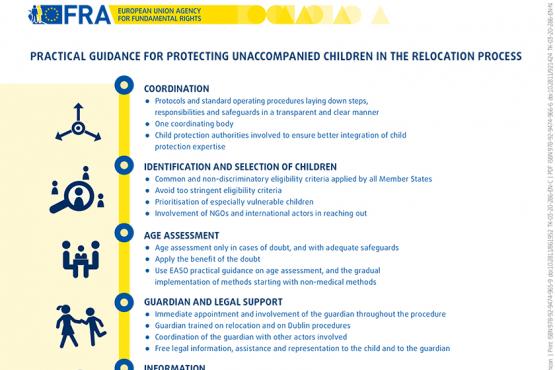
In recent years, thousands of girls and boys have reached Europe without their parents, and sought international protection. Many of them experienced violence, abuse and neglect in their home countries, and while in transit. They have the right to be protected in line with the provisions of the UN Convention on the Rights of the Child, the European Convention on Human Rights, and European Union law. This report explores the challenges and good practices gathered in the implementation of such relocation programmes. Based on information FRA collected in 10 EU Member States, it aims to help national authorities to support the relocation of unaccompanied children by taking measures that are fully rights compliant and practically feasible.
Based on the lessons learned from relocation
experiences and on existing international and EU legal
standards, FRA has developed a number of practical
suggestions for the adjustment of relocation efforts to
the protection needs of unaccompanied children. This
guidance aims to be a practical tool for Member States
that wish to engage in the relocation of unaccompanied
children and in any future responsibility-sharing
mechanisms, and to gain knowledge on how this can
be done while respecting the child’s best interests.
The outbreak of COVID-19 affects people’s daily life in the 27 EU Member States. As the number of infected people in the EU territory began to mount rapidly in February and March, governments put in place a raft of measures – often introduced in a period of only a few days – in an effort to contain the spread of the virus. Many of these measures reflect how, in exceptional emergency situations, the urgent need to save lives justifies restrictions on other rights, such as the freedom of movement and of assembly. This report outlines some of the measures EU Member States have put in place to protect public health during the COVID-19 pandemic. It covers the period 1 February – 20 March 2020.
Children in migration are more vulnerable than adults, particularly when they are unaccompanied. Their vulnerability makes them more exposed to violence, exploitation and trafficking in human beings, as well as physical, psychological and sexual abuse. This report looks into challenges to the fundamental rights of children in migration throughout 2019. It pulls together the main issues identified in FRA’s Quarterly Bulletins on migration in selected EU Member States.
Council of Europe (CoE) and European Union (EU) Member States have an undeniable sovereign right to control the entry of non-nationals into their territory. While exercising border control, states have a duty to protect the fundamental rights of all people under their jurisdiction, regardless of their nationality and/or legal status. Under EU law, this includes providing access to asylum procedures.
Greece needs solid, sustained support and solidarity as it faces great migration challenges, says FRA Director Michael O’Flaherty after 2 days of meetings in Athens with authorities.
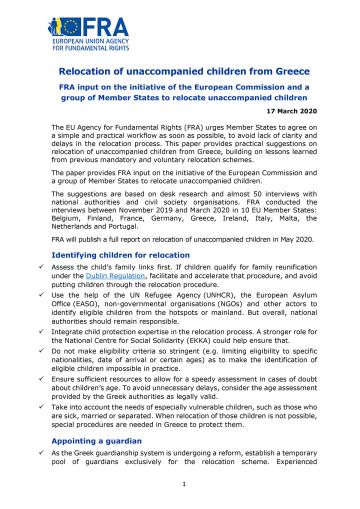
The EU Agency for Fundamental Rights (FRA) urges Member States to agree on a simple and practical workflow as soon as possible, to avoid lack of clarity and delays in the relocation process. This paper provides practical suggestions on relocation of unaccompanied children from Greece, building on lessons learned from previous mandatory and voluntary relocation schemes. The paper provides FRA input on the initiative of the European Commission and a group of Member States to relocate unaccompanied children.
In today’s media landscape the way in which journalists and editors receive, process and publish news is constantly changing. Journalists face immense time pressure, as news frequently breaks online To facilitate training on the coverage of migration news, this Trainer’s Manual is a tool to be used together with the e-Media Toolkit.
The EU Agency for Fundamental Rights has been regularly collecting data on migration since September 2015. This report focuses on the fundamental rights situation of people arriving in Member States and EU candidate countries particularly affected by large migration movements. It addresses key fundamental rights concerns between 1 October and 31 December 2019.
Тази брошура помага на служителите и органите да информират кандидатите за убежище и мигрантите по разбираем и достъпен начин относно обработката на техните пръстови отпечатъци в системата Евродак.
Tento leták má napomoci úředníkům a úřadům informovat žadatele o azyl a migranty srozumitelně a přístupnou cestou o zpracování jejich otisků prstů v systému Eurodac.
Denne folder hjælper grænsevagter og myndigheder med at informere asylansøgere og immigranter om behandlingen af deres fingeraftryk i Eurodac på en forståelig og lettilgængelig måde.
Dieses Merkblatt unterstützt Beamte und Behörden bei der verständlichen und anschaulichen Information von Asylbewerbern und Migranten über die Verarbeitung ihrer Fingerabdrücke in Eurodac.
Το παρόν φυλλάδιο βοηθά τους αρμόδιους υπαλλήλους και τις αρχές να ενημερώνουν με εύκολο και απλό τρόπο τους αιτούντες άσυλο και τους μετανάστες σχετικά με την επεξεργασία των δακτυλικών τους αποτυπωμάτων στο Eurodac.
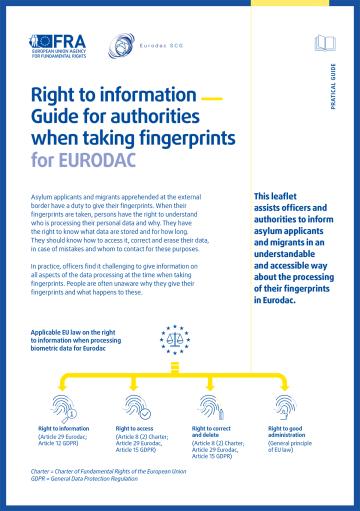
This leaflet assists officers and authorities to inform asylum applicants and migrants in an understandable and accessible way about the processing of their fingerprints in Eurodac.
Este folleto ayuda a los funcionarios y a las autoridades a informar a los solicitantes de asilo y a los inmigrantes, de un modo comprensible y accesible, sobre el tratamiento de sus huellas dactilares en Eurodac.
See teabeleht aitab ametnikel ja ametiasutustel teavitada varjupaigataotlejaid ning rändajaid arusaadaval ja kättesaadaval viisil nende sõrmejälgede töötlemisest Eurodac-süsteemis.