FRA’s 2019 survey on Roma and Travellers in Belgium, France, Ireland, the Netherlands, Sweden and the United Kingdom interviewed almost 4 700 Roma and Travellers, collecting information on more than 8 200 individuals living in their households.
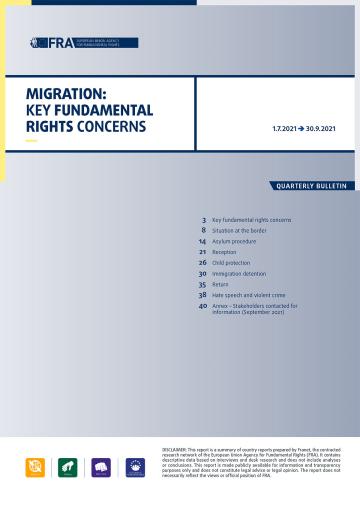
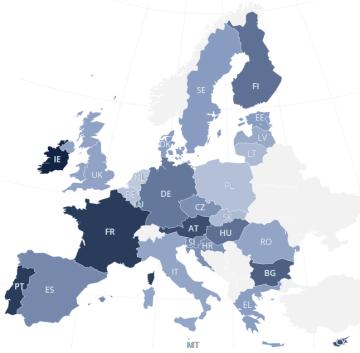
The EU Agency for Fundamental Rights has been regularly collecting data on asylum and migration since September 2015. This report focuses on the fundamental rights situation of people arriving in Member States and EU candidate countries particularly affected by migration. It addresses fundamental rights concerns between 1 July and 30 September 2021.
Since 2014, FRA has been publishing an annual update of the forced return monitoring systems EU Member States have set up under Article 8 (6) of the EU’s Return Directive. This overview describes different indicators for an effective forced return monitoring system. It includes the organisation responsible for monitoring forced return, the number of operations monitored in 2020, the phases of monitored return operations, the number of staff trained and working as monitors, and whether the monitoring body issued public reports about their monitoring.
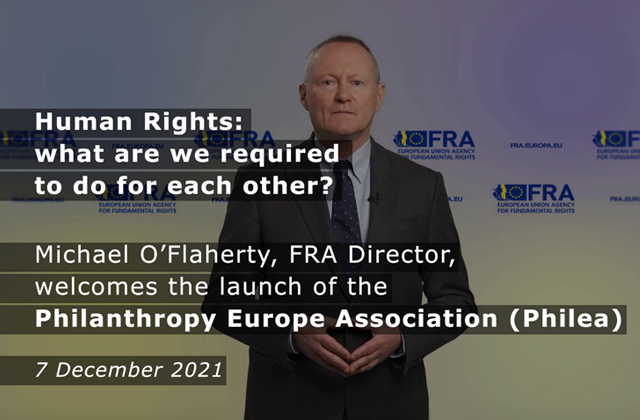
The Director of the EU Agency for Fundamental Rights, Michael O’Flaherty, welcomes the launch of the Philanthropy Europe Association (Philea), the merger of the European Foundation Centre (EFC) and the Donors and Foundations Networks in Europe (Dafne), on 7 December 2021.
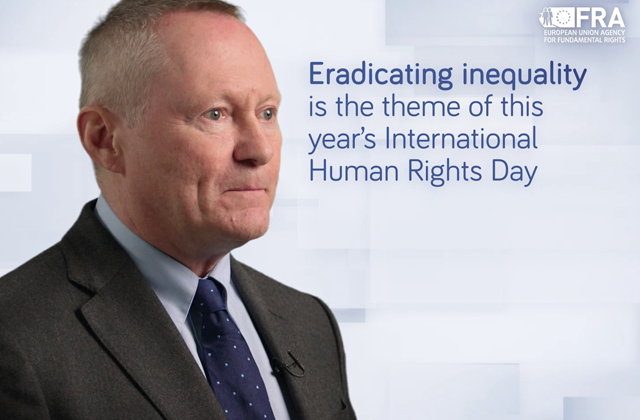
In this vlog, FRA Director Michael O’Flaherty points to the urgent need to work towards a fairer society and asks us all, as we go forward, to work less for people in the struggle for equality, but much more with them.
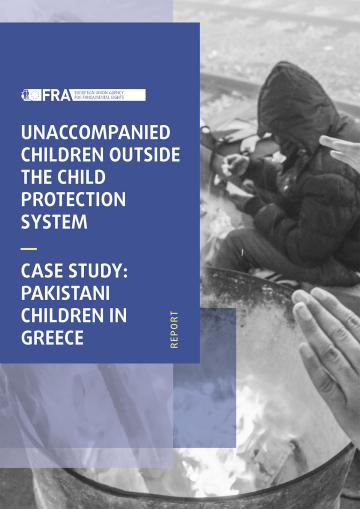
This report sheds light on the realities faced by unaccompanied migrant children who are not in the care of child protection systems in the EU. Presented as a case study, it tells the story of children and young adults from Pakistan who travelled alone to the EU without their parents or other adults.
FRA Opinion 1/21 illustrates the extent and nature of lived experiences of inequality and discrimination across the EU. It does so with reference to the grounds of discrimination and areas of life covered by the racial and employment equality directives, as well as by the proposed Equal Treatment Directive. It was issued on 30 April 2021. This summary presents the main recommendations (‘Key findings and opinions’) outlined in FRA Opinion 1/21.
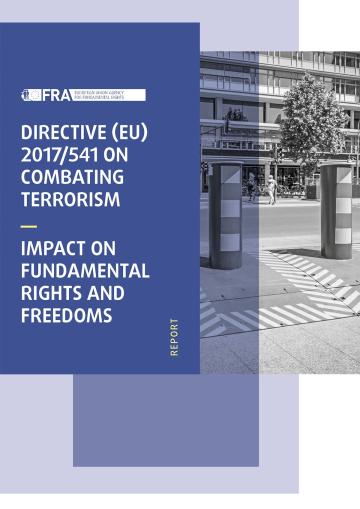
This report examines the EU’s main criminal law instrument in the field of counter-terrorism, Directive (EU) 2017/541. Specifically, it considers how the directive engages issues of fundamental rights, affecting individuals, groups and society as a whole.
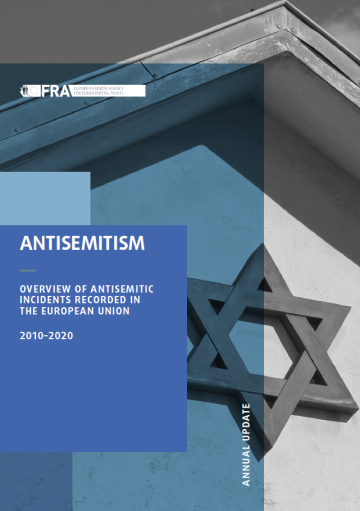
Antisemitic incidents and hate crimes violate fundamental rights, especially the right to human dignity, the right to equality of treatment, and the freedom of thought, conscience and religion. This report provides an overview of available data on antisemitism as recorded by official and unofficial sources in the EU Member States as well as Albania, North Macedonia and Serbia. The data provided by the countries are supplemented with information from international organisations.
This report outlines to what extent legal aid is available to those held in pre-removal detention in the 27 EU Member States, and in North Macedonia and Serbia, during procedures related to their return. These involve decisions on return, on detention pending removal, the removal itself and on bans on entry. The report also examines when people are entitled to free legal aid and how this aid is funded, as well as who provides representation and various factors that limit the scope of legal aid.
Speaking up for human rights has never been more important!
But how can we bring people together and cut through the noise?
International and regional human rights organisations across Europe have joined forces with the EU Agency for Fundamental Rights, united behind the '10 keys to effectively communicating human rights'.
This report proposes a framework for becoming, and functioning as, a ‘human rights city’ in the EU. It includes ‘foundations’, ‘structures’ and ‘tools’ for mayors, local administrations and grassroots organisations to reinforce fundamental rights locally. It is based on existing good practice and expert input by representatives of human rights cities in the EU, academic experts, international organisations and city networks.
Since September 2020, three National Human Rights Institutions (NHRIs) had a change in their accreditation status, two new institutions were created and nine have had a change in tasks covered by their mandates. Following up on the September 2020 report “Strong and effective national human rights institutions – challenges, promising practices and opportunities”, this update provides an overview of developments in the accreditation status and mandates of NHRIS in the past 12 months. The update covers the 27 EU Member States as well as three additional states within FRA’s mandate (Albania, North Macedonia and Serbia).
The EU Agency for Fundamental Rights has been regularly collecting data on asylum and migration since September 2015. This report focuses on the fundamental rights situation of people arriving in Member States and EU candidate countries particularly affected by migration. It addresses fundamental rights concerns between 1 January and 30 June 2021.
Civil society organisations play a vital role in promoting fundamental rights, but they face diverse challenges across the European Union. This report presents FRA’s findings on a range of such challenges. The findings are based on research, and on two online consultations with civil society organisations, carried out in 2020.
This report examines why victims do not report bias-motivated incidents and the barriers that they face when reporting incidents through national crime reporting systems. By mapping existing practices that have a bearing on the victim’s experiences when reporting bias-motivated violence and harassment, it aims to provide evidence to support national efforts to encourage and facilitate reporting – and ultimately assist Member States in delivering on their duties with regard to combating hate crime.
The Consolidated annual activity report 2020 provides an overview of the activities and achievements of the European Union Agency for Fundamental Rights (FRA) in that year. It follows the guidelines established by the European Commission.
The Employers Sanctions Directive was primarily enacted to dissuade employers from recruiting migrants in an irregular situation, but it also contains provisions to protect workers. It facilitates access to justice for exploited workers and sets out workers’ rights to claim back payment of outstanding wages. The directive also contains provisions to enhance the effectiveness of labour inspections. This report describes how the 25 Member States bound by the directive have been implementing its protective provisions, focusing on the impact these provisions have on migrant workers in an irregular situation who are victims of exploitation and other labour
law violations.
This Coronavirus Bulletin focuses on equitable access to vaccines. It outlines the situation in the 27 EU Member States from 1 March to 30 April 2021. The bulletin looks at two main areas: planning and prioritisation in deploying Covid-19 vaccinations and their rollout in the countries. It covers information and communication campaigns, as well as (pre)registration channels for and the administration of vaccinations.
The year 2020 brought both progress and setbacks in terms of fundamental rights protection. FRA’s Fundamental Rights Report 2021 reviews major developments in the field, identifying both achievements and remaining areas of concern. This publication presents FRA’s opinions on the main developments in the thematic areas covered, and a synopsis of the evidence supporting these opinions.