eu-charter

Charta der Grundrechte der Europäischen Union

Präambel

Die Völker Europas sind entschlossen, auf der Grundlage gemeinsamer Werte eine friedliche Zukunft zu teilen, indem sie sich zu einer immer engeren Union verbinden.

In dem Bewusstsein ihres geistig-religiösen und sittlichen Erbes gründet sich die Union auf die unteilbaren und universellen Werte der Würde des Menschen, der Freiheit, der Gleichheit und der Solidarität. Sie beruht auf den Grundsätzen der Demokratie und der Rechtsstaatlichkeit. Sie stellt den Menschen in den Mittelpunkt ihres Handelns, indem sie die Unionsbürgerschaft und einen Raum der Freiheit, der Sicherheit und des Rechts begründet.
Die Union trägt zur Erhaltung und zur Entwicklung dieser gemeinsamen Werte unter Achtung der Vielfalt der Kulturen und Traditionen der Völker Europas sowie der nationalen Identität der Mitgliedstaaten und der Organisation ihrer staatlichen Gewalt auf nationaler, regionaler und lokaler Ebene bei. Sie ist bestrebt, eine ausgewogene und nachhaltige Entwicklung zu fördern und stellt den freien Personen-, Dienstleistungs-, Waren- und Kapitalverkehr sowie die Niederlassungsfreiheit sicher.
Zu diesem Zweck ist es notwendig, angesichts der Weiterentwicklung der Gesellschaft, des sozialen Fortschritts und der wissenschaftlichen und technologischen Entwicklungen den Schutz der Grundrechte zu stärken, indem sie in einer Charta sichtbarer gemacht werden.
Diese Charta bekräftigt unter Achtung der Zuständigkeiten und Aufgaben der Union und des Subsidiaritätsprinzips die Rechte, die sich vor allem aus den gemeinsamen Verfassungstraditionen und den gemeinsamen internationalen Verpflichtungen der Mitgliedstaaten, aus der Europäischen Konvention zum Schutz der Menschenrechte und Grundfreiheiten, aus den von der Union und dem Europarat beschlossenen Sozialchartas sowie aus der Rechtsprechung des Gerichtshofs der Europäischen Union und des Europäischen Gerichtshofs für Menschenrechte ergeben. In diesem Zusammenhang erfolgt die Auslegung der Charta durch die Gerichte der Union und der Mitgliedstaaten unter gebührender Berücksichtigung der Erläuterungen, die unter der Leitung des Präsidiums des Konvents zur Ausarbeitung der Charta formuliert und unter der Verantwortung des Präsidiums des Europäischen Konvents aktualisiert wurden.
Die Ausübung dieser Rechte ist mit Verantwortung und mit Pflichten sowohl gegenüber den Mitmenschen als auch gegenüber der menschlichen Gemeinschaft und den künftigen Generationen verbunden.
Daher erkennt die Union die nachstehend aufgeführten Rechte, Freiheiten und Grundsätze an.

Erläuterungen

  • Text:
    Quelle:
    Preamble - Explanations relating to the Charter of Fundamental Rights:

Rechtsprechung

0 results found

Nationales Verfassungsrecht

0 results found

EU-Recht

0 results found

Internationales Recht

0 results found

Produkte

  • Report / Paper / Summary
    13
    September
    2023
    Europe’s ageing population is ever-increasing, and our societies are becoming more digitalised. Many public services are now available online, with many more services in the process of being digitalised. But the digitalisation of public services poses a risk of exclusion for older persons. In this new report, FRA explores the impact of digitalisation on the fundamental rights of older persons. The report maps the current legislation, policies and practices fostering digital inclusion. It provides an overview of the laws at the national level that provide for equal access to public services, both online and offline. The findings show how Member States safeguard older person’s rights to access services undergoing digitalisation. It outlines how Member States can support digital skills and ensure older people can fully participate in public life.

  • Report / Paper / Summary
    6
    September
    2023
    Integration and social inclusion are important aspects of EU migration and asylum policy. The fundamental rights of long-term residents in the EU are explored through this report, focussing on the Long-Term Residence Directive. EU long-term resident status includes rights to move and reside in other EU Member States. This report examines the reasons behind the low uptake of EU long-term resident permits, despite them typically giving more rights than national long-term resident permits.
  • Report / Paper / Summary
    11
    Juli
    2023
    Across the world, human rights defenders protect and uphold human rights in some of the most challenging situations. In some countries they face worrying levels of threats and attacks, intimidation and harassment. This report outlines how human rights defenders can enter and stay in the EU when they need protection. It suggests how EU institutions and Member States could use the flexibility in existing legal provisions and provide shelter for defenders who seek protection.
  • Report / Paper / Summary
    6
    Juli
    2023
    Following yet another recent tragic shipwreck and loss of life in the Mediterranean, this short report sets out examples of actions the EU could take to meet its obligations to protect the right to life and prevent more deaths at sea. As part of the work that the EU Agency for Fundamental Rights (FRA) does on upholding fundamental rights in asylum and return procedures, this report calls for better protection for shipwreck survivors, and prompt and independent investigations. It sets out measures that EU Member States should take to improve search and rescue efforts and provide legal pathways to safety to prevent deaths at sea.
  • Report / Paper / Summary
    15
    Juni
    2023
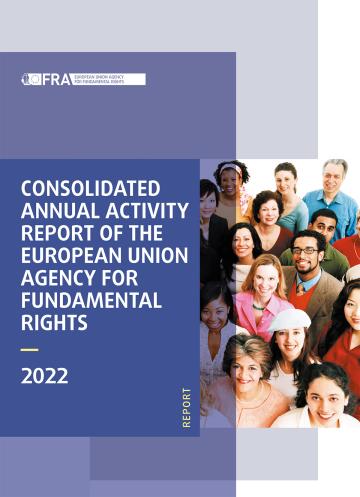
    The Consolidated Annual Activity Report (CAAR) 2022 provides an overview of the activities and achievements of the European Union Agency for Fundamental Rights (FRA) in 2022.
  • Report / Paper / Summary
    14
    Juni
    2023
    In responding to Russia’s war against Ukraine, the EU activated its Temporary Protection Directive (TPD) for people who fled the country, allowing them to settle in the EU and to access basic public services and the labour market. By spring 2023, more than 4.5 million people had made use of the TPD or similar national protection schemes in the EU. In 2022, the European Union Agency for Fundamental Rights conducted an online survey among people displaced from Ukraine. Eurofound has analysed the survey results on their experiences when seeking to access employment. This paper highlights the main barriers that displaced people encountered and suggests ways to facilitate their inclusion.
  • Fundamental Rights Report
    8
    Juni
    2023
    FRA’s Fundamental Rights Report 2023 reviews major developments in the field in 2022, identifying both achievements and areas of concern. It also presents FRA’s opinions on these developments, including a synopsis of the evidence supporting these opinions.
  • Fundamental Rights Report
    8
    Juni
    2023
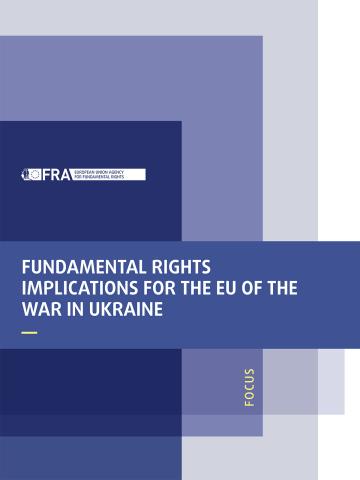
    Russia’s unprovoked war of aggression against Ukraine has resulted in massive internal and external population displacement. The European Union (EU) rapidly activated its Temporary Protection Directive for the first time since it was adopted in 2001. This entitled nearly 4 million people to legal residence and access to work, housing and legal assistance, education and healthcare.
  • Fundamental Rights Report
    8
    Juni
    2023
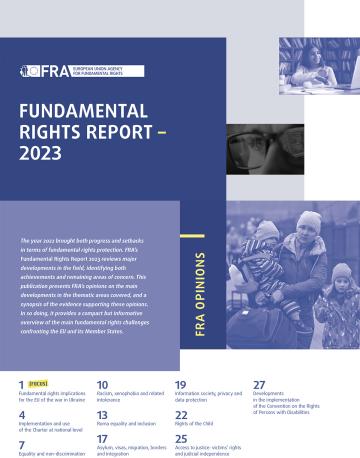
    Das Jahr 2022 brachte im Hinblick auf den Schutz der Grundrechte sowohl Fortschritte als auch Rückschläge. Der Grundrechte-Bericht 2023 der FRA untersucht wichtige Entwicklungen auf diesem Gebiet und zeigt sowohl Erfolge als auch verbleibende Problembereiche auf. Darüber hinaus enthält der Bericht die Stellungnahmen der FRA zu den wichtigsten Entwicklungen in den jeweiligen Themenbereichen und fasst die Informationen, die diesen Stellungnahmen zugrunde liegen, zusammen.
  • Periodic updates / Series
    30
    Mai
    2023
    Over the span of nearly eight years, there have been developments in showing respect for the human rights of those who arrive at the EU’s borders. Russia’s war of aggression against Ukraine has shown how a large and sudden influx of people can be managed effectively and respectfully. Notwithstanding the improvements, the growing number of people crossing or attempting to enter the EU pose a wide range of fundamental rights challenges.

    In this bulletin, FRA takes stock of concerns and improvements regarding the fundamental rights of migrants, asylum seekers and refugees. It highlights the EU Member States’ legal and practical responses. It identifies key trends, promising practices, long-standing and emerging patterns, and persistent concerns.