eu-charter

EU Charter of Fundamental Rights

Article 7 - Respect for private and family life

Article 7 - Respect for private and family life

Everyone has the right to respect for his or her private and family life, home and communications.

Explanations

  • Text:

    The rights guaranteed in Article 7 correspond to those guaranteed by Article 8 of the ECHR. To take account of developments in technology the word "correspondence" has been replaced by "communications".
    In accordance with Article 52(3), the meaning and scope of this right are the same as those of the corresponding article of the ECHR. Consequently, the limitations which may legitimately be imposed on this right are the same as those allowed by Article 8 of the ECHR:

    "1. Everyone has the right to respect for his private and family life, his home and his correspondence.
    2. There shall be no interference by a public authority with the exercise of this right except such as is in accordance with the law and is necessary in a democratic society in the interests of national security, public safety or the economic well-being of the country, for the prevention of disorder or crime, for the protection of health or morals, or for the protection of the rights and freedoms of others."

    Source:
    Official Journal of the European Union C 303/17 - 14.12.2007
    Preamble - Explanations relating to the Charter of Fundamental Rights:
    These explanations were originally prepared under the authority of the Praesidium of the Convention which drafted the Charter of Fundamental Rights of the European Union. Although they do not as such have the status of law, they are a valuable tool of interpretation intended to clarify the provisions of the Charter.

Case Law References

  • La Quadrature du Net, Fédération des fournisseurs d’accès à Internet associatifs, Franciliens.net, French Data Network v Premier ministre, Ministre de la Culture
    Decision date:
  • Order of Francophone and Germanophone Bars, Order of Flemish Bars and the Institute of Accountants and Tax Consultants and others
    Decision date:
  • The Institute for the equality for women and a private individual (anonymous) v Council of Ministers
    Decision date:
  • Jens Hermans, Karin Verelst and C.U.; and others Association without lucrative purpose «Association de Promotion des Droits Humains et des Minorités» Versus The Flemish Government; The United College oCommon Community Commissionf the
    Decision date:
  • Ordre des barreaux francophones et germanophone ; “Académie Fiscale” and Jean Pierre Riquet; “Liga voor Mensenrechten”; “Ligue des Droits de l’Homme”; Patrick Van Assche and others.
    Decision date:
  • Belgian French and German-speaking bar associations and two Belgian League of Human Rights associations (‘Liga voor Mensenrechten/Ligue des Droits de l’Homme’) v Belgian State
    Decision date:
  • Order of Flemish Bars and Alain Claes and the de facto association “Belgian Association of Tax Lawyers” and others v. The Government of the Brussels-Capital Region and the Flemish Government
    Decision date:
  • VZW Kinderrechtencoalitie Vlaanderen (Children’s rights coalition Flanders) and VZW Liga voor Mensenrechten (League for Human Rights) v. the Kingdom of Belgium
    Decision date:
  • Liga voor Mensenrechten, Ligue des Droits de l’Homme, Ordre des barreaux francophones et germanophone, Association pour le droit des Etrangers, and others
    Decision date:
  • N.Z.G. vs the Director of the Metropolitan Home for Joyful Rites of Sofia Municipality (Столичен дом за радостни обреди към Столична община)
    Decision date:

National Constitutional Law

41 results found

  • КОНСТИТУЦИЯ на Република България
    Country:
    Bulgaria

    Чл. 32.(1) Личният живот на гражданите е неприкосновен. Всеки има право на защита срещу незаконна намеса в личния и семейния му живот и срещу посегателство върху неговата чест, достойнство и добро име. [...] Чл. 33. (1) Жилището е неприкосновено. Без съгласието на обитателя му никой не може да влиза или да остава в него освен в случаите, изрично посочени в закона. (2) Влизане или оставане в жилището без съгласие на неговия обитател или без разрешение на съдебната власт се допуска само за предотвратяване на непосредствено предстоящо или започнало престъпление, за залавяне на извършителя му, както и в случаите на крайна необходимост.Чл. 34. (1) Свободата и тайната на кореспонденцията и на другите съобщения са неприкосновени. (2) Изключения от това правило се допускат само с разрешение на съдебната власт, когато това се налага за разкриване или предотвратяване на тежки престъпления.

EU Law

26 results found

  • Regulation (EU) 2017/1128 of the European Parliament and of the Council of 14 June 2017 on cross-border portability of online content services in the internal market

    [...]

    (30) This Regulation respects fundamental rights and observes the principles recognised in the Charter of Fundamental Rights of the European Union (‘Charter’). Accordingly, this Regulation should be interpreted and applied in accordance with those rights and principles, in particular the right to respect for private and family life, the right to protection of personal data, the right to freedom of expression, the freedom to conduct a business and the right to property, including intellectual property. Any processing of personal data under this Regulation should respect fundamental rights, including the right to respect for private and family life and the right to protection of personal data under Articles 7 and 8 of the Charter, and it is essential that such processing be in compliance with Directives 95/46/EC and 2002/58/EC. In particular, providers of online content services should ensure that any processing of personal data under this Regulation is necessary, reasonable and proportionate in order to achieve the relevant purpose. Where authentication of a subscriber is sufficient in order to provide the service, identification of the subscriber should not be required. Data collected pursuant to this Regulation for the purposes of verification of the Member State of residence should not be stored by the provider longer than necessary to complete such verification. Such data should be immediately and irreversibly destroyed after the verification is completed. However, this is without prejudice to the storage of data which was collected for another legitimate purpose, subject to applicable data protection rules, including rules concerning the storage of that data.

    [...]

  • Regulation (EU) 2019/1157 of the European Parliament and of the Council of 20 June 2019 on strengthening the security of identity cards of Union citizens and of residence documents issued to Union citizens and their family members

    Article 1

    Subject matter

    This Regulation strengthens the security standards applicable to identity cards issued by Member States to their nationals and to residence documents issued by Member States to Union citizens and their family members when exercising their right to free movement.

  • Council Regulation (EU) 2016/1103 of 24 June 2016 implementing enhanced cooperation in the area of jurisdiction, applicable law and the recognition and enforcement of decisions in matters of matrimonial property regimes

    [...]

    (73) This Regulation respects fundamental rights and observes the principles recognised in the Charter, in particular Articles 7, 9, 17, 21 and 47 concerning, respectively, respect for private and family life, the right to marry and to found a family according to national laws, property rights, the principle of non-discrimination and the right to an effective remedy and to a fair trial. This Regulation should be applied by the courts and other competent authorities of the Member States in compliance with those rights and principles.

    [...]

  • Regulation (EU) 2023/1543 of the European Parliament and of the Council of 12 July 2023 on European Production Orders and European Preservation Orders for electronic evidence in criminal proceedings and for the execution of custodial sentences

    Preamble 


    (13) The respect for private and family life and the protection of natural persons regarding the processing of personal data are fundamental rights. In accordance with Article 7 and Article 8(1) of the Charter, everyone has the right to respect for their private and family life, home and communications and to the protection of personal data concerning them.

    (46) The principle of ne bis in idem is a fundamental principle of law in the Union, as recognised by the Charter and developed by the case law of the Court of Justice of the European Union. Where the issuing authority has grounds to believe that parallel criminal proceedings could be ongoing in another Member State, it should consult the authorities of that Member State in accordance with Council Framework Decision 2009/948/JHA . In any case, a European Production Order or a European Preservation Order is not to be issued where the issuing authority has grounds to believe that this would be contrary to the ne bis in idem principle.

    Article 1: Subject matter

    1. This Regulation lays down the rules under which an authority of a Member State, in criminal proceedings, may issue a European Production Order or a European Preservation Order and thereby order a service provider offering services in the Union and established in another Member State, or, if not established, represented by a legal representative in another Member State, to produce or to preserve electronic evidence regardless of the location of the data. This Regulation is without prejudice to the powers of national authorities to address service providers established or represented on their territory for the purpose of ensuring that they comply with national measures similar to those referred to in the first subparagraph.

    2. The issuing of a European Production Order or of a European Preservation Order may also be requested by a suspect or an accused person, or by a lawyer on that person’s behalf within the framework of applicable defence rights in accordance with national criminal procedural law.

    3. This Regulation shall not have the effect of modifying the obligation to respect the fundamental rights and legal principles as enshrined in the Charter and in Article 6 TEU, and any obligations applicable to law enforcement authorities or judicial authorities in this respect shall remain unaffected. This Regulation applies without prejudice to fundamental principles, in particular the freedom of expression and information, including the freedom and pluralism of the media, respect for private and family life, the protection of personal data, as well as the right to effective judicial protection.

  • Regulation (EU) 2021/1232 of the European Parliament and of the Council of 14 July 2021 on a temporary derogation from certain provisions of Directive 2002/58/EC as regards the use of technologies by providers

    Article 1

    Subject matter and scope

    1. This Regulation lays down temporary and strictly limited rules derogating from certain obligations laid down in Directive 2002/58/EC, with the sole objective of enabling providers of certain number-independent interpersonal communications services (‘providers’) to use, without prejudice to Regulation (EU) 2016/679, specific technologies for the processing of personal and other data to the extent strictly necessary to detect online child sexual abuse on their services and report it and to remove online child sexual abuse material from their services.

    2. This Regulation does not apply to the scanning of audio communications.

  • Directive (EU) 2022/2381 of the European Parliament and of the Council of 23 November 2022 on improving the gender balance among directors of listed companies and related measures

    Article 1

    Purpose

    This Directive aims to achieve a more balanced representation of women and men among the directors of listed companies by establishing effective measures that aim to accelerate progress towards gender balance, while allowing listed companies sufficient time to make the necessary arrangements for that purpose.

  • Directive (EU) 2019/1937 of the European Parliament and of the Council of 23 October 2019 on the protection of persons who report breaches of Union law

    Article 1

    Purpose

    The purpose of this Directive is to enhance the enforcement of Union law and policies in specific areas by laying down common minimum standards providing for a high level of protection of persons reporting breaches of Union law.

  • Regulation (EU) 2021/692 of the European Parliament and of the Council of 28 April 2021 establishing the Citizens, Equality, Rights and Values Programme and repealing Regulation (EU) No 1381/2013

    Article 4

    Equality, rights and gender equality strand

    Within the general objective set out in Article 2(1) and within the specific objective set out in point (b) of Article 2(2), the Programme shall focus on:

    (1) promoting equality and preventing and combating inequalities and discrimination based on sex, racial or ethnic origin, religion or belief, disability, age or sexual orientation, and respecting the principle of non-discrimination on the grounds provided for in Article 21 of the Charter;

    [...]

  • Regulation (EU) 2018/1725 of the European Parliament and of the Council of 23 October 2018 on the protection of natural persons with regard to the processing of personal data, repealing Regulation (EC) No 45/2001 and Decision No 1247/2002/EC

    Preamble

    (1) The protection of natural persons in relation to the processing of personal data is a fundamental right. Article 8(1) of the Charter of Fundamental Rights of the European Union (the ‘Charter’) and Article 16(1) of the Treaty on the Functioning of the European Union (TFEU) provide that everyone has the right to the protection of personal data concerning him or her. This right is also guaranteed under Article 8 of the European Convention for the Protection of Human Rights and Fundamental Freedoms.

    [...]

    (74) The supervisory competence of the European Data Protection Supervisor should not cover the processing of personal data by the Court of Justice when acting in its judicial capacity, in order to safeguard the independence of the Court in the performance of its judicial tasks, including decision-making. For such processing operations, the Court should establish independent supervision, in accordance with Article 8(3) of the Charter, for example through an internal mechanism.

    Article 1 Subject matter and objectives

    1. This Regulation lays down rules relating to the protection of natural persons with regard to the processing of personal data by the Union institutions and bodies and rules relating to the free movement of personal data between them or to other recipients established in the Union.

    2. This Regulation protects fundamental rights and freedoms of natural persons and in particular their right to the protection of personal data.

    3. The European Data Protection Supervisor shall monitor the application of the provisions of this Regulation to all processing operations carried out by a Union institution or body.

  • Regulation (EU) 2022/2065 of the European Parliament and of the Council of 19 October 2022 on a Single Market For Digital Services and amending Directive 2000/31/EC (Digital Services Act)

    Article 34: Risk assessment

    1. Providers of very large online platforms and of very large online search engines shall diligently identify, analyse and assess any systemic risks in the Union stemming from the design or functioning of their service and its related systems, including algorithmic systems, or from the use made of their services.

    They shall carry out the risk assessments by the date of application referred to in Article 33(6), second subparagraph, and at least once every year thereafter, and in any event prior to deploying functionalities that are likely to have a critical impact on the risks identified pursuant to this Article. This risk assessment shall be specific to their services and proportionate to the systemic risks, taking into consideration their severity and probability, and shall include the following systemic risks:

    [...]

    (b) any actual or foreseeable negative effects for the exercise of fundamental rights, in particular the fundamental rights to human dignity enshrined in Article 1 of the Charter, to respect for private and family life enshrined in Article 7 of the Charter, to the protection of personal data enshrined in Article 8 of the Charter, to freedom of expression and information, including the freedom and pluralism of the media, enshrined in Article 11 of the Charter, to non-discrimination enshrined in Article 21 of the Charter, to respect for the rights of the child enshrined in Article 24 of the Charter and to a high-level of consumer protection enshrined in Article 38 of the Charter;

International Law

8 results found

  • Parliamentary Assembly Resolution 2243 (2018) on Family reunification of refugees and migrants in the Council of Europe member States

    1. The Parliamentary Assembly is deeply concerned about growing political discourse and action against foreigners, which are a real threat to the protection of refugees and in particular their family life. Families must not be torn apart and should not be prevented from reuniting after an often dangerous and challenging departure from their country of origin, where their fundamental rights to safety and security were threatened.

    ...

  • European Convention on Human Rights - Article 8

    Article 8 – Right to respect for private and family life

    1. Everyone has the right to respect for his private and family life, his home and his correspondence.

    2. There shall be no interference by a public authority with the exercise of this right except such as is in accordance with the law and is necessary in a democratic society in the interests of national security, public safety or the economic well-being of the country, for the prevention of disorder or crime, for the protection of health or morals, or for the protection of the rights and freedoms of others.

  • Convention on the Rights of the Child

    Article 16

    1. No child shall be subjected to arbitrary or unlawful interference with his or her privacy, family, home or correspondence, nor to unlawful attacks on his or her honour and reputation.

    2. The child has the right to the protection of the law against such interference or attacks.

  • Convention on the Elimination of all Forms of Discrimination Against Women

    Article 16

    1. States Parties shall take all appropriate measures to eliminate discrimination against women in all matters relating to marriage and family relations and in particular shall ensure, on a basis of equality of men and women:

    (a) The same right to enter into marriage;

    (b) The same right freely to choose a spouse and to enter into marriage only with their free and full consent;

    (c) The same rights and responsibilities during marriage and at its dissolution;

    (d) The same rights and responsibilities as parents, irrespective of their marital status, in matters relating to their children; in all cases the interests of the children shall be paramount;

    (e) The same rights to decide freely and responsibly on the number and spacing of their children and to have access to the information, education and means to enable them to exercise these rights;

    (f) The same rights and responsibilities with regard to guardianship, wardship, trusteeship and adoption of children, or similar institutions where these concepts exist in national legislation; in all cases the interests of the children shall be paramount;

    (g) The same personal rights as husband and wife, including the right to choose a family name, a profession and an occupation;

    (h) The same rights for both spouses in respect of the ownership, acquisition, management, administration, enjoyment and disposition of property, whether free of charge or for a valuable consideration.

    2. The betrothal and the marriage of a child shall have no legal effect, and all necessary action, including legislation, shall be taken to specify a minimum age for marriage and to make the registration of marriages in an official registry compulsory.

  • International Covenant on Civil and Political Rights

    Article 17

    1. No one shall be subjected to arbitrary or unlawful interference with his privacy, family, home or correspondence, nor to unlawful attacks on his honour and reputation.

    2. Everyone has the right to the protection of the law against such interference or attacks.

  • Convention on the Rights of Persons with Disabilities - Article 22

    Article 22 – Respect for privacy

    1. No person with disabilities, regardless of place of residence or living arrangements, shall be subjected to arbitrary or unlawful interference with his or her privacy, family, home or correspondence or other types of communication or to unlawful attacks on his or her honour and reputation. Persons with disabilities have the right to the protection of the law against such interference or attacks.

    2. States Parties shall protect the privacy of personal, health and rehabilitation information of persons with disabilities on an equal basis with others.

  • Global Compact for Safe, Orderly and Regular Migration

    Resolution adopted by the General Assembly on 19 December 2018

  • Human Rights Council Resolution 29/22 (2015) - Protection of the family: contribution of the family to the realization of the right to an adequate standard of living for its members, particularly through its role in poverty eradication and achieving su...

    C. Right to privacy and family life
    ‘34. Article 12 of the Universal Declaration on Human Rights provides that “[n]o one shall be subjected to arbitrary interference with his privacy, family, home or correspondence.” A similar provision is found in Article 17(1) of the International Covenant on Civil and Political Rights and in other United Nations instruments. This right has been interpreted broadly, encompassing inter alia the protection against forced evictions, the demolition of homes or property, the destruction of traditional burial grounds, and the expulsion of foreigners. The right to family life also applies in relation to persons deprived of liberty, who should be allowed to communicate with their families, subject only to reasonable restrictions established by law.
    35. The right to family life is reflected in the general preference for preserving the family unit and non-separation of its members, particularly dependent members. The Convention on the Rights of the Child affirms the right of children not to be separated from their parents against their will, except where “necessary for the best interest of the child,” such as in cases of abuse or neglect (art. 9.1), following a judicial determination to this effect. Children deprived of their family environment should be provided alternative care (art. 20), and, whenever possible, to have contact with their parents (art. 9(3)). According to article 23(4) of the Convention on the Rights of Persons with Disabilities, in no case shall a child be separated from parents on the basis of a disability of either the child or one or both of the parents.
    36. The Convention on the Rights of Migrant Workers and their Families requires States to ensure “the protection of the unity of the families,” including by facilitating the reunification of documented migrants with their spouses and dependent children (art. 44). The Convention on the Rights of the Child urges State Parties to deal with such requests in a “positive, humane and expeditious manner” (art. 10).‘

Publications and data

  • Handbook / Guide / Manual
    7
    April
    2022
    12 new language versions now available
    04 March 2026
    Children are full-fledged holders of rights. They are beneficiaries of all human and fundamental rights and subjects of special regulations, given their specific characteristics. This handbook aims to illustrate how European law and case law accommodate the specific interests and needs of children. It also considers the importance of parents and guardians or other legal representatives and makes reference, where appropriate, to situations in which rights and responsibilities are most prominently vested in children’s carers. It is a point of reference on both European Union (EU) and Council of Europe (CoE) law related to these subjects, explaining how each issue is regulated under EU law, including the Charter of Fundamental Rights of the European Union, as well as under the European Convention on Human Rights, the European Social Charter and other CoE instruments.
  • Handbook / Guide / Manual
    19
    August
    2022
    DA, ET, FI, LT, PT, SV versions now available
    30 July 2024
    The Charter of Fundamental Rights of the European Union (CFREU) is the EU’s bill of rights. It always binds the EU institutions and the Member States when they act within the scope of EU law. However, it is far from easy to assess whether a concrete case falls within the scope of EU law. This is why it is necessary to provide training and training material to legal professionals so that they can understand the field of application of the Charter as laid out in its Article 51. This trainer’s manual aims at providing guidance on both the organisation and the implementation of such trainings based on a series of case studies,
    which will be extended in the future.
  • Handbook / Guide / Manual
    25
    May
    2018
    Arabic version now available
    18 July 2024
    The rapid development of information technology has exacerbated the need for robust personal data protection, the right to which is safeguarded by both European Union (EU) and Council of Europe (CoE) instruments. Safeguarding this important right entails new and significant challenges as technological advances expand the frontiers of areas such as surveillance, communication interception and data storage. This handbook is designed to familiarise legal practitioners not specialised in data protection with this emerging area of the law.
  • Fundamental Rights Report
    8
    June
    2022
    All language versions now available
    14 September 2022
    The year 2021 brought both progress and setbacks in terms of fundamental rights protection. FRA’s Fundamental Rights Report 2022 reviews major developments in the field, identifying both achievements and remaining areas of concern. This publication presents FRA’s opinions on the main developments in the thematic areas covered, and a synopsis of the evidence supporting these opinions.
  • Report / Paper / Summary
    8
    March
    2021
    24 language versions now available
    23 November 2021
    This summary presents the main insights from FRA’s second main report based on its Fundamental Rights Survey. The survey collected data from around 35,000 people about their experiences, perceptions and opinions on a range of issues that are variously encompassed by human rights.
  • Report / Paper / Summary
    21
    January
    2021
    All language versions now available
    16 April 2021
    National Human Rights Institutions (NHRIs) are a vital part of the country-level human rights protection system. By raising awareness, providing advice, monitoring and holding authorities to account, they have a central role in navigating the great human rights challenges of our day – tackling both persistent concerns like discrimination and inequality, and novel issues such as the rights implications of artificial intelligence and of the COVID-19 pandemic.
  • Handbook / Guide / Manual
    5
    December
    2018
    Last versions available are EL and NL
    11 March 2021
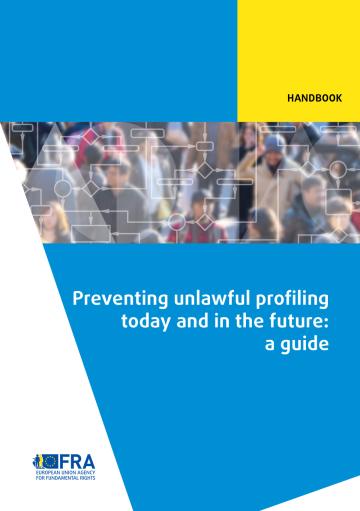
    This guide explains what profiling is, the legal frameworks that regulate it, and why conducting profiling lawfully is both necessary to comply with fundamental rights and crucial for effective policing and border management. The guide also provides practical guidance on how to avoid unlawful profiling in police and border management operations.
  • Report / Paper / Summary
    3
    September
    2020
    Summary version now available
    21 January 2021
    National Human Rights Institutions (NHRIs) are a vital part of the country-level human rights protection system. This report, published 10 years after FRA’s first in-depth study on NHRIs, looks at such bodies in the EU, as well as the Republic of North Macedonia, the Republic of Serbia, and the United Kingdom of Great Britain and Northern Ireland. It explores relevant developments, challenges to their effectiveness and ways to maximise their impact.
  • Periodic updates / Series
    21
    July
    2026
    This is the second bulletin in FRA’s new quarterly series monitoring the situation of migrants, asylum seekers and refugees. It covers key developments and ongoing concerns from 1 April to 30 June 2026.

    Following regular reporting on fundamental rights issues related to migration and asylum from 2015 to 2023, FRA resumed the series in 2026 under the EU's 2024 Asylum and Migration Management Regulation, ahead of the June 2026 implementation of the EU Migration and Asylum Pact. The first bulletin, published in April 2026, covered developments from 1 January 2025 to 31 March 2026.
  • In brief / Factsheet
    30
    June
    2026
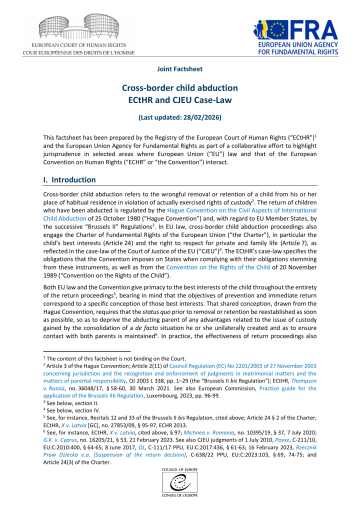
    This factsheet examines case law on cross-border child abduction, meaning the unlawful removal of a child from one EU Member State to another. Jointly published by the European Court of Human Rights and the EU Agency for Fundamental Rights, it explains how courts handle issues where EU law and human rights law overlap. It highlights key court decisions from the Court of Justice of the European Union (CJEU) and the European Court of Human Rights (ECtHR) to show how these two legal systems work together on issues of child abduction and prioritising the best interests of the child.