Systems

Support for human rights systems and defenders

Many organisations work to defend your rights. We help their efforts with independent evidence, advice and expertise.

We support their frontline work. And we shine a light on potential risks and priority areas. Together we make your rights a reality.

Highlights

  • Report / Paper / Summary
    22
    October
    2025
    This publication discusses how businesses can meet their human rights and environmental responsibilities. It focuses on key elements of mandatory human rights due diligence and presents reflections on principles from international law and EU law. The paper explains why risk-based human rights due diligence is needed and how it should be implemented. It also highlights the importance of stakeholder engagement, access to remedies, and oversight. It aims to inform EU policymakers and stakeholders about ways to effectively promote responsible business conduct and to ensure adequate protection of rightsholders.
  • Report / Paper / Summary
    11
    July
    2023
    Across the world, human rights defenders protect and uphold human rights in some of the most challenging situations. In some countries they face worrying levels of threats and attacks, intimidation and harassment. This report outlines how human rights defenders can enter and stay in the EU when they need protection. It suggests how EU institutions and Member States could use the flexibility in existing legal provisions and provide shelter for defenders who seek protection.
  • Report / Paper / Summary
    19
    December
    2023
    All EU funds must be spent in a way that respect fundamental rights. The EU spends billions of euros on creating jobs, economic growth, sustainable development and improving people’s lives. To prevent funds from being spent in ways that directly violate people’s fundamental rights, the EU strengthened the conditions how funds can be spent in 2021. This report looks at how the newly introduced conditions related to the EU Charter of Fundamental Rights and the United Nations Convention on the Rights of Persons with Disabilities can be upheld in practice. It analyses the potential role of national human rights institutions, ombudsperson institutions and equality bodies. These safeguards can advance compliance with fundamental rights.
  • Periodic updates / Series
    18
    October
    2023
    Civil society organisations struggle to maintain an environment safe from threats and attacks. FRA’s sixth annual update on civic space explores the challenges for organisations across the EU. While there has been significant development since FRA began monitoring the situation in 2018, civil society organisations remain under immense pressure. Abusive lawsuits and attacks against those involved in migrant search and rescue at sea are just some of the challenges identified. This report presents ways forward to protect civil society and human rights.
    Publications and data
    Talk by Sarah Wishart of Rights Info at the Human Rights Communicators' Workshop held at FRA on 3-4 October 2019.
    Talk by Szczepan Orlowski of Animorph at the Human Rights Communicators' Workshop held at FRA on 3-4 October 2019.
    Talk by Flavia Kleiner of Operation Libero to the Human Rights Communicators' Workshop held at FRA on 3-4 October 2019.
    FRA Director Michael O'Flaherty gave the opening talk at the Human Rights Communicators' Workshop held at the Agency on 3-4 October 2019.
    In the latest edition of his video blog, FRA Director Michael O'Flaherty focuses on the migration situation in the Mediterranean Sea and makes three proposals.
    Fundamental Rights Report 2019: Ten years after the UN’s Disability Convention entered into force, 2018 saw it continue
    to drive advances in disability rights across the EU.
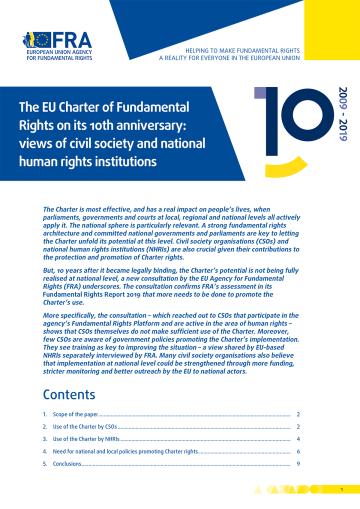
    Fundamental Rights Report 2019: The Charter of Fundamental Rights is the EU’s bill of human rights. These rights and principles have to be respected and promoted by EU institutions and Member States whenever they act within EU law. Approaching the Charter’s 10th anniversary, Member States do not yet make full use of the potential it offers.
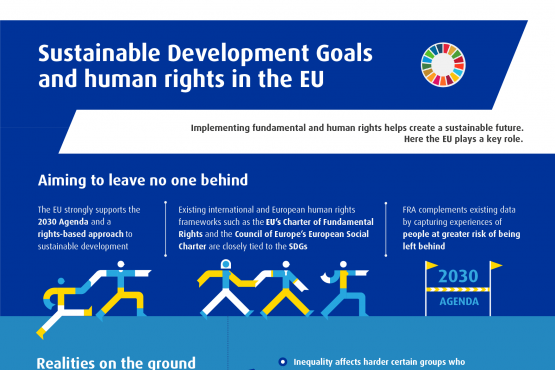
    Fundamental Rights Report 2019: Implementing fundamental and human rights helps create a sustainable future.
    Here the EU plays a key role.
    19
    June
    2019
    In 2018, some 2,299 people are estimated to have died or gone missing at sea while crossing the sea to reach Europe to escape war or persecution or to pursue a better life. This is on average more than six people per day. Before mid-2017, a significant share of migrants in distress at sea have been rescued by civil society vessels deployed with a humanitarian mandate to reduce fatalities and bring rescued migrants to safety. In 2018, however, authorities in some Member States viewed civil society-deployed rescue vessels with hostility. As a reaction, they seized rescue vessels, arrested crew members, and initiated legal procedures against them (more than a dozen altogether). In some cases, rescue vessels were blocked in harbours due to flag issues.
    12
    June
    2019
    The General Data Protection Regulation (GDPR) has applied across the European Union (EU) since 25 May 2018. One year on, this paper looks at how the new regulation has affected the daily work of civil society organisations (CSOs).
    6
    June
    2019
    This year’s focus explores the interrelationship between the human and fundamental rights framework and the Sustainable
    Development Goals (SDGs) of the global Agenda 2030 in the context of Member States’ and the EU’s internal policies.
    It takes a closer look at the SDGs related to reducing inequality (SDG 10) and promoting peace, justice and strong
    institutions (SDG 16).
    6
    June
    2019
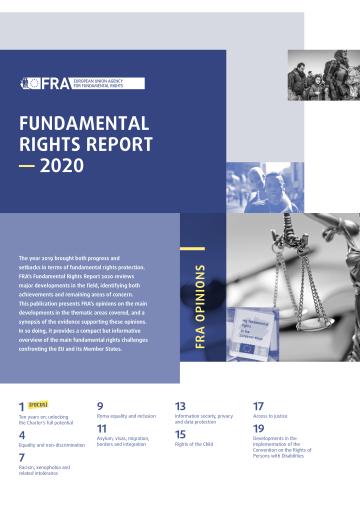
    The year 2018 brought both progress and setbacks in terms of fundamental rights protection. FRA’s Fundamental Rights Report 2019 reviews major developments in the field, identifying both achievements and remaining areas of concern. This publication presents FRA’s opinions on the main developments in the thematic areas covered, and a synopsis of the evidence supporting these
    opinions.
    In the latest edition of his video blog, FRA Director Michael O'Flaherty focuses on press freedom and the importance of an independent media for the society.
    22
    March
    2019
    Member States have an explicit duty to promote the Charter’s application. These country-sheets support that effort by giving examples of the Charter’s use and highlighting how it adds value.
    26
    November
    2018
    Civil society organisations play a critical role in democracies, and the importance of their work is widely recognised in international legal and policy documents. However, they face many obstacles when it comes to their day-to-day work. Based on the results of an online consultation with FRA's civil society network, the Fundamental Rights Platform (FRP), in September 2018, this paper complements the January 2018 report.
    26
    October
    2018
    The EU Agency for Fundamental Rights’ 2018 Fundamental Rights Forum
    brought together more than 700 human rights champions at a time of
    widening social divisions and increasingly polarised politics across
    Europe.
    23
    October
    2018
    ES, HU, LT, LV, SK, SL and PT versions now available
    18 November 2020
    As a very modern human rights catalogue containing many rights not found in established bills of rights, the Charter indeed looks good on paper. Those familiar with the main principles of EU law can usually quickly recite that the Charter is always binding on the EU, and binding on Member States only when they are "implementing EU law". But what does this often-quoted language from Article 51 of the Charter actually mean?
    1
    October
    2018
    This note draws attention to the recent trend of criminalising search and rescue operations (SAR) in the Mediterranean Sea carried out by non-governmental organisations (NGOs) or other private entities. This includes seizing rescue vessels, as well as arrests for crew members, in some EU Member States. Most of such incidents concerned NGOs operating in the Central Mediterranean Sea.
    1
    October
    2018
    With this Opinion, FRA aims to contribute to the European Parliament's own-initiative report on the “Implementation of the Charter of Fundamental Rights of the European Union in the EU institutional framework”, being prepared in the Parliament’s Committee for Constitutional Affairs (AFCO). The request aims at understanding the interaction between the Charter’s implementation at national and EU level, and whether there are “instruments, mechanisms and practices” available at EU level to assist Member States to better implement the Charter.
    26
    September
    2018
    These 10 keys sum up the core points
    communicators and practitioners in various fields
    raised in FRA’s expert meetings, practitioners’
    seminars and focus groups in 2017 and 2018.
    People’s fundamental rights are at risk across Europe. This is due to rising levels of poverty, persistent threats against democracy, widespread racism and challenges occurring in the context of migration, finds FRA’s Fundamental Rights Report 2024. These threats underline the need to ensure a strong and sustainable fundamental rights protection across the EU, particularly for people in vulnerable situations. The report suggests how policymakers and civil society can work in tandem to counter the threat of social exclusion and enable a more equal and fairer society for all.
    On 16 May, FRA Director Sirpa Rautio held a roundtable discussion with 36 civil society organisations in Brussels.
    FRA addressed the OSCE’s Supplementary Human Dimension Meeting on 23-23 April in Vienna. FRA focused on how to support and protect human rights defenders, and on the specific support needs that human rights defenders in exile have.
    FRA presented findings from its report on ‘EU funds: Ensuring compliance with fundamental rights’ to a committee of the European Social Fund Plus (ESF+). It brings together a government representative from all Member States, and representatives of workers' organisations and employers' organisations.
    The Concluding Conference Statement on the role of National Human Rights Institutions in implementing the EU’s Fundamental Rights Charter is now available. The conference took place in Brussels from 21-22 March.
    FRA released its practical guidance for Human Rights Cities in 14 additional EU languages. The guidance provides hands-on support and advice to cities and other forms of local authorities wishing to improve their efforts to respect, protect and promote human rights.
    Immediately after the Fundamental Rights Forum, on 12 and 13 March the Scientific Committee met in Vienna. The Scientific Committee meeting provided the first opportunity for the Committee to meet the new FRA Director Sirpa Rautio.
    On 5 March, FRA took part in a webinar, organised by the Prime Minister’s Office, launching the Finnish website on fundamental and human rights indicators. The website will monitor the implementation of fundamental rights in Finland.
    FRA recently added nine new language versions to its Charter e-learning platform. This development marks a significant step in FRA's commitment to providing comprehensive resources to a wider audience.
    FRA held the closing conference of its EEA & Norway Grants-funded regional cooperation project ‘Supporting National Human Rights Institutions in monitoring fundamental rights and the fundamental rights aspects of the rule of law’. The event raised awareness and improved understanding of NHRIs’ role in enhancing the application of the EU’s Fundamental Rights Charter at the national level and in the EU framework.
    FRA spoke during the online launch of the Global Nonprofits Guide 2.0 on 1 March. The guide brings together information on laws relating to the setting up and operations of civil society organisations in 70 countries.
    FRA presented the key results of its recent report on EU funds and ensuring compliance with fundamental rights during two national diagnostic workshops online from 26 to 27 February. The Bulgarian Ombuds Office organised the events.
    FRA spoke at a session of the European Parliament’s Committee on Regional Development on 14 February. The Agency presented its report ‘EU funds-ensuring compliance with fundamental rights’ to the Committee.
    On 6 February, FRA published its update of the accreditation status and mandates of National Human Rights Institutions (NHRIs). It now also covers the role of NHRIs in the context of EU funds and the use of the EU’s Fundamental Rights Charter.

    FRA welcomes views from all civil society organisations working in an EU Member State or in Serbia, Albania or North Macedonia or at the EU level for its annual civic space survey.
    FRA presented its findings on civic space at a European Commission workshop on shrinking antiracism civic space on 31 January in Brussels.
    A delegation from Moldova visited FRA on 16 January. It was an opportunity to present the Agency to the delegation and showcase how it works with examples.
    FRA’s provides guidance on organising and running training on the EU’s Fundamental Rights Charter. The trainer’s manual is based on a series of cases studies.
    EU funds must respect fundamental rights and are a key driver for equality and inclusion. The EU Agency for Fundamental Rights (FRA) calls on the EU and its Member States to involve national human rights institutions, ombuds institutions and equality bodies in the programming, implementing and monitoring of EU funds. This will prevent EU money from being spent in ways that undermine or directly violate our rights.
    On 10-11 December, the EU Agency for Fundamental Rights (FRA) took part in the Human Rights Conference organised by the city of Vienna. Highlighting the Agency’s long-standing partnership with the city of Vienna, FRA Director Michael O'Flaherty delivered opening remarks on the role of cities in protecting and promoting human rights.
    FRA will speak at the OECD’s new Civic Space Protection Network which first meets online on 27 June. This new initiative aims to bring together public officials, to serve as a platform to share experiences, learnings, and good practices.
    FRA will speak at a conference of the Council of Europe’s Steering Committee for Human Rights (CDDH) on 25 June in Helsinki. The conference will be streamed live.
    On 28 June, FRA will welcome the participants of the Public Leadership Programme for Women from the Mathias Corvinus Collegium in Budapest.
    FRA will hold a meeting of foresight practitioners and human rights experts to raise awareness on the importance of considering fundamental rights in foresight activities.
    -
    FRA will speak at the European Commission’s meeting on stronger Equality Bodies to combat discrimination. FRA will present its work on equality data, fundamental rights indicators and on strengthening statutory bodies.
    -
    FRA will contribute to the annual meeting of the EU Temporary Relocation Platform. The meeting takes place from 5 to 6 June in Berlin.
    On 8 May, FRA will welcome a group of Master’s students from the Central European University specialising in EU human rights law and public policy studies.
    -
    FRA will hold its regular meeting with its National Liaison Officers (NLOs) from 23 to 24 April online. The NLOs are FRA’s main contact points in Member States and in observer States to the work of FRA.
    FRA Director Sirpa Rautio and the Council of Europe Secretary General Marija Pejčinović Burić will meet on 25 April in Vienna. They will exchange views on current challenges to human rights in Europe and the importance of respecting fundamental rights standards.
    On 19 April, a workshop on fundamental rights data collection will take place at FRA. The objective is to provide expertise to Albanian authorities in developing fundamental rights data collection methodologies.
    On 16 April, FRA will welcome the Western Balkans Fellowship Programme at the Austrian Parliament in cooperation with the European Funds for the Balkans.
    On 5 June, FRA will hold a webinar on ensuring compliance with fundamental rights when using EU funds.
    FRA will run a webinar on 20 March at 10:00-12:00 CET for civil society organisations on available resources to Human Rights Defenders in need of relocation. This includes research and support available in the EU.
    FRA’s Executive Board will meet on 21 March via videoconference.
    FRA will join Equinet’s online meeting on 20 March about Equality Bodies’ standards. There will be an update on the current state of the legislative initiative and the expected conclusion.
    -
    The Council of Europe will host a networking conference in Strasbourg from 29 February to 1 March for its Human Rights Education for Legal Professionals (HELP) programme.
    -
    FRA will host the closing conference of its EEA and Norway Grants-funded regional cooperation project ‘Supporting National Human Rights Institutions in monitoring fundamental rights and the fundamental rights aspects of the rule of law’. The event takes place in Brussels from 21 to 22 February.
    FRA will present its Draft Programming Document 2025-2027 to the Council of the EU’s Working Party on Fundamental Rights, Citizen’s Rights and Free Movement of Persons (FREMP) on 30 January in Brussels.
    FRA will give an online presentation on its work and activities to a delegation of Turkish authorities on 25 January.