Search and rescue operations in the Central Mediterranean and fundamental rights - June 2026 update
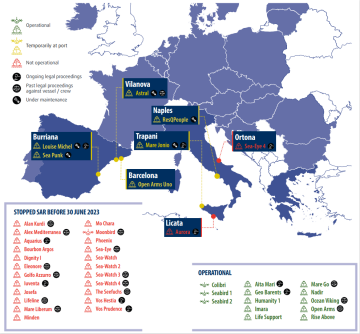
Since 2017, Germany, Italy, Malta, the Netherlands and Spain have initiated 105 administrative or criminal proceedings affecting search and rescue (SAR) operations by civil society actors. 19 of these have occurred since 1 June 2025, when FRA issued its last update. Annex 1 lists the ongoing and closed administrative and criminal proceedings against non-governmental organisation (NGO) rescue vessels, aircraft and/or their crew members. FRA reviewed and updated the list based on publicly available sources and communication with civil society actors.
Such criminal proceedings and administrative measures against deployed vessels—like blocking ships in ports for contravening national law—hinder SAR missions. They also have a chilling effect on SAR operations as they divert NGOs away from their objective. This forces them to waste time and resources, as emphasized in the Parliamentary Assembly of the Council of Europe 2025 report Saving the lives of migrants at sea and protecting their human rights (point 3.6).
Table 1 shows that almost two out of three vessels deployed since 2017 have faced legal proceedings (30 out of 49).
Table 1 – Assets deployed by civil society: legal proceedings in EU Member States, 2017 – 30 June 2026
|
|
Vessels which faced legal proceedings |
Vessels which faced no legal proceedings |
Aircraft which faced legal proceedings |
Aircraft which faced no legal proceedings |
Total |
|
Operational assets* |
13 |
8 |
2 |
3 |
26 |
|
Non-operational assets |
17 |
11 |
1 |
1 |
30 |
|
Total assets |
30 |
19 |
3 |
4 |
56 |
*Note: includes the vessel Oyvon under maintenance in Sicily. FRA (2026), based on public sources and civil society input.
The legal proceedings listed in Table 1 were mainly initiated in Italy. In the past, some procedures occurred also in Germany, Malta, the Netherlands and Spain.
Since June 2025, 19 new legal cases were opened, all in Italy. Most procedures concern measures against SAR vessels. They usually involve fines of 2,000 to 10,000 EUR and the temporary blocking of vessels in ports for periods of 20 or 60 days. None of the operational NGO vessels were detained or blocked in a port on 30 June 2026.
Since 2023, most measures against SAR vessels are based on Italy’s Decree-Law No. 1/2023, converted into Law No. 15/2023. This legislation imposes the obligation for SAR vessels to proceed to designated ports, often distant from rescue areas. It requires that SAR vessels proceed immediately to the assigned port after each rescue. This, thereby, limits their ability to rescue other groups of people in distress over the course of several days.
The legislation was amended in December 2024, with Decree-Law No. 145/2024, converted into Law No. 187/2024. These amendments impose new reporting obligations on the Italian maritime rescue coordination centre for SAR aircraft. If not respected, a fine of between 2,000 and 10,000 EUR could be imposed on the operating entity and the aircraft could be detained. The new rules also reduce the deadline to appeal the administrative detention of vessels and aircraft from 60 to 10 days.
Fewer than one in five measures concern criminal proceedings against the staff working for NGOs deploying the vessels or against the crew. However, this trend may be changing. In May 2026, Italy opened a criminal investigation against the captain of the Sea-Watch 5 for aiding and abetting unauthorised immigration. According to information available at FRA, this is the first criminal procedure opened against staff working for NGO-deployed SAR vessels since the case against crew members of the Mare Jonio in 2021.
In May 2024, the Italian Civil Aviation Authority issued five decisions banning civil society deployed reconnaissance aircraft from taking off for search operations at sea from five airports in Sicily: Lampedusa, Palermo Bocca di Falco, Palermo Punta Raisi, Pantelleria, and Trapani. In August 2025, Italian authorities detained Seabird 1. In September 2025, the Italian Civil Aviation Authority imposed a fine of 100,000 EUR and a detention order of 20 days on the aircraft Colibri 2. The penalty was for not having immediately alerted the Libyan and Tunisian coast guards when spotting boats in distress in their respective search and rescue zone.
Most closed cases ended with an acquittal, the release of the confiscated or detained vessel, or were discontinued due to lack of evidence. In some cases, NGOs agreed to pay a fine and waited until the authorities allowed their vessel to leave the port. While many of these proceedings do not result in convictions, such legal actions may have a deterrent effect on humanitarian activities.
In Ten years of rescue in the Central Mediterranean (2026), SOS Méditerranée describes a continued deterioration of the operational environment for civil society SAR. This includes administrative restrictions, distant port assignments, and vessel detentions.
The NGO Sea Watch counted that from 2023 to June 2026, the Italian authorities issued over 40 detention orders against NGO rescue vessels. This amounted to 1,075 days of detention. According to a report issued by the NGO EMERGENCY, its Life Support vessel had to sail more than 10,000 additional kilometres to reach assigned ports, including in Central and Northern Italy.
The first national court rulings against the blocking of ships in ports based on Law No. 15/2023 was handed down in June 2024. Since then, as described in Annex 1, the following Italian courts found the blocking of NGO rescue ships at port to be unlawful and annulled the related fines: in Agrigento, Ancona, Catania, Catanzaro, Chieti, Crotone, Genoa, Reggio Calabria, Rome, Trapani, and Vibo Valentia. Several courts issued interim measures suspending the administrative detention of SAR vessels.
In February 2025, the Italian Supreme Court of Cassation (order 17687/2024) clarified that SAR responsibility includes organising disembarkation ‘within the shortest reasonably possible time’ at a place of safety. Considerations related to migration management cannot override these obligations.
The Italian Constitutional Court (judgement 101/2025) upheld the constitutionality of the legislative provisions regulating civil society SAR operations in July 2025. However, they clarified that their implementation must comply with international maritime law and fundamental rights. This includes the duty to render assistance to persons in distress at sea.
In 2025, developments occurred also in relation to Malta. A March 2025 case in Malta involved 32 people stranded near the Miskar gas platform on the border of the Tunisian and Maltese SAR zones. The UN Human Rights Committee (HRC) responded by issuing interim measures evoking Malta’s duties under international law to conduct SAR operations. The individuals were ultimately rescued that same day by the rescue vessel Aurora, operated by Sea-Watch. The HRC reaffirmed Malta’s duty under Articles 6 and 7 of the International Covenant on Civil and Political Rights to protect the right to life and prevent inhuman treatment. They requested Malta to promptly coordinate rescue and ensure disembarkation in a place of safety.
In March 2026, the HRC issued further interim measures. They asked Malta to coordinate a SAR operation for more than 100 people stranded on the same Miskar gas platform. The individuals were subsequently rescued on 19 March by the NGO ship Ocean Viking. This marked the third set of interim measures concerning Malta in 12 months. Prior, in September 2025, the HRC issued an order requiring Malta and Italy to coordinate the rescue of 41 survivors stranded aboard a gas platform supply vessel.
No NGO is deploying SAR vessels in Greece. Pursuant to Article 40 of Law 4825/2021, deploying SAR vessels in the area of responsibility of the Hellenic Coast Guard requires their prior authorisation. Organisations that act without authorisation may be fined up to 6,000 EUR. Each person involved in the mission may also be fined up to 1,000 EUR. In addition, they may be sanctioned with imprisonment of one year (or of a minimum of three years if their actions cause an accident), without prejudice to stricter penalties based on other applicable provisions (Article 40). The new legal migration law 5275/2026 adopted in February 2026 further restricts civil society’s activities.