Search and rescue operations in the Central Mediterranean and fundamental rights - June 2026 update
In Preventing and responding to deaths at sea: What the European Union can do (2023), FRA identified six action areas to prevent deaths at sea. These included strengthening search and rescue (SAR) capacities, ensuring effective investigations into shipwrecks, improving protection for survivors and more legal pathways to the EU.
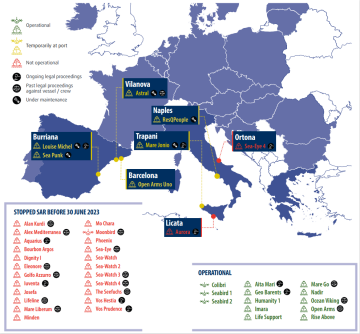
To fill the SAR gap, the Parliamentary Assembly of the Council of Europe adopted Resolution 2612 (2025) on 26 June 2025. It called on states to re-establish large-scale European SAR operations and suggested European SAR corps be dedicated to preserving lives at sea, while respecting human rights. A policy report issued in June 2026, Saving lives at sea: Towards a common European approach to search and rescue in the Mediterranean, outlines options for a coordinated European framework for SAR in the Mediterranean.
For many years FRA has been drawing attention to the need for a clear legal distinction between humanitarian assistance and migrant smuggling, as regards measures against non-governmental organisations supporting migrants and refugees (see FRA, Criminalisation of migrants in an irregular situation and of persons engaging with them).
EU Member States should ensure that measures to combat migrant smuggling do not lead to the criminalisation of those enforcing the human rights imperative of saving lives at sea, acting out of humanitarian considerations or following international legal obligations on rescue at sea. The ongoing revision of Directive 2002/90/EC on the facilitation of unauthorised entry, transit and residence provides an opportunity to clarify that humanitarian assistance should not be criminalised.
The Pact on the Mediterranean (the Pact), issued by the European Commission in October 2025, embeds migration into a broader framework for cooperation in the Mediterranean region. It promotes a whole-of-route as well as a rights-based approach to migration management. This includes providing solutions to ensure the protection of migrants and refugees along the routes. The Pact does not cover search and rescue at sea. However, the EU and its Member States could use it to trigger actions to improve the protection space in the region, reducing the dangerous sea crossings.
The 75th anniversary of the 1951 Refugee Convention in 2026 is not only a reminder that one of the biggest fundamental rights issues in Europe remains unresolved. It should also encourage the EU and its Member States to take action to reduce fatalities at sea.
For more information, see the following FRA publications:
- FRA (2013), Fundamental rights at Europe’s southern sea borders, 27 March 2013
- FRA (2023), Preventing and responding to deaths at sea: what the European Union can do, 6 July 2023
- FRA (2024), Guidance on investigating alleged ill-treatment at borders, 30 July 2024
- FRA (2026), Migration and Fundamental Rights Bulletin - 1/2026, 21 April 2026
- FRA (2026), Migration and Fundamental Rights Bulletin - 2/2026, 21 July 2026
- For FRA’s previous regular updates on SAR in the Mediterranean, see Products | European Union Agency for Fundamental Rights (europa.eu)