eu-charter

Povelja o temeljnim pravima Europske unije

Članak 20 - Jednakost pred zakonom

Članak 20 - Jednakost pred zakonom

Svi su pred zakonom jednaki.

Objašnjenja

  • Text:
    Source:
    Preamble - Explanations relating to the Charter of Fundamental Rights:

Sudska praksa

Nacionalnom ustavnom pravu

45 results found

  • Sweden / Instrument of Government
    Zemlja:
    Sweden

    Chapter 1 - Basic principles of the form of government:

    Article 2 Public power shall be exercised with respect for the equal worth of all and the liberty and dignity of the individual. (...) The public institutions shall promote the opportunity for all to attain participation and equality in society and for the rights of the child to be safeguarded. The public institutions shall combat discrimination of persons on grounds of gender, colour, national or ethnic origin, linguistic or religious affiliation, functional disability, sexual orientation, age or other circumstance affecting the individual. The opportunities of the Sami people and ethnic, linguistic and religious minorities to preserve and develop a cultural and social life of their own shall be promoted;

    Article 9 Courts of law, administrative authorities and others performing public administration functions shall pay regard in their work to the equality of all before the law and shall observe objectivity and impartiality.

    Chapter 2 - Fundamental rights and freedoms:

    Article 12 No act of law or other provision may imply the unfavourable treatment of anyone because they belong to a minority group by reason of ethnic origin, colour, or other similar circumstances or on account of their sexual orientation;

    Article 13 No act of law or other provision may imply the unfavourable treatment of anyone on grounds of gender, unless the provision forms part of efforts to promote equality between men and women or relates to compulsory military service or other equivalent official duties.

  • Basic Law for the Federal Republic of Germany
    Zemlja:
    Germany

    Article 3 (1) All persons shall be equal before the law. (...)

  • Bundes-Verfassungsgesetz (B-VG)
    Zemlja:
    Austria

    Artikel 7 (1) Alle Staatsbürger sind vor dem Gesetz gleich. Vorrechte der Geburt, des Geschlechtes, des Standes, der Klasse und des Bekenntnisses sind ausgeschlossen. Niemand darf wegen seiner Behinderung benachteiligt werden. Die Republik (Bund, Länder und Gemeinden) bekennt sich dazu, die Gleichbehandlung von behinderten und nichtbehinderten Menschen in allen Bereichen des täglichen Lebens zu gewährleisten.

  • Constitution
    Zemlja:
    France

    Article 1La France est une République indivisible, laïque, démocratique et sociale. Elle assure l'égalité devant la loi de tous les citoyens sans distinction d'origine, de race ou de religion. Elle respecte toutes les croyances. (...)

  • Constitution
    Zemlja:
    France

    Article 1 France shall be an indivisible, secular, democratic and social Republic. It shall ensure the equality of all citizens before the law, without distinction of origin, race or religion. It shall respect all beliefs. (...)

  • Constitution of Finland
    Zemlja:
    Finland

    Section 6 Equality Everyone is equal before the law. (...)

  • Constitution of Ireland
    Zemlja:
    Ireland

    Article 40.1. All citizens shall, as human persons, be held equal before the law. This shall not be held to mean that the State shall not in its enactments have due regard to differences of capacity, physical and moral, and of social function.

  • Constitution of Malta
    Zemlja:
    Malta

    Article 14 The State shall promote the equal right of men and women to enjoy all economic, social, cultural, civil and political rights and for this purpose shall take appropriate measures to eliminate all forms of discrimination between the sexes by any person, organisation or enterprise; the State shall in particular aim at ensuring that women workers enjoy equal rights and the same wages for the same work as men.

  • Constitution of the Hellenic Republic
    Zemlja:
    Greece

    Article 4 (1). All Greeks are equal before the law. [...]

  • Constitution of the Italian Republic
    Zemlja:
    Italy

    Art. 3. All citizens have equal social dignity and are equal before the law, without distinction of sex, race, language, religion, political opinion, personal and social conditions.

  • Constitution of the Republic of Austria
    Zemlja:
    Austria

    Article 7 (1) All nationals are equal before the law. Privileges based upon birth, sex, estate, class or religion are excluded. No one shall be discriminated against because of his disability. The Republic (Federation, provinces and municipalities) commits itself to ensuring the equal treatment of disabled and nondisabled persons in all spheres of everyday life.

  • Constitution of the Republic of Bulgaria
    Zemlja:
    Bulgaria

    [Preamble] We, the Members of the Seventh Grand National Assembly, guided by our desire to express the will of the people of Bulgaria, by pledging our loyalty to the universal human values of liberty, peace, humanism, equality, justice and tolerance [...] Art. 6. (1) All persons are born free and equal in dignity and rights. (2) All citizens shall be equal before the law. There shall be no privileges or restriction of rights on the grounds of race, national or social origin, ethnic self-identity, sex, religion, education, opinion, political affiliation, personal or social status or property status.

  • Constitution of the Republic of Croatia
    Zemlja:
    Croatia

    Article 14
    (2) All persons shall be equal before the law.

  • Constitution of the Republic of Estonia
    Zemlja:
    Estonia

    Article 12. Everyone is equal before the law. No one may be discriminated against on the basis of nationality, race, colour, sex, language, origin, religion, political or other views, property or social status, or on other grounds. (...)

  • Constitution of the Republic of Latvia
    Zemlja:
    Latvia

    91. All human beings in Latvia shall be equal before the law and the courts. Human rights shall be realised without discrimination of any kind.

  • Constitution of the Republic of Lithuania
    Zemlja:
    Lithuania

    Article 29. All persons shall be equal before the law, the court, and other State institutions and officials. The rights of the human being may not be restricted, nor may he be granted any privileges on the ground of gender, race, nationality, language, origin, social status, belief, convictions, or views.

  • Constitution of the Republic of Poland
    Zemlja:
    Poland

    Article 32.1. All persons shall be equal before the law. All persons shall have the right to equal treatment by public authorities.(...)

  • Costituzione della Repubblica Italiana
    Zemlja:
    Italy

    Art. 3. Tutti i cittadini hanno pari dignità sociale e sono eguali davanti alla legge, senza distinzione di sesso, di razza, di lingua, di religione, di opinioni politiche, di condizioni personali e sociali. (...)

  • Czechia / Charter of Fundamental Rights and Freedoms
    Zemlja:
    Czechia

    Article 1 All people are free and equal in their dignity and rights. Their fundamental rights and freedoms are inherent, inalienable, non-prescriptible, and irrepealable. Article 37 (…) (3) All parties to such proceedings are equal.

  • Czechia / Constitution of the Czech Republic
    Zemlja:
    Czechia

    Article 96 (1) All parties to a proceeding have equal rights before the court.

Pravo EU-a

3 results found

  • Directive 2009/52/EC of the European Parliament and of the Council of 18 June 2009 providing for minimum standards on sanctions and measures against employers of illegally staying third-country nationals

    Preamble  


    (37) This Directive respects the fundamental rights and observes the principles recognised in particular by the European Convention for the Protection of Human Rights and Fundamental Freedoms and the Charter of Fundamental Rights of the European Union. Specifically, it should be applied with due respect for the freedom to conduct a business, equality before the law and the principle of non-discrimination, the right to an effective remedy and to a fair trial and the principles of legality and proportionality of criminal offences and penalties, in accordance with Articles 16, 20, 21, 47 and 49 of the Charter.

  • Council Directive 2000/43/EC of 29 June 2000 implementing the principle of equal treatment between persons irrespective of racial or ethnic origin

    Preamble 

    (3) The right to equality before the law and protection against discrimination for all persons constitutes a universal right recognised by the Universal Declaration of Human Rights, the United Nations Convention on the Elimination of all forms of Discrimination Against Women, the International Convention on the Elimination of all forms of Racial Discrimination and the United Nations Covenants on Civil and Political Rights and on Economic, Social and Cultural Rights and by the European Convention for the Protection of Human Rights and Fundamental Freedoms, to which all Member States are signatories.

    (9) Discrimination based on racial or ethnic origin may undermine the achievement of the objectives of the EC Treaty, in particular the attainment of a high level of employment and of social protection, the raising of the standard of living and quality of life, economic and social cohesion and solidarity. It may also undermine the objective of developing the European Union as an area of freedom, security and justice.

    (13) To this end, any direct or indirect discrimination based on racial or ethnic origin as regards the areas covered by this Directive should be prohibited throughout the Community. This prohibition of discrimination should also apply to nationals of third countries, but does not cover differences of treatment based on nationality and is without prejudice to provisions governing the entry and residence of third-country nationals and their access to employment and to occupation.

    (14) In implementing the principle of equal treatment irrespective of racial or ethnic origin, the Community should, in accordance with Article 3(2) of the EC Treaty, aim to eliminate inequalities, and to promote equality between men and women, especially since women are often the victims of multiple discrimination.

    (19) Persons who have been subject to discrimination based on racial and ethnic origin should have adequate means of legal protection. To provide a more effective level of protection, associations or legal entities should also be empowered to engage, as the Member States so determine, either on behalf or in support of any victim, in proceedings, without prejudice to national rules of procedure concerning representation and defence before the courts.

    Article 1: Purpose

    The purpose of this Directive is to lay down a framework for combating discrimination on the grounds of racial or ethnic origin, with a view to putting into effect in the Member States the principle of equal treatment.

    Article 2: Concept of discrimination

    1. For the purposes of this Directive, the principle of equal treatment shall mean that there shall be no direct or indirect discrimination based on racial or ethnic origin.

    2. For the purposes of paragraph 1:

    (a) direct discrimination shall be taken to occur where one person is treated less favourably than another is, has been or would be treated in a comparable situation on grounds of racial or ethnic origin;

    (b) indirect discrimination shall be taken to occur where an apparently neutral provision, criterion or practice would put persons of a racial or ethnic origin at a particular disadvantage compared with other persons, unless that provision, criterion or practice is objectively justified by a legitimate aim and the means of achieving that aim are appropriate and necessary.

    3. Harassment shall be deemed to be discrimination within the meaning of paragraph 1, when an unwanted conduct related to racial or ethnic origin takes place with the purpose or effect of violating the dignity of a person and of creating an intimidating, hostile, degrading, humiliating or offensive environment. In this context, the concept of harassment may be defined in accordance with the national laws and practice of the Member States.

    4. An instruction to discriminate against persons on grounds of racial or ethnic origin shall be deemed to be discrimination within the meaning of paragraph 1.

    Article 7: Defence of rights

    1. Member States shall ensure that judicial and/or administrative procedures, including where they deem it appropriate conciliation procedures, for the enforcement of obligations under this Directive are available to all persons who consider themselves wronged by failure to apply the principle of equal treatment to them, even after the relationship in which the discrimination is alleged to have occurred has ended.

    2. Member States shall ensure that associations, organisations or other legal entities, which have, in accordance with the criteria laid down by their national law, a legitimate interest in ensuring that the provisions of this Directive are complied with, may engage, either on behalf or in support of the complainant, with his or her approval, in any judicial and/or administrative procedure provided for the enforcement of obligations under this Directive.

  • Council Directive 2000/78/EC of 27 November 2000 establishing a general framework for equal treatment in employment and occupation

    Preamble  

    (2) The principle of equal treatment between women and men is well established by an important body of Community law, in particular in Council Directive 76/207/EEC of 9 February 1976 on the implementation of the principle of equal treatment for men and women as regards access to employment, vocational training and promotion, and working conditions(5).

    (3) In implementing the principle of equal treatment, the Community should, in accordance with Article 3(2) of the EC Treaty, aim to eliminate inequalities, and to promote equality between men and women, especially since women are often the victims of multiple discrimination.

    (4) The right of all persons to equality before the law and protection against discrimination constitutes a universal right recognised by the Universal Declaration of Human Rights, the United Nations Convention on the Elimination of All Forms of Discrimination against Women, United Nations Covenants on Civil and Political Rights and on Economic, Social and Cultural Rights and by the European Convention for the Protection of Human Rights and Fundamental Freedoms, to which all Member States are signatories. Convention No 111 of the International Labour Organisation (ILO) prohibits discrimination in the field of employment and occupation.

    (6) The Community Charter of the Fundamental Social Rights of Workers recognises the importance of combating every form of discrimination, including the need to take appropriate action for the social and economic integration of elderly and disabled people.

    (8) The Employment Guidelines for 2000 agreed by the European Council at Helsinki on 10 and 11 December 1999 stress the need to foster a labour market favourable to social integration by formulating a coherent set of policies aimed at combating discrimination against groups such as persons with disability. They also emphasise the need to pay particular attention to supporting older workers, in order to increase their participation in the labour force.

    (10) On 29 June 2000 the Council adopted Directive 2000/43/EC(6) implementing the principle of equal treatment between persons irrespective of racial or ethnic origin. That Directive already provides protection against such discrimination in the field of employment and occupation.

    (11) Discrimination based on religion or belief, disability, age or sexual orientation may undermine the achievement of the objectives of the EC Treaty, in particular the attainment of a high level of employment and social protection, raising the standard of living and the quality of life, economic and social cohesion and solidarity, and the free movement of persons.

    (12) To this end, any direct or indirect discrimination based on religion or belief, disability, age or sexual orientation as regards the areas covered by this Directive should be prohibited throughout the Community. This prohibition of discrimination should also apply to nationals of third countries but does not cover differences of treatment based on nationality and is without prejudice to provisions governing the entry and residence of third-country nationals and their access to employment and occupation.

    Article 1: Purpose

    The purpose of this Directive is to lay down a general framework for combating discrimination on the grounds of religion or belief, disability, age or sexual orientation as regards employment and occupation, with a view to putting into effect in the Member States the principle of equal treatment.

    Article 2: Concept of discrimination

    1. For the purposes of this Directive, the "principle of equal treatment" shall mean that there shall be no direct or indirect discrimination whatsoever on any of the grounds referred to in Article 1.

    2. For the purposes of paragraph 1:

    (a) direct discrimination shall be taken to occur where one person is treated less favourably than another is, has been or would be treated in a comparable situation, on any of the grounds referred to in Article 1;

    (b) indirect discrimination shall be taken to occur where an apparently neutral provision, criterion or practice would put persons having a particular religion or belief, a particular disability, a particular age, or a particular sexual orientation at a particular disadvantage compared with other persons unless:

    (i) that provision, criterion or practice is objectively justified by a legitimate aim and the means of achieving that aim are appropriate and necessary, or

    (ii) as regards persons with a particular disability, the employer or any person or organisation to whom this Directive applies, is obliged, under national legislation, to take appropriate measures in line with the principles contained in Article 5 in order to eliminate disadvantages entailed by such provision, criterion or practice.

    3. Harassment shall be deemed to be a form of discrimination within the meaning of paragraph 1, when unwanted conduct related to any of the grounds referred to in Article 1 takes place with the purpose or effect of violating the dignity of a person and of creating an intimidating, hostile, degrading, humiliating or offensive environment. In this context, the concept of harassment may be defined in accordance with the national laws and practice of the Member States.

    Article 5: Reasonable accommodation for disabled persons

    In order to guarantee compliance with the principle of equal treatment in relation to persons with disabilities, reasonable accommodation shall be provided. This means that employers shall take appropriate measures, where needed in a particular case, to enable a person with a disability to have access to, participate in, or advance in employment, or to undergo training, unless such measures would impose a disproportionate burden on the employer. This burden shall not be disproportionate when it is sufficiently remedied by measures existing within the framework of the disability policy of the Member State concerned.

    Article 9: Defence of rights

    1. Member States shall ensure that judicial and/or administrative procedures, including where they deem it appropriate conciliation procedures, for the enforcement of obligations under this Directive are available to all persons who consider themselves wronged by failure to apply the principle of equal treatment to them, even after the relationship in which the discrimination is alleged to have occurred has ended.

    2. Member States shall ensure that associations, organisations or other legal entities which have, in accordance with the criteria laid down by their national law, a legitimate interest in ensuring that the provisions of this Directive are complied with, may engage, either on behalf or in support of the complainant, with his or her approval, in any judicial and/or administrative procedure provided for the enforcement of obligations under this Directive.

    3. Paragraphs 1 and 2 are without prejudice to national rules relating to time limits for bringing actions as regards the principle of equality of treatment.

Međunarodno pravo

2 results found

Proizvodi

  • Report / Paper / Summary
    10
    April
    2024
    Racism in the police can include discriminatory racial profiling practices through to excessive use of force. Incidents like these highlight deeper systemic issues that need addressing. Many in society are affected by racism in policing, not only the individuals or communities targeted. Lack of trust in policing can fuel social exclusion and damages the foundations of a fair and equal society, however promising practices are developing to address these issues. This is the first EU-wide report on racism in policing. FRA’s findings identify gaps in regulatory frameworks and propose concrete steps for action.
  • Report / Paper / Summary
    25
    October
    2023
    FRA's first Being Black in the EU report exposed widespread and entrenched racism against people of African descent in Europe. Now updated with new data, this report revisits the situation revealing persistent racial discrimination, harassment and violence. Overall, experiences of racial discrimination increased in the EU countries since 2016, reaching as high as 77%. The lack of progress is alarming despite binding anti-discrimination law in the EU since 2000 and significant EU policy developments since then.
  • Report / Paper / Summary
    6
    September
    2023
    Integration and social inclusion are important aspects of EU migration and asylum policy. The fundamental rights of long-term residents in the EU are explored through this report, focussing on the Long-Term Residence Directive. EU long-term resident status includes rights to move and reside in other EU Member States. This report examines the reasons behind the low uptake of EU long-term resident permits, despite them typically giving more rights than national long-term resident permits.
  • Fundamental Rights Report
    8
    June
    2023
    Russia’s unprovoked war of aggression against Ukraine has resulted in massive internal and external population displacement. The European Union (EU) rapidly activated its Temporary Protection Directive for the first time since it was adopted in 2001. This entitled nearly 4 million people to legal residence and access to work, housing and legal assistance, education and healthcare.
  • Fundamental Rights Report
    8
    June
    2023
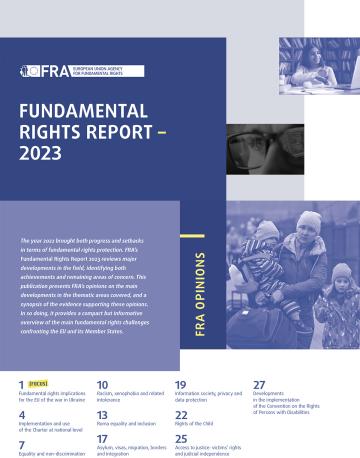
    Godina 2022. donijela je i napredak i prepreke u pogledu zaštite temeljnih prava. U FRA-inu Izvješću o temeljnim pravima 2023. daje se pregled važnih promjena i postignuća u tom području te se ističu područja koja još izazivaju zabrinutost. U ovoj publikaciji navode se mišljenja FRA-e o glavnim promjenama u obuhvaćenim tematskim područjima te se ukratko iznose dokazi kojima se potkrjepljuju ta mišljenja. Na taj se način pruža sažet i informativan pregled glavnih pitanja povezanih s temeljnim pravima s kojima se suočavaju EU i njegove države članice.
  • Fundamental Rights Report
    8
    June
    2023
    FRA’s Fundamental Rights Report 2023 reviews major developments in the field in 2022, identifying both achievements and areas of concern. It also presents FRA’s opinions on these developments, including a synopsis of the evidence supporting these opinions.
  • Report / Paper / Summary
    22
    February
    2023
    Directive 2012/29/EU represents a milestone in the development of victims’ rights. It establishes minimum standards for the rights, support and protection of victims of crime. It defines the scope of support services, guarantees the right to effective protection against secondary victimisation and comprehensively regulates the measures required for this purpose. This report covers three core components underpinning victims’ rights: support services, crime reporting, and protection from secondary and repeat victimisation. Examples highlight the relevant legal provisions in Member States and how specific rights under the Victims’ Rights Directive work in practice.
  • Report / Paper / Summary
    8
    December
    2022
    Artificial intelligence is everywhere and affects everyone – from deciding what content people see on their social media feeds to determining who will receive state benefits. AI technologies are typically based on algorithms that make predictions to support or even fully automate decision-making.
  • Report / Paper / Summary
    19
    July
    2022
    Civil society is a key component of Europe’s fundamental rights architecture. From supporting people affected by the pandemic to helping those fleeing the war in Ukraine, civil society plays a crucial role in upholding people’s rights. In so doing, it contributes to a healthy rule of law culture. FRA’s civic space report provides an overview of the many ways in which civil society contributes to the checks and balances that underpin the rule of law.
  • Report / Paper / Summary
    22
    September
    2021
    Civil society organisations play a vital role in promoting fundamental rights, but they face diverse challenges across the European Union. This report presents FRA’s findings on a range of such challenges. The findings are based on research, and on two online consultations with civil society organisations, carried out in 2020.