This guide explains what profiling is, the legal frameworks that regulate it, and why conducting profiling lawfully is both necessary to comply with fundamental rights and crucial for effective policing and border management. The guide also provides practical guidance on how to avoid unlawful profiling in police and border management operations.
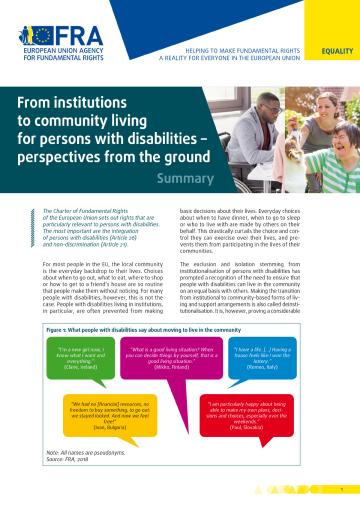
The Convention on the Rights of Persons with Disabilities commits both the EU and all of its Member States to realising the right of persons with disabilities to live independently in the community – which includes achieving deinstitutionalisation for those residing in institutional settings. But much remains to be done to make this a reality in practice. This report presents the main insights gained during fieldwork on the drivers of and barriers to deinstitutionalisation. Focusing on the local level, it gives voice to a diverse set of actors – most importantly, to people with disabilities themselves.
The European Union Agency for Fundamental Rights
(FRA) wanted to contribute to making steps to implement
deinstitutionalisation more effective, by capturing
concrete evidence of what is and what is
not working on the ground. To do this, the agency
conducted extensive fieldwork research in five EU
Member States at different stages of the deinstitutionalisation
process.
This summary report presents the key findings of
that fieldwork and the FRA opinions stemming from
them.
Almost twenty years after adoption of EU laws forbidding discrimination, people of African descent in the EU face widespread and entrenched prejudice and exclusion. This report outlines selected results from FRA's second large-scale EU-wide survey on migrants and minorities (EU-MIDIS II) carried out in 2016. It examines the experiences of almost 6,000 people of African descent in 12 EU Member States.
Civil society organisations play a critical role in democracies, and the importance of their work is widely recognised in international legal and policy documents. However, they face many obstacles when it comes to their day-to-day work. Based on the results of an online consultation with FRA's civil society network, the Fundamental Rights Platform (FRP), in September 2018, this paper complements the January 2018 report.
With this Opinion, FRA aims to contribute to the European Parliament's own-initiative report on the “Implementation of the Charter of Fundamental Rights of the European Union in the EU institutional framework”, being prepared in the Parliament’s Committee for Constitutional Affairs (AFCO). The request aims at understanding the interaction between the Charter’s implementation at national and EU level, and whether there are “instruments, mechanisms and practices” available at EU level to assist Member States to better implement the Charter.
These 10 keys sum up the core points
communicators and practitioners in various fields
raised in FRA’s expert meetings, practitioners’
seminars and focus groups in 2017 and 2018.
This Opinion by the European Union Agency for Fundamental Rights (FRA) aims to inform the European Parliament’s position concerning the legislative proposal for a Regulation on strengthening the security of identity cards of European Union (EU) citizens and of residence documents issued to EU citizens and their family members exercising their right of free movement. It focuses on the processing of biometric data and complements the opinion published by the European Data Protection Supervisor (EDPS).
This Opinion aims to
inform the European Parliament’s position on the legislative proposal amending the
Visa Information System, the Visa Code and other related provisions of EU law. The
European Commission presented the proposal on 16 May 2018 and EU legislators are
currently discussing it.
The founding treaties, the EU Charter of Fundamental Rights and secondary EU law all provide for EU citizens’ freedom to move and reside freely in any EU country of their choice. Growing numbers of citizens, and their family members, are making use of this freedom and related rights, such as the right not to be discriminated against based on nationality and the right to vote in certain elections in the host Member State. But making these rights a reality remains a challenge. This report presents an EU-wide, comparative overview of the application of the Free Movement Directive (2004/38/EC) across the 28 Member States based on a review of select case law at national level.
Across the European Union, people face hatred because of their skin colour, ethnicity, religion, gender or sexuality. In response, the EU and its Member States have introduced laws against hate crime and support services for victims. But these will only fulfil their potential if victims report hate-motivated harassment and violence to the police, and if police officers record such incidents as hate crimes. This report provides rich and detailed information on hate crime recording and data collection systems across the EU, including any systemic cooperation with civil society.
The stories of the domestic workers FRA interviewed for this paper reveal appalling working conditions and fundamental rights abuses in private homes across the EU. These stories indicate that, seven years on from FRA’s first report on domestic workers in 2011, little has changed in terms of the risks and experiences of severe labour exploitation domestic workers in the EU face.
The Consolidated Annual Activity Report (CAAR) 2017
provides an overview of the activities and achievements
of the European Union Agency for Fundamental
Rights (FRA) in that year. It follows the guidelines of
the European Union (EU) Agencies Network.
European societies are not getting any younger! It is a simple truth we must face both about ourselves and Europe as a whole. In two generations, by 2080, those aged 65 or above will account for almost 30% of the European Union’s population.
The year 2017 brought both progress and setbacks in terms of rights protection. The European Pillar of Social Rights marked an important move towards a more ‘social Europe’. But, as experiences with the EU Charter of Fundamental Rights underscore, agreement on a text is merely a first step. Even in its eighth year as the EU's binding bill of rights, the Charter's potential was not fully exploited, highlighting the need to more actively promote its use.
The year 2017 brought both progress and setbacks in terms of fundamental rights protection. FRA’s Fundamental Rights Report 2018 reviews major developments in the field, identifying both achievements and remaining areas of concern.
2017 r. przyniósł zarówno postęp, jak i regres pod względem ochrony praw podstawowych. Sprawozdanie FRA na temat praw podstawowych z 2018 r. zawiera przegląd najważniejszych zmian, jakie miały miejsce w tym obszarze,
wskazując zarówno na osiągnięcia, jak i kwestie, które nadal wymagają stosownych działań.
EU Member States, and the EU itself have ratified
the CRPD, committing themselves to achieving independent
living for persons with disabilities. Doing so
requires a meaningful and sustainable shift from institutional
to community-based living arrangements. This
publication summarises the findings from the three
FRA reports focusing on different aspects of deinstitutionalisation.
Den hurtige udvikling inden for informations- og kommunikationsteknologi fremhæver det øgede behov for
solid beskyttelse af personoplysninger – en ret, der er sikret ved både EU’s og Europarådets instrumenter.
Beskyttelse af denne vigtige rettighed indebærer nye og væsentlige udfordringer, da teknologiske fremskridt
udvider mulighederne for f.eks. overvågning, opfangelse af kommunikation og lagring af data. Denne håndbog
har til formål at give jurister, som ikke er specialister inden for databeskyttelse, kendskab til dette nye
juridiske område.
The rapid development of information technology has exacerbated the need for robust personal data protection, the right to which is safeguarded by both European Union (EU) and Council of Europe (CoE) instruments. Safeguarding this important right entails new and significant challenges as technological advances expand the frontiers of areas such as surveillance, communication interception and data storage. This handbook is designed to familiarise legal practitioners not specialised in data protection with this emerging area of the law.