FRA aruandes tehisintellekti ja põhiõiguste kohta tuuakse konkreetseid näiteid sellest, kuidas ELi ettevõtted ja avaliku sektori asutused kasutavad või püüavad kasutada tehisintellekti. Ülevaates tutvustatakse uuringu põhiaruandes välja toodud peamisi järeldusi. Need võivad ELi ja liikmesriikide poliitikakujundajatel aidata edendada tehisintellekti põhiste vahendite kasutamist, austades inim- ja põhiõigusi.
FRA ataskaitoje apie dirbtinį intelektą ir pagrindines teises pateikiama konkrečių pavyzdžių, kaip ES įmonės ir viešojo administravimo institucijos naudoja arba bando naudoti DI. Dėmesys sutelkiamas į keturias pagrindines sritis – socialines išmokas, prognozėmis grindžiamą viešosios tvarkos palaikymą, sveikatos priežiūros paslaugas ir tikslinę reklamą. Ataskaitoje aptariamas galimas poveikis pagrindinėms teisėms ir analizuojama, kaip naudojant arba plėtojant DI sistemas į tokias teises atsižvelgiama.
O relatório da FRA sobre inteligência artificial e direitos fundamentais apresenta exemplos concretos de como as empresas e as administrações públicas na UE estão a utilizar, ou a tentar utilizar, a IA. O relatório incide sobre quatro domínios essenciais — benefícios sociais, policiamento preditivo, serviços de saúde e publicidade direcionada. O documento debate as potenciais implicações em matéria de direitos fundamentais e analisa a forma como esses direitos são tidos em consideração ao utilizar ou criar aplicações de IA.
FRA:s rapport om artificiell intelligens och grundläggande rättigheter innehåller konkreta exempel på hur företag och offentliga förvaltningar i EU använder eller försöker använda AI. Den är inriktad på fyra huvudområden – sociala förmåner, prognostiserat polisarbete, hälso- och sjukvårdstjänster och riktad reklam. Rapporten innehåller en diskussion om potentiella konsekvenser för de grundläggande rättigheterna och en analys av hur dessa rättigheter beaktas när AI-tillämpningar används eller utvecklas.
De nationale menneskerettighedsinstitutioner er en afgørende del af systemet til beskyttelse af menneskerettigheder på nationalt plan. Ved at skabe større bevidsthed, yde rådgivning, overvåge og stille myndighederne til ansvar har de en central rolle med hensyn til at navigere mellem nutidens store menneskerettighedsudfordringer — og tackle både vedvarende problemstillinger som diskrimination og ulighed og nye spørgsmål som f.eks. konsekvenserne af kunstig intelligens og covid-19-pandemien for rettighederne.
National Human Rights Institutions (NHRIs) are a vital part of the country-level human rights protection system. By raising awareness, providing advice, monitoring and holding authorities to account, they have a central role in navigating the great human rights challenges of our day – tackling both persistent concerns like discrimination and inequality, and novel issues such as the rights implications of artificial intelligence and of the COVID-19 pandemic.
Inimõigustega tegelevad riiklikud asutused on oluline osa inimõiguste kaitse süsteemist riigi tasandil. Teadlikkuse suurendajate, nõustajate ning ametiasutuste jälgijate ja vastutusele võtjatena on neil keskne roll tänapäeva suurte inimõigusprobleemide lahendamisel ning nad tegelevad nii alaliste probleemidega, nagu diskrimineerimine ja ebavõrdsus, kui ka uute küsimustega, nagu COVID-19 pandeemia ja tehisintellekti mõju inimõigustele.
Les institutions nationales des droits de l’homme (INDH) constituent un élément essentiel du système de protection des droits de l’homme dans chaque pays. En sensibilisant le public, en fournissant des conseils, en assurant une surveillance et en demandant des comptes aux autorités, elles jouent un rôle central dans la gestion des graves risques pesant sur les droits de l’homme à notre époque, affrontant à la fois les préoccupations persistantes, telles que la discrimination et les inégalités, et les nouvelles questions, telles que les répercussions sur les droits de l’intelligence artificielle et de la pandémie de COVID-19.
Nacionalinės žmogaus teisių institucijos (NŽTI) yra gyvybiškai svarbi žmogaus teisių apsaugos sistemos dalis, veikianti šalies lygmeniu. Didindamos informuotumą, teikdamos rekomendacijas, vykdydamos stebėseną ir užtikrindamos valdžios institucijų atskaitomybę, šios institucijos atlieka pagrindinį vaidmenį sprendžiant sunkiausius šių dienų uždavinius žmogaus teisių srityje – kovoti su tokiais nuolat susirūpinimą keliančiais reiškiniais kaip diskriminacija ir nelygybė, naujomis problemomis, pvz., dirbtinio intelekto poveikiu teisėms, ir COVID-19 pandemija.
As Instituições Nacionais dos Direitos Humanos (INDH) são uma parte vital do sistema de proteção dos direitos humanos à escala nacional. Ao sensibilizar, aconselhar, fiscalizar e velar pela responsabilização das autoridades, estas instituições desempenham um papel central nos grandes desafios que atualmente se levantam em matéria de direitos humanos, enfrentando quer os problemas persistentes, como a discriminação e as desigualdades, quer os novos problemas emergentes, como as implicações da inteligência artificial e da pandemia da COVID-19 em matéria dos direitos.
De nationella människorättsinstitutionerna är en viktig del av ländernas system för att skydda de mänskliga rättigheterna. Genom att bidra till en ökad medvetenhet, och genom att ge råd, övervaka och ställa myndigheter till svars, spelar de en central roll i hanteringen av vår tids stora människorättsutmaningar. De arbetar både med ständigt aktuella problem som diskriminering och ojämlikhet och med nya frågor som hur våra rättigheter påverkas av artificiell intelligens eller covid-19-pandemin.
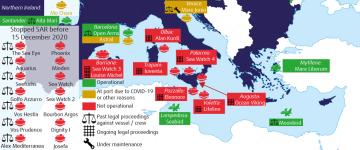
In 2020 (until 15 December), the International Organization for Migration estimated that about 1,054 people have died or gone missing while crossing the Mediterranean Sea to reach Europe to escape war or persecution or to pursue a better life. This is an average of almost three people per day. In the past years, a significant number of migrants in distress at sea have been rescued by civil society vessels deployed with a humanitarian mandate to reduce fatalities and bring rescued migrants to safety. Since 2018, however, national authorities initiated some 50 administrative and criminal proceedings against crew members or vessels, also seizing the latter. In some cases, rescue vessels were blocked in harbours due to flag issues or the inability to meet maritime safety-related and other technical requirements.
Den europæiske menneskerettighedskonvention og Den Europæiske Unions lovgivning udgør en stadigt vigtigere ramme for beskyttelse af udlændinges rettigheder. Den Europæiske Unions lovgivning vedrørende asyl, grænser og indvandring udvikler sig hurtigt. Der er en imponerende mængde retspraksis fra Den Europæiske Menneskerettighedsdomstol vedrørende navnlig artikel 3, 5, 8 og 13 i EMRK. Den Europæiske Unions Domstol bliver oftere og oftere anmodet om at fortolke bestemmelserne i EU-retten på dette område. Den tredje udgave af denne håndbog, der er opdateret frem til juli 2020, fremlægger denne EU-lovgivning og retspraksis fra de to europæiske domstole på en lettilgængelig måde. Håndbogen er tiltænkt aktører inden for retsvæsenet, anklagere, indvandringsmedarbejdere og ikkestatslige organisationer i EU’s og Europarådets medlemsstater.
The European Convention on Human Rights and European Union law provide an increasingly important framework for the protection of the rights of foreigners. European Union legislation relating to asylum, borders and immigration is developing fast. There is an impressive body of case law by the European Court of Human Rights relating in particular to Articles 3, 5, 8 and 13 of the ECHR. The Court of Justice of the European Union is increasingly asked to pronounce on the interpretation of European Union law provisions in this field. The third edition of this handbook, updated up to July 2020, presents this European Union legislation and the body of case law by the two European courts in an accessible way.
Euroopa inimõiguste konventsioon ja Euroopa Liidu õigus moodustavad üha olulisema raamistiku välismaalaste õiguste kaitseks. Varjupaiga, piiride ja sisserändega seotud Euroopa Liidu õigusaktid arenevad kiiresti. Euroopa Inimõiguste Kohtu kohtupraktika
on ulatuslik, eelkõige seoses Euroopa inimõiguste konventsiooni artiklitega 3, 5, 8 ja 13. Euroopa Liidu Kohtul palutakse üha sagedamini võtta seisukoht Euroopa Liidu õiguse sätete tõlgendamise kohta selles valdkonnas. Käsiraamatu kolmandas väljaandes, mida on ajakohastatud kuni juulini 2020, tutvustatakse arusaadavalt Euroopa Liidu õigusakte ja Euroopa mõlema kohtu kohtupraktikat. See on ette nähtud ELi ja Euroopa Nõukogu liikmesriikide õigusala töötajatele, kohtunikele, prokuröridele, sisserändeametnikele ja vabaühendustele.
Europos žmogaus teisių konvencija ir Europos Sąjungos teisė – tai vis svarbesnė užsieniečių teisių apsaugos sistema. Europos Sąjungos teisės aktai, susiję su prieglobsčiu, sienomis ir imigracija, sparčiai tobulėja. Europos Žmogaus Teisių Teismas yra suformavęs įspūdingą teismų praktiką, visų pirma susijusią su EŽTK 3, 5, 8 ir 13 straipsniais. Europos Sąjungos Teisingumo Teismo vis dažniau prašoma pasisakyti dėl Europos Sąjungos teisės nuostatų aiškinimo šioje srityje. Trečiame šio vadovo leidime, atnaujintame iki 2020 m. liepos mėn., prieinamai pristatomi šie Europos Sąjungos teisės aktai ir dviejų Europos Sąjungos teismų praktikos visuma.
A Convenção Europeia dos Direitos Humanos e o direito da União Europeia proporcionam um enquadramento cada vez mais importante para a proteção dos direitos dos estrangeiros. A legislação da União Europeia em matéria de asilo, fronteiras e imigração está a evoluir rapidamente. O Tribunal Europeu dos Direitos Humanos já possui uma jurisprudência abundante relativa, designadamente, aos artigos 3.º, 5.º, 8.º e 13.º da CEDH. O Tribunal de Justiça da União Europeia é crescentemente solicitado a pronunciar-se sobre a interpretação das disposições do direito da União Europeia neste domínio. Esta terceira edição do manual, que foi atualizada até ao final de julho de 2020, apresenta de forma acessível a legislação da União Europeia e a jurisprudência dos dois tribunais europeus. Tem como destinatários os profissionais da justiça, juízes, procuradores, funcionários dos serviços de imigração e organizações não governamentais dos Estados-Membros da União Europeia e do Conselho da Europa.
Den europeiska konventionen om skydd för de mänskliga rättigheterna och de grundläggande friheterna och EU-rätten utgör en allt viktigare ram för skyddet av utlänningars rättigheter. EU-lagstiftningen om asyl, gränser och invandring utvecklas snabbt. Det finns en imponerande rättspraxis från Europeiska domstolen för de mänskliga rättigheterna, särskilt när det gäller artiklarna 3, 5, 8 och 13 i Europakonventionen. Europeiska unionens domstol ombeds i allt högre grad att uttala sig om tolkningen av unionsrättsliga bestämmelser på detta område. I den tredje utgåvan av denna handbok, som uppdaterats fram till juli 2020,
presenteras denna EU-lagstiftning och rättspraxis från de två europeiska domstolarna på ett lättillgängligt sätt. Den är avsedd för rättstillämpare, domare, åklagare, immigrationstjänstemän och icke-statliga organisationer i EU och Europarådets medlemsstater.
The EU is founded on the values of democracy, rule of law and respect for human rights. Yet these values, and discussions on fundamental rights at the EU and Member State level, can seem remote in people’s daily lives. With this in mind, FRA explored what people understand, know and experience with respect to their fundamental rights in practice. The resulting data provide comprehensive and comparable evidence on these aspects.
Artificial intelligence (AI) already plays a role in deciding what unemployment benefits someone gets, where a burglary is likely to take place, whether someone is at risk of cancer, or who sees that catchy advertisement for low mortgage rates. Its use keeps growing, presenting seemingly endless possibilities. But we need to make sure to fully uphold fundamental rights standards when using AI. This report presents concrete examples of how companies and public administrations in the EU are using, or trying to use, AI. It focuses on four core areas – social benefits, predictive policing, health services and targeted advertising.