This Opinion by the European Union Agency for Fundamental Rights (FRA) aims to inform the European Parliament’s position concerning the legislative proposal for a Regulation on strengthening the security of identity cards of European Union (EU) citizens and of residence documents issued to EU citizens and their family members exercising their right of free movement. It focuses on the processing of biometric data and complements the opinion published by the European Data Protection Supervisor (EDPS).
In November 2017, the European Commission requested FRA’s support in evaluating the impact on fundamental rights of the European Border Surveillance System (Eurosur) Regulation. Further to this request, FRA reviewed the work of the European Border and Coast Guard Agency (Frontex) and analysed cooperation agreements concluded by EU Member States with third countries which are relevant for the exchange of information for the purposes of Eurosur. This report presents the main findings of such review.
This Opinion aims to
inform the European Parliament’s position on the legislative proposal amending the
Visa Information System, the Visa Code and other related provisions of EU law. The
European Commission presented the proposal on 16 May 2018 and EU legislators are
currently discussing it.
The founding treaties, the EU Charter of Fundamental Rights and secondary EU law all provide for EU citizens’ freedom to move and reside freely in any EU country of their choice. Growing numbers of citizens, and their family members, are making use of this freedom and related rights, such as the right not to be discriminated against based on nationality and the right to vote in certain elections in the host Member State. But making these rights a reality remains a challenge. This report presents an EU-wide, comparative overview of the application of the Free Movement Directive (2004/38/EC) across the 28 Member States based on a review of select case law at national level.
Across the European Union, people face hatred because of their skin colour, ethnicity, religion, gender or sexuality. In response, the EU and its Member States have introduced laws against hate crime and support services for victims. But these will only fulfil their potential if victims report hate-motivated harassment and violence to the police, and if police officers record such incidents as hate crimes. This report provides rich and detailed information on hate crime recording and data collection systems across the EU, including any systemic cooperation with civil society.
European societies are not getting any younger! It is a simple truth we must face both about ourselves and Europe as a whole. In two generations, by 2080, those aged 65 or above will account for almost 30% of the European Union’s population.
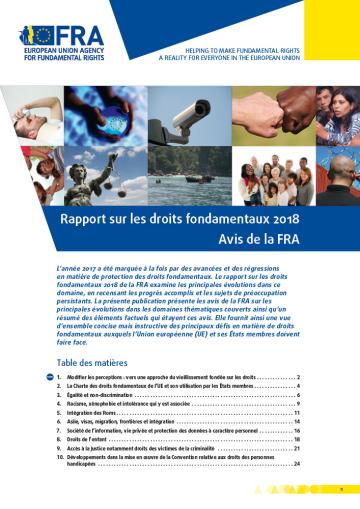
L’année 2017 a été marquée à la fois par des avancées et des régressions en matière de protection des droits fondamentaux. Le rapport sur les droits fondamentaux 2018 de la FRA examine les principales évolutions intervenues dans l’Union entre janvier et décembre 2017 et présente les avis de la FRA à cet égard.
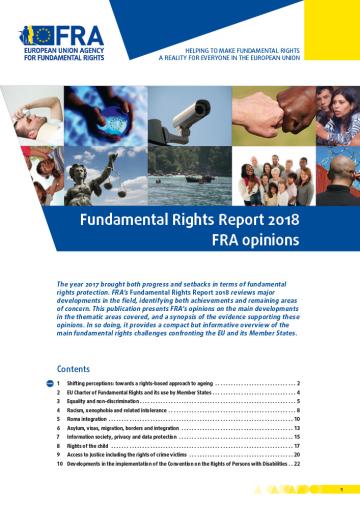
The year 2017 brought both progress and setbacks in terms of rights protection. The European Pillar of Social Rights marked an important move towards a more ‘social Europe’. But, as experiences with the EU Charter of Fundamental Rights underscore, agreement on a text is merely a first step. Even in its eighth year as the EU's binding bill of rights, the Charter's potential was not fully exploited, highlighting the need to more actively promote its use.
The year 2017 brought both progress and setbacks in terms of fundamental rights protection. FRA’s Fundamental Rights Report 2018 reviews major developments in the field, identifying both achievements and remaining areas of concern.
Tógadh céimeanna chun tosaigh agus céimeanna siar araon i ndáil le cosaint ceart bunúsach sa bhliain 2017. Déantar athbhreithniú sa Tuarascáil um Chearta Bunúsacha 2018 ó FRA ar na mórfhorbairtí san earnáil, agus sainaithnítear inti freisin na héachtaí a baineadh amach agus na rudaí ar ábhair imní iad go fóill.
We live in a world of big data, where technological developments in the area of machine learning and artificial intelligence have changed the way we live. Decisions and processes concerning everyday life are increasingly automated, based on data. This affects fundamental rights in various ways. This focus paper specifically deals with discrimination, a fundamental rights area particularly affected by technological developments.
The rapid development of information technology has exacerbated the need for robust personal data protection, the right to which is safeguarded by both European Union (EU) and Council of Europe (CoE) instruments. Safeguarding this important right entails new and significant challenges as technological advances expand the frontiers of areas such as surveillance, communication interception and data storage. This handbook is designed to familiarise legal practitioners not specialised in data protection with this emerging area of the law.
L’évolution rapide des technologies de l’information souligne la nécessité d’une protection
solide des données à caractère personnel, un droit qui est garanti à la fois par les instruments de
l’Union européenne (UE) et du Conseil de l’Europe (CdE). Les avancées technologiques repoussent
notamment les frontières de la surveillance, de l’interception des communications et de la
conservation des données, ce qui met le droit à la protection des données face à des défis
majeurs. Le présent manuel est conçu de façon à permettre aux praticiens du droit qui ne sont pas
spécialisés dans la protection des données de se familiariser avec ce nouveau domaine du droit.
Il présente un aperçu des cadres légaux applicables de l’UE et du CdE. Il explique la jurisprudence
essentielle et résume les principaux arrêts de la Cour de justice de l’Union européenne et de
la Cour européenne des droits de l’homme. Il propose, en outre, des illustrations pratiques
basées sur des scénarios hypothétiques des divers problèmes rencontrés dans ce domaine en
évolution constante.
Civil society organisations in the European Union play a crucial role in promoting fundamental
rights, but it has become harder for them do so – due to both legal and practical restrictions.
This summary outlines the main
findings and FRA’s opinions on the different
types and patterns of challenges faced by civil society
organisations across the EU,
Au sein de l’Union européenne, les OSC jouent un rôle crucial dans la promotion des droits
fondamentaux, mais il leur est désormais plus difficile d’assumer ce rôle en raison de restrictions
d’ordre à la fois juridique et pratique.
Le rapport de la l’Agence des droits fondamentaux de l’Union européenne (FRA) se penche
par conséquent sur les différents types de difficultés rencontrées par les OSC actives dans
le domaine des droits de l’homme au sein de l’Union européenne.
With terrorism, cyber-attacks and sophisticated cross-border criminal networks posing growing threats, the work of intelligence services has become more urgent, complex and international. Such work can strongly interfere with fundamental rights, especially privacy and data protection. While continuous technological advances potentially exacerbate the threat of such interference, effective oversight and remedies can curb the potential for abuse.
La persistance de la menace terroriste à un niveau élevé, la constitution de
réseaux criminels transnationaux sur le territoire de l’Union européenne, mais
également les conséquences des ingérences d’origine étatique de nature diverse
et le durcissement des modes opératoires hostiles dans l’espace cyber représentent
des enjeux de sécurité nationale d’importance majeure pour les États
membres ; la prévention de ces menaces peut reposer sur la mise en oeuvre,
par des services de renseignement, de mesures de surveillance attentatoires
aux libertés. Parallèlement, le développement continu des progrès techniques
accroit les capacités d’ingérences dans la vie privée des personnes.
This report outlines Member States’ approaches to age requirements and limits
regarding child participation in judicial proceedings; procedural safeguards for, and rights of, children involved in criminal
proceedings; as well as issues related to depriving children of their liberty.
The right to access justice and all other relevant procedural rights are not just rights in themselves; they also protect against violations of every other right. Respect for children’s rights in the area of justice is therefore essential. International treaties, the Charter of Fundamental Rights of the European Union, European Union (EU) secondary law, and national legislation provide a number of relevant rights.