eu-charter

Carta drepturilor fundamentale a Uniunii Europene

Articolul 47 - Dreptul la o cale de atac eficientă și la un proces echitabil

Articolul 47 - Dreptul la o cale de atac eficientă și la un proces echitabil

Orice persoană ale cărei drepturi și libertăți garantate de dreptul Uniunii sunt încălcate are dreptul la o cale de atac eficientă în fața unei instanțe judecătorești, în conformitate cu condițiile stabilite de prezentul articol. Orice persoană are dreptul la un proces echitabil, public și într-un termen rezonabil, în fața unei instanțe judecătorești independente și imparțiale, constituită în prealabil prin lege. Orice persoană are posibilitatea de a fi consiliată, apărată și reprezentată. Asistența juridică gratuită se acordă celor care nu dispun de resurse suficiente, în măsura în care aceasta este necesară pentru a-i asigura accesul efectiv la justiție.

Explicaţii

  • Text:

    Primul paragraf se întemeiază pe articolul 13 din CEDO:

    `Orice persoană ale cărei drepturi şi libertăţi recunoscute de prezenta Convenţie sunt încălcate are dreptul să se adreseze efectiv unei instanţe naţionale, chiar şi atunci când încălcarea s-ar datora unor persoane care au acţionat în exercitarea atribuţiilor lor oficiale`.

    Cu toate acestea, protecţia din dreptul Uniunii este mai extinsă, deoarece aceasta garantează dreptul de a apela efectiv la un judecător. Curtea de Justiţie a consacrat acest drept, ca principiu general de drept al Uniunii, prin hotărârea din 15 mai 1986 (cauza 222/84, Johnston, Rec. 1986, p. 1651; a se vedea şi hotărârea din 15 octombrie 1987, cauza 222/86, Heylens, Rec. 1987, p. 4097 şi hotărârea din 3 decembrie 1992, C-97/91, Borelli, Rec. 1992, p. I-6313). Potrivit Curţii, acest principiu general de drept al Uniunii se aplică şi statelor membre în cazul în care acestea aplică dreptul Uniunii. Menţionarea acestei jurisprudenţe în cartă nu avea ca obiect modificarea sistemului de control jurisdicţional prevăzut în tratate şi, în special, a normelor privind admisibilitatea acţiunilor formulate direct în faţa Curţii de Justiţie a Uniunii Europene. Convenţia Europeană a examinat sistemul de control jurisdicţional al Uniunii, inclusiv normele privind admisibilitatea, şi l-a confirmat, modificând însă anumite aspecte, după cum se arată la articolele 251-281 din Tratatul privind funcţionarea Uniunii Europene şi, în special, la articolul 263 alineatul (4). Articolul 47 se aplică instituţiilor Uniunii şi ale statelor membre în cazul în care acestea pun în aplicare dreptul Uniunii pentru toate drepturile garantate de dreptul Uniunii.

    Al doilea paragraf corespunde articolului 6 alineatul (1) din CEDO, cu următorul text:

    `Orice persoană are dreptul la judecarea în mod echitabil, în mod public şi într-un termen rezonabil a cauzei sale, de către o instanţă independentă şi imparţială, instituită de lege, care va hotărî fie asupra încălcării drepturilor şi a obligaţiilor sale cu caracter civil, fie asupra temeiniciei oricărei acuzaţii în materie penală îndreptate împotriva sa.
    Hotărârea trebuie să fie pronunţată în mod public, dar accesul în sala de şedinţă poate fi interzis presei şi publicului pe întreaga durată a procesului sau a unei părţi a acestuia, în interesul moralităţii, al ordinii publice ori al securităţii naţionale într-o societate democratică, atunci când interesele minorilor sau protecţia vieţii private a părţilor la proces o impun, sau în măsura considerată absolut necesară de către instanţă, atunci când, în împrejurări speciale, publicitatea ar fi de natură să aducă atingere intereselor justiţiei`.
    În dreptul Uniunii, dreptul de a se adresa unei instanţe nu se aplică numai pentru plângerile privind drepturile şi obligaţiile cu caracter civil. Aceasta este una dintre consecinţele faptului că Uniunea este o comunitate de drept, după cum a constatat Curtea de Justiţie în cauza 294/83, `Verzii`/Parlamentul European (hotărârea din 23 aprilie 1986, Rec. 1986, p. 1339). Cu toate acestea, cu excepţia domeniului lor de aplicare, garanţiile oferite de CEDO se aplică în mod similar în Uniune.

    În ceea ce priveşte paragraful al treilea, trebuie observat faptul că, în conformitate cu jurisprudenţa Curţii Europene a Drepturilor Omului, trebuie acordată asistenţă juridică în cazurile în care absenţa acesteia ar face ineficientă garantarea accesului efectiv la justiţie (hotărârea CEDO din 9 octombrie 1979, Airey, seria A, volumul 32, p. 11). Există, de asemenea, şi un sistem de asistenţă judiciară pentru cazurile de la Curtea de Justiţie a Uniunii Europene.

    Source:
    Jurnalul Oficial al Uniunii Europene C 303/17 - 14.12.2007
    Preamble - Explanations relating to the Charter of Fundamental Rights:
    Explicaţiile redate în continuare au fost redactate iniţial sub autoritatea prezidiului Convenţiei care a elaborat Carta drepturilor fundamentale a Uniunii Europene. Acestea au fost actualizate sub autoritatea prezidiului Convenţiei Europene, având în vedere adaptarea de către respectiva Convenţie a textului cartei (în special la articolele 51 şi 52), precum şi evoluţia dreptului Uniunii. Cu toate că aceste explicaţii nu au valoare juridică în sine, acestea constituie un preţios instrument de interpretare destinat clarificării dispoziţiilor cartei.

Jurisprudență

Dreptul constituțional național

50 results found

  • Sweden / Instrument of Government
    Țara:
    Sweden

    Chapter 2 - Fundamental rights and freedoms:

    Article 9 If a public authority other than a court of law has deprived an individual of his or her liberty on account of a criminal act or because he or she is suspected of having committed such an act, the individual shall be entitled to have the deprivation of liberty examined before a court of law without undue delay. This shall not, however, apply where the matter concerns the transfer to Sweden of responsibility for executing a penal sanction involving deprivation of liberty according to a sentence in another state. Also those who for reasons other than those specified in paragraph one, have been taken forcibly into custody, shall likewise be entitled to have the matter of custody examined before a court of law without undue delay (...) Also those who for reasons other than those specified in paragraph one, have been taken forcibly into custody, shall likewise be entitled to have the matter of custody examined before a court of law without undue delay. In such a case, examination before a tribunal shall be equated with examination before a court of law, provided the composition of the tribunal has been laid down in law and it is stipulated that the chair of the tribunal shall be currently, or shall have been previously, a permanent salaried judge (...);

    Article 10 No one may be sentenced to a penalty or penal sanction for an act which was not subject to a penal sanction at the time it was committed. Nor may anyone be sentenced to a penal sanction which is more severe than that which was in force when the act was committed. The provisions laid down here with respect to penal sanctions also apply to forfeiture and other special legal effects of crime (...);

    Article 11 No court of law may be established on account of an act already committed, or for a particular dispute or otherwise for a particular case. Legal proceedings shall be carried out fairly and within a reasonable period of time. Proceedings in courts of law shall be open to the public.

  • A Magyar Köztársaság Alkotmánya
    Țara:
    Hungary

    57 § (1) A Magyar Köztársaságban a bíróság előtt mindenki egyenlő, és mindenkinek joga van ahhoz, hogy az ellene emelt bármely vádat, vagy valamely perben a jogait és kötelességeit a törvény által felállított független és pártatlan bíróság igazságos és nyilvános tárgyaláson bírálja el.(…) (5) A Magyar Köztársaságban a törvényben meghatározottak szerint mindenki jogorvoslattal élhet az olyan bírósági, közigazgatási és más hatósági döntés ellen, amely a jogát vagy jogos érdekét sérti. A jogorvoslati jogot - a jogviták ésszerű időn belüli elbírálásának érdekében, azzal arányosan - a jelen lévő országgyűlési képviselők kétharmadának szavazatával elfogadott törvény korlátozhatja.70/K § Az alapvető jogok megsértése miatt keletkezett igények, továbbá a kötelességek teljesítésével kapcsolatban hozott állami döntések elleni kifogások bíróság előtt érvényesíthetők.

  • Basic Law for the Federal Republic of Germany
    Țara:
    Germany

    Article 19 (...) (4) Should any person’s rights be violated by public authority, he may have recourse to the courts. If no other jurisdiction has been established, recourse shall be to the ordinary courts. The second sentence of paragraph (2) of Article 10 shall not be affected by this paragraph. Article 97 (1) Judges shall be independent and subject only to the law. (...) Article 101 (1) Extraordinary courts shall not be allowed. No one may be removed from the jurisdiction of his lawful judge. (2) Courts for particular fields of law may be established only by a law. Article 103 (1) In the courts every person shall be entitled to a hearing in accordance with law. (2) An act may be punished only if it was defined by a law as a criminal offence before the act was committed. (3) No person may be punished for the same act more than once under the general criminal laws.

  • Bundes-Verfassungsgesetz (B-VG)
    Țara:
    Austria

    Artikel 83(2) Niemand darf seinem gesetzlichen Richter entzogen werden. Artikel 87(1) Die Richter sind in Ausübung ihres richterlichen Amtes unabhängig.(...) Article 90(1) Die Verhandlungen in Zivil- und Strafrechtssachen vor dem erkennenden Gericht sind mündlich und öffentlich. Ausnahmen bestimmt das Gesetz.

  • Constitution
    Țara:
    France

    Article 64 Le Président de la République est garant de l'indépendance de l'autorité judiciaire.(...) 

  • Constitution
    Țara:
    France

    Article 64 The President of the Republic shall be the guarantor of the independence of the
    Judicial Authority (...)

  • Constitution of Finland
    Țara:
    Finland

    Section 21 Protection under the law Everyone has the right to have his or her case dealt with appropriately and without undue delay by a legally competent court of law or other authority, as well as to have a decision pertaining to his or her rights or obligations reviewed by a court of law or other independent organ for the administration of justice. Provisions concerning the publicity of proceedings, the right to be heard, the right to receive a reasoned decision and the right of appeal, as well as the other guarantees of a fair trial and good governance shall be laid down by an Act.

  • Constitution of Ireland
    Țara:
    Ireland

    Article 34.1. Justice shall be administered in courts established by law by judges appointed in the manner provided by this Constitution, and, save in such special and limited cases as may be prescribed by law, shall be administered in public.Article 38.1No person shall be tried on any criminal charge save in due course of law.

  • Constitution of Malta
    Țara:
    Malta

    Article 39(1) Whenever any person is charged with a criminal offence he shall, unless the charge is withdrawn, be afforded a fair hearing within a reasonable time by an independent and impartial court established by law.(2) Any court or other adjudicating authority prescribed by law for the determination of the existence or the extent of civil rights or obligations shall be independent and impartial; and, where proceedings for such a determination are instituted by any person before such a court or other adjudicating authority, the ease shall be given a fair hearing within a reasonable time.(3) Except with the agreement of all the parties thereto, all proceedings of every court and proceedings relating to the determination of the existence or the extent of a person's civil rights or obligations before any other adjudicating authority, including the announcement of the decision of the court or other authority, shall be held in public. (...)

  • Constitution of the Hellenic Republic
    Țara:
    Greece

    Article 8 No person shall be deprived of the judge assigned to him by law against his will. Judicial committees or extraordinary courts, under any name whatsoever, shall not be constituted. [...] .Article 20 (1) Every person shall be entitled to receive legal protection by the courts and may plead before them his views concerning his rights or interests, as specified by law. (2). The right of a person to a prior hearing also applies in any administrative action or measure adopted at the expense of his rights or interests. [...] .Article 87 (1). Justice shall be administered by courts composed of regular judges who shall enjoy functional and personal independence. (2). In the discharge of their duties, judges shall be subject only to the Constitution and the laws; in no case whatsoever shall they be obliged to comply with provisions enacted in violation of the Constitution. (3). Regular judges shall be inspected by judges of a superior rank, as well as by the Public Prosecutor and the Deputy Prosecutor of the Supreme Civil and Criminal Court; Public Prosecutors shall be inspected by the Supreme Civil and Criminal Court judges and Public Prosecutors of a superior rank, as specified by law [...] Article 97 (1). Felonies and political crimes shall be tried by mixed jury courts composed of ordinary judges and jurors, as specified by law. The judgments of these courts shall be subject to the legal remedies specified by law. (2). Felonies and political crimes which prior to the date of entry into force of this Constitution have, by constituent acts, parliamentary resolutions and special statutes, come under the jurisdiction of courts of appeal shall continue to be tried by the said courts, as long as a statute does not transfer them to the jurisdiction of mixed jury courts. Other felonies may be transferred to the jurisdiction of the same courts of appeal by statute. (3). Crimes of any degree committed through the press shall be under the jurisdiction of ordinary criminal courts, as specified by law. [...]

  • Constitution of the Italian Republic
    Țara:
    Italy

    Art. 24. Anyone may bring cases before a court of law in order to protect their rights under civil and administrative law. Defense is an inviolable right at every stage and instance of legal proceedings. The poor are entitled by law to proper means for action or defense in all courts. The law shall define the conditions and forms of reparation in case of judicial errors. Art. 25. No case may be removed from the court seized with it as established by law. No punishment may be inflicted except by virtue of a law in force at the time tehe offence was committed. No restriction may be placed on a person's liberty save for as provided by law. Art. 101. Justice is administered in the name of the people. Judges are subject only to the law. Art. 104. The Judiciary is a branch that is autonomous and independent of all other powers. (...) Art. 111. Jurisdiction is implemented through due process regulated by law. All court trials are conducted with adversary proceedings and the parties. are entitled to equal conditions before an impartial judge in third party position. The law provides for the reasonable duration of trials. In criminal law trials, the law provides that the alleged offender shall be
    promptly informed confidentially of the nature and reasons for the charges that are brought and shall have adequate time and conditions to prepare a
    defence. The defendant shall have the right to cross-examine or to have cross-examined before a judge the persons making accusations and to
    summon and examine persons for the defence in the same conditions as the prosecution, as well as the right to produce all other evidence in favour of
    the defence. The defendant is entitled to the assistance of an interpreter in the case that he or she does not speak or understand the language in which
    the court proceedings are conducted. In criminal law proceedings, the formation of evidence is based on the principle of adversary hearings. The guilt of the defendant cannot be established on the basis of statements by persons who, out of their own free choice, have always voluntarily avoided undergoing cross-examination by
    the defendant or the defence counsel. The law regulates the cases in which the formation of evidence does not occur in an adversary proceeding with the consent of the defendant or owing to reasons of ascertained objective impossibility or proven illicit conduct. All judicial decisions shall include a statement of reasons. Appeals to the Court of Cassation in cases of violations of the law are always allowed against sentences and against measures affecting personal freedom pronounced by ordinary and special courts. This rule can only be waived in cases of sentences by military tribunals in time of war. Appeals to the Court of Cassation against decisions of the Council of State
    and the Court of Accounts are permitted only for reasons of jurisdiction. Art. 112. The public prosecutor has the obligation to institute criminal proceedings. Art. 113. The judicial safeguarding of rights and legitimate interests before the bodies of ordinary or administrative justice is always permitted against acts of the public administration. Such judicial protection may not be excluded or limited to particular kinds of appeal or for particular categories of acts. The law determines which judicial bodies are empowered to annul acts of public administration in the cases and with the consequences provided for by the law itself.

  • Constitution of the Republic of Austria
    Țara:
    Austria

    Article 83(2) No one may be deprived of his lawful judge. Article 87(1) Judges are independent in the exercise of their judicial office.(...) Article 90(1) Hearings in civil and criminal cases are oral and public. Exceptions are regulated by law.

  • Constitution of the Republic of Bulgaria
    Țara:
    Bulgaria

    Art. 30 [...] (4) Everyone shall be entitled to legal counsel from the moment of detention or from the moment of being charged.(5) Everyone shall be entitled to meet his legal counsel in private. The confidentiality of such communication shall be inviolable. Art. 31(1) Anyone charged with a crime shall be brought before a court within the time established by law. [...] (4) The rights of a defendant shall not be restricted beyond what is necessary for the purposes of a fair trial. Art. 45.
    All citizens shall have the right to lodge complaints, proposals and petitions with the state authorities.
    Art. 56Everyone shall have the right to legal defence whenever his rights or legitimate interests are violated or endangered. He shall have the right to be accompanied by legal counsel when appearing before an agency of the State. Art. 117.
    (1) The judiciary shall protect the rights and legitimate interests of all citizens, legal entities and the State. [...] Art. 120.
    (1) The courts shall supervise the legality of the acts and actions of the administrative bodies.
    (2) Citizens and legal entities shall be free to challange any administrative act which affects them, except those listed expressly by the laws. Art. 122(1) Citizens and legal entities shall have the right to legal counsel at all stages of a trial.(2) The procedure by which the right to legal counsel shall be practiced shall be established by law.

  • Constitution of the Republic of Croatia
    Țara:
    Croatia

    Article 18
    The right to appeal against individual legal decisions made in first-instance proceedings by courts or other authorized bodies shall be guaranteed.
    By way of exception, the right to appeal may be denied in cases specified by law if other legal protections are ensured.

    Article 26
    All citizens of the Republic of Croatia and aliens shall be equal before the courts,
    governmental agencies and other bodies vested with pubic authority.

    Article 28
    Everyone is presumed innocent and may not be held guilty of a criminal offence until such
    guilt is proven by a binding court judgment.

    Article 29
    Everyone shall be entitled have his or her rights and obligations, or suspicion or accusation of
    a criminal offence decided upon fairly before a legally established, independent and impartial
    court within a reasonable period.
    In the case of suspicion or accusation of a criminal offence, the suspected, accused or indicted
    person shall be entitled:
    – to be informed in detail and in a language he/she understands, within the shortest possible
    term, of the nature and grounds for the charges against him/her and the evidence incriminating
    him/her,
    – to have adequate time and opportunity to prepare his/her defence,
    – to defence counsel and unrestricted communication therewith, and to be informed of this
    right,
    – to mount his/her own defence independently or with the assistance of a defence counsel of
    his/her own choice, and if he/she lacks the resources to engage such counsel, to have free
    counsel provided under the conditions specified by law,
    – to be present at his/her trial insofar as he/she is at the disposal of the court,
    – to interrogate or to arrange for interrogation of witnesses for the prosecution and to demand
    the attendance and questioning of defence witnesses under the same conditions which apply to
    witnesses for the prosecution,
    – to assistance by an interpreter free of charge insofar as he/she does not understand the
    language used in the court.
    An admission of guilt may not be coerced from a suspected, accused or indicted individual.
    Evidence obtained illegally may not be admitted in court proceedings.
    Criminal proceedings may only be initiated before the court at the request of an authorized
    prosecutor.

  • Constitution of the Republic of Estonia
    Țara:
    Estonia

    Article 15. Everyone whose rights and freedoms have been violated has the right of recourse to the courts. Everyone is entitled to petition the court that hears his or her case to declare unconstitutional any law, other legislative instrument, administrative decision or measure which is relevant in the case.
    The courts observe the Constitution and declare unconstitutional any law, other legislative instrument, administrative decision or measure which violates any rights or freedoms provided in the Constitution or which otherwise contravenes the Constitution.
    Article 24. No one may be transferred, against his or her free will, from the jurisdiction of a court specified by law to the jurisdiction of another court.
    Everyone is entitled to attend any hearing held by a court in his or her case.
    Court hearings are public. The court may, in the cases and pursuant to a procedure provided by law, order a hearing or a part thereof to be held in camera to protect a state secret or a trade secret, public morality or the private and family life of individuals, or where the interests of a minor, a victim, or the administration of justice so require.
    Judgments are pronounced publicly, except in cases where the interests of a minor, a spouse, or a victim require otherwise.
    In accordance with the procedure provided by law, everyone is entitled to appeal a judgment rendered in his or her case to a higher court.

  • Constitution of the Republic of Hungary
    Țara:
    Hungary

    Article 57(1) In the Republic of Hungary everyone is equal before the law and has the right to have the accusations brought against him, as well as his rights and duties in legal proceedings, judged in a just, public trial by an independent and impartial court established by law. (…) (5) In the Republic of Hungary everyone may seek legal remedy, in accordance with the provisions of the law, to judicial, administrative or other official decisions, which infringe on his rights or justified interests. A law passed by a majority of two-thirds of the votes of the Members of Parliament present may impose restrictions on the right to legal remedy in the interest of, and in proportion with, adjudication of legal disputes within a reasonable period of time.Article 70/KClaims arising from infringement on fundamental rights, and objections to the decisions of public authorities regarding the fulfilment of duties may be brought before a court of law.

  • Constitution of the Republic of Latvia
    Țara:
    Latvia

    92. Everyone has the right to defend his or her rights and lawful interests in a fair court. Everyone shall be presumed innocent until his or her guilt has been established in accordance with law. Everyone, where his or her rights are violated without basis, has a right to commensurate compensation. Everyone has a right to the assistance of counsel.

  • Constitution of the Republic of Lithuania
    Țara:
    Lithuania

    Article 20(...) No one may be arbitrarily detained or held arrested. No one may be deprived of his freedom otherwise than on the grounds and according to the procedures which have been established by law.A person detained in flagrante delicto must, within 48 hours, be brought before a court for the purpose of deciding, in the presence of the detainee, on the validity of the detention. If the court does not adopt a decision to arrest the person, the detainee shall be released immediately.Article 29All persons shall be equal before the law, the court, and other State institutions and officials.Article 30The person whose constitutional rights or freedoms are violated shall have the right to apply to court.Compensation for material and moral damage inflicted upon a person shall be established by law.Article 31(...) A person charged with the commission of a crime shall have the right to a public and fair hearing of his case by an independent and impartial court.Article 20. No one may be arbitrarily apprehended or detained. No one may be deprived of his liberty otherwise than on the grounds and according to the procedures established by law. A person apprehended in flagrante delicto must, within 48 hours, be brought before a court for the purpose of deciding, in the presence of this person, on the validity of the apprehension. If the court does not adopt a decision to detain the person, the apprehended person shall be released immediately.
    Article 30. A person whose constitutional rights or freedoms are violated shall have the right to apply to a court. Compensation for material and moral damage inflicted upon a person shall be established by law.
    Article 31. A person charged with committing a crime shall have the right to a public and fair hearing of his case by an independent and impartial court. A person suspected of committing a crime, as well as the accused, shall be guaranteed, from the moment of his apprehension or first interrogation, the right to defence, as well as the right to an advocate.
    Article 109. In the Republic of Lithuania, justice shall be administered only by courts. When administering justice, judges and courts shall be independent. When considering cases, judges shall obey only the law. Courts shall adopt decisions in the name of the Republic of Lithuania.

  • Constitution of the Republic of Poland
    Țara:
    Poland

    Article 451. Everyone shall have the right to a fair and public hearing of his case, without undue delay, before a competent, impartial and independent court.2. Exceptions to the public nature of hearings may be made for reasons of morality, State security, public order or protection of the private life of a party, or other important private interest. Judgments shall be announced publicly.Article 771. Everyone shall have the right to compensation for any harm done to him by any action of an organ of public authority contrary to law.2. Statutes shall not bar the recourse by any person to the courts in pursuit of claims alleging infringement of freedoms or rights.

  • Constitution of the Republic of Poland
    Țara:
    Poland

    Article 45.1. Everyone shall have the right to a fair and public hearing of his case, without undue delay, before a competent, impartial and independent court.2. Exceptions to the public nature of hearings may be made for reasons of morality, State security, public order or protection of the private life of a party, or other important private interest. Judgments shall be announced publicly.Article 77.1. Everyone shall have the right to compensation for any harm done to him by any action of an organ of public authority contrary to law.2. Statutes shall not bar the recourse by any person to the courts in pursuit of claims alleging infringement of freedoms or rights.

Legislația UE

35 results found

  • Directive (EU) 2024/1346 of the European Parliament and of the Council of 14 May 2024 laying down standards for the reception of applicants for international protection

    Preamble 


    (31) Applicants who are in detention should be treated with full respect for human dignity and their reception should be specifically designed to meet their needs in that situation. In particular, Member States should ensure that Article 24 of the Charter and Article 37 of the 1989 United Nations Convention on the Rights of the Child are applied.


    (38) In applying this Directive, Member States should seek to ensure full respect for the principles of the best interests of the child and of family unity, in accordance with the Charter, the 1989 United Nations Convention on the Rights of the Child, the European Convention for the Protection of Human Rights and Fundamental Freedoms and, where applicable, the Council of Europe Convention on Preventing and Combating Violence against Women and Domestic Violence.


    (75) This Directive respects the fundamental rights and observes the principles recognised in particular by the Charter. In particular, this Directive seeks to ensure full respect for human dignity and to promote the application of Articles 1, 4, 6, 7, 18, 21, 24 and 47 of the Charter and has to be implemented accordingly.

    Article 19: General rules on material reception conditions and health care

    2.   Member States shall ensure that material reception conditions and health care received in accordance with Article 22 provide an adequate standard of living for applicants, which guarantees their subsistence, protects their physical and mental health and respects their rights under the Charter.

    Article 21: Reception conditions in a Member State other than the one in which the applicant is required to be present

    From the moment applicants have been notified of a decision to transfer them to the Member State responsible in accordance with Regulation (EU) 2024/1351, they shall not be entitled to the reception conditions set out in Articles 17 to 20 of this Directive in any Member State other than the one in which they are required to be present in accordance with Regulation (EU) 2024/1351. This shall be without prejudice to the need to ensure a standard of living in accordance with Union law, including the Charter, and international obligations.

  • Regulation (EU) 2024/1351 of the European Parliament and of the Council of 14 May 2024 on asylum and migration management

    Preamble 

    (46) In accordance with the 1989 United Nations Convention on the Rights of the Child and with the Charter, the best interests of the child should be a primary consideration of Member States when applying this Regulation. In assessing the best interests of the child, Member States should, in particular, take due account of the minor’s well-being and social development in the short, medium and long term, safety and security considerations and the views of the minor in accordance with his or her age and maturity, including his or her background. In addition, specific procedural guarantees for unaccompanied minors should be laid down on account of their particular vulnerability, including the appointment of a representative.


    (48) In accordance with the European Convention for the Protection of Human Rights and Fundamental Freedoms and with the Charter, respect for private and family life should be a primary consideration of Member States when applying this Regulation.


    (62) In order to guarantee the effective protection of the applicants' fundamental rights to respect for private and family life, the rights of the child and the protection against inhuman and degrading treatment because of a transfer, applicants should have a right to an effective remedy, limited to those rights, in accordance, in particular, with Article 47 of the Charter and the relevant case-law of the Court of Justice of the European Union.


    (63) In order to facilitate the smooth application of this Regulation, Member States should in all cases indicate the Member State responsible in Eurodac after having concluded the procedures for determining the Member State responsible, including in cases where the responsibility results from the failure to respect the time limits for sending or replying to take charge requests, carrying out a transfer, as well as in cases where the Member State of first application becomes responsible or it is impossible to carry out the transfer to the Member State primarily responsible due to a real risk that the applicant will be subjected to inhuman or degrading treatment within the meaning of Article 4 of the Charter as a result of the transfer to that Member State and subsequently another Member State is determined as responsible.


    (87) This Regulation respects the fundamental rights and observes the principles which are guaranteed in Union and international law, including in the Charter. In particular, this Regulation seeks to ensure full observance of the right to asylum guaranteed by Article 18 of the Charter as well as the rights recognised under Articles 1, 4, 7, 24 and 47 thereof. Member States should therefore apply this Regulation accordingly, in full observance of those fundamental rights.

    Article 16: Access to the procedure for examining an application for international protection

    3.   Where it is impossible for a Member State to transfer an applicant to the Member State primarily designated as responsible because there are substantial grounds for believing that the applicant, because of the transfer to that Member State, would face a real risk of violation of the applicant’s fundamental rights that amounts to inhuman or degrading treatment within the meaning of Article 4 of the Charter, the determining Member State shall continue to examine the criteria set out in Chapter II or the clauses set out in Chapter III of this Part in order to establish whether another Member State can be designated as responsible.

    Article 18 : Consequences of non-compliance

    1.   Provided that the applicant has been informed of his or her obligations and the consequences of non-compliance therewith in accordance with Article 11(1), point (b), of Regulation (EU) 2024/1356 or Article 5(1) and 21 of Directive (EU) 2024/1346, the applicant shall not be entitled to the reception conditions set out in Articles 17 to 20 of that Directive in any Member State other than the one in which he or she is required to be present pursuant to Article 17(4) of this Regulation from the moment he or she has been notified of a decision to transfer him or her to the Member State responsible.

    The first subparagraph shall be without prejudice to the need to ensure a standard of living in accordance with Union law, including the Charter, and international obligations.

    Article 43: Remedies

    1.   The applicant or another person as referred to in Article 36(1), points (b) and (c), shall have the right to an effective remedy, in the form of an appeal or a review, in fact and in law, against a transfer decision before a court or tribunal.

    The scope of such remedy shall be limited to an assessment of:

    (a) whether the transfer would, for the person concerned, result in a real risk of inhuman or degrading treatment within the meaning of Article 4 of the Charter;

  • Directive 2013/32/EU of the European Parliament and of the Council of 26 June 2013 on common procedures for granting and withdrawing international protection (recast)

    Preamble 
    (33) The best interests of the child should be a primary consideration of Member States when applying this Directive, in accordance with the Charter of Fundamental Rights of the European Union (the Charter) and the 1989 United Nations Convention on the Rights of the Child. In assessing the best interest of the child, Member States should in particular take due account of the minor’s well-being and social development, including his or her background.

    (39) In determining whether a situation of uncertainty prevails in the country of origin of an applicant, Member States should ensure that they obtain precise and up-to-date information from relevant sources such as EASO, UNHCR, the Council of Europe and other relevant international organisations. Member States should ensure that any postponement of conclusion of the procedure fully complies with their obligations under Directive 2011/95/EU and Article 41 of the Charter, without prejudice to the efficiency and fairness of the procedures under this Directive.


    (60) This Directive respects the fundamental rights and observes the principles recognised by the Charter. In particular, this Directive seeks to ensure full respect for human dignity and to promote the application of Articles 1, 4, 18, 19, 21, 23, 24, and 47 of the Charter and has to be implemented accordingly.

    Article 13: Obligations of the applicants

    1. Member States shall impose upon applicants the obligation to cooperate with the competent authorities with a view to establishing their identity and other elements referred to in Article 4(2) of Directive 2011/95/EU. Member States may impose upon applicants other obligations to cooperate with the competent authorities insofar as such obligations are necessary for the processing of the application.

    2. In particular, Member States may provide that:

    (a) applicants are required to report to the competent authorities or to appear before them in person, either without delay or at a specified time;

    (b) applicants have to hand over documents in their possession relevant to the examination of the application, such as their passports;

    (c) applicants are required to inform the competent authorities of their current place of residence or address and of any changes thereof as soon as possible. Member States may provide that the applicant shall have to accept any communication at the most recent place of residence or address which he or she indicated accordingly;

    (d) the competent authorities may search the applicant and the items which he or she is carrying. Without prejudice to any search carried out for security reasons, a search of the applicant’s person under this Directive shall be carried out by a person of the same sex with full respect for the principles of human dignity and of physical and psychological integrity;

    (e) the competent authorities may take a photograph of the applicant; and

    (f) the competent authorities may record the applicant’s oral statements, provided he or she has previously been informed thereof.

    ...

    Article 30: Collection of information on individual cases

    For the purposes of examining individual cases, Member States shall not:

    (a) disclose information regarding individual applications for international protection, or the fact that an application has been made, to the alleged actor(s) of persecution or serious harm;

    (b) obtain any information from the alleged actor(s) of persecution or serious harm in a manner that would result in such actor(s) being directly informed of the fact that an application has been made by the applicant in question, and would jeopardise the physical integrity of the applicant or his or her dependants, or the liberty and security of his or her family members still living in the country of origin.

    ...

    Article 45: Procedural rules

    1. Member States shall ensure that, where the competent authority is considering withdrawing international protection from a third-country national or stateless person in accordance with Article 14 or 19 of Directive 2011/95/EU, the person concerned enjoys the following guarantees:

    (a) to be informed in writing that the competent authority is reconsidering his or her qualification as a beneficiary of international protection and the reasons for such a reconsideration; and

    (b) to be given the opportunity to submit, in a personal interview in accordance with Article 12(1)(b) and Articles 14 to 17 or in a written statement, reasons as to why his or her international protection should not be withdrawn.

    2. In addition, Member States shall ensure that within the framework of the procedure set out in paragraph 1:

    (a) the competent authority is able to obtain precise and up-to-date information from various sources, such as, where appropriate, from EASO and UNHCR, as to the general situation prevailing in the countries of origin of the persons concerned; and

    (b) where information on an individual case is collected for the purposes of reconsidering international protection, it is not obtained from the actor(s) of persecution or serious harm in a manner that would result in such actor(s) being directly informed of the fact that the person concerned is a beneficiary of international protection whose status is under reconsideration, or jeopardise the physical integrity of the person or his or her dependants, or the liberty and security of his or her family members still living in the country of origin.

    3. Member States shall ensure that the decision of the competent authority to withdraw international protection is given in writing. The reasons in fact and in law shall be stated in the decision and information on how to challenge the decision shall be given in writing.

    4. Once the competent authority has taken the decision to withdraw international protection, Article 20, Article 22, Article 23(1) and Article 29 are equally applicable.

    5. By way of derogation from paragraphs 1 to 4 of this Article, Member States may decide that international protection shall lapse by law where the beneficiary of international protection has unequivocally renounced his or her recognition as such. A Member State may also provide that international protection shall lapse by law where the beneficiary of international protection has become a national of that Member State. 

  • Regulation (EU) No 656/2014 of the European Parliament and of the Council of 15 May 2014 establishing rules for the surveillance of the external sea borders in the context of operational cooperation coordinated by Frontex

    Preamble 


    (19) This Regulation respects the fundamental rights and observes the principles recognised by Articles 2 and 6 of the Treaty on European Union (TEU) and by the Charter, in particular respect for human dignity, the right to life, the prohibition of torture and of inhuman or degrading treatment or punishment, the prohibition of trafficking in human beings, the right to liberty and security, the right to the protection of personal data, the right to asylum and to protection against removal and expulsion, the principles of non-refoulement and non-discrimination, the right to an effective remedy and the rights of the child. This Regulation should be applied by Member States and the Agency in accordance with those rights and principles.

  • Treaty on the Functioning of the European Union

    Article 251

    (ex Article 221 TEC)

    The Court of Justice shall sit in chambers or in a Grand Chamber, in accordance with the rules laid down for that purpose in the Statute of the Court of Justice of the European Union.

    When provided for in the Statute, the Court of Justice may also sit as a full Court.

    Article 252

    (ex Article 222 TEC)

    The Court of Justice shall be assisted by eight Advocates-General. Should the Court of Justice so request, the Council, acting unanimously, may increase the number of Advocates-General.

    It shall be the duty of the Advocate-General, acting with complete impartiality and independence, to make, in open court, reasoned submissions on cases which, in accordance with the Statute of the Court of Justice of the European Union, require his involvement.

    Article 253

    (ex Article 223 TEC)

    The Judges and Advocates-General of the Court of Justice shall be chosen from persons whose independence is beyond doubt and who possess the qualifications required for appointment to the highest judicial offices in their respective countries or who are jurisconsults of recognised competence; they shall be appointed by common accord of the governments of the Member States for a term of six years, after consultation of the panel provided for in Article 255.

    Every three years there shall be a partial replacement of the Judges and Advocates-General, in accordance with the conditions laid down in the Statute of the Court of Justice of the European Union.

    The Judges shall elect the President of the Court of Justice from among their number for a term of three years. He may be re-elected.

    Retiring Judges and Advocates-General may be reappointed.

    The Court of Justice shall appoint its Registrar and lay down the rules governing his service.

    The Court of Justice shall establish its Rules of Procedure. Those Rules shall require the approval of the Council.

    Article 254

    (ex Article 224 TEC)

    The number of Judges of the General Court shall be determined by the Statute of the Court of Justice of the European Union. The Statute may provide for the General Court to be assisted by Advocates-General.

    The members of the General Court shall be chosen from persons whose independence is beyond doubt and who possess the ability required for appointment to high judicial office. They shall be appointed by common accord of the governments of the Member States for a term of six years, after consultation of the panel provided for in Article 255. The membership shall be partially renewed every three years. Retiring members shall be eligible for reappointment.

    The Judges shall elect the President of the General Court from among their number for a term of three years. He may be re-elected.

    The General Court shall appoint its Registrar and lay down the rules governing his service.

    The General Court shall establish its Rules of Procedure in agreement with the Court of Justice. Those Rules shall require the approval of the Council.

    Unless the Statute of the Court of Justice of the European Union provides otherwise, the provisions of the Treaties relating to the Court of Justice shall apply to the General Court.

    Article 255

    A panel shall be set up in order to give an opinion on candidates' suitability to perform the duties of Judge and Advocate-General of the Court of Justice and the General Court before the governments of the Member States make the appointments referred to in Articles 253 and 254.

    The panel shall comprise seven persons chosen from among former members of the Court of Justice and the General Court, members of national supreme courts and lawyers of recognised competence, one of whom shall be proposed by the European Parliament. The Council shall adopt a decision establishing the panel's operating rules and a decision appointing its members. It shall act on the initiative of the President of the Court of Justice.

    Article 256

    (ex Article 225 TEC)

    1. The General Court shall have jurisdiction to hear and determine at first instance actions or proceedings referred to in Articles 263, 265, 268, 270 and 272, with the exception of those assigned to a specialised court set up under Article 257 and those reserved in the Statute for the Court of Justice. The Statute may provide for the General Court to have jurisdiction for other classes of action or proceeding.

    Decisions given by the General Court under this paragraph may be subject to a right of appeal to the Court of Justice on points of law only, under the conditions and within the limits laid down by the Statute.

    2. The General Court shall have jurisdiction to hear and determine actions or proceedings brought against decisions of the specialised courts.

    Decisions given by the General Court under this paragraph may exceptionally be subject to review by the Court of Justice, under the conditions and within the limits laid down by the Statute, where there is a serious risk of the unity or consistency of Union law being affected.

    3. The General Court shall have jurisdiction to hear and determine questions referred for a preliminary ruling under Article 267, in specific areas laid down by the Statute.

    Where the General Court considers that the requires a decision of principle likely to affect the unity or consistency of Union law, it may refer the to the Court of Justice for a ruling.

    Decisions given by the General Court on questions referred for a preliminary ruling may exceptionally be subject to review by the Court of Justice, under the conditions and within the limits laid down by the Statute, where there is a serious risk of the unity or consistency of Union law being affected.

    Article 257

    (ex Article 225a TEC)

    The European Parliament and the Council, acting in accordance with the ordinary legislative procedure, may establish specialised courts attached to the General Court to hear and determine at first instance certain classes of action or proceeding brought in specific areas. The European Parliament and the Council shall act by means of regulations either on a proposal from the Commission after consultation of the Court of Justice or at the request of the Court of Justice after consultation of the Commission.

    The regulation establishing a specialised court shall lay down the rules on the organisation of the court and the extent of the jurisdiction conferred upon it.

    Decisions given by specialised courts may be subject to a right of appeal on points of law only or, when provided for in the regulation establishing the specialised court, a right of appeal also on matters of fact, before the General Court.

    The members of the specialised courts shall be chosen from persons whose independence is beyond doubt and who possess the ability required for appointment to judicial office. They shall be appointed by the Council, acting unanimously.

    The specialised courts shall establish their Rules of Procedure in agreement with the Court of Justice. Those Rules shall require the approval of the Council.

    Unless the regulation establishing the specialised court provides otherwise, the provisions of the Treaties relating to the Court of Justice of the European Union and the provisions of the Statute of the Court of Justice of the European Union shall apply to the specialised courts. Title I of the Statute and Article 64 thereof shall in any apply to the specialised courts.

    Article 258

    (ex Article 226 TEC)

    If the Commission considers that a Member State has failed to fulfil an obligation under the Treaties, it shall deliver a reasoned opinion on the matter after giving the State concerned the opportunity to submit its observations.

    If the State concerned does not comply with the opinion within the period laid down by the Commission, the latter may bring the matter before the Court of Justice of the European Union.

    Article 259

    (ex Article 227 TEC)

    A Member State which considers that another Member State has failed to fulfil an obligation under the Treaties may bring the matter before the Court of Justice of the European Union.

    Before a Member State brings an action against another Member State for an alleged infringement of an obligation under the Treaties, it shall bring the matter before the Commission.

    The Commission shall deliver a reasoned opinion after each of the States concerned has been given the opportunity to submit its own and its observations on the other party's both orally and in writing.

    If the Commission has not delivered an opinion within three months of the date on which the matter was brought before it, the absence of such opinion shall not prevent the matter from being brought before the Court.

    Article 260

    (ex Article 228 TEC)

    1. If the Court of Justice of the European Union finds that a Member State has failed to fulfil an obligation under the Treaties, the State shall be required to take the necessary measures to comply with the judgment of the Court.

    2. If the Commission considers that the Member State concerned has not taken the necessary measures to comply with the judgment of the Court, it may bring the before the Court after giving that State the opportunity to submit its observations. It shall specify the amount of the lump sum or penalty payment to be paid by the Member State concerned which it considers appropriate in the circumstances.

    If the Court finds that the Member State concerned has not complied with its judgment it may impose a lump sum or penalty payment on it.

    This procedure shall be without prejudice to Article 259.

    3. When the Commission brings a before the Court pursuant to Article 258 on the grounds that the Member State concerned has failed to fulfil its obligation to notify measures transposing a directive adopted under a legislative procedure, it may, when it deems appropriate, specify the amount of the lump sum or penalty payment to be paid by the Member State concerned which it considers appropriate in the circumstances.

    If the Court finds that there is an infringement it may impose a lump sum or penalty payment on the Member State concerned not exceeding the amount specified by the Commission. The payment obligation shall take effect on the date set by the Court in its judgment.

    Article 261

    (ex Article 229 TEC)

    Regulations adopted jointly by the European Parliament and the Council, and by the Council, pursuant to the provisions of the Treaties, may give the Court of Justice of the European Union unlimited jurisdiction with regard to the penalties provided for in such regulations.

    Article 262

    (ex Article 229a TEC)

    Without prejudice to the other provisions of the Treaties, the Council, acting unanimously in accordance with a special legislative procedure and after consulting the European Parliament, may adopt provisions to confer jurisdiction, to the extent that it shall determine, on the Court of Justice of the European Union in disputes relating to the application of acts adopted on the basis of the Treaties which create European intellectual property rights. These provisions shall enter into force after their approval by the Member States in accordance with their respective constitutional requirements.

    Article 263

    (ex Article 230 TEC)

    The Court of Justice of the European Union shall review the legality of legislative acts, of acts of the Council, of the Commission and of the European Central Bank, other than recommendations and opinions, and of acts of the European Parliament and of the European Council intended to produce legal effects vis-à-vis third parties. It shall also review the legality of acts of bodies, offices or agencies of the Union intended to produce legal effects vis-à-vis third parties.

    It shall for this purpose have jurisdiction in actions brought by a Member State, the European Parliament, the Council or the Commission on grounds of lack of competence, infringement of an essential procedural requirement, infringement of the Treaties or of any rule of law relating to their application, or misuse of powers.

    The Court shall have jurisdiction under the same conditions in actions brought by the Court of Auditors, by the European Central Bank and by the Committee of the Regions for the purpose of protecting their prerogatives.

    Any natural or legal person may, under the conditions laid down in the first and second paragraphs, institute proceedings against an act addressed to that person or which is of direct and individual concern to them, and against a regulatory act which is of direct concern to them and does not entail implementing measures.

    Acts setting up bodies, offices and agencies of the Union may lay down specific conditions and arrangements concerning actions brought by natural or legal persons against acts of these bodies, offices or agencies intended to produce legal effects in relation to them.

    The proceedings provided for in this Article shall be instituted within two months of the publication of the measure, or of its notification to the plaintiff, or, in the absence thereof, of the day on which it came to the knowledge of the latter, as the may be.

    Article 264

    (ex Article 231 TEC)

    If the action is well founded, the Court of Justice of the European Union shall declare the act concerned to be void.

    However, the Court shall, if it considers this necessary, state which of the effects of the act which it has declared void shall be considered as definitive.

    Article 265

    (ex Article 232 TEC)

    Should the European Parliament, the European Council, the Council, the Commission or the European Central Bank, in infringement of the Treaties, fail to act, the Member States and the other institutions of the Union may bring an action before the Court of Justice of the European Union to have the infringement established. This Article shall apply, under the same conditions, to bodies, offices and agencies of the Union which fail to act.

    The action shall be admissible only if the institution, body, office or agency concerned has first been called upon to act. If, within two months of being so called upon, the institution, body, office or agency concerned has not defined its position, the action may be brought within a further period of two months.

    Any natural or legal person may, under the conditions laid down in the preceding paragraphs, complain to the Court that an institution, body, office or agency of the Union has failed to address to that person any act other than a recommendation or an opinion.

    Article 266

    (ex Article 233 TEC)

    The institution whose act has been declared void or whose failure to act has been declared contrary to the Treaties shall be required to take the necessary measures to comply with the judgment of the Court of Justice of the European Union.

    This obligation shall not affect any obligation which may result from the application of the second paragraph of Article 340.

    Article 267

    (ex Article 234 TEC)

    The Court of Justice of the European Union shall have jurisdiction to give preliminary rulings concerning:

    (a) the interpretation of the Treaties;

    (b) the validity and interpretation of acts of the institutions, bodies, offices or agencies of the Union;

    Where such a question is raised before any court or tribunal of a Member State, that court or tribunal may, if it considers that a decision on the question is necessary to enable it to give judgment, request the Court to give a ruling thereon.

    Where any such question is raised in a pending before a court or tribunal of a Member State against whose decisions there is no judicial remedy under national law, that court or tribunal shall bring the matter before the Court.

    If such a question is raised in a pending before a court or tribunal of a Member State with regard to a person in custody, the Court of Justice of the European Union shall act with the minimum of delay.

    Article 268

    (ex Article 235 TEC)

    The Court of Justice of the European Union shall have jurisdiction in disputes relating to compensation for damage provided for in the second and third paragraphs of Article 340.

    Article 269

    The Court of Justice shall have jurisdiction to decide on the legality of an act adopted by the European Council or by the Council pursuant to Article 7 of the Treaty on European Union solely at the request of the Member State concerned by a determination of the European Council or of the Council and in respect solely of the procedural stipulations contained in that Article.

    Such a request must be made within one month from the date of such determination. The Court shall rule within one month from the date of the request.

    Article 270

    (ex Article 236 TEC)

    The Court of Justice of the European Union shall have jurisdiction in any dispute between the Union and its servants within the limits and under the conditions laid down in the Staff Regulations of Officials and the Conditions of Employment of other servants of the Union.

    Article 271

    (ex Article 237 TEC)

    The Court of Justice of the European Union shall, within the limits hereinafter laid down, have jurisdiction in disputes concerning:

    (a) the fulfilment by Member States of obligations under the Statute of the European Investment Bank. In this connection, the Board of Directors of the Bank shall enjoy the powers conferred upon the Commission by Article 258;

    (b) measures adopted by the Board of Governors of the European Investment Bank. In this connection, any Member State, the Commission or the Board of Directors of the Bank may institute proceedings under the conditions laid down in Article 263;

    (c) measures adopted by the Board of Directors of the European Investment Bank. Proceedings against such measures may be instituted only by Member States or by the Commission, under the conditions laid down in Article 263, and solely on the grounds of non-compliance with the procedure provided for in Article 19(2), (5), (6) and (7) of the Statute of the Bank;

    (d) the fulfilment by national central banks of obligations under the Treaties and the Statute of the ESCB and of the ECB. In this connection the powers of the Governing Council of the European Central Bank in respect of national central banks shall be the same as those conferred upon the Commission in respect of Member States by Article 258. If the Court finds that a national central bank has failed to fulfil an obligation under the Treaties, that bank shall be required to take the necessary measures to comply with the judgment of the Court.

    Article 272

    (ex Article 238 TEC)

    The Court of Justice of the European Union shall have jurisdiction to give judgment pursuant to any arbitration clause contained in a contract concluded by or on behalf of the Union, whether that contract be governed by public or private law.

    Article 273

    (ex Article 239 TEC)

    The Court of Justice shall have jurisdiction in any dispute between Member States which relates to the subject matter of the Treaties if the dispute is submitted to it under a special agreement between the parties.

    Article 274

    (ex Article 240 TEC)

    Save where jurisdiction is conferred on the Court of Justice of the European Union by the Treaties, disputes to which the Union is a party shall not on that ground be excluded from the jurisdiction of the courts or tribunals of the Member States.

    Article 275

    The Court of Justice of the European Union shall not have jurisdiction with respect to the provisions relating to the common foreign and security policy nor with respect to acts adopted on the basis of those provisions.

    However, the Court shall have jurisdiction to monitor compliance with Article 40 of the Treaty on European Union and to rule on proceedings, brought in accordance with the conditions laid down in the fourth paragraph of Article 263 of this Treaty, reviewing the legality of decisions providing for restrictive measures against natural or legal persons adopted by the Council on the basis of Chapter 2 of Title V of the Treaty on European Union.

    Article 276

    In exercising its powers regarding the provisions of Chapters 4 and 5 of Title V of Part Three relating to the area of freedom, security and justice, the Court of Justice of the European Union shall have no jurisdiction to review the validity or proportionality of operations carried out by the police or other law-enforcement services of a Member State or the exercise of the responsibilities incumbent upon Member States with regard to the maintenance of law and order and the safeguarding of internal security.

    Article 277

    (ex Article 241 TEC)

    Notwithstanding the expiry of the period laid down in Article 263, sixth paragraph, any party may, in proceedings in which an act of general application adopted by an institution, body, office or agency of the Union is at issue, plead the grounds specified in Article 263, second paragraph, in order to invoke before the Court of Justice of the European Union the inapplicability of that act.

    Article 278

    (ex Article 242 TEC)

    Actions brought before the Court of Justice of the European Union shall not have suspensory effect. The Court may, however, if it considers that circumstances so require, order that application of the contested act be suspended.

    Article 279

    (ex Article 243 TEC)

    The Court of Justice of the European Union may in any cases before it prescribe any necessary interim measures.

    Article 280

    (ex Article 244 TEC)

    The judgments of the Court of Justice of the European Union shall be enforceable under the conditions laid down in Article 299.

    Article 281

    (ex Article 245 TEC)

    The Statute of the Court of Justice of the European Union shall be laid down in a separate Protocol.

    The European Parliament and the Council, acting in accordance with the ordinary legislative procedure, may amend the provisions of the Statute, with the exception of Title I and Article 64. The European Parliament and the Council shall act either at the request of the Court of Justice and after consultation of the Commission, or on a proposal from the Commission and after consultation of the Court of Justice.

  • EU Strategy on victims' rights (2020-2025)

    .

  • Directive (EU) 2018/1808 of the European Parliament and of the Council of 14 November 2018 amending Directive 2010/13/EU on the coordination of certain provisions laid down by law

    Article 6

    1. Without prejudice to the obligation of Member States to respect and protect human dignity, Member States shall ensure by appropriate means that audiovisual media services provided by media service providers under their jurisdiction do not contain any:

    (a) incitement to violence or hatred directed against a group of persons or a member of a group based on any of the grounds referred to in Article 21 of the Charter;

    (b) public provocation to commit a terrorist offence as set out in Article 5 of Directive (EU) 2017/541.

    2. The measures taken for the purposes of this Article shall be necessary and proportionate and shall respect the rights and observe principles set out in the Charter.’;

    [...]

    Article 28b

    ...

    (b) the general public from programmes, user-generated videos and audiovisual commercial communications containing incitement to violence or hatred directed against a group of persons or a member of a group based on any of the grounds referred to in Article 21 of the Charter;

  • Regulation (EU) 2021/1057 of the European Parliament and of the Council of 24 June 2021 establishing the European Social Fund Plus (ESF+) and repealing Regulation (EU) No 1296/2013

    Article 8

    Respect for the Charter

    1. All operations shall be selected and implemented while respecting the Charter of Fundamental Rights of the European Union (the ‘Charter’) and in accordance with the relevant provisions of Regulation (EU) 2021/1060.

    2. In accordance with Article 69(7) of Regulation (EU) 2021/1060, Member States shall ensure the effective examination of complaints. This is without prejudice to the general possibility of citizens and stakeholders to address complaints to the Commission, including with regard to infringements of the Charter.

    3. Where the Commission finds that there has been an infringement of the Charter, the Commission shall take into account the gravity of the infringement in its determination of the corrective measures to be applied in line with the relevant provisions of Regulation (EU) 2021/1060.

  • Directive 2014/59/EU of the European Parliament and of the Council of 15 May 2014 establishing a framework for the recovery and resolution of credit institutions and investment firms

    (24) Where an institution does not present an adequate recovery plan, competent authorities should be empowered to require that institution to take measures necessary to redress the material deficiencies of the plan. That requirement may affect the freedom to conduct a business as guaranteed by Article 16 of the Charter. The limitation of that fundamental right is however necessary to meet the objectives of financial stability. More specifically, such a limitation is necessary in order to strengthen the business of institutions and avoid institutions growing excessively or taking excessive risks without being able to tackle setbacks and losses and to restore their capital base. The limitation is proportionate because it permits preventative action to the extent that it is necessary to address the deficiencies and therefore complies with Article 52 of the Charter.

    [...]

    (49) The limitations on the rights of shareholders and creditors should be in accordance with Article 52 of the Charter. The resolution tools should therefore be applied only to those institutions that are failing or likely to fail, and only when it is necessary to pursue the objective of financial stability in the general interest. In particular, resolution tools should be applied where the institution cannot be wound up under normal insolvency proceedings without destabilising the financial system and the measures are necessary in order to ensure the rapid transfer and continuation of systemically important functions and where there is no reasonable prospect for any alternative private solution, including any increase of capital by the existing shareholders or by any third party sufficient to restore the full viability of the institution. In addition, when applying resolutions tools and exercising resolution powers, the principle of proportionality and the particularities of the legal form of an institution should be taken into account.

    [...]

    (88) In accordance with Article 47 of the Charter, the parties concerned have a right to due process and to an effective remedy against the measures affecting them. Therefore, the decisions taken by the resolution authorities should be subject to a right of appeal.

  • Regulation (EU) No 604/2013 of the European Parliament and of the Council of 26 June 2013 establishing the criteria and mechanisms for determining the Member State responsible for examining an application for international protection

    Preamble

    (13) In accordance with the 1989 United Nations Convention on the Rights of the Child and with the Charter of Fundamental Rights of the European Union, the best interests of the child should be a primary consideration of Member States when applying this Regulation. In assessing the best interests of the child, Member States should, in particular, take due account of the minor’s well-being and social development, safety and security considerations and the views of the minor in accordance with his or her age and maturity, including his or her background. In addition, specific procedural guarantees for unaccompanied minors should be laid down on account of their particular vulnerability.

    (19) In order to guarantee effective protection of the rights of the persons concerned, legal safeguards and the right to an effective remedy in respect of decisions regarding transfers to the Member State responsible should be established, in accordance, in particular, with Article 47 of the Charter of Fundamental Rights of the European Union. In order to ensure that international law is respected, an effective remedy against such decisions should cover both the examination of the application of this Regulation and of the legal and factual situation in the Member State to which the applicant is transferred.


    (39) This Regulation respects the fundamental rights and observes the principles which are acknowledged, in particular, in the Charter of Fundamental Rights of the European Union. In particular, this Regulation seeks to ensure full observance of the right to asylum guaranteed by Article 18 of the Charter as well as the rights recognised under Articles 1, 4, 7, 24 and 47 thereof. This Regulation should therefore be applied accordingly.

    Article 3: Access to the procedure for examining an application for international protection

    2.   Where no Member State responsible can be designated on the basis of the criteria listed in this Regulation, the first Member State in which the application for international protection was lodged shall be responsible for examining it.

    Where it is impossible to transfer an applicant to the Member State primarily designated as responsible because there are substantial grounds for believing that there are systemic flaws in the asylum procedure and in the reception conditions for applicants in that Member State, resulting in a risk of inhuman or degrading treatment within the meaning of Article 4 of the Charter of Fundamental Rights of the European Union, the determining Member State shall continue to examine the criteria set out in Chapter III in order to establish whether another Member State can be designated as responsible.

    Where the transfer cannot be made pursuant to this paragraph to any Member State designated on the basis of the criteria set out in Chapter III or to the first Member State with which the application was lodged, the determining Member State shall become the Member State responsible.

Drept internațional

0 results found

Produse

  • Handbook / Guide / Manual
    19
    August
    2022
    Carta drepturilor fundamentale a Uniunii Europene (CDFUE) constituie Declarația UE a drepturilor. Aceasta are întotdeauna caracter obligatoriu pentru instituțiile UE și statele membre atunci când acționează în domeniul de aplicare al dreptului Uniunii. Nu este însă nici pe departe ușor să se aprecieze dacă o cauză concretă intră în domeniul de aplicare al dreptului Uniunii. Acesta este motivul pentru care este necesar să se asigure formarea practicienilor în domeniul dreptului și să se pună la dispoziția acestora materiale de formare ca să poată înțelege domeniul de aplicare al cartei, astfel cum este prevăzut la articolul 51. Acest manual pentru formatori își propune să ofere îndrumări privind atât organizarea, cât și implementarea unor astfel de ateliere de formare bazate pe o serie de studii de caz, care vor fi extinse în viitor.
  • Fundamental Rights Report
    8
    June
    2022
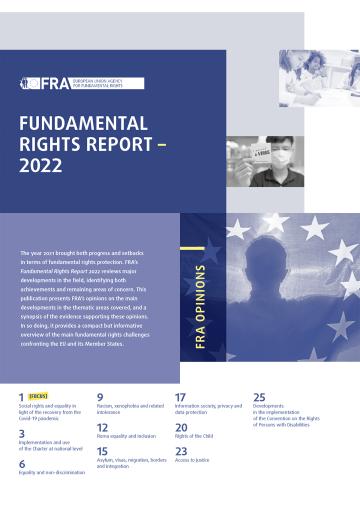
    Anul 2021 a adus atât progrese, cât și pași înapoi în ceea ce privește protecția drepturilor fundamentale. Raportul privind drepturile fundamentale 2022 al FRA analizează evoluțiile majore din domeniu, identificând atât realizările, cât și problemele îngrijorătoare rămase nesoluționate. Această publicație prezintă opiniile FRA în legătură cu principalele evoluții înregistrate în domeniile tematice vizate, precum și o sinteză a dovezilor care vin în sprijinul acestor opinii.
  • Report / Paper / Summary
    7
    July
    2021
    Italian version now available
    12 September 2022
    This report examines why victims do not report bias-motivated incidents and the barriers that they face when reporting incidents through national crime reporting systems. By mapping existing practices that have a bearing on the victim’s experiences when reporting bias-motivated violence and harassment, it aims to provide evidence to support national efforts to encourage and facilitate reporting – and ultimately assist Member States in delivering on their duties with regard to combating hate crime.
  • Report / Paper / Summary
    21
    January
    2021
    German language version now available
    26 January 2021
    Instituțiile naționale pentru apărarea drepturilor omului (INDO) reprezintă o parte vitală a sistemului de protecție a drepturilor omului existent la nivelul unei țări. Prin eforturile lor de sensibilizare, consiliere, monitorizare și responsabilizare a autorităților, aceste instituții au un rol central în depășirea marilor provocări legate de drepturile omului din zilele noastre, abordând atât preocupări persistente, precum cele referitoare la discriminare și inegalitate, cât și chestiuni noi, cum ar fi implicațiile inteligenței artificiale și ale pandemiei de COVID-19 asupra acestor drepturi.
  • Report / Paper / Summary
    3
    September
    2020
    Summary version now available
    21 January 2021
    National Human Rights Institutions (NHRIs) are a vital part of the country-level human rights protection system. This report, published 10 years after FRA’s first in-depth study on NHRIs, looks at such bodies in the EU, as well as the Republic of North Macedonia, the Republic of Serbia, and the United Kingdom of Great Britain and Northern Ireland. It explores relevant developments, challenges to their effectiveness and ways to maximise their impact.
  • Fundamental Rights Report
    11
    June
    2020
    Now available in all 24 official EU languages
    12 August 2020
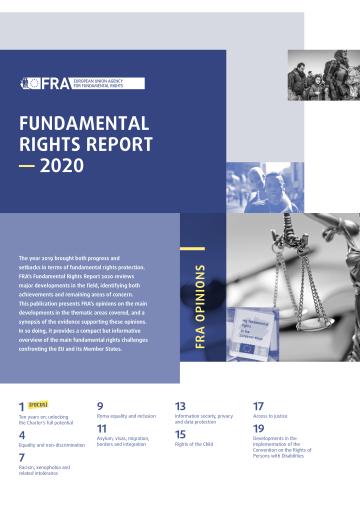
    Anul 2019 a adus atât progrese, cât și pași înapoi în
    ceea ce privește protecția drepturilor fundamentale.
    Raportul privind drepturile fundamentale 2020 al FRA
    analizează evoluțiile majore din domeniu, identificând
    atât realizările, cât și problemele îngrijorătoare rămase
    nesoluționate. Această publicație prezintă opiniile FRA
    în legătură cu principalele evoluții înregistrate în
    domeniile tematice vizate, precum și o sinteză
    a dovezilor care vin în sprijinul acestor opinii. Astfel,
    raportul oferă o prezentare compactă, dar informativă
    a principalelor provocări legate de drepturile
    fundamentale cu care se confruntă UE și statele sale
    membre.
  • Periodic updates / Series
    21
    July
    2026
    This is the second bulletin in FRA’s new quarterly series monitoring the situation of migrants, asylum seekers and refugees. It covers key developments and ongoing concerns from 1 April to 30 June 2026.

    Following regular reporting on fundamental rights issues related to migration and asylum from 2015 to 2023, FRA resumed the series in 2026 under the EU's 2024 Asylum and Migration Management Regulation, ahead of the June 2026 implementation of the EU Migration and Asylum Pact. The first bulletin, published in April 2026, covered developments from 1 January 2025 to 31 March 2026.
  • In brief / Factsheet
    30
    June
    2026
    This factsheet examines case law on cross-border child abduction, meaning the unlawful removal of a child from one EU Member State to another. Jointly published by the European Court of Human Rights and the EU Agency for Fundamental Rights, it explains how courts handle issues where EU law and human rights law overlap. It highlights key court decisions from the Court of Justice of the European Union (CJEU) and the European Court of Human Rights (ECtHR) to show how these two legal systems work together on issues of child abduction and prioritising the best interests of the child.
  • Handbook / Guide / Manual
    29
    June
    2026
    This guidance explains the role of a guardian assigned to a child during the screening and asylum procedure. It provides an overview of the different phases of the process and outlines a child’s legal rights throughout. The guidance includes topics such as lodging an application for international protection, preparing for the application interview and appealing against a negative decision. The European Union Agency for Asylum (EUAA) and the European Union Agency for Fundamental Rights (FRA) have developed a series of practical tools for guardians of unaccompanied children with international protection needs.
  • Report / Paper / Summary
    23
    June
    2026
    The publication is an excerpt from the full report: Places of care = places of safety? Violence against persons with disabilities in institutions. The report looks at the breadth and depth of violence and neglect faced by people with disabilities living in institutions. It includes key findings and calls for better protection, greater prevention of violence, and clear accountability. It urges the EU and its Member States to implement their obligations on equality and fundamental rights. It is available in English, German, Croatian, Italian, Latvian, Polish, Portuguese, Slovakian and Slovenian.