W niniejszym przewodniku wyjaśniono, czym jest profilowanie, które ramy prawne je regulują oraz dlaczego prowadzenie profilowania w sposób zgodny z prawem jest zarówno konieczne, aby przestrzegać praw podstawowych, jak i kluczowe do prowadzenia skutecznych działań policji i skutecznego zarządzania granicami. W przewodniku zawarto również praktyczne wytyczne dotyczące sposobu unikania niezgodnego z prawem profilowania podczas operacji policyjnych i zarządzania granicami.
O presente guia explica o que é a definição de perfis, os quadros jurídicos que a regulam e a razão pela qual a definição lícita de perfis é necessária para fazer respeitar os direitos fundamentais e indispensável para a eficácia da ação policial e da gestão das fronteiras. O guia fornece igualmente orientações práticas sobre como evitar a definição ilícita de perfis nas operações policiais e de gestão das fronteiras.
Prezentul ghid explică ce este crearea de profiluri, cadrele juridice care o reglementează și motivele pentru care utilizarea profilurilor în mod legal este necesară pentru respectarea drepturilor fundamentale și, totodată, esențială pentru eficiența activității polițienești și de gestionare a frontierelor. De asemenea, ghidul oferă îndrumări practice care să ajute la evitarea situațiilor în care utilizarea profilurilor în cadrul operațiunilor poliției și ale autorităților de gestionare a frontierelor este ilegală.
V tejto príručke sa vysvetľuje, čo je profilovanie, akými právnymi rámcami sa riadi, a prečo vykonávanie profilovania v súlade so zákonom je nutné na dodržiavanie základných práv, ako aj na účely efektívnej policajnej práce a riadenia hraníc. V príručke sa uvádzajú tiež praktické usmernenia týkajúce sa toho, ako zabrániť nezákonnému profilovaniu v policajných operáciách a operáciách riadenia hraníc.
V tem priročniku je pojasnjeno, kaj je profiliranje, kateri pravni okviri ga urejajo ter zakaj je zakonitost profiliranja potrebna zaradi spoštovanja temeljnih pravic ter ključna za učinkovito policijsko delo in upravljanje meja. Priročnik vsebuje tudi praktične smernice o tem, kako se izogniti nezakonitemu profiliranju pri policijskih operacijah in operacijah upravljanja meja.
I denna vägledning förklaras vad profilering innebär, vilken rättslig ram som utgör dess grund och varför en laglig profilering både är nödvändig för att uppfylla de grundläggande rättigheterna och helt avgörande för att effektivisera polisarbetet och gränsförvaltningen. Vägledningen innehåller även praktiska riktlinjer om hur olaglig profilering kan undvikas vid insatser inom polisverksamheten och gränsförvaltningen.
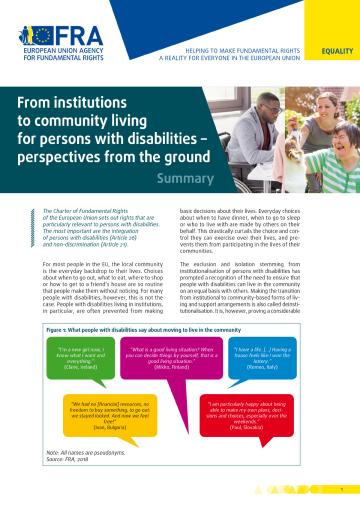
The Convention on the Rights of Persons with Disabilities commits both the EU and all of its Member States to realising the right of persons with disabilities to live independently in the community – which includes achieving deinstitutionalisation for those residing in institutional settings. But much remains to be done to make this a reality in practice. This report presents the main insights gained during fieldwork on the drivers of and barriers to deinstitutionalisation. Focusing on the local level, it gives voice to a diverse set of actors – most importantly, to people with disabilities themselves.
The European Union Agency for Fundamental Rights
(FRA) wanted to contribute to making steps to implement
deinstitutionalisation more effective, by capturing
concrete evidence of what is and what is
not working on the ground. To do this, the agency
conducted extensive fieldwork research in five EU
Member States at different stages of the deinstitutionalisation
process.
This summary report presents the key findings of
that fieldwork and the FRA opinions stemming from
them.
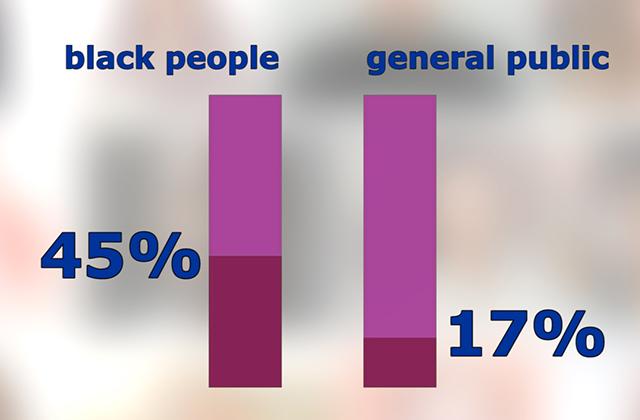
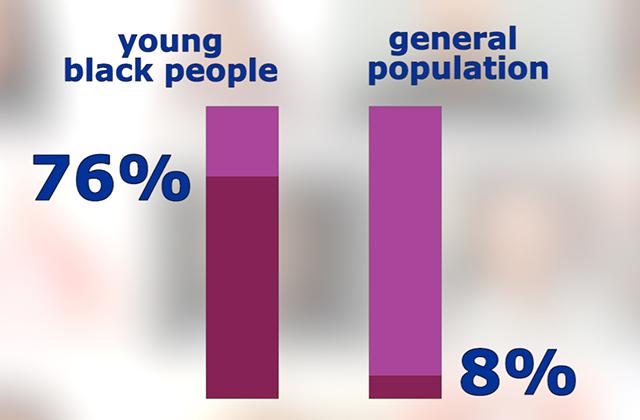
Black people in the EU face unacceptable difficulties in getting a decent job because of their skin colour. Racist harassment also remains all too common.
Almost twenty years after adoption of EU laws forbidding discrimination, people of African descent in the EU face widespread and entrenched prejudice and exclusion. This report outlines selected results from FRA's second large-scale EU-wide survey on migrants and minorities (EU-MIDIS II) carried out in 2016. It examines the experiences of almost 6,000 people of African descent in 12 EU Member States.
Civil society organisations play a critical role in democracies, and the importance of their work is widely recognised in international legal and policy documents. However, they face many obstacles when it comes to their day-to-day work. Based on the results of an online consultation with FRA's civil society network, the Fundamental Rights Platform (FRP), in September 2018, this paper complements the January 2018 report.
This report presents the main insights gained during the EU Fundamental Rights Agency’s project on local engagement for Roma inclusion, which explores how to best involve Roma in integration efforts at the local level. Bringing together local authorities and residents, especially Roma, it investigated what aspects work, which ones do not, and why this is the case.
Antisemitism can be expressed in the form of verbal and physical attacks, threats,
harassment, discrimination and unequal treatment, property damage and graffiti or other
forms of speech or text, including on the internet. The present report provides an overview of data on antisemitism as recorded by
international organisations and by official and unofficial sources in the 28 European
Union (EU) Member States, based on their own definitions and categorisations.
The EU Agency for Fundamental Rights’ 2018 Fundamental Rights Forum
brought together more than 700 human rights champions at a time of
widening social divisions and increasingly polarised politics across
Europe.
Almost 25 million children under 18 are at risk of poverty or social exclusion in the EU. Poverty deprives children of educational
opportunities, childcare, access to health care, adequate food and housing, family support and even protection from violence.
This report outlines data and survey findings that highlight the magnitude of child poverty in the EU, but also presents tools
available to counter this phenomenon and keep track of progress made.
With this Opinion, FRA aims to contribute to the European Parliament's own-initiative report on the “Implementation of the Charter of Fundamental Rights of the European Union in the EU institutional framework”, being prepared in the Parliament’s Committee for Constitutional Affairs (AFCO). The request aims at understanding the interaction between the Charter’s implementation at national and EU level, and whether there are “instruments, mechanisms and practices” available at EU level to assist Member States to better implement the Charter.
With enormous volumes of data generated every day, more and more decisions are based on data analysis and algorithms. This can bring welcome benefits, such as consistency and objectivity, but algorithms also entail great risks. A FRA focus paper looks at how the use of automation in decision making can result in, or exacerbate, discrimination.
In November 2017, the European Commission requested FRA’s support in evaluating the impact on fundamental rights of the European Border Surveillance System (Eurosur) Regulation. Further to this request, FRA reviewed the work of the European Border and Coast Guard Agency (Frontex) and analysed cooperation agreements concluded by EU Member States with third countries which are relevant for the exchange of information for the purposes of Eurosur. This report presents the main findings of such review.
This Opinion aims to
inform the European Parliament’s position on the legislative proposal amending the
Visa Information System, the Visa Code and other related provisions of EU law. The
European Commission presented the proposal on 16 May 2018 and EU legislators are
currently discussing it.