This report provides an overview of data on antisemitism as recorded by
international organisations and by official and unofficial sources in the 28 European
Union (EU) Member States, based on their own definitions and categorisations.
Muslims living in the EU face discrimination in a broad range of settings – and particularly when looking for work, on the job, and when trying to access public or private services. The report examines how characteristics – such as an individual's first and last name, skin colour and the wearing of visible religious symbols like a headscarf, for example – may trigger discriminatory treatment and harassment.
Diverse efforts at both EU and national levels sought to bolster fundamental rights protection in 2016, while some measures threatened to undermine such protection.
Diverse efforts at both EU and national levels sought to bolster fundamental rights protection in 2016, while some measures threatened to undermine such protection.
Hate crime is the most severe expression of discrimination and a core fundamental rights abuse. The European Union (EU) has demonstrated its resolve to tackle hate crime with legislation such as the 2008 Framework Decision on combating certain forms and expressions of racism and xenophobia by means of criminal law. Nonetheless, the majority of hate crimes perpetrated in the EU remain unreported and therefore invisible, leaving victims without redress.
Antisemitism can be expressed in the form of verbal and physical attacks, threats,
harassment, property damage and graffiti or other forms of text, including on the
internet. The present report relates to manifestations of antisemitism as they are
recorded by international organisations, and by official and unofficial sources in the
28 EU Member States.
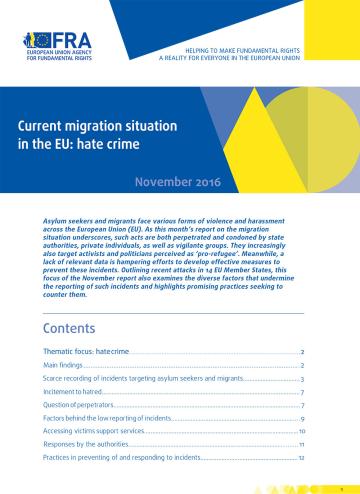
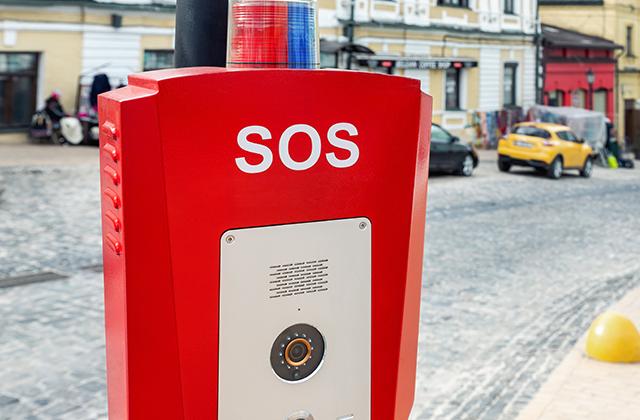
Asylum seekers and migrants face various forms of violence and harassment across the European Union (EU). As this month’s report on the migration situation underscores, such acts are both perpetrated and condoned by state authorities, private individuals, as well as vigilante groups. They increasingly also target activists and politicians perceived as ‘pro-refugee’.
A free and pluralist media is vital to the democratic functioning of the European
Union (EU) and its Member States. However, journalists and other media actors
in the EU face various challenges, including violence, threats and other forms of
pressure, both direct and indirect.
Media content and political discourse in EU Member States, whether online or
offline, show incitement to discrimination, hatred or violence on different
grounds, as evidence collected by FRA reveals. The growing reliance on the internet as the main source of
information for many enables the fast spread of often unverified statements
that could also incite to hatred.
The European Union (EU) and its Member States introduced and pursued numerous initiatives to safeguard and strengthen
fundamental rights in 2015. Some of these efforts produced important progress; others fell short of their aims. Meanwhile,
various global developments brought new – and exacerbated existing – challenges.


 Report / Paper / Summary7July2021
 Report / Paper / Summary21June2018