This report provides an overview of data on antisemitism as recorded by
international organisations and by official and unofficial sources in the 28 European
Union (EU) Member States, based on their own definitions and categorisations.
Les musulmans qui vivent dans l’Union européenne sont confrontés à la discrimination dans de nombreuses circonstances, en particulier lorsqu’ils cherchent un emploi, qu’ils travaillent ou qu’ils essaient d’accéder à des services publics ou privés. Ce rapport examine la manière dont des caractéristiques telles que le prénom et le nom d’une personne, la couleur de la peau et le fait de porter des symboles religieux visibles (le foulard par exemple) peuvent déclencher un comportement discriminatoire ou de harcèlement.
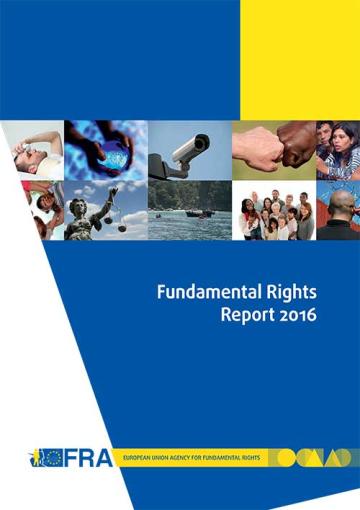
Différents efforts déployés aux niveaux national et de l’Union européenne (UE) visaient à promouvoir la protection des droits fondamentaux en 2016, tandis que certaines mesures risquaient de compromettre cette protection.
Diverse efforts at both EU and national levels sought to bolster fundamental rights protection in 2016, while some measures threatened to undermine such protection.
Le crime de haine est la manifestation la plus grave
de discrimination et constitue une violation majeure
des droits fondamentaux. L’Union européenne (UE)
a illustré sa détermination à lutter contre les crimes
de haine en prenant des mesures législatives telle
que la décision-cadre de 2008 sur la lutte contre
certaines formes et manifestations de racisme et de
xénophobie au moyen du droit pénal. Toutefois, la
majorité des crimes de haine perpétrés dans l’UE ne
font pas l’objet d’un dépôt de plainte et demeurent
par conséquent invisibles, laissant souvent les
victimes sans possibilité de former un recours.
Antisemitism can be expressed in the form of verbal and physical attacks, threats,
harassment, property damage and graffiti or other forms of text, including on the
internet. The present report relates to manifestations of antisemitism as they are
recorded by international organisations, and by official and unofficial sources in the
28 EU Member States.
Asylum seekers and migrants face various forms of violence and harassment across the European Union (EU). As this month’s report on the migration situation underscores, such acts are both perpetrated and condoned by state authorities, private individuals, as well as vigilante groups. They increasingly also target activists and politicians perceived as ‘pro-refugee’.
A free and pluralist media is vital to the democratic functioning of the European
Union (EU) and its Member States. However, journalists and other media actors
in the EU face various challenges, including violence, threats and other forms of
pressure, both direct and indirect.
Media content and political discourse in EU Member States, whether online or
offline, show incitement to discrimination, hatred or violence on different
grounds, as evidence collected by FRA reveals. The growing reliance on the internet as the main source of
information for many enables the fast spread of often unverified statements
that could also incite to hatred.
The European Union (EU) and its Member States introduced and pursued numerous initiatives to safeguard and strengthen
fundamental rights in 2015. Some of these efforts produced important progress; others fell short of their aims. Meanwhile,
various global developments brought new – and exacerbated existing – challenges.


 Report / Paper / Summary7juillet2021
 Report / Paper / Summary21juin2018