Οι εθνικοί οργανισμοί για τα ανθρώπινα δικαιώματα (ΕΟΑΔ) αποτελούν καίριας σημασίας στοιχείο του συστήματος προστασίας των ανθρωπίνων δικαιωμάτων σε επίπεδο χωρών. Μέσω της ευαισθητοποίησης, της παροχής συμβουλών, της παρακολούθησης και της εξασφάλισης λογοδοσίας των αρχών, διαδραματίζουν κεντρικό ρόλο στην αντιμετώπιση των μεγάλων σύγχρονων προκλήσεων στον τομέα των ανθρωπίνων δικαιωμάτων —τόσο σε ό,τι αφορά τα ζητήματα που προκαλούν επίμονες ανησυχίες, όπως οι διακρίσεις και η ανισότητα, όσο και σε ό,τι αφορά καινοφανή ζητήματα, όπως οι επιπτώσεις της τεχνητής νοημοσύνης και της πανδημίας COVID-19 στα ανθρώπινα δικαιώματα.
National Human Rights Institutions (NHRIs) are a vital part of the country-level human rights protection system. By raising awareness, providing advice, monitoring and holding authorities to account, they have a central role in navigating the great human rights challenges of our day – tackling both persistent concerns like discrimination and inequality, and novel issues such as the rights implications of artificial intelligence and of the COVID-19 pandemic.
Las instituciones nacionales de derechos humanos (INDH) constituyen una parte esencial del sistema de protección de los derechos humanos en cada país. Con su trabajo de sensibilización, asesoramiento, supervisión y exigencia de rendición de
cuentas a las autoridades, estas instituciones desempeñan un papel fundamental a la hora de abordar los grandes retos actuales en materia de derechos humanos, al ocuparse tanto de problemáticas recurrentes, tales como la discriminación y la
desigualdad, como de problemas de reciente aparición como las implicaciones desde el punto de vista de los derechos de la inteligencia artificial y de la pandemia de la COVID-19.
Inimõigustega tegelevad riiklikud asutused on oluline osa inimõiguste kaitse süsteemist riigi tasandil. Teadlikkuse suurendajate, nõustajate ning ametiasutuste jälgijate ja vastutusele võtjatena on neil keskne roll tänapäeva suurte inimõigusprobleemide lahendamisel ning nad tegelevad nii alaliste probleemidega, nagu diskrimineerimine ja ebavõrdsus, kui ka uute küsimustega, nagu COVID-19 pandeemia ja tehisintellekti mõju inimõigustele.
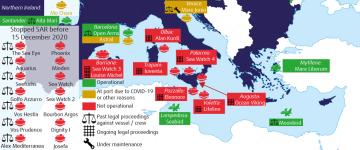
In 2020 (until 15 December), the International Organization for Migration estimated that about 1,054 people have died or gone missing while crossing the Mediterranean Sea to reach Europe to escape war or persecution or to pursue a better life. This is an average of almost three people per day. In the past years, a significant number of migrants in distress at sea have been rescued by civil society vessels deployed with a humanitarian mandate to reduce fatalities and bring rescued migrants to safety. Since 2018, however, national authorities initiated some 50 administrative and criminal proceedings against crew members or vessels, also seizing the latter. In some cases, rescue vessels were blocked in harbours due to flag issues or the inability to meet maritime safety-related and other technical requirements.
The European Convention on Human Rights and European Union law provide an increasingly important framework for the protection of the rights of foreigners. European Union legislation relating to asylum, borders and immigration is developing fast. There is an impressive body of case law by the European Court of Human Rights relating in particular to Articles 3, 5, 8 and 13 of the ECHR. The Court of Justice of the European Union is increasingly asked to pronounce on the interpretation of European Union law provisions in this field. The third edition of this handbook, updated up to July 2020, presents this European Union legislation and the body of case law by the two European courts in an accessible way.
В настоящото резюме се представят основните
изводи от първия доклад на FRA, които се
базират на проучването ѝ за основните права.
В проучването са събрани данни от около 35 000
лица относно техния опит, възприятия и мнения
по редица въпроси, които са обхванати по
различен начин от правата на човека.
Toto shrnutí představuje hlavní poznatky z první
zprávy agentury FRA, která vychází z průzkumu
o základních právech. Průzkum shromáždil od
přibližně 35 000 lidí údaje o jejich zkušenostech,
vnímání a názorech na celou řadu otázek, které
různým způsobem zasahují do oblasti lidských práv.
Dette sammendrag indeholder de vigtigste
erfaringer fra FRA’s første rapport, der er baseret
på dets spørgeundersøgelse om grundlæggende
rettigheder. I undersøgelsen blev der indsamlet
data fra ca. 35 000 personer om deres erfaringer,
opfattelse og mening vedrørende en række
spørgsmål, der er omfattet af forskellige
menneskerettigheder.
Η παρούσα περίληψη παρουσιάζει τα κυριότερα
στοιχεία της πρώτης έκθεσης του FRA η οποία
βασίζεται στην έρευνά του για τα θεμελιώδη
δικαιώματα. Για τις ανάγκες της έρευνας
συλλέχθηκαν δεδομένα από περίπου 35 000 πολίτες
σχετικά με τις εμπειρίες, τις αντιλήψεις και τη γνώμη
τους για μια σειρά θεμάτων που άπτονται με
ποικίλους τρόπους των ανθρωπίνων δικαιωμάτων.
The EU is founded on the values of democracy, rule of law and respect for human rights. Yet these values, and discussions on fundamental rights at the EU and Member State level, can seem remote in people’s daily lives. With this in mind, FRA explored what people understand, know and experience with respect to their fundamental rights in practice. The resulting data provide comprehensive and comparable evidence on these aspects.
Este resumen presenta las principales percepciones
del primer informe de la Agencia de los Derechos
Fundamentales de la Unión Europea (FRA) basado
en su encuesta sobre los derechos fundamentales.
La encuesta recabó datos de unas 35 000 personas
sobre sus experiencias, percepciones y opiniones
en relación con una serie de cuestiones
relacionadas, de diversas maneras, con los
derechos humanos.
Käesolevas ülevaates tutvustatakse peamisi
õppetunde Euroopa Liidu Põhiõiguste Ameti
esimesest aruandest põhiõiguste uuringu kohta.
Uuringus koguti ligikaudu 35 000 inimeselt
andmeid nende kogemuste, arusaamade ja
arvamuste kohta seoses rea küsimustega, mis
puutuvad eri moel kokku inimõigustega.
Šioje santraukoje pateikiamos pagrindinės FRA
pirmos ataskaitos, grindžiamos pagrindinių teisių
tyrimu, įžvalgos. Tyrimo metu iš maždaug 35 000
žmonių surinkti duomenys apie jų patirtį, suvokimą
ir nuomonę tam tikrais klausimais, įvairiai
susijusiais su žmogaus teisėmis.
W niniejszym streszczeniu zaprezentowano główne
spostrzeżenia zawarte w pierwszym sprawozdaniu
FRA z przeprowadzonego badania dotyczącego praw
podstawowych. W ramach badania zebrano
informacje od około 35 tys. osób dotyczące ich
doświadczeń, poglądów i opinii na temat szeregu
kwestii w różny sposób związanych z prawami
człowieka.
Rezumatul de față prezintă principalele constatări
ale primului raport întocmit de FRA pe baza
Sondajului privind drepturile fundamentale.
Sondajul a colectat date de la aproximativ 35 000
de persoane referitor la experiențele, la percepțiile
și la opiniile acestora cu privire la o serie de
aspecte care intră în sfera drepturilor omului sub
diverse forme.
V tomto zhrnutí sú uvedené hlavné poznatky
z prvej správy agentúry FRA založenej na
prieskume základných práv, ktorý uskutočnila
agentúra. V prieskume boli zhromaždené údaje
približne od 35 000 osôb o skúsenostiach, vnímaní
a názoroch týkajúcich sa celého radu záležitostí,
ktoré sa rôznym spôsobom týkajú ľudských práv.
V tem povzetku so predstavljeni glavni uvidi iz
prvega poročila agencije FRA na podlagi njene
raziskave o temeljnih pravicah. V raziskavi so bili
pri približno 35 000 ljudeh zbrani podatki o njihovih
izkušnjah, dojemanju in mnenjih v zvezi z vrsto
vprašanj, ki se na različne načine nanašajo na
človekove pravice.
Den här sammanfattningen innehåller de viktigaste
lärdomarna från FRA:s första rapport, baserad
på undersökningen om de grundläggande
rättigheterna. I undersökningen samlades data in
från runt 35 000 människor om deras erfarenheter
av, inställning till och åsikter om en mängd frågor
som på olika sätt rör de mänskliga rättigheterna.
National Human Rights Institutions (NHRIs) are a vital part of the country-level human rights protection system. This report, published 10 years after FRA’s first in-depth study on NHRIs, looks at such bodies in the EU, as well as the Republic of North Macedonia, the Republic of Serbia, and the United Kingdom of Great Britain and Northern Ireland. It explores relevant developments, challenges to their effectiveness and ways to maximise their impact.