This report presents findings from FRA’s 2021 survey on Roma in Croatia, Czechia, Greece, Hungary, Italy, Portugal, Romania and Spain, as well as in North Macedonia and Serbia. The survey includes interviews with more than 8,400 Roma, collecting information on more than 20,000 individuals living in their households. By focusing on Roma, the survey provides unique data and information that are not available from European general population surveys, which do not disaggregate on grounds of ethnic origin. The findings present a bleak but familiar picture of exclusion, deprivation, discrimination and racism.
The Russian invasion of Ukraine triggered solidarity from EU governments, local authorities and society as they welcomed more than 7 million people fleeing the aggression. The European Union’s rapid response, activating the EU Temporary Protection Directive, offered welcome relief and much-needed support to those in need. It allowed displaced persons the opportunity to quickly settle and to work, travel and access services across the EU. But other pressing human rights issues have come to the fore and remain high on the EU’s agenda, such as human trafficking, sexual and gender-based violence, hate crime and hate-fuelled disinformation.
** As of 19 September 2024 a new version of this guidance has been issued. Please see the link below. **
Fundamental rights monitoring at EU external borders should be systematically and regularly carried out for a range of border management activities. These include border surveillance, apprehensions at land, sea and air borders, and the operation of referral mechanisms, including in the event of mass arrivals. This general guidance provides assistance to EU Member States in setting up national independent mechanisms to monitor fundamental rights compliance at EU external borders, in line with the proposed screening regulation of 23 September 2020 by the European Commission. The EU Agency for Fundamental Rights prepared this guidance at the request of the Commission.
Monitorowanie praw podstawowych na granicach zewnętrznych UE powinno być prowadzone systematycznie i regularnie w odniesieniu do szeregu działań związanych z zarządzaniem granicami. Należą do nich: ochrona granicy, zatrzymania na granicach lądowych, morskich i powietrznych oraz funkcjonowanie mechanizmów ukierunkowanej pomocy, także w przypadku masowego napływu. Niniejsze ogólne wytyczne stanowią pomoc dla państw członkowskich w tworzeniu niezależnych krajowych mechanizmów monitorowania przestrzegania praw podstawowych na granicach zewnętrznych UE, zgodnie z proponowanym przez Komisję Europejską rozporządzeniem w sprawie kontroli przesiewowej z dnia 23 września 2020 r. Agencja Praw Podstawowych Unii Europejskiej przygotowała niniejsze wytyczne na wniosek Komisji.
Acts of terrorism represent a serious threat to the lives and safety of people, and a profound security challenge for states. At the same time, counter-terrorism legislation, policies and other measures can entail, directly or indirectly, serious limitations to fundamental rights, and can adversely affect individuals, groups and society as a whole. This summary presents FRA’s main findings from its report on Directive (EU) 2017/541 on combating terrorism, the main criminal law instrument at EU level in the field of counter-terrorism.
Civilsamfundsorganisationer står over for forskellige udfordringer overalt i Den Europæiske Union. Med sin rapport Protecting civic space in the EU fremlægger FRA sine konklusioner om disse udfordringer. Rapporten blev fremlagt i september 2021. Dette er et sammendrag af hovedresultaterne og FRA’s udtalelser i rapporten.
Civil society organisations face diverse challenges across the European Union. FRA’s report on Protecting civic space in the EU presents the agency’s findings on these challenges. It was issued in September of 2021. This summary presents the Key findings and FRA opinions outlined in the report.
Organizacje społeczeństwa obywatelskiego w całej Unii Europejskiej stają w obliczu różnych wyzwań. Sprawozdanie FRA na temat ochrony przestrzeni społeczeństwa obywatelskiego w UE zawiera ustalenia agencji dotyczące tych wyzwań. Zostało wydane we wrześniu 2021 r. W niniejszym streszczeniu przedstawiono najważniejsze ustalenia i opinie FRA zawarte w sprawozdaniu.
Civil society is a key component of Europe’s fundamental rights architecture. From supporting people affected by the pandemic to helping those fleeing the war in Ukraine, civil society plays a crucial role in upholding people’s rights. In so doing, it contributes to a healthy rule of law culture. FRA’s civic space report provides an overview of the many ways in which civil society contributes to the checks and balances that underpin the rule of law.
Since September 2021, two National Human Rights Institutions (NHRIs) had a change in their accreditation status, one applied for accreditation and five have had a change in tasks covered by their mandates. This new 2022 update provides an overview of developments in the accreditation status and mandates of NHRIs from September 2021 to May 2022. It is a follow up of FRA’s 2020 report on ‘Strong and effective national human rights institutions – challenges, promising practices and opportunities’ and the September 2021 update. It covers the 27 EU Member States and three candidate countries (Albania, North Macedonia and Serbia).
Every child has a right to be protected even when they are accused or suspected of committing a crime. The basic principles of justice apply to adults and children alike. But children face specific obstacles during criminal proceedings, such as a lack of understandable information about their rights, limited legal support and poor treatment. The report looks at the practical implementation of Directive (EU) 2016/800 on procedural safeguards for children who are suspects or accused persons in criminal proceedings in nine Member States – Austria, Belgium, Bulgaria, Germany, Estonia, Italy, Malta, Poland and Portugal.
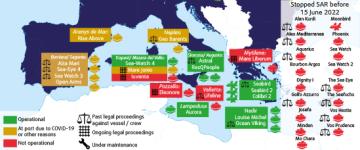
The EU Agency for Fundamental Rights (FRA) regularly collects data on the operations of NGO vessels involved in search and rescue in the Mediterranean. This includes any legal proceedings against them, as well as on any difficulties in disembarking migrants in safe ports. The International Organization for Migration estimates that from January to 15 June 2022 about 842 people died or went missing while crossing the Mediterranean Sea to reach Europe to escape war or persecution, or to pursue a better life. This is an average of five people per day.
FRA’s Fundamental Rights Report 2022 reviews major developments in the field in 2021, identifying both achievements and areas of concern. It also presents FRA’s opinions on these developments, including a synopsis of the evidence supporting these opinions.
This focus looks at the impact of the pandemic on social rights. It examines the measures in national recovery and resilience plans that address the social vulnerabilities among a variety of population groups in the EU, including women, children and young people in situations of vulnerability, people with disabilities, older people, Roma and people in precarious working conditions.
I 2021 oplevede vi både fremgang og tilbagegang med hensyn til beskyttelsen af grundlæggende rettigheder. FRA’s rapport om grundlæggende rettigheder — 2022 gennemgår udviklingen på dette område og fastslår både, hvad der er opnået, og hvilke områder, der fortsat volder bekymring. Publikationen indeholder FRA’s udtalelser om udviklingen på de afdækkede emneområder og et sammendrag af den underliggende evidens for disse udtalelser. Den giver således en kompakt, men informativ oversigt over de vigtigste udfordringer, som EU og medlemsstaterne står over for med hensyn til grundlæggende rettigheder.
The year 2021 brought both progress and setbacks in terms of fundamental rights protection. FRA’s Fundamental Rights Report 2022 reviews major developments in the field, identifying both achievements and remaining areas of concern. This publication presents FRA’s opinions on the main developments in the thematic areas covered, and a synopsis of the evidence supporting these opinions.
Rok 2021 przyniósł zarówno postępy, jak i regres pod względem ochrony praw podstawowych. Sprawozdanie FRA na temat praw podstawowych z 2022 r. zawiera przegląd najważniejszych zmian, jakie miały miejsce w tym obszarze – wskazano w nim zarówno osiągnięcia, jak i kwestie, które nadal wymagają stosownych działań. W niniejszej publikacji przedstawiono opinie FRA na temat najważniejszych zmian, jakie miały miejsce w uwzględnionych obszarach tematycznych, oraz podsumowanie
dowodów, na których oparto te opinie.
This bulletin looks at the fundamental rights situation of all persons fleeing the Russian war in Ukraine to the four EU Member States neighbouring Ukraine. This is primarily in terms of the application of the EU Temporary Protection Directive. It is based on findings of FRA’s field mission to Hungary, Poland, Romania and Slovakia at the beginning of March 2022. It is also based on weekly country reports prepared by Franet, the contracted research network of FRA between 1 March and 27 April 2022.
Denne vejledning kan hjælpe byer, der ønsker at forbedre deres indsats for at respektere menneskerettighederne. Den har til formål at tilskynde lokale myndigheder til at vedtage højere menneskerettighedsstandarder. Idéen er at tilskynde til og støtte gensidig læring om menneskerettighederne og de grundlæggende rettigheder. Den Europæiske Unions Agentur for Grundlæggende Rettigheder (FRA), en gruppe menneskerettighedsbyer og forskellige aktører i EU har
samarbejdet om at udarbejde denne vejledning. Vejledningen er baseret på erfaringer og lovende praksis fra byer, regioner, eksperter, internationale organisationer og netværk, hvilket du kan finde mere om i FRA-rapporten Human rights cities in the EU: A framework for reinforcing rights locally (Menneskerettighedsbyer i EU: En ramme for styrkelse af rettigheder lokalt).