Den hurtige udvikling inden for informations- og kommunikationsteknologi fremhæver det øgede behov for
solid beskyttelse af personoplysninger – en ret, der er sikret ved både EU’s og Europarådets instrumenter.
Beskyttelse af denne vigtige rettighed indebærer nye og væsentlige udfordringer, da teknologiske fremskridt
udvider mulighederne for f.eks. overvågning, opfangelse af kommunikation og lagring af data. Denne håndbog
har til formål at give jurister, som ikke er specialister inden for databeskyttelse, kendskab til dette nye
juridiske område.
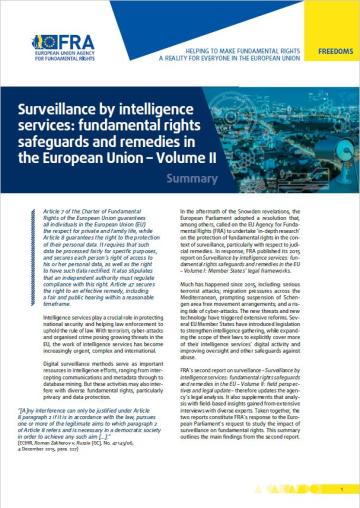
Med tiltagende trusler i form af terrorisme, internetangreb og sofistikerede grænseoverskridende kriminelle netværk er efterretningstjenesternes arbejde blevet mere påtrængende, komplekst og internationalt. Dette arbejde kan kraftigt forstyrre de grundlæggende rettigheder, især beskyttelsen af personoplysninger og privatlivets fred. Selvom den fortsatte teknologiske udvikling potentielt
forværrer risikoen for en sådan forstyrrelse, kan et effektivt tilsyn og effektive retsmidler bremse muligheden for misbrug.
This report is FRA’s second publication addressing a European Parliament request for in-depth research on the impact of surveillance on fundamental rights. It updates FRA’s 2015 legal analysis on the topic, and supplements that analysis with field-based insights gained from extensive interviews with diverse experts in intelligence and related fields, including its oversight.
In 2006 the EU issued its Data Retention Directive. According to the Directive, EU Member States had to store electronic telecommunications data for at least six months and at most 24 months for investigating, detecting and prosecuting serious crime. In 2016, with an EU legal framework on data retention still lacking, the CJEU further clarified what safeguards are required for data retention to be lawful.This paper looks at amendments to national data retention laws in 2016 after the Digital Rights Ireland judgment.
This report, drafted in response to the European Parliament’s call for thorough research on fundamental rights protection in the context of surveillance, maps and analyses the legal frameworks on surveillance in place in EU Member States.
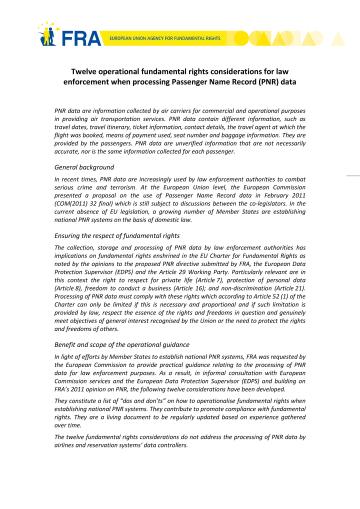
FRA was requested by the European Commission (EC) in January 2014 to provide practical guidance on the processing of Passenger Name Record (PNR) data for law enforcement purposes, in light of efforts by Member States to establish national PNR systems. As a result, in informal consultation with EC services and the European Data Protection Supervisor (EDPS) and building on opinions FRA, the EDPS and the Article 29 Working Party on PNR, FRA presented twelve fundamental rights considerations to EU Member States experts at technical level.
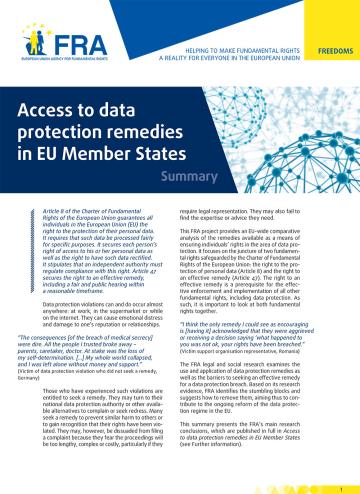
Technological advances make it ever more important to safeguard the right to personal data, which is enshrined in the Charter of Fundamental Rights of the European Union. Data protection violations arise principally from internet‑based activities, direct marketing and video surveillance, perpetrated by, for example, government bodies or financial and health institutions, research by the European Union Fundamental Rights Agency (FRA) shows.
Following a request by the European Parliament on 5 September 2012 for an analysis of the fundamental rights issues associated with the proposed EU data protection reform package, FRA issued its opinion on the draft legislation on 1 October 2012.
When a decision to stop an individual is motivated solely or mainly by virtue of a person's race, ethnicity or religion, this constitutes discriminatory ethnic profiling. Such practices can serve to alienate certain communities in the EU, and in turn can contribute to inefficient policing. The FRA guide aims to help the police address and avoid discriminatory ethnic profiling, and is designed to be used as a tool for more effective policing.



 Report / Paper / Summary24May2023
 Report / Paper / Summary18June2020