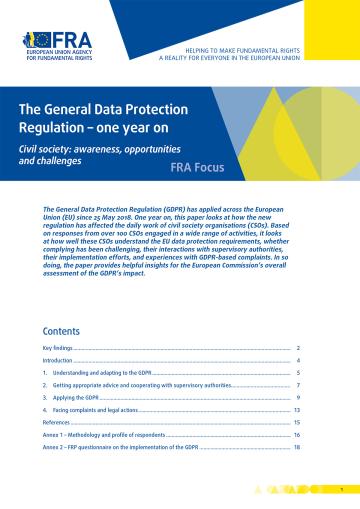
The General Data Protection Regulation (GDPR) has applied across the European Union (EU) since 25 May 2018. One year on, this paper looks at how the new regulation has affected the daily work of civil society organisations (CSOs).
Šiame vadove paaiškinama, kas yra profiliavimas, kokios teisinės sistemos jį reglamentuoja ir kodėl teisėtai vykdyti profiliavimą yra būtina siekiant užtikrinti pagrindines teises ir ypač veiksmingą viešąją tvarką bei sienų valdymą. Vadove pateikiama ir praktinių patarimų, kaip išvengti neteisėto profiliavimo vykdant policijos ir sienų valdymo operacijas.
Handbook / Guide / Manual
25
May
2018
New language versions - Danish, Lithuanian, Slovenian
Dėl sparčios informacinių technologijų plėtros padidėjo poreikis užtikrinti patikimą asmens duomenų apsaugą
taikant tiek Europos Sąjungos, tiek Europos Tarybos priemones. Siekiant užtikrinti šią svarbią teisę, kyla naujų
ir svarbių uždavinių, nes dėl technologinės pažangos plečiamos tokių sričių, kaip stebėjimas, ryšių perėmimas
ir duomenų saugojimas, ribos. Šis vadovas parengtas siekiant supažindinti teisės specialistus, kurie neturi
itin daug žinių apie duomenų apsaugą, su šia naujai besiformuojančia teisės sritimi.
Terorizmui, kibernetiniams išpuoliams ir itin gerai organizuotiems tarpvalstybiniams nusikaltėlių tinklams keliant vis didesnę grėsmę, žvalgybos tarnybų darbas tampa vis labiau būtinas, sudėtingas ir tarptautinis. Tokia veikla gali būti stipriai pažeidžiamos pagrindinės, ypač privatumo ir duomenų apsaugos, teisės. Kadangi dėl nuolatinės technologijų pažangos gali padidėti tokių pažeidimų
grėsmė, veiksminga priežiūra ir teisių gynimo priemonės gali padėti pažaboti piktnaudžiavimo šioje srityje galimybes.
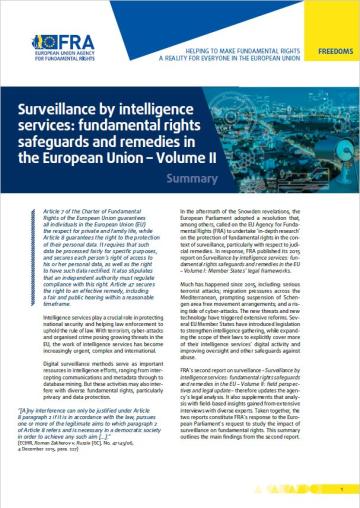
This report is FRA’s second publication addressing a European Parliament request for in-depth research on the impact of surveillance on fundamental rights. It updates FRA’s 2015 legal analysis on the topic, and supplements that analysis with field-based insights gained from extensive interviews with diverse experts in intelligence and related fields, including its oversight.
In 2006 the EU issued its Data Retention Directive. According to the Directive, EU Member States had to store electronic telecommunications data for at least six months and at most 24 months for investigating, detecting and prosecuting serious crime. In 2016, with an EU legal framework on data retention still lacking, the CJEU further clarified what safeguards are required for data retention to be lawful.This paper looks at amendments to national data retention laws in 2016 after the Digital Rights Ireland judgment.
This report, drafted in response to the European Parliament’s call for thorough research on fundamental rights protection in the context of surveillance, maps and analyses the legal frameworks on surveillance in place in EU Member States.
FRA was requested by the European Commission (EC) in January 2014 to provide practical guidance on the processing of Passenger Name Record (PNR) data for law enforcement purposes, in light of efforts by Member States to establish national PNR systems. As a result, in informal consultation with EC services and the European Data Protection Supervisor (EDPS) and building on opinions FRA, the EDPS and the Article 29 Working Party on PNR, FRA presented twelve fundamental rights considerations to EU Member States experts at technical level.
Technological advances make it ever more important to safeguard the right to personal data, which is enshrined in the Charter of Fundamental Rights of the European Union. Data protection violations arise principally from internet‑based activities, direct marketing and video surveillance, perpetrated by, for example, government bodies or financial and health institutions, research by the European Union Fundamental Rights Agency (FRA) shows.



 Report / Paper / Summary24May2023
 Report / Paper / Summary18June2020