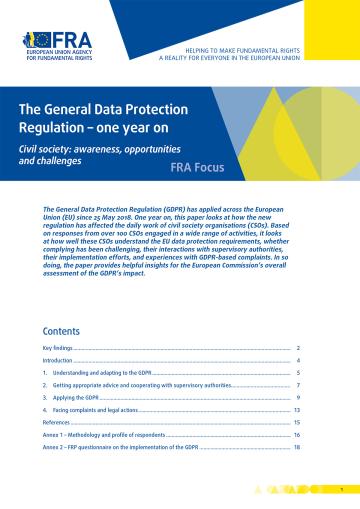
The General Data Protection Regulation (GDPR) has applied across the European Union (EU) since 25 May 2018. One year on, this paper looks at how the new regulation has affected the daily work of civil society organisations (CSOs).
In deze gids wordt uitgelegd wat profilering is, welke wettelijke kaders van toepassing zijn en waarom een rechtmatige toepassing van profilering niet alleen nodig is om aan de grondrechten te voldoen, maar ook van cruciaal belang is voor een doeltreffende ordehandhaving en grensbeheer.
De snelle ontwikkeling van de informatietechnologie heeft de noodzaak voor een degelijke bescherming
van persoonsgegevens weer versterkt, het recht dat wordt gewaarborgd door zowel de Europese Unie
(EU) als de Raad van Europa (RvE). De bescherming van dit belangrijke recht brengt nieuwe en belangrijke
uitdagingen met zich mee, aangezien technologische ontwikkelingen de grenzen van domeinen zoals
toezicht, onderschepping van communicatie en gegevensopslag, verlegt. Deze handleiding is bedoeld voor
beoefenaars van juridische beroepen die niet gespecialiseerd zijn in gegevensbescherming, om vertrouwd
te raken met dit opkomende domein van de wet.
Med tiltagende trusler i form af terrorisme, internetangreb og sofistikerede grænseoverskridende kriminelle netværk er efterretningstjenesternes arbejde blevet mere påtrængende, komplekst og internationalt. Dette arbejde kan kraftigt forstyrre de grundlæggende rettigheder, især beskyttelsen af personoplysninger og privatlivets fred. Selvom den fortsatte teknologiske udvikling potentielt
forværrer risikoen for en sådan forstyrrelse, kan et effektivt tilsyn og effektive retsmidler bremse muligheden for misbrug.
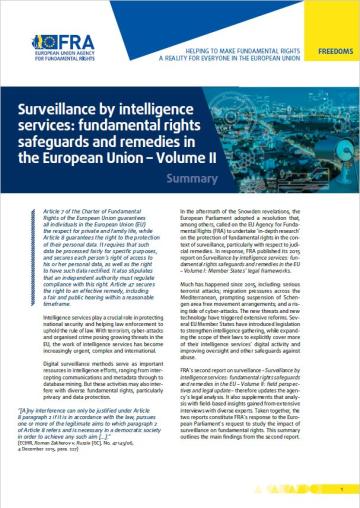
This report is FRA’s second publication addressing a European Parliament request for in-depth research on the impact of surveillance on fundamental rights. It updates FRA’s 2015 legal analysis on the topic, and supplements that analysis with field-based insights gained from extensive interviews with diverse experts in intelligence and related fields, including its oversight.
In 2006 the EU issued its Data Retention Directive. According to the Directive, EU Member States had to store electronic telecommunications data for at least six months and at most 24 months for investigating, detecting and prosecuting serious crime. In 2016, with an EU legal framework on data retention still lacking, the CJEU further clarified what safeguards are required for data retention to be lawful.This paper looks at amendments to national data retention laws in 2016 after the Digital Rights Ireland judgment.
This report, drafted in response to the European Parliament’s call for thorough research on fundamental rights protection in the context of surveillance, maps and analyses the legal frameworks on surveillance in place in EU Member States.
FRA was requested by the European Commission (EC) in January 2014 to provide practical guidance on the processing of Passenger Name Record (PNR) data for law enforcement purposes, in light of efforts by Member States to establish national PNR systems. As a result, in informal consultation with EC services and the European Data Protection Supervisor (EDPS) and building on opinions FRA, the EDPS and the Article 29 Working Party on PNR, FRA presented twelve fundamental rights considerations to EU Member States experts at technical level.
Technological advances make it ever more important to safeguard the right to personal data, which is enshrined in the Charter of Fundamental Rights of the European Union. Data protection violations arise principally from internet‑based activities, direct marketing and video surveillance, perpetrated by, for example, government bodies or financial and health institutions, research by the European Union Fundamental Rights Agency (FRA) shows.



 Report / Paper / Summary24May2023
 Report / Paper / Summary18June2020