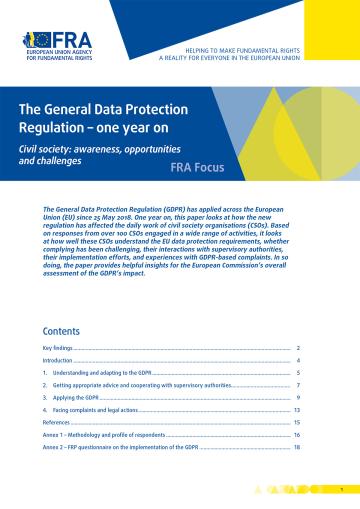
The General Data Protection Regulation (GDPR) has applied across the European Union (EU) since 25 May 2018. One year on, this paper looks at how the new regulation has affected the daily work of civil society organisations (CSOs).
V tem priročniku je pojasnjeno, kaj je profiliranje, kateri pravni okviri ga urejajo ter zakaj je zakonitost profiliranja potrebna zaradi spoštovanja temeljnih pravic ter ključna za učinkovito policijsko delo in upravljanje meja. Priročnik vsebuje tudi praktične smernice o tem, kako se izogniti nezakonitemu profiliranju pri policijskih operacijah in operacijah upravljanja meja.
Handbook / Guide / Manual
25
May
2018
New language versions - Danish, Lithuanian, Slovenian
Hiter razvoj informacijske tehnologije stopnjuje potrebo po trdnem varstvu osebnih podatkov, kar je pravica,
ki je zaščitena z instrumenti Evropske unije (EU) in Sveta Evrope. Varovanje te pomembne pravice prinaša
nove in pomembne izzive, saj se s tehnološkim napredkom širijo meje področij, kot so nadzor, prestrezanje
komunikacij in shranjevanje podatkov. Ta priročnik je bil oblikovan, da bi delavce v pravni stroki, ki niso
specializirani za varstvo osebnih podatkov, seznanil s tem nastajajočim področjem prava.
Ker terorizem, kibernetski napadi in dobro razvite čezmejne kriminalne mreže pomenijo čedalje večje grožnje, je postalo delo obveščevalnih služb nujnejše ter bolj zapleteno in mednarodno. Tako delo lahko pomeni velik poseg v temeljne pravice, zlasti zasebnost in varstvo podatkov. Čeprav nenehen tehnološki napredek potencialno stopnjuje grožnjo takega posega, lahko učinkovit nadzor in
pravna sredstva omejijo možnosti zlorabe.
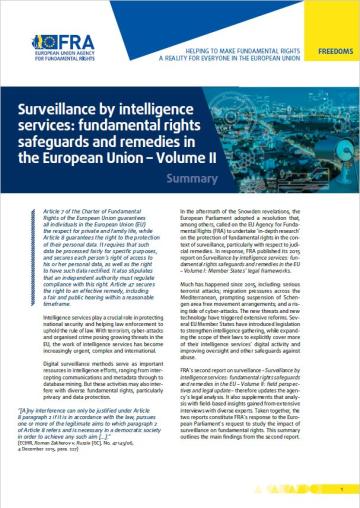
This report is FRA’s second publication addressing a European Parliament request for in-depth research on the impact of surveillance on fundamental rights. It updates FRA’s 2015 legal analysis on the topic, and supplements that analysis with field-based insights gained from extensive interviews with diverse experts in intelligence and related fields, including its oversight.
In 2006 the EU issued its Data Retention Directive. According to the Directive, EU Member States had to store electronic telecommunications data for at least six months and at most 24 months for investigating, detecting and prosecuting serious crime. In 2016, with an EU legal framework on data retention still lacking, the CJEU further clarified what safeguards are required for data retention to be lawful.This paper looks at amendments to national data retention laws in 2016 after the Digital Rights Ireland judgment.
This report, drafted in response to the European Parliament’s call for thorough research on fundamental rights protection in the context of surveillance, maps and analyses the legal frameworks on surveillance in place in EU Member States.
FRA was requested by the European Commission (EC) in January 2014 to provide practical guidance on the processing of Passenger Name Record (PNR) data for law enforcement purposes, in light of efforts by Member States to establish national PNR systems. As a result, in informal consultation with EC services and the European Data Protection Supervisor (EDPS) and building on opinions FRA, the EDPS and the Article 29 Working Party on PNR, FRA presented twelve fundamental rights considerations to EU Member States experts at technical level.
Technological advances make it ever more important to safeguard the right to personal data, which is enshrined in the Charter of Fundamental Rights of the European Union. Data protection violations arise principally from internet‑based activities, direct marketing and video surveillance, perpetrated by, for example, government bodies or financial and health institutions, research by the European Union Fundamental Rights Agency (FRA) shows.



 Report / Paper / Summary24May2023
 Report / Paper / Summary18June2020