Labour inspectors are essential for enforcing workers’ rights and for detecting and addressing labour exploitation. Together, the European Labour Authority (ELA) and the European Union Agency for Fundamental Rights (FRA) have developed a guide for workplace inspectors on how to detect labour exploitation. This guide is a practical tool for labour inspectors. It focuses on non-national workers in the EU who work in a country other than their own. Such workers are particularly vulnerable to labour exploitation. The guide is also accompanied by a leaflet that summarises the detailed information provided in this guide.
This manual is designed to be used by workplace inspection staff in the Member States. It is intended to empower them to enforce the protective standards in EU law that safeguard the rights of third-country workers, including seasonal workers, migrant workers with temporary permits and migrants in an irregular situation. Third-country workers are nationals who are not from a Member State or from Iceland, Liechtenstein, Norway or Switzerland.
Migrant workers are particularly at risk of labour exploitation. Workplace inspectors play a role in protecting non-EU workers' rights. This report guides inspectors to identify abuse and protect migrant workers. In autumn 2024, FRA will publish a manual with extensive resources to support workplace inspectors.
The EU Agency for Fundamental Rights (FRA) regularly collects data on the operations of NGO vessels involved in search and rescue in the Mediterranean. This includes any legal proceedings against them, as well as on any difficulties in disembarking migrants in safe ports. The International Organization for Migration estimates that from January to 15 June 2022 about 842 people died or went missing while crossing the Mediterranean Sea to reach Europe to escape war or persecution, or to pursue a better life. This is an average of five people per day.
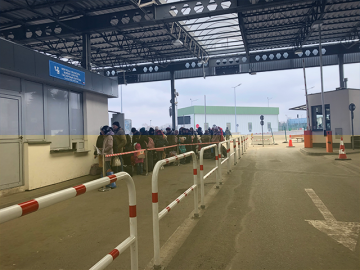
The EU is facing a large-scale humanitarian crisis. Over 10 days at the beginning of March, the EU Agency for Fundamental Rights (FRA) visited all EU countries bordering Ukraine and Moldova – Hungary, Poland, Romania and Slovakia.
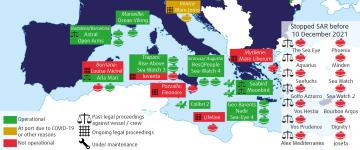
The EU Agency for Fundamental Rights (FRA) regularly collects data on NGO vessels involved in search and rescue in the Mediterranean. This includes any legal proceedings against them, as well as any difficulties disembarking migrants in safe ports. The International Organization for Migration estimates that from January to 10 December 2021 about 1,654 people have died or gone missing while crossing the Mediterranean Sea to reach Europe to escape war or persecution or to pursue a better life. This is an average of more than four people per day. Deadly incidents have also occurred recently in the Channel (La Manche).
The Employers Sanctions Directive was primarily enacted to dissuade employers from recruiting migrants in an irregular situation, but it also contains provisions to protect workers. It facilitates access to justice for exploited workers and sets out workers’ rights to claim back payment of outstanding wages. The directive also contains provisions to enhance the effectiveness of labour inspections. This report describes how the 25 Member States bound by the directive have been implementing its protective provisions, focusing on the impact these provisions have on migrant workers in an irregular situation who are victims of exploitation and other labour
law violations.
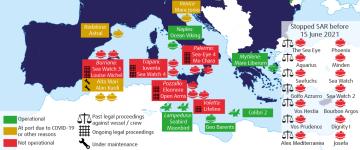
The International Organization for Migration estimates that about 813 people died or went missing crossing the Mediterranean Sea to reach Europe to escape war, persecution or to pursue a better life in 2021, up to 15 June. This is an average of almost five people per day. The EU Agency for Fundamental Rights (FRA) collects data on NGO ships involved in search and rescue in the Mediterranean, legal proceedings against them, as well as difficulties in disembarking migrants in safe ports.
FRA’s Fundamental Rights Report 2021 reviews major developments in the field in 2020, identifying both achievements and areas of concern. It also presents FRA’s opinions on these developments, including a synopsis of the evidence supporting these opinions. This year’s focus chapter explores the impact of the COVID-19 pandemic on fundamental rights. The remaining chapters cover: the EU Charter of Fundamental Rights; equality and non-discrimination; racism, xenophobia and related intolerance; Roma equality and inclusion; asylum, borders and migration; information society, privacy and data protection; rights of the child; access to justice; and the implementation of the Convention on the Rights of Persons with Disabilities.
FRA’s 2019 survey on Roma and Travellers in Belgium, France, Ireland, the Netherlands, Sweden and the United Kingdom interviewed almost 4 700 Roma and Travellers, collecting information on more than 8 200 individuals living in their households.
La convention européenne des droits de l’homme (CEDH) et la législation de l’Union européenne
(UE) fournissent un cadre de plus en plus important pour la protection des droits
des ressortissants étrangers. La législation de l’UE relative à l’asile, aux frontières et à l’immigration
se développe rapidement. Il existe un impressionnant corpus de jurisprudence de
la Cour européenne des droits de l’homme qui porte, en particulier, sur les articles 3, 5, 8 et
13 de la CEDH. La Cour de justice de l’Union européenne (CJUE) est également de plus en
plus souvent appelée à se prononcer sur l’interprétation des dispositions de la législation de
l’UE en la matière. La troisième édition du présent manuel, mise à jour jusqu’en juillet 2020,
expose de manière accessible cette législation et la jurisprudence des deux cours européennes
dans ce domaine.
Европейската конвенция за защита на правата на човека (ЕКПЧ) и правото на Евро- пейския съюз (ЕС) предоставят рамка за защита на правата на чужденците, чието значение непрестанно се повишава. Законодателството на Европейския съюз относно убежището, границите и имиграцията се развива бързо. Съществува вну- шителна по обем съдебна практика на Европейския съд по правата на човека във връзка по-специално с членове 3, 5, 8 и 13 от ЕКПЧ. Към Съда на Европейския съюз биват отправяни все повече искания да се произнесе по отношение на тълкуването на разпоредбите на правото на Европейския съюз в тази област. Третото издание на този наръчник, актуализирано до юли 2020 г., предоставя по достъпен начин това законодателство на Европейския съюз и съвкупността от съдебната практика на европейските съдилища. Наръчникът е предназначен за практикуващи юристи, съдии, прокурори, служители на имиграционните служби и неправителствени орга- низации в държавите — членки на ЕС, и на Съвета на Европа.
Evropská úmluva o lidských právech a právo Evropské unie poskytují stále důležitější rámec pro ochranu práv cizinců. Právní předpisy Evropské unie týkající se azylu, hranic a přistěhovalectví se rychle vyvíjejí. Existuje rozsáhlá judikatura Evropského soudu pro lidská práva týkající se zejména článků 3, 5, 8 a 13 EÚLP. Soudní dvůr Evropské unie je stále častěji žádán, aby se vyjádřil k výkladu ustanovení práva Evropské unie v této oblasti. Třetí vydání této příručky, aktualizované k červenci 2020, představuje tyto právní předpisy Evropské unie a judikaturu obou evropských soudů přístupným způsobem. Příručka je určena právníkům, soudcům, státním zástupcům, imigračním úředníkům a nevládním organizacím v členských státech EU a Rady Evropy.
Den europæiske menneskerettighedskonvention og Den Europæiske Unions lovgivning udgør en stadigt vigtigere ramme for beskyttelse af udlændinges rettigheder. Den Europæiske Unions lovgivning vedrørende asyl, grænser og indvandring udvikler sig hurtigt. Der er en imponerende mængde retspraksis fra Den Europæiske Menneskerettighedsdomstol vedrørende navnlig artikel 3, 5, 8 og 13 i EMRK. Den Europæiske Unions Domstol bliver oftere og oftere anmodet om at fortolke bestemmelserne i EU-retten på dette område. Den tredje udgave af denne håndbog, der er opdateret frem til juli 2020, fremlægger denne EU-lovgivning og retspraksis fra de to europæiske domstole på en lettilgængelig måde. Håndbogen er tiltænkt aktører inden for retsvæsenet, anklagere, indvandringsmedarbejdere og ikkestatslige organisationer i EU’s og Europarådets medlemsstater.
Η Ευρωπαϊκή Σύμβαση Δικαιωμάτων του Ανθρώπου και το δίκαιο της Ευρωπαϊκής Ένω- σης παρέχουν ένα όλο και πιο σημαντικό πλαίσιο για την προστασία των δικαιωμάτων των αλλοδαπών. Η νομοθεσία της Ευρωπαϊκής Ένωσης σχετικά με το άσυλο, τα σύνορα και τη μετανάστευση εξελίσσεται με ταχείς ρυθμούς. Υπάρχει ένα εντυπωσιακό σώμα νομολογίας του Ευρωπαϊκού Δικαστηρίου Ανθρωπίνων Δικαιωμάτων που αφορά ειδικό- τερα τα άρθρα 3, 5, 8 και 13 της ΕΣΔΑ. Το Δικαστήριο της Ευρωπαϊκής Ένωσης καλείται όλο και περισσότερο να αποφανθεί σχετικά με την ερμηνεία των διατάξεων του δικαίου της Ευρωπαϊκής Ένωσης στον τομέα αυτό. Η τρίτη έκδοση του παρόντος εγχειριδίου, που επικαιροποιήθηκε έως τον Ιούλιο του 2020, παρουσιάζει την εν λόγω νομοθεσία της Ευρωπαϊκής Ένωσης και το σώμα της νομολογίας των δύο ευρωπαϊκών δικαστηρίων με εύχρηστο τρόπο. Απευθύνεται σε επαγγελματίες του νομικού κλάδου, δικαστές, εισαγ- γελείς, υπαλλήλους στον τομέα της μετανάστευσης και μη κυβερνητικές οργανώσεις, στα κράτη μέλη της ΕΕ και του Συμβουλίου της Ευρώπης.
The European Convention on Human Rights and European Union law provide an increasingly important framework for the protection of the rights of foreigners. European Union legislation relating to asylum, borders and immigration is developing fast. There is an impressive body of case law by the European Court of Human Rights relating in particular to Articles 3, 5, 8 and 13 of the ECHR. The Court of Justice of the European Union is increasingly asked to pronounce on the interpretation of European Union law provisions in this field. The third edition of this handbook, updated up to July 2020, presents this European Union legislation and the body of case law by the two European courts in an accessible way.
El Convenio Europeo para la Protección de los Derechos Humanos y de las Libertades Fundamentales
(CEDH) y el Derecho de la Unión Europea (UE) constituyen un marco cada vez más importante para la
protección de los derechos de los extranjeros. La legislación de la UE sobre asilo, fronteras e inmigración
se está desarrollando rápidamente. La jurisprudencia del Tribunal Europeo de Derechos Humanos
(TEDH) en este ámbito es abundante y relativa en particular a los artículos 3, 5, 8 y 13 del CEDH. El Tribunal
de Justicia de la Unión Europea (TJUE) debe pronunciarse cada vez más sobre la interpretación de
las disposiciones del Derecho de la UE en la materia. La tercera edición de este manual, que se actualizó
en julio de 2020, presenta de manera accesible el Derecho de la UE y la jurisprudencia de los dos
tribunales europeos en la materia.
Euroopa inimõiguste konventsioon ja Euroopa Liidu õigus moodustavad üha olulisema raamistiku välismaalaste õiguste kaitseks. Varjupaiga, piiride ja sisserändega seotud Euroopa Liidu õigusaktid arenevad kiiresti. Euroopa Inimõiguste Kohtu kohtupraktika
on ulatuslik, eelkõige seoses Euroopa inimõiguste konventsiooni artiklitega 3, 5, 8 ja 13. Euroopa Liidu Kohtul palutakse üha sagedamini võtta seisukoht Euroopa Liidu õiguse sätete tõlgendamise kohta selles valdkonnas. Käsiraamatu kolmandas väljaandes, mida on ajakohastatud kuni juulini 2020, tutvustatakse arusaadavalt Euroopa Liidu õigusakte ja Euroopa mõlema kohtu kohtupraktikat. See on ette nähtud ELi ja Euroopa Nõukogu liikmesriikide õigusala töötajatele, kohtunikele, prokuröridele, sisserändeametnikele ja vabaühendustele.
Euroopan ihmisoikeussopimus ja Euroopan unionin oikeus sisältävät yhä tärkeämmäksi käyvän ulkomaalaisten oikeuksien suojaamista koskevan säännöstön. Euroopan unionin oikeus turvapaikkaoikeudesta, rajoista ja maahanmuutosta kehittyy nopeasti. Euroopan ihmisoikeustuomioistuimessa on kertynyt runsaasti oikeuskäytäntöä, erityisesti Euroopan ihmisoikeussopimuksen 3, 5, 8 ja 13 artiklasta. Euroopan unionin tuomioistuimelta pyydetään yhä useammin lausuntoa unionin oikeuden tämän alan säännösten tulkinnasta. Käsikirjan kolmannessa painoksessa, jota on päivitetty heinäkuuhun 2020 saakka, esitetään EU:n lainsäädäntöä ja molempien tuomioistuinten oikeuskäytäntöä helposti saatavilla olevassa muodossa.
Europska konvencija o ljudskim pravima i pravo Europske unije čine sve važniji okvir za zaštitu prava stranaca. Zakonodavstvo Europske unije u području azila, granica i imigracije brzo se razvija. Dostupna je opsežna sudska praksa Europskog suda za ljudska prava koja se konkretno odnosi na članke 3., 5., 8. i 13. EKLJP‑a. Od Suda Europske unije sve se češće traži da donosi odluke o tumačenju odredaba prava Europske unije u tom području. U trećem izdanju ovog priručnika, koji je ažuriran u skladu s informacijama dostupnima do srpnja 2020., na pristupačan su način predstavljeni zakonodavstvo Europske unije i sudska praksa navedenih dvaju europskih sudova. Priručnik je namijenjen pravnim stručnjacima, sudcima, tužiteljima, imigracijskim službenicima i nevladinim organizacijama u državama članicama EU‑a i Vijeća Europe.