eu-charter

Povelja o temeljnim pravima Europske unije

Članak 18 - Pravo na azil

Članak 18 - Pravo na azil

Zajamčeno je pravo na azil, uz poštovanje pravila iz Ženevske konvencije od 28. srpnja 1951. i Protokola od 31. siječnja 1967. o statusu izbjeglica i u skladu s Ugovorom o Europskoj uniji i Ugovoru o funkcioniranju Europske unije (u daljnjem tekstu „Ugovori“).

Objašnjenja

  • Text:
    Source:
    Preamble - Explanations relating to the Charter of Fundamental Rights:

Sudska praksa

Nacionalnom ustavnom pravu

27 results found

  • Slovakia / Constitution of the Slovak Republic
    Zemlja:
    Slovakia

    Article 53 The Slovak Republic grants asylum to foreign nationals persecuted for upholding political rights and freedoms. Asylum may be denied to those who acted in violation of basic human rights and freedoms. Details shall be laid down by law.

  • Slovenia / Constitution of the Republic of Slovenia
    Zemlja:
    Slovenia

    Article 48 Within the limits of the law, the right of asylum shall be recognised for foreign nationals and stateless persons who are subject to persecution for their commitment to human rights and fundamental freedoms.

  • Spain / Constitution of the Kingdom of Spain
    Zemlja:
    Spain

    Section 13 (1) Aliens in Spain shall enjoy the public freedoms guaranteed by the present Part, under the terms to be laid down by treaties and the law. (2) Only Spaniards shall have the rights recognized in section 23, except in cases which may be established by treaty or by law concerning the right to vote and the right to be elected in municipal elections, and subject to the principle of reciprocity. (This text includes the first constitutional reform adopted on 27/08/1992; it just added the words "and the right to be elected" to the paragraph). (3) Extradition shall be granted only in compliance with a treaty or with the law, on reciprocal basis. No extradition can be granted for political crimes; but acts of terrorism shall not be regarded as such. (4) The law shall lay down the terms under which citizens from other countries and stateless persons may enjoy the right to asylum in Spain.

  • Suomen perustuslaki
    Zemlja:
    Finland

    9 § Liikkumisvapaus Suomen kansalaisella ja maassa laillisesti oleskelevalla ulkomaalaisella on vapaus liikkua maassa ja valita asuinpaikkansa. Jokaisella on oikeus lähteä maasta. Tähän oikeuteen voidaan lailla säätää välttämättömiä rajoituksia oikeudenkäynnin tai rangaistuksen täytäntöönpanon varmistamiseksi taikka maanpuolustusvelvollisuuden täyttämisen turvaamiseksi. Suomen kansalaista ei saa estää saapumasta maahan, karkottaa maasta eikä vastoin tahtoaan luovuttaa tai siirtää toiseen maahan. Lailla voidaan kuitenkin säätää, että Suomen kansalainen voidaan rikoksen johdosta tai oikeudenkäyntiä varten taikka lapsen huoltoa tai hoitoa koskevan päätöksen täytäntöönpanemiseksi luovuttaa tai siirtää maahan, jossa hänen ihmisoikeutensa ja oikeusturvansa on taattu. Ulkomaalaisen oikeudesta tulla Suomeen ja oleskella maassa säädetään lailla. Ulkomaalaista ei saa karkottaa, luovuttaa tai palauttaa, jos häntä tämän vuoksi uhkaa kuolemanrangaistus, kidutus tai muu ihmisarvoa loukkaava kohtelu. 

  • The Fundamental Law of Hungary
    Zemlja:
    Hungary

    Article XIV (Freedom and Responsibility) [...] (3) Hungary shall, upon request, grant the right to asylum to non-Hungarian citizens being persecuted or
    having a well-founded fear of persecution in their native country or in the country of their
    habitual residence for reasons of race, nationality, membership of a particular social group, religious, political belief, if they do not receive protection from their country of origin or from any other country.

  • Ustav Republike Hrvatske
    Zemlja:
    Croatia

    Članak 33.
    Strani državljanin i osobe bez državljanstva mogu dobiti utočište u Republici Hrvatskoj, osim ako su progonjeni za nepolitičke zločine i djelatnosti oprečne temeljnim načelima međunarodnog prava.
    Stranac koji se zakonito nalazi na teritoriju Republike Hrvatske ne može biti protjeran ni izručen drugoj državi, osim kad se mora izvršiti odluka donesena u skladu s međunarodnim ugovorom i zakonom.

  • КОНСТИТУЦИЯ на Република България
    Zemlja:
    Bulgaria

    Чл. 26. [...] (2) Чужденците, които пребивават в Република България, имат всички права и задължения по тази Конституция с изключение на правата и задълженията, за които Конституцията и законите изискват българско гражданство. Чл. 27. (1) Чужденците, които пребивават в страната на законно основание, не могат да бъдат изгонвани от нея или предавани на друга държава против тяхната воля, освен при условията и по реда, определени със закон. (2) Република България дава убежище на чужденци, преследвани заради техните убеждения или дейност в защита на международно признати права и свободи. (3) Условията и редът за даване на убежище се уреждат със закон.

Pravo EU-a

14 results found

  • Directive (EU) 2024/1346 of the European Parliament and of the Council of 14 May 2024 laying down standards for the reception of applicants for international protection

    Preamble 


    (31) Applicants who are in detention should be treated with full respect for human dignity and their reception should be specifically designed to meet their needs in that situation. In particular, Member States should ensure that Article 24 of the Charter and Article 37 of the 1989 United Nations Convention on the Rights of the Child are applied.


    (38) In applying this Directive, Member States should seek to ensure full respect for the principles of the best interests of the child and of family unity, in accordance with the Charter, the 1989 United Nations Convention on the Rights of the Child, the European Convention for the Protection of Human Rights and Fundamental Freedoms and, where applicable, the Council of Europe Convention on Preventing and Combating Violence against Women and Domestic Violence.


    (75) This Directive respects the fundamental rights and observes the principles recognised in particular by the Charter. In particular, this Directive seeks to ensure full respect for human dignity and to promote the application of Articles 1, 4, 6, 7, 18, 21, 24 and 47 of the Charter and has to be implemented accordingly.

    Article 19: General rules on material reception conditions and health care

    2.   Member States shall ensure that material reception conditions and health care received in accordance with Article 22 provide an adequate standard of living for applicants, which guarantees their subsistence, protects their physical and mental health and respects their rights under the Charter.

    Article 21: Reception conditions in a Member State other than the one in which the applicant is required to be present

    From the moment applicants have been notified of a decision to transfer them to the Member State responsible in accordance with Regulation (EU) 2024/1351, they shall not be entitled to the reception conditions set out in Articles 17 to 20 of this Directive in any Member State other than the one in which they are required to be present in accordance with Regulation (EU) 2024/1351. This shall be without prejudice to the need to ensure a standard of living in accordance with Union law, including the Charter, and international obligations.

  • Regulation (EU) 2024/1351 of the European Parliament and of the Council of 14 May 2024 on asylum and migration management

    Preamble 

    (46) In accordance with the 1989 United Nations Convention on the Rights of the Child and with the Charter, the best interests of the child should be a primary consideration of Member States when applying this Regulation. In assessing the best interests of the child, Member States should, in particular, take due account of the minor’s well-being and social development in the short, medium and long term, safety and security considerations and the views of the minor in accordance with his or her age and maturity, including his or her background. In addition, specific procedural guarantees for unaccompanied minors should be laid down on account of their particular vulnerability, including the appointment of a representative.


    (48) In accordance with the European Convention for the Protection of Human Rights and Fundamental Freedoms and with the Charter, respect for private and family life should be a primary consideration of Member States when applying this Regulation.


    (62) In order to guarantee the effective protection of the applicants' fundamental rights to respect for private and family life, the rights of the child and the protection against inhuman and degrading treatment because of a transfer, applicants should have a right to an effective remedy, limited to those rights, in accordance, in particular, with Article 47 of the Charter and the relevant case-law of the Court of Justice of the European Union.


    (63) In order to facilitate the smooth application of this Regulation, Member States should in all cases indicate the Member State responsible in Eurodac after having concluded the procedures for determining the Member State responsible, including in cases where the responsibility results from the failure to respect the time limits for sending or replying to take charge requests, carrying out a transfer, as well as in cases where the Member State of first application becomes responsible or it is impossible to carry out the transfer to the Member State primarily responsible due to a real risk that the applicant will be subjected to inhuman or degrading treatment within the meaning of Article 4 of the Charter as a result of the transfer to that Member State and subsequently another Member State is determined as responsible.


    (87) This Regulation respects the fundamental rights and observes the principles which are guaranteed in Union and international law, including in the Charter. In particular, this Regulation seeks to ensure full observance of the right to asylum guaranteed by Article 18 of the Charter as well as the rights recognised under Articles 1, 4, 7, 24 and 47 thereof. Member States should therefore apply this Regulation accordingly, in full observance of those fundamental rights.

    Article 16: Access to the procedure for examining an application for international protection

    3.   Where it is impossible for a Member State to transfer an applicant to the Member State primarily designated as responsible because there are substantial grounds for believing that the applicant, because of the transfer to that Member State, would face a real risk of violation of the applicant’s fundamental rights that amounts to inhuman or degrading treatment within the meaning of Article 4 of the Charter, the determining Member State shall continue to examine the criteria set out in Chapter II or the clauses set out in Chapter III of this Part in order to establish whether another Member State can be designated as responsible.

    Article 18 : Consequences of non-compliance

    1.   Provided that the applicant has been informed of his or her obligations and the consequences of non-compliance therewith in accordance with Article 11(1), point (b), of Regulation (EU) 2024/1356 or Article 5(1) and 21 of Directive (EU) 2024/1346, the applicant shall not be entitled to the reception conditions set out in Articles 17 to 20 of that Directive in any Member State other than the one in which he or she is required to be present pursuant to Article 17(4) of this Regulation from the moment he or she has been notified of a decision to transfer him or her to the Member State responsible.

    The first subparagraph shall be without prejudice to the need to ensure a standard of living in accordance with Union law, including the Charter, and international obligations.

    Article 43: Remedies

    1.   The applicant or another person as referred to in Article 36(1), points (b) and (c), shall have the right to an effective remedy, in the form of an appeal or a review, in fact and in law, against a transfer decision before a court or tribunal.

    The scope of such remedy shall be limited to an assessment of:

    (a) whether the transfer would, for the person concerned, result in a real risk of inhuman or degrading treatment within the meaning of Article 4 of the Charter;

  • Regulation (EU) 2024/1358 of the European Parliament and of the Council of 14 May 2024 on the establishment of ‘Eurodac’ for the comparison of biometric data

    Preamble 

    (94) This Regulation respects the fundamental rights and observes the principles recognised in particular by the Charter. In particular, this Regulation seeks to ensure full respect for the protection of personal data and for the right to seek international protection, and to promote the application of Articles 8 and 18 of the Charter. This Regulation should therefore be applied accordingly.

    Article 13: Obligation to take biometric data 

    6.   The procedure for taking biometric data shall be determined and applied in accordance with the national practice of the Member State concerned and in accordance with the safeguards laid down in the Charter and in the European Convention for the Protection of Human Rights and Fundamental Freedoms.

  • Directive 2011/95 - Standards for the qualification of third-country nationals or stateless persons as beneficiaries of international protection, for a uniform status for refugees or for persons eligible for subsidiary protection, and for the content of t

    Preamble 

    (10) This Directive respects the fundamental rights and observes the principles recognised in particular by the Charter of Fundamental Rights of the European Union. In particular this Directive seeks to ensure full respect for human dignity and the right to asylum of applicants for asylum and their accompanying family members.

    (16) This Directive respects the fundamental rights and observes the principles recognised in particular by the Charter of Fundamental Rights of the European Union.  In particular this Directive seeks to ensure full respect for  human dignity and the right to asylum of applicants for  asylum and their accompanying family members and to  promote the application of Articles 1, 7, 11, 14, 15, 16, 
    18, 21, 24, 34 and 35 of that Charter, and should  therefore be implemented accordingly.


    (34) With regard to social assistance and health care, the modalities and detail of the provision of core benefits to beneficiaries of subsidiary protection status should be determined by national law. The possibility of limiting the benefits for beneficiaries of subsidiary protection status to core benefits is to be understood in the sense that this notion covers at least minimum income support, assistance in case of illness, pregnancy and parental assistance, in so far as they are granted to nationals according to the legislation of the Member State concerned.

    (35) Access to health care, including both physical and mental health care, should be ensured to beneficiaries of refugee or subsidiary protection status.

    Article 2: Definitions
    For the purposes of this Directive the following definitions shall apply:
    (a) ‘international protection’ means refugee status and subsidiary protection status as defined in points (e) and (g);
    (d) ‘refugee’ means a third-country national who, owing to a well-founded fear of being persecuted for reasons of race, religion, nationality, political opinion or membership of a particular social group, is outside the country of nationality and is unable or, owing to such fear, is unwilling to avail himself or herself of the protection of that country, or a stateless person, who, being outside of the country of former habitual residence for the same reasons as mentioned above, is unable or, owing to such fear, unwilling to return to it, and to whom Article 12 does not apply; [...]
    (e) ‘refugee status’ means the recognition by a Member State of a third-country national or a stateless person as a refugee;
    (f) ‘person eligible for subsidiary protection’ means a third-country national or a stateless person who does not qualify as a refugee but in respect of whom substantial grounds have been shown for believing that the person concerned, if returned to his or her country of origin, or in the case of a stateless person, to his or her country of former habitual residence, would face a real risk of suffering serious harm as defined in Article 15, and to whom Article 17(1) and (2) does not apply, and is unable, or, owing to such risk, unwilling to avail himself or herself of the protection of that country;
    (g) ‘subsidiary protection status’ means the recognition by a Member State of a third-country national or a stateless person as a person eligible for subsidiary protection; [...]

    Article 13: Granting of refugee status
    Member States shall grant refugee status to a third-country national or a stateless person who qualifies as a refugee in accordance with Chapters II and III.‘

    Article 18: Granting of subsidiary protection status
    Member States shall grant subsidiary protection status to a third-country national or a stateless person eligible for subsidiary protection in accordance with Chapters II and V.‘

    Article 21: Protection from refoulement

    1.   Member States shall respect the principle of non-refoulement in accordance with their international obligations.

    2.   Where not prohibited by the international obligations mentioned in paragraph 1, Member States may refoule a refugee, whether formally recognised or not, when:

    (a) there are reasonable grounds for considering him or her as a danger to the security of the Member State in which he or she is present; or

    (b) he or she, having been convicted by a final judgement of a particularly serious crime, constitutes a danger to the community of that Member State.

    3.   Member States may revoke, end or refuse to renew or to grant the residence permit of (or to) a refugee to whom paragraph 2 applies.

    Article 22: Information

    Member States shall provide persons recognised as being in need of international protection, as soon as possible after the respective protection status has been granted, with access to information, in a language likely to be understood by them, on the rights and obligations relating to that status.

    Article 23: Maintaining family unity

    1.   Member States shall ensure that family unity can be maintained.

    2.   Member States shall ensure that family members of the beneficiary of refugee or subsidiary protection status, who do not individually qualify for such status, are entitled to claim the benefits referred to in Articles 24 to 34, in accordance with national procedures and as far as it is compatible with the personal legal status of the family member.

    In so far as the family members of beneficiaries of subsidiary protection status are concerned, Member States may define the conditions applicable to such benefits.

    In these cases, Member States shall ensure that any benefits provided guarantee an adequate standard of living.

    3.   Paragraphs 1 and 2 are not applicable where the family member is or would be excluded from refugee or subsidiary protection status pursuant to Chapters III and V.

    4.   Notwithstanding paragraphs 1 and 2, Member States may refuse, reduce or withdraw the benefits referred therein for reasons of national security or public order.

    5.   Member States may decide that this Article also applies to other close relatives who lived together as part of the family at the time of leaving the country of origin, and who were wholly or mainly dependent on the beneficiary of refugee or subsidiary protection status at that time.

    Article 26: Access to employment

    1.   Member States shall authorise beneficiaries of refugee status to engage in employed or self-employed activities subject to rules generally applicable to the profession and to the public service, immediately after the refugee status has been granted.

    2.   Member States shall ensure that activities such as employment-related education opportunities for adults, vocational training and practical workplace experience are offered to beneficiaries of refugee status, under equivalent conditions as nationals.

    3.   Member States shall authorise beneficiaries of subsidiary protection status to engage in employed or self-employed activities subject to rules generally applicable to the profession and to the public service immediately after the subsidiary protection status has been granted. The situation of the labour market in the Member States may be taken into account, including for possible prioritisation of access to employment for a limited period of time to be determined in accordance with national law. Member States shall ensure that the beneficiary of subsidiary protection status has access to a post for which the beneficiary has received an offer in accordance with national rules on prioritisation in the labour market.

    4.   Member States shall ensure that beneficiaries of subsidiary protection status have access to activities such as employment-related education opportunities for adults, vocational training and practical workplace experience, under conditions to be decided by the Member States.

    5.   The law in force in the Member States applicable to remuneration, access to social security systems relating to employed or self-employed activities and other conditions of employment shall apply.

    Article 27: Access to education

    1.   Member States shall grant full access to the education system to all minors granted refugee or subsidiary protection status, under the same conditions as nationals.

    2.   Member States shall allow adults granted refugee or subsidiary protection status access to the general education system, further training or retraining, under the same conditions as third country nationals legally resident.

    3.   Member States shall ensure equal treatment between beneficiaries of refugee or subsidiary protection status and nationals in the context of the existing recognition procedures for foreign diplomas, certificates and other evidence of formal qualifications.

    Article 28: Social welfare

    1.   Member States shall ensure that beneficiaries of refugee or subsidiary protection status receive, in the Member State that has granted such statuses, the necessary social assistance, as provided to nationals of that Member State.

    2.   By exception to the general rule laid down in paragraph 1, Member States may limit social assistance granted to beneficiaries of subsidiary protection status to core benefits which will then be provided at the same levels and under the same eligibility conditions as nationals.

    Article 29: Health care

    1.   Member States shall ensure that beneficiaries of refugee or subsidiary protection status have access to health care under the same eligibility conditions as nationals of the Member State that has granted such statuses.

    2.   By exception to the general rule laid down in paragraph 1, Member States may limit health care granted to beneficiaries of subsidiary protection to core benefits which will then be provided at the same levels and under the same eligibility conditions as nationals.

    3.   Member States shall provide, under the same eligibility conditions as nationals of the Member State that has granted the status, adequate health care to beneficiaries of refugee or subsidiary protection status who have special needs, such as pregnant women, disabled people, persons who have undergone torture, rape or other serious forms of psychological, physical or sexual violence or minors who have been victims of any form of abuse, neglect, exploitation, torture, cruel, inhuman and degrading treatment or who have suffered from armed conflict.

  • Regulation (EU) 2024/1359 of the European Parliament and of the Council of 14 May 2024 addressing situations of crisis and force majeure in the field of migration and asylum and amending Regulation (EU) 2021/1147

    Preamble 

    (8) This Regulation respects the fundamental rights of third-country nationals and stateless persons and observes the principles recognised by the Charter of Fundamental Rights of the European Union (the ‘Charter’), in particular the respect and protection of human dignity, prohibition of torture and inhuman or degrading treatment or punishment, respect for private and family life, the principle of the best interests of the child, the right to asylum and protection in the event of removal, expulsion or extradition, as well as the Geneva Convention Relating to the Status of Refugees of 28 July 1951, as supplemented by the New York Protocol of 31 January 1967 (the ‘Geneva Convention’). This Regulation should be implemented in compliance with the Charter and general principles of Union law as well as with international law. In order to reflect the primary consideration that must be given to the best interests of the child, in line with the 1989 United Nations Convention on the Rights of the Child, and the need to respect family life, as well as to ensure the protection of the health of the persons concerned, safeguards should be applied in respect of minors and their family members, and of applicants for international protection (‘applicants’) whose state of health requires specific and adequate support. The rules and guarantees set out in Regulation (EU) 2024/1348 should continue to apply in respect of persons subject to the derogations provided for in this Regulation, except where this Regulation provides otherwise. The rules set out in Directive (EU) 2024/1346 of the European Parliament and of the Council (7), including those concerning the detention of applicants, should continue to apply from the moment an application for international protection is made.


    (18) In a situation of instrumentalisation, third-country nationals and stateless persons could apply for international protection at the external border or in a transit zone of a Member State, often being persons apprehended in connection with unauthorised crossings of the external border by land, sea or air or who are disembarked following search and rescue operations. This can lead, in particular, to an unexpected significant increase in the caseload of applications for international protection at the external borders. In that regard, effective and genuine access to the international protection procedure must be ensured in accordance with Article 18 of the Charter and the Geneva Convention.


    (42) In situations of crisis and force majeure, the Member State should be authorised to derogate from Regulation (EU) 2024/1348 in order to register applications for international protection no later than four weeks after they are made. Such an extension should be without prejudice to the rights of asylum applicants guaranteed by the Charter, Regulation (EU) 2024/1348 and Directive (EU) 2024/1346. Without prejudice to the exception provided for during the period between the request and the adoption of the Council implementing decision, in a situation of crisis, characterised by mass arrivals of third-country nationals and stateless persons, the extension of the registration period should only be applied during the time period set out in the initial Council implementing decision.

    Article 1: Subject matter

    2.   Temporary measures adopted pursuant to this Regulation shall meet the requirements of necessity and proportionality, be appropriate to achieving their stated objectives and ensuring the protection of the rights of applicants and beneficiaries of international protection, and be consistent with the obligations of the Member States under the Charter, international law and the Union asylum acquis. This Regulation shall not affect the fundamental principles and guarantees, established by the legislative acts from which derogations are allowed pursuant to this Regulation.

  • Directive 2013/32/EU of the European Parliament and of the Council of 26 June 2013 on common procedures for granting and withdrawing international protection (recast)

    Preamble 
    (33) The best interests of the child should be a primary consideration of Member States when applying this Directive, in accordance with the Charter of Fundamental Rights of the European Union (the Charter) and the 1989 United Nations Convention on the Rights of the Child. In assessing the best interest of the child, Member States should in particular take due account of the minor’s well-being and social development, including his or her background.

    (39) In determining whether a situation of uncertainty prevails in the country of origin of an applicant, Member States should ensure that they obtain precise and up-to-date information from relevant sources such as EASO, UNHCR, the Council of Europe and other relevant international organisations. Member States should ensure that any postponement of conclusion of the procedure fully complies with their obligations under Directive 2011/95/EU and Article 41 of the Charter, without prejudice to the efficiency and fairness of the procedures under this Directive.


    (60) This Directive respects the fundamental rights and observes the principles recognised by the Charter. In particular, this Directive seeks to ensure full respect for human dignity and to promote the application of Articles 1, 4, 18, 19, 21, 23, 24, and 47 of the Charter and has to be implemented accordingly.

    Article 13: Obligations of the applicants

    1. Member States shall impose upon applicants the obligation to cooperate with the competent authorities with a view to establishing their identity and other elements referred to in Article 4(2) of Directive 2011/95/EU. Member States may impose upon applicants other obligations to cooperate with the competent authorities insofar as such obligations are necessary for the processing of the application.

    2. In particular, Member States may provide that:

    (a) applicants are required to report to the competent authorities or to appear before them in person, either without delay or at a specified time;

    (b) applicants have to hand over documents in their possession relevant to the examination of the application, such as their passports;

    (c) applicants are required to inform the competent authorities of their current place of residence or address and of any changes thereof as soon as possible. Member States may provide that the applicant shall have to accept any communication at the most recent place of residence or address which he or she indicated accordingly;

    (d) the competent authorities may search the applicant and the items which he or she is carrying. Without prejudice to any search carried out for security reasons, a search of the applicant’s person under this Directive shall be carried out by a person of the same sex with full respect for the principles of human dignity and of physical and psychological integrity;

    (e) the competent authorities may take a photograph of the applicant; and

    (f) the competent authorities may record the applicant’s oral statements, provided he or she has previously been informed thereof.

    ...

    Article 30: Collection of information on individual cases

    For the purposes of examining individual cases, Member States shall not:

    (a) disclose information regarding individual applications for international protection, or the fact that an application has been made, to the alleged actor(s) of persecution or serious harm;

    (b) obtain any information from the alleged actor(s) of persecution or serious harm in a manner that would result in such actor(s) being directly informed of the fact that an application has been made by the applicant in question, and would jeopardise the physical integrity of the applicant or his or her dependants, or the liberty and security of his or her family members still living in the country of origin.

    ...

    Article 45: Procedural rules

    1. Member States shall ensure that, where the competent authority is considering withdrawing international protection from a third-country national or stateless person in accordance with Article 14 or 19 of Directive 2011/95/EU, the person concerned enjoys the following guarantees:

    (a) to be informed in writing that the competent authority is reconsidering his or her qualification as a beneficiary of international protection and the reasons for such a reconsideration; and

    (b) to be given the opportunity to submit, in a personal interview in accordance with Article 12(1)(b) and Articles 14 to 17 or in a written statement, reasons as to why his or her international protection should not be withdrawn.

    2. In addition, Member States shall ensure that within the framework of the procedure set out in paragraph 1:

    (a) the competent authority is able to obtain precise and up-to-date information from various sources, such as, where appropriate, from EASO and UNHCR, as to the general situation prevailing in the countries of origin of the persons concerned; and

    (b) where information on an individual case is collected for the purposes of reconsidering international protection, it is not obtained from the actor(s) of persecution or serious harm in a manner that would result in such actor(s) being directly informed of the fact that the person concerned is a beneficiary of international protection whose status is under reconsideration, or jeopardise the physical integrity of the person or his or her dependants, or the liberty and security of his or her family members still living in the country of origin.

    3. Member States shall ensure that the decision of the competent authority to withdraw international protection is given in writing. The reasons in fact and in law shall be stated in the decision and information on how to challenge the decision shall be given in writing.

    4. Once the competent authority has taken the decision to withdraw international protection, Article 20, Article 22, Article 23(1) and Article 29 are equally applicable.

    5. By way of derogation from paragraphs 1 to 4 of this Article, Member States may decide that international protection shall lapse by law where the beneficiary of international protection has unequivocally renounced his or her recognition as such. A Member State may also provide that international protection shall lapse by law where the beneficiary of international protection has become a national of that Member State. 

  • Regulation (EU) 2024/1356 of the European Parliament and of the Council of 14 May 2024 introducing the screening of third-country nationals at the external borders and amending Regulations (EC) No 767/2008, (EU) 2017/2226, (EU) 2018/1240 and (EU) 2019/817

    Preamble 
    (25) During the screening, the best interests of the child should always be a primary consideration in accordance with Article 24(2) of the Charter of Fundamental Rights of the European Union (the ‘Charter’). Child protection authorities should, wherever necessary, be closely involved in the screening to ensure that the best interests of the child are duly taken into account throughout the screening. A representative should be appointed to represent and assist the unaccompanied minor during the screening or, where a representative has not been appointed, a person trained to safeguard the best interests and general wellbeing of the minor should be designated. Where applicable, that representative should be the same as the representative appointed in accordance with the rules on unaccompanied minors in Directive (EU) 2024/1346. The trained person should be the person designated to provisionally act as a representative under that Directive, where that person has been designated.


    (37) A preliminary vulnerability check should be carried out with a view to identifying persons with indications of being vulnerable, of being victims of torture or other inhuman or degrading treatment, or of being stateless, or who may have special reception or procedural needs within the meaning of Directive (EU) 2024/1346 and Regulation (EU) 2024/1348, respectively. This should be without prejudice to further assessment in ensuing procedures following the completion of the screening. The vulnerability check should be carried out by specialised personnel of the screening authorities trained for that purpose.


    (38) During the screening, all persons concerned should be guaranteed a standard of living complying with the Charter and have access to emergency health care and essential treatment of illnesses. Particular attention should be paid to individuals with vulnerabilities, such as pregnant women, elderly persons, single-parent families, persons with an immediately identifiable physical or mental disability, persons visibly having suffered psychological or physical trauma and unaccompanied minors. In particular, in the case of a minor, information should be provided in a child-friendly and age-appropriate manner. All the authorities involved in the performance of the tasks related to the screening should report any situation of vulnerabilities observed or reported to them, should respect human dignity and privacy, and should refrain from any discrimination.

    Article 8 : Requirements concerning the screening

    8.   Member States shall ensure that all persons subject to the screening are accorded a standard of living which guarantees their subsistence, protects their physical and mental health and respects their rights under the Charter.

    Article 10 : Monitoring of fundamental rights

    2.   Each Member State shall provide for an independent monitoring mechanism in accordance with the requirements set out in this Article, which shall:

    (a) monitor compliance with Union and international law, including the Charter, in particular as regards access to the asylum procedure, the principle of non-refoulement, the best interest of the child and the relevant rules on detention, including relevant provisions on detention in national law, during the screening; and

    (b) ensure that substantiated allegations of failure to respect fundamental rights in all relevant activities in relation to the screening are dealt with effectively and without undue delay, trigger, where necessary, investigations into such allegations and monitor the progress of such investigations.

    Article 12: Preliminary health checks and vulnerabilities

    3.   Third-country nationals subjected to the screening referred to in Articles 5 and 7 shall be subject to a preliminary vulnerability check by specialised personnel of the screening authorities trained for that purpose, with a view to identifying whether a third-country national might be a stateless person, vulnerable or a victim of torture or other inhuman or degrading treatment, or have special needs within the meaning of Directive 2008/115/EC, Article 25 of Directive (EU) 2024/1346 and Article 20 of Regulation (EU) 2024/1348. For the purpose of that vulnerability check, the screening authorities may be assisted by non-governmental organisations and, where relevant, by qualified medical personnel.

    Article 13: Guarantees for minors

    1.   During the screening, the best interests of the child shall always be a primary consideration in accordance with Article 24(2) of the Charter.

  • Regulation (EU) No 656/2014 of the European Parliament and of the Council of 15 May 2014 establishing rules for the surveillance of the external sea borders in the context of operational cooperation coordinated by Frontex

    Preamble 


    (19) This Regulation respects the fundamental rights and observes the principles recognised by Articles 2 and 6 of the Treaty on European Union (TEU) and by the Charter, in particular respect for human dignity, the right to life, the prohibition of torture and of inhuman or degrading treatment or punishment, the prohibition of trafficking in human beings, the right to liberty and security, the right to the protection of personal data, the right to asylum and to protection against removal and expulsion, the principles of non-refoulement and non-discrimination, the right to an effective remedy and the rights of the child. This Regulation should be applied by Member States and the Agency in accordance with those rights and principles.

  • Regulation (EU) No 603/2013 of the European Parliament and of the Council of 26 June 2013 on the establishment of 'Eurodac' for the comparison of fingerprints for the effective application of Regulation (EU) No 604/2013

    Preamble

    (50) This Regulation respects the fundamental rights and observes the principles recognised in particular by the Charter. In particular, this Regulation seeks to ensure full respect for the protection of personal data and for the right to seek international protection, and to promote the application of Articles 8 and 18 of the Charter. This Regulation should therefore be applied accordingly.

    Article 1- Purpose of "Eurodac" 
    [...]
    ‘2. This Regulation also lays down the conditions under which Member States' designated authorities and the European Police Office (Europol) may request the comparison of fingerprint data with those stored in the Central System for law enforcement purposes. 
    3.   Without prejudice to the processing of data intended for Eurodac by the Member State of origin in databases set up under the latter's national law, fingerprint data and other personal data may be processed in Eurodac only for the purposes set out in this Regulation and Article 34(1) of Regulation (EU) No 604/2013.‘ 
    Article 23 - Responsibility for data processing
    [...]
    ‘2. In accordance with Article 34, the Member State of origin shall ensure the security of the data referred to in paragraph 1 before and during transmission to the Central System as well as the security of the data it receives from the Central System.‘
    Article 27 - Access to, and correction or erasure of, data recorded in Eurodac
    [...]
    ‘4.   If a Member State or the Agency has evidence to suggest that data recorded in the Central System are factually inaccurate, it shall advise the Member State of origin as soon as possible.
    If a Member State has evidence to suggest that data were recorded in the Central System in breach of this Regulation, it shall advise the Agency, the Commission and the Member State of origin as soon as possible. The Member State of origin shall check the data concerned and, if necessary, amend or erase them without delay.‘
    Article 33 - Protection of personal data for law enforcement purposes
    [...]
    ‘3.   The processing of personal data by Europol pursuant to this Regulation shall be in accordance with Decision 2009/371/JHA and shall be supervised by an independent external data protection supervisor. Articles 30, 31 and 32 of that Decision shall be applicable to the processing of personal data by Europol pursuant to this Regulation. The independent external data protection supervisor shall ensure that the rights of the individual are not violated.‘ 

  • Protocol (No 24) on asylum for nationals of Member States of the European Union

    Sole Article

    Given the level of protection of fundamental rights and freedoms by the Member States of the European Union, Member States shall be regarded as constituting safe countries of origin in respect of each other for all legal and practical purposes in relation to asylum matters. Accordingly, any application for asylum made by a national of a Member State may be taken into consideration or declared admissible for processing by another Member State only in the following cases:

    (a) if the Member State of which the applicant is a national proceeds after the entry into force of the Treaty of Amsterdam, availing itself of the provisions of Article 15 of the European Convention for the Protection of Human Rights and Fundamental Freedoms, to take measures derogating in its territory from its obligations under that Convention;

    (b) if the procedure referred to Article 7(1) of the Treaty on European Union has been initiated and until the Council, or, where appropriate, the European Council, takes a decision in respect thereof with regard to the Member State of which the applicant is a national;

    (c) if the Council has adopted a decision in accordance with Article 7(1) of the Treaty on European Union in respect of the Member State of which the applicant is a national or if the European Council has adopted a decision in accordance with Article 7(2) of that Treaty in respect of the Member State of which the applicant is a national;

    (d) if a Member State should so decide unilaterally in respect of the application of a national of another Member State; in that case the Council shall be immediately informed; the application shall be dealt with on the basis of the presumption that it is manifestly unfounded without affecting in any way, whatever the cases may be, the decision-making power of the Member State.

Međunarodno pravo

5 results found

Proizvodi

  • Fundamental Rights Report
    8
    June
    2022
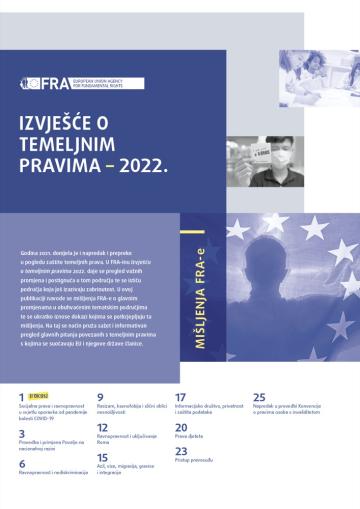
    Godina 2021. donijela je i napredak i prepreke u pogledu zaštite temeljnih prava. U FRA-inu Izvješću o temeljnim pravima 2022. daje se pregled važnih promjena i postignuća u tom području te se ističu područja koja još izazivaju zabrinutost. U ovoj publikaciji navode se mišljenja FRA-e o glavnim promjenama u obuhvaćenim tematskim područjima te se ukratko iznose dokazi kojima se potkrjepljuju ta mišljenja. Na taj se način pruža sažet i informativan pregled glavnih pitanja povezanih s temeljnim pravima s kojima se suočavaju EU i njegove države članice.
  • Report / Paper / Summary
    27
    March
    2020
    French version now available
    24 April 2020
    Council of Europe (CoE) and European Union (EU) Member States have an undeniable sovereign right to control the entry of non-nationals into their territory. While exercising border control, states have a duty to protect the fundamental rights of all people under their jurisdiction, regardless of their nationality and/or legal status. Under EU law, this includes providing access to asylum procedures.
  • Periodic updates / Series
    21
    July
    2026
    This is the second bulletin in FRA’s new quarterly series monitoring the situation of migrants, asylum seekers and refugees. It covers key developments and ongoing concerns from 1 April to 30 June 2026.

    Following regular reporting on fundamental rights issues related to migration and asylum from 2015 to 2023, FRA resumed the series in 2026 under the EU's 2024 Asylum and Migration Management Regulation, ahead of the June 2026 implementation of the EU Migration and Asylum Pact. The first bulletin, published in April 2026, covered developments from 1 January 2025 to 31 March 2026.
  • Handbook / Guide / Manual
    29
    June
    2026
    This guidance is for newly appointed guardians supporting a child who is applying for or has obtained international protection. It explains key terms, such as refugee status and subsidiary protection, as well as the legal framework for children’s rights in this context. The guidance also covers how to ensure the child’s participation and best interests during the asylum procedure. It is part of a series of practical tools developed by the European Union Agency for Asylum (EUAA) and the European Union Agency for Fundamental Rights (FRA) for guardians of unaccompanied children with international protection needs.
  • Fundamental Rights Report
    11
    June
    2026
    The Fundamental Rights Report: Challenges and Achievements in 2025 is FRA’s flagship annual publication. It provides an overview of the state of fundamental rights in the EU and highlights selected critical developments from 2025. This year, it focuses on four areas: rights protection in a rapidly changing digital environment; the housing crisis and rising homelessness rates; employment challenges for people from non-EU countries; and the implementation of the EU Charter of Fundamental Rights. The publication is a valuable resource for those seeking to stay informed about the EU’s shifting landscape of fundamental rights.
  • Periodic updates / Series
    21
    April
    2026
    From 2015 to 2023, FRA regularly published bulletins on fundamental rights issues related to migration and asylum. As part of the EU's 2024 Asylum and Migration Management Regulation, FRA is now restarting this reporting ahead of the June 2026 implementation of the EU Migration and Asylum Pact. This first bulletin in the new series takes stock of the situation of migrants, asylum seekers and refugees as of March 2026. It looks at key developments between January 2025 and the end of March 2026, as well as ongoing problems and new areas of concern.
  • Report / Paper / Summary
    14
    April
    2026
    In response to increased arrivals of asylum seekers, in 2015 the European Commission introduced the hotspot approach. Under this approach, the European Commission and EU agencies supported Greece and Italy in identifying, registering and fingerprinting newly arrived people. FRA regularly visited the initial reception facilities hosting them. This report looks back at the lessons learnt from 10 years of FRA visits. It identifies recurring risks to rights and highlights practical measures and promising practices to prevent or address them. These ‘lessons learnt’ can inform the implementation of the 2024 Pact on Migration and Asylum in line with the EU Charter of Fundamental Rights.
  • Report / Paper / Summary
    4
    December
    2025
    Artificial Intelligence comes with both benefits and risks. Safe AI use that accounts for fundamental rights is thus crucial. While the 2024 EU AI Act was a milestone in this regard, its broad definitions regarding AI systems and high-risk AI could introduce loopholes for fundamental rights compliance. This report offers an empirical basis for much-needed practical guidance on the Act’s implementation. Based on interviews with AI developers, sellers, and users, FRA addresses challenges of its use in critical domains, like asylum, education, and employment. Our findings help guide next steps in realising the AI Act’s potential to ensure responsible innovation.
  • Handbook / Guide / Manual
    8
    October
    2025
    The Entry/Exit System (EES), launching in 2025, will register non-EU nationals crossing the EU’s external borders. This FRA guidance supports managers overseeing the operation of the new system. It helps them to ensure compliance with EU fundamental rights. It outlines operational considerations: clear communication, dignified biometric data collection and data protection. It also addresses staff training needs. Based on fieldwork at 10 border crossing points in 6 Member States, the guidance will ensure rights are respected under the new system. A separate guidance publication for border guards accompanies this publication.
  • Opinion / Position Paper
    23
    July
    2025
    This position paper examines how the EU can counter the instrumentalisation of migrants while also upholding fundamental rights. Instrumentalisation refers to countries outside the EU using migration to exert political pressure. This position paper defines the phenomenon, provides examples, and outlines legal obligations under EU law. It provides legal analysis and warns that some responses risk undermining fundamental rights at the EU’s external borders, including the right to asylum. To counter instrumentalisation and uphold fundamental rights, the position paper proposes practical measures for Member States to take, such as sanctions, border controls, and cooperation with private operators.