eu-charter

Povelja o temeljnim pravima Europske unije

Članak 25 - Prava starijih osoba

Članak 25 - Prava starijih osoba

Unija priznaje i poštuje prava starijih osoba na dostojan život i neovisnost te na sudjelovanje u društvenom i kulturnom životu.

Objašnjenja

  • Text:
    Source:
    Preamble - Explanations relating to the Charter of Fundamental Rights:

Sudska praksa

Nacionalnom ustavnom pravu

30 results found

  • Portugal / Constitution of the Portuguese Republic
    Zemlja:
    Portugal

    Article 72 (The elderly) (1) The elderly shall possess the right to economic security and to conditions in terms of housing and family and community life that respect their personal autonomy and avoid and overcome isolation or social marginalisation. (2) The policy for the elderly shall include measures of an economic, social and cultural nature that tend to provide elderly people with opportunities for personal fulfilment by means of an active participation in community life.

  • Preamble to the Constitution of 27 October 1946
    Zemlja:
    France

    § 11.It shall guarantee to all, notably to children, mothers and elderly workers, protection of their health, material security, rest and leisure. All people who, by virtue of their age, physical or mental condition, or economic situation, are incapable of working, shall have to the right to receive suitable means of existence from society.

  • Préambule de la Constitution du 27 Octobre 1946
    Zemlja:
    France

    § 11.Elle garantit à tous, notamment à l'enfant, à la mère et aux vieux travailleurs, la protection de la santé, la sécurité matérielle, le repos et les loisirs. Tout être humain qui, en raison de son âge, de son état physique ou mental, de la situation économique, se trouve dans l'incapacité de travailler a le droit d'obtenir de la collectivité des moyens convenables d'existence.

  • Slovakia / Constitution of the Slovak Republic
    Zemlja:
    Slovakia

     Article 39 (1) Citizens have the right to adequate material provision in old age, in the event of work disability, as well as after losing their provider.(...) (3) Details concerning rights listed in paragraphs 1 and 2 shall be laid down by law.

  • Spain / Constitution of the Kingdom of Spain
    Zemlja:
    Spain

    Section 50 The public authorities shall guarantee, through adequate and periodically updated pensions, a sufficient income for citizens in old age. Likewise, and without prejudice to the obligations of the families, they shall promote their welfare through a system of social services that provides for their specific problems of health, housing, culture and leisure.

  • Suomen perustuslaki
    Zemlja:
    Finland

    19 § Oikeus sosiaaliturvaan (...) Lailla taataan jokaiselle oikeus perustoimeentulon turvaan työttömyyden, sairauden, työkyvyttömyyden ja vanhuuden aikana sekä lapsen syntymän ja huoltajan menetyksen perusteella.

  • The Belgian Constitution
    Zemlja:
    Belgium

    Article 22. Everyone has the right to the respect of his private and family life, except in the cases and conditions determined by the law. The laws, federate laws and rules referred to in Article 134 guarantee the protection
    of this right. Article 23 Everyone has the right to lead a life in keeping with human dignity. (...)

  • The Fundamental Law of Hungary
    Zemlja:
    Hungary

    Article XV (Freedom and Responsibility) […] (5) By means of separate measures, Hungary shall protect families, children, women, the elderly and those living with disabilities.

    Article XIX (Freedom and Responsibility) […] (4) Hungary shall contribute to ensuring a life of dignity for the elderly by maintaining a
    general state pension system based on social solidarity and by allowing for the operation of voluntarily established social institutions. An Act may lay down the conditions for entitlement to state pension also with regard to the requirement for stronger protection for women.

    Article 40 (The State) In the interests of satisfying common needs in a predictable manner and of the secure livelihood of the elderly, basic rules for sharing public burdens and for the pension system
    shall be laid down in a cardinal Act.

  • Ustav Republike Hrvatske
    Zemlja:
    Croatia

    Članak 64.
    (4)Djeca su dužna brinuti se za stare i nemoćne roditelje.

    Članak 65.
    (1)Dužnost je svih da štite djecu i nemoćne osobe.

  • КОНСТИТУЦИЯ на Република България
    Zemlja:
    Bulgaria

    Чл. 51. [...] (3) Старите хора, които нямат близки и не могат да се издържат от своето имущество [...] се намират под особена закрила на държавата и обществото

Pravo EU-a

2 results found

  • Community Charter of the Fundamental Social Rights of Workers (not in force)

    25. Any person who has reached retirement age but who is not entitled to a pension or who does not have other means of subsistence, must be entitled to sufficient resources and to medical and social assistance specifically suited to his needs.

  • Community Charter of the Fundamental Social Rights of Workers (not in force)

    24. Every worker of the European Community must, at the time of retirement, be able to enjoy resources affording him or her a decent standard of living.

Međunarodno pravo

5 results found

Proizvodi

  • Opinion / Position Paper
    23
    July
    2025
    This position paper examines how the EU can counter the instrumentalisation of migrants while also upholding fundamental rights. Instrumentalisation refers to countries outside the EU using migration to exert political pressure. This position paper defines the phenomenon, provides examples, and outlines legal obligations under EU law. It provides legal analysis and warns that some responses risk undermining fundamental rights at the EU’s external borders, including the right to asylum. To counter instrumentalisation and uphold fundamental rights, the position paper proposes practical measures for Member States to take, such as sanctions, border controls, and cooperation with private operators.
  • Fundamental Rights Report
    10
    June
    2025
    The Fundamental Rights Report 2025 is the annual report of the European Union Agency for Fundamental Rights (FRA). It provides an overview of the state of fundamental rights in the EU and highlights selected critical developments and trends in 2024. The report covers issues such as inclusive elections, gender-based violence, and the implementation of the EU Charter of Fundamental Rights. It presents FRA’s opinions on these developments, setting out the actions that the EU and Member States should take. This annual publication is a valuable resource for those seeking to stay informed about the EU’s shifting landscape of fundamental rights.
  • Opinion / Position Paper
    6
    February
    2025
    This FRA Position Paper outlines the Agency’s position on the creation of 'return hubs' in non-EU countries for migrants who have been ordered to leave the EU. Considering the serious fundamental rights risks connected with running return hubs, this legal analysis presents the conditions that would have to be met for return hubs to respect fundamental rights and comply with EU law. These include setting up agreements with the host countries and creating independent human rights monitoring mechanisms. The position paper does not examine centres in third countries that process asylum applications.
  • Report / Paper / Summary
    13
    September
    2023
    Europe’s ageing population is ever-increasing, and our societies are becoming more digitalised. Many public services are now available online, with many more services in the process of being digitalised. But the digitalisation of public services poses a risk of exclusion for older persons. In this new report, FRA explores the impact of digitalisation on the fundamental rights of older persons. The report maps the current legislation, policies and practices fostering digital inclusion. It provides an overview of the laws at the national level that provide for equal access to public services, both online and offline. The findings show how Member States safeguard older person’s rights to access services undergoing digitalisation. It outlines how Member States can support digital skills and ensure older people can fully participate in public life.

  • Fundamental Rights Report
    8
    June
    2023
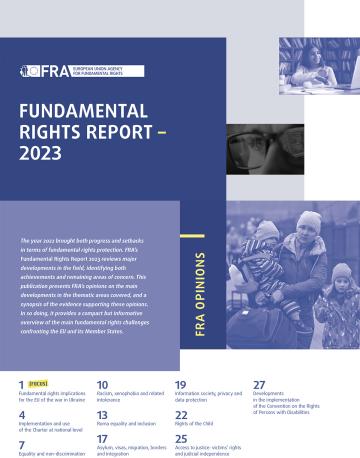
    Godina 2022. donijela je i napredak i prepreke u pogledu zaštite temeljnih prava. U FRA-inu Izvješću o temeljnim pravima 2023. daje se pregled važnih promjena i postignuća u tom području te se ističu područja koja još izazivaju zabrinutost. U ovoj publikaciji navode se mišljenja FRA-e o glavnim promjenama u obuhvaćenim tematskim područjima te se ukratko iznose dokazi kojima se potkrjepljuju ta mišljenja. Na taj se način pruža sažet i informativan pregled glavnih pitanja povezanih s temeljnim pravima s kojima se suočavaju EU i njegove države članice.
  • Fundamental Rights Report
    8
    June
    2022
    FRA’s Fundamental Rights Report 2022 reviews major developments in the field in 2021, identifying both achievements and areas of concern. It also presents FRA’s opinions on these developments, including a synopsis of the evidence supporting these opinions.
  • Fundamental Rights Report
    8
    June
    2022
    This focus looks at the impact of the pandemic on social rights. It examines the measures in national recovery and resilience plans that address the social vulnerabilities among a variety of population groups in the EU, including women, children and young people in situations of vulnerability, people with disabilities, older people, Roma and people in precarious working conditions.
  • Fundamental Rights Report
    10
    June
    2021
    FRA’s Fundamental Rights Report 2021 reviews major developments in the field in 2020, identifying both achievements and areas of concern. It also presents FRA’s opinions on these developments, including a synopsis of the evidence supporting these opinions. This year’s focus chapter explores the impact of the COVID-19 pandemic on fundamental rights. The remaining chapters cover: the EU Charter of Fundamental Rights; equality and non-discrimination; racism, xenophobia and related intolerance; Roma equality and inclusion; asylum, borders and migration; information society, privacy and data protection; rights of the child; access to justice; and the implementation of the Convention on the Rights of Persons with Disabilities.
  • Fundamental Rights Report
    10
    June
    2021
    This focus looks at COVID-19’s impact on fundamental rights. It underscores that a human rights-based approach to tackling the pandemic requires balanced measures that are based on law, necessary, temporary and proportional. It also requires addressing the pandemic’s socio-economic impact, protecting the vulnerable and fighting racism.