O relatório da FRA sobre inteligência artificial e direitos fundamentais apresenta exemplos concretos de como as empresas e as administrações públicas na UE estão a utilizar, ou a tentar utilizar, a IA. O relatório incide sobre quatro domínios essenciais — benefícios sociais, policiamento preditivo, serviços de saúde e publicidade direcionada. O documento debate as potenciais implicações em matéria de direitos fundamentais e analisa a forma como esses direitos são tidos em consideração ao utilizar ou criar aplicações de IA.
Raportul FRA privind inteligența artificială și drepturile fundamentale prezintă exemple concrete ale modului în care întreprinderile și administrațiile publice din UE utilizează sau încearcă să utilizeze IA. Acesta se concentrează pe patru domenii principale: prestațiile sociale, activitățile polițienești bazate pe analiza predictivă, serviciile de sănătate și publicitatea direcționată. Raportul analizează implicațiile potențiale asupra drepturilor fundamentale și analizează modul în care aceste drepturi sunt luate în considerare la utilizarea sau dezvoltarea aplicațiilor IA.
V správe agentúry FRA o umelej inteligencii a základných právach sú uvedené konkrétne príklady toho, ako spoločnosti a verejná správa v EÚ využívajú alebo sa pokúšajú využívať UI. Zameriava sa na štyri kľúčové oblasti – sociálne dávky, prediktívne vykonávanie policajných funkcií, zdravotnícke služby a cielená reklama. Správa sa zaoberá možným vplyvom na základné práva a analyzuje spôsob, akým sú tieto práva zohľadnené pri používaní alebo vývoji aplikácií UI.
V poročilu agencije FRA o umetni inteligenci in temeljnih pravicah so navedeni konkretni primeri, kako podjetja in javne uprave v EU uporabljajo umetno inteligenco ali jo poskušajo uporabljati. Osredotoča se na štiri osrednja področja – družbene koristi, napovedno policijsko delo, zdravstvene storitve in ciljno trženje. Poročilo obravnava morebitne posledice za temeljne pravice in analizira, kako se te pravice upoštevajo pri uporabi ali razvoju aplikacij umetne inteligence.
FRA:s rapport om artificiell intelligens och grundläggande rättigheter innehåller konkreta exempel på hur företag och offentliga förvaltningar i EU använder eller försöker använda AI. Den är inriktad på fyra huvudområden – sociala förmåner, prognostiserat polisarbete, hälso- och sjukvårdstjänster och riktad reklam. Rapporten innehåller en diskussion om potentiella konsekvenser för de grundläggande rättigheterna och en analys av hur dessa rättigheter beaktas när AI-tillämpningar används eller utvecklas.
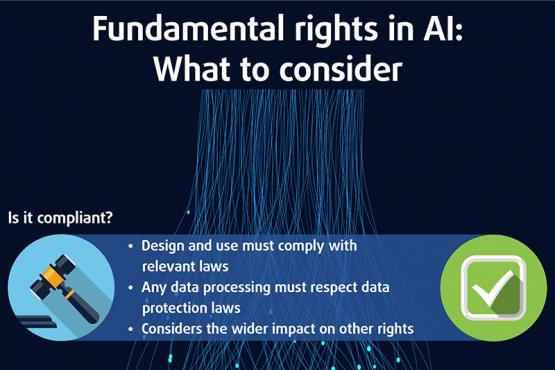
Artificial intelligence (AI) already plays a role in deciding what unemployment benefits someone gets, where a burglary is likely to take place, whether someone is at risk of cancer, or who sees that catchy advertisement for low mortgage rates. Its use keeps growing, presenting seemingly endless possibilities. But we need to make sure to fully uphold fundamental rights standards when using AI. This report presents concrete examples of how companies and public administrations in the EU are using, or trying to use, AI. It focuses on four core areas – social benefits, predictive policing, health services and targeted advertising.
V tem poročilu so predstavljeni konkretni primeri, kako podjetja in javne uprave v Evropski uniji (EU) uporabljajo ali poskušajo uporabljati umetno inteligenco. Obravnavane so možne posledice za temeljne pravice, prav tako je prikazano, ali uporabniki umetne inteligence upoštevajo pravice in na kakšen način.
As we enter the second half of 2020, the constraints on our daily lives brought about by the Coronavirus pandemic have become a firm reality. New local lockdowns and the reintroduction of restrictive measures prompted by fresh outbreaks of the virus are a stark reminder that COVID-19 continues to shape our lives – and our enjoyment of fundamental rights – in profound ways. There is compelling evidence of how the pandemic has exacerbated existing challenges in our societies. This FRA Bulletin outlines some of the measures EU Member States adopted to safely reopen their societies and economies while continuing to mitigate the spread of COVID-19. It highlights the impact these measures may have on civil, political and socioeconomic rights.
This paper presents people’s concerns and experiences relating to security. It covers worry about crime, including terrorism and online fraud; experience of online fraud; experience of cyberharassment; and concern about illegal access to data.
This document presents data from the FRA Fundamental Rights Survey. It includes data on opinions and experiences of people in the European Union (EU) linked to data protection and technology.
През 2019 г. отбелязахме както напредък, така и неуспехи по отношение на защитата на основните права. В Доклада на FRA относно основните права от 2020 г. е извършен преглед на важните развития в областта, като са посочени както постиженията, така и областите, които все още пораждат загриженост. В настоящата публикация са представени становищата на FRA относно основните развития в обхванатите тематични области и обзор на доказателствата в подкрепа на тези становища. По този начин в нея е даден стегнат, но съдържателен преглед на основните предизвикателства в областта на основните права, пред които са изправени ЕС и неговите държави членки.
Rok 2019 přinesl v oblasti ochrany základních práv
pokrok i nezdary. Zpráva o základních právech 2020
agentury FRA přináší přehled hlavního vývoje v této
oblasti a upozorňuje jak na úspěchy, tak na oblasti,
které i nadále vzbuzují obavy. Tato publikace
představuje stanoviska agentury FRA k hlavnímu
vývoji v uvedených tematických oblastech a souhrn
důkazů podporujících tato stanoviska. Poskytuje tak
hutný, ale informativní přehled hlavních problémů,
jimž EU a její členské státy čelí v oblasti základních
práv.
I 2019 skete der både fremgang og tilbagegang med
hensyn til beskyttelsen af grundlæggende rettigheder.
FRA’s rapport om grundlæggende rettigheder 2020
gennemgår den vigtigste udvikling på området,
herunder både de opnåede resultater og områder, der
fortsat giver anledning til bekymring. Publikationen
indeholder FRA’s udtalelser om den væsentligste
udvikling inden for de afdækkede emneområder og et
sammendrag af den dokumentation, der understøtter
disse udtalelser. Det er således en kompakt, men
informativ oversigt over de største udfordringer med
hensyn til grundlæggende rettigheder, som EU og
medlemsstaterne står over for.