Den europeiska icke-diskrimineringslagstiftningen, som i huvudsak består av EU:s ickediskrimineringsdirektiv och artikel 14 i och protokoll nr 12 till Europakonventionen om de mänskliga rättigheterna, förbjuder diskriminering på en rad olika grunder och i olika sammanhang. Den här handboken innehåller en genomgång av den europeiska icke-diskrimineringslagstiftning som härrör från dessa två källor. De ses som två kompletterande system som delvis överlappar varandra. I de fall de skiljer sig åt påpekas detta.
Европейското право в областта на недискриминацията, както е предвидено в директивите
на ЕС относно недискриминацията, в член 14 и в Протокол 12 към Европейската конвенция
за правата на човека, забранява дискриминацията в рамките на широк набор от видове
контекст и основания. В настоящия наръчник се разглежда европейско право в областта на
недискриминацията, което произхожда от тези два източника като допълващи се системи.
Те му служат взаимозаменяемо дотолкова, че се припокриват, като същевременно се
подчертават съществуващите разлики.
Evropské antidiskriminační právo, které tvoří směrnice EU o zákazu diskriminace a článek 14 a protokol č. 12 Evropské úmluvy o ochraně lidských práv a základních svobod, zakazuje diskriminaci v celé řadě situací a z celé řady důvodů. Tato příručka zkoumá evropské antidiskriminační právo vycházející z uvedených dvou zdrojů jako vzájemně se doplňující systémy, využívá jejich vzájemné zaměnitelnosti v míře, v jaké se tyto systémy překrývají, a upozorňuje na jejich rozdíly, pokud existují.
Den europæiske lovgivning om ikke-forskelsbehandling, som består af EU’s direktiver om ikkeforskelsbehandling og artikel 14 i den europæiske menneskerettighedskonvention (EMRK) samt protokol nr. 12 hertil, forbyder forskelsbehandling i en række sammenhænge og af en række årsager. I denne håndbog ser vi på EU-lovgivningen om ikke-forskelsbehandling i henhold til disse to kilder som komplementære systemer, idet de vil blive brugt i flæng, hvis de overlapper hinanden, mens evt. forskelle vil blive fremhævet.
Guardians are a key element of a protection system for children who are temporarily or
permanently deprived of their family environment and cannot have their interests represented
by their parents. Great disparities exist between the types of guardianship provided
to children in and within European Union (EU) Member States. This report explores the key
features of guardianship systems put in place to cater for the needs of all children in need
of protection, including child victims and those at risk of becoming victims of trafficking in
human beings or of other forms of exploitation.
Seventeen years after adoption of EU laws that forbid discrimination, immigrants, descendants of immigrants, and minority ethnic groups continue to face widespread discrimination across the EU and in all areas of life – most often when seeking employment. For many, discrimination is a recurring experience. This is just one of the findings of FRA’s second European Union Minorities and Discrimination Survey (EU-MIDIS II), which collected information from over 25,500 respondents with different ethnic minority and immigrant backgrounds across all 28 EU Member States.
This survey involved interviews with 25,515 people with different ethnic minority and immigrant backgrounds across 28 EU countries. It explores issues concerning discrimination as well as experiences of harassment, hate-motivated violence and discriminatory profiling.
This report provides an overview of data on antisemitism as recorded by
international organisations and by official and unofficial sources in the 28 European
Union (EU) Member States, based on their own definitions and categorisations.
This report is FRA’s second publication addressing a European Parliament request for in-depth research on the impact of surveillance on fundamental rights. It updates FRA’s 2015 legal analysis on the topic, and supplements that analysis with field-based insights gained from extensive interviews with diverse experts in intelligence and related fields, including its oversight.
In 2006 the EU issued its Data Retention Directive. According to the Directive, EU Member States had to store electronic telecommunications data for at least six months and at most 24 months for investigating, detecting and prosecuting serious crime. In 2016, with an EU legal framework on data retention still lacking, the CJEU further clarified what safeguards are required for data retention to be lawful.This paper looks at amendments to national data retention laws in 2016 after the Digital Rights Ireland judgment.
This report outlines examples of community policing measures in select EU Member State regions and localities with recently arrived asylum seekers and migrants. It focuses on four main issues: 1) community policing, 2) related police training, 3) community involvement (for example: consultations; giving voice to the concerns of local communities; police involvement in local responses to concerns), and 4) crime prevention activities.
This Consolidated Annual Activity Report (CAAR) provides
an overview of the activities and achievements
of the European Union Agency for Fundamental Rights
(FRA) in 2016.
Hate crime is the most severe expression of discrimination and a core fundamental rights abuse. The European Union (EU) has demonstrated its resolve to tackle hate crime with legislation such as the 2008 Framework Decision on combating certain forms and expressions of racism and xenophobia by means of criminal law. Nonetheless, the majority of hate crimes perpetrated in the EU remain unreported and therefore invisible, leaving victims without redress.
The Council of the EU requested this FRA Opinion in its Conclusions on business and human rights. The expert opinion sought from FRA was to look at “possible avenues to lower barriers for access to remedy at the EU level” – the third of three pillars of the UN Guiding Principles.
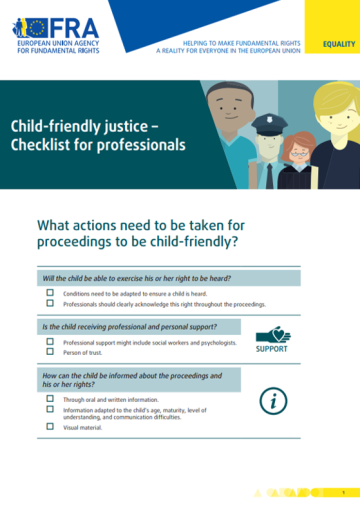
The treatment of children in justice systems remains a concern across the European Union (EU). With this checklist, FRA aims to help professionals by providing a list of actions that need to be taken for judicial proceedings to be child-friendly.
Around 2.5 million children participate in judicial proceedings across the European Union (EU)
every year, affected by parental divorce or as victims of, or witnesses to, crime. Although their
effective participation in such proceedings is vital for improving the operation of justice, the
treatment of children in justice systems remains a concern.
Around 2.5 million children participate in judicial proceedings across the European Union (EU) every year, affected by parental divorce or as victims of, or witnesses to, crime. Although their effective participation in such proceedings is vital for improving the operation of justice, the treatment of children in justice systems remains a concern. FRA investigated to what extent children’s rights to be heard, to be informed, to be protected, and to non-discrimination are fulfilled in practice.
Antisemitism can be expressed in the form of verbal and physical attacks, threats,
harassment, property damage and graffiti or other forms of text, including on the
internet. The present report relates to manifestations of antisemitism as they are
recorded by international organisations, and by official and unofficial sources in the
28 EU Member States.
EU Member States have largely implemented, and started applying, three instruments on transferring prison sentences, probation measures and alternative sanctions, as well as pre-trial supervision measures, to other Member States. This report provides an overview of their first experiences with these measures, highlighting both best practices and shortcomings.