eu-charter

Europos Sąjungos pagrindinių teisių chartija

21 straipsnis - Diskriminacijos uždraudimas

21 straipsnis - Diskriminacijos uždraudimas

1. Draudžiama bet kokia diskriminacija, ypač dėl asmens lyties, rasės, odos spalvos, tautinės ar socialinės kilmės, genetinių bruožų, kalbos, religijos ar tikėjimo, politinių ar kitokių pažiūrų, priklausymo tautinei mažumai, turtinės padėties, gimimo, negalios, amžiaus, seksualinės orientacijos.
2. Sutarčių taikymo srityje ir nepažeidžiant konkrečių jų nuostatų draudžiama bet kokia diskriminacija dėl asmens pilietybės.

Paaiškinimai

  • Text:

    1 dalis remiasi EB sutarties 13 straipsniu, dabar pakeistu Sutarties dėl Europos Sąjungos veikimo 19 straipsniu, EŽTK 14 straipsniu bei Žmogaus teisių ir biomedicinos konvencijos 11 straipsniu dėl genetinio paveldo. Kiek tai atitinka EŽTK 14 straipsnį, ji taikoma laikantis šio straipsnio.
    Tarp 1 dalies ir Sutarties dėl Europos Sąjungos veikimo 19 straipsnio, kurio taikymo sritis ir tikslas yra kitas, nėra prieštaravimo ar nesuderinamumo: 19 straipsniu Sąjungai suteikiamas įgaliojimas priimti įstatymo galią turinčius aktus, įskaitant valstybių narių įstatymų ir kitų teisės aktų suderinimą, siekiant kovoti su diskriminacija, pasireiškiančia tam tikromis formomis, kurios yra išsamiai išvardintos tame straipsnyje. Tokie teisės aktai gali apimti valstybių narių institucijų veiksmus (taip pat privačių asmenų santykius) bet kurioje srityje Sąjungos įgaliojimų ribose. Priešingai, 21 straipsnio 1 dalis nesukuria jokio įgaliojimo leisti antidiskriminacinius įstatymus šiose valstybių narių ar privačių veiksmų srityse ir nenustato bendro pobūdžio diskriminacijos draudimo tose labai įvairiose srityse. Vietoj to ji apima tik pačių Sąjungos institucijų ir organų vykdomos diskriminacijos atvejus, naudojantis įgaliojimais, kurie yra suteikti pagal Sutartis, ir valstybių narių vykdomos diskriminacijos atvejus, tik joms įgyvendinant Sąjungos teisę. Todėl 1 dalis nepakeičia nei pagal 19 straipsnį suteiktų įgaliojimų apimties, nei šio straipsnio aiškinimo.
    2 dalis atitinka Sutarties dėl Europos Sąjungos veikimo 18 straipsnio pirmąją pastraipą ir turi būti taikoma laikantis šio straipsnio.

    Source:
    Europos Sąjungos oficialusis leidinys C 303/17 - 14.12.2007
    Preamble - Explanations relating to the Charter of Fundamental Rights:
    Šie išaiškinimai buvo pirmą kartą parengti prižiūrint Europos Sąjungos pagrindinių teisių chartiją rengusio Konvento prezidiumui. Jie buvo atnaujinti Europos konvento prezidiumo atsakomybe, atsižvelgiant į Konvento įvestas Chartijos teksto projekto pataisas (ypač 51 ir 52 straipsnių) ir kitus Sąjungos teisės pakeitimus. Nors išaiškinimai neturi teisinės galios, jie yra svarbi Chartijos nuostatoms išaiškinti skirta aiškinimo priemonė.

Teismų praktika

Nacionalinės konstitucinės teisės

57 results found

  •  European Convention on Human Rights - Article 14
    Šalis:
    Austria

    Article 14 - Prohibition of discrimination 

    The enjoyment of the rights and freedoms set forth in this Convention shall be secured without discrimination on any ground such as sex, race, colour, language, religion, political or other opinion, national or social origin, association with a national minority, property, birth or other status

  • Sweden / Instrument of Government
    Šalis:
    Sweden

    Chapter 1 - Basic principles of the form of government:

    Article 2. Public power shall be exercised with respect for the equal worth of all and the liberty and dignity of the individual. (…) The public institutions shall promote the opportunity for all to attain participation and equality in society and for the rights of the child to be safeguarded. The public institutions shall combat discrimination of persons on grounds of gender, colour, national or ethnic origin, linguistic or religious affiliation, functional disability, sexual orientation, age or other circumstance affecting the individual. The opportunities of the Sami people and ethnic, linguistic and religious minorities to preserve and develop a cultural and social life of their own shall be promoted;

    Article 9 Courts of law, administrative authorities and others performing public administration functions shall pay regard in their work to the equality of all before the law and shall observe objectivity and impartiality.

    Chapter 2 - Fundamental rights and freedoms:

    Article 12 No act of law or other provision may imply the unfavourable treatment of anyone because they belong to a minority group by reason of ethnic origin, colour, or other similar circumstances or on account of their sexual orientation;

    Article 13 No act of law or other provision may imply the unfavourable treatment of anyone on grounds of gender, unless the provision forms part of efforts to promote equality between men and women or relates to compulsory military service or other equivalent official duties.

  • ACT No. 365/2004 Coll. - Antidiscrimination Act
    Šalis:
    Slovakia

    § 1 Scope This Act provides for the application of the principle of equal treatment and lays down the means of legal protection in a case of violation of this principle. § 2 Basic provisions (1) Adherence to the principle of equal treatment shall lay in the prohibition of discrimination on grounds of sex, religion or belief, race, nationality or ethnic origin, disability, age, sexual orientation, marital or family status, colour, language, political affiliation or other conviction, national or social origin, property, lineage or any other status. (2) While adhering to the principle of equal treatment, observance shall also be paid to good morals for the purpose of broadening of protection against discrimination. (3) Adherence to the principle of equal treatment shall also rest in adoption of measures for the protection against discrimination.

  • Algemene wet gelijke behandeling (AWGB)
    Šalis:
    Netherlands

    Preambule : Alzo Wij in overweging genomen hebben, dat het wenselijk is om, mede in verband met artikel 1 van de Grondwet, ter bevordering van de deelneming op gelijke voet aan het maatschappelijk leven bescherming te bieden tegen discriminatie op grond van godsdienst, levensovertuiging, politieke gezindheid, ras, geslacht, nationaliteit, hetero- of homoseksuele gerichtheid of burgerlijke staat, dat het daarom wenselijk is behoudens wettelijke uitzonderingen onderscheid op deze gronden te verbieden en dat het in verband met de handhaving van dit verbod wenselijk is een Commissie gelijke behandeling in te stellen;

  • Allgemeines Gleichbehandlungsgesetz
    Šalis:
    Germany


  • Basic Law for the Federal Republic of Germany
    Šalis:
    Germany

    Article 3 (... ) (3) No person shall be favoured or disfavoured because of sex, parentage, race, language, homeland and origin, faith, or religious or political opinions. No person shall be disfavoured because of disability. Article 33 (1) Every German shall have in every Land the same political rights and duties. (2) Every German shall be equally eligible for any public office according to his aptitude, qualifications and professional achievements. (3) Neither the enjoyment of civil and political rights, nor eligibility for public office, nor rights acquired in the public service shall be dependent upon religious affiliation. No one may be disadvantaged by reason of adherence or non-adherence to a particular religious denomination or philosophical creed.

  • Bundes-Verfassungsgesetz (B-VG)
    Šalis:
    Austria

    Artikel 7 (1) Alle Staatsbürger sind vor dem Gesetz gleich. Vorrechte der Geburt, des Geschlechtes, des Standes, der Klasse und des Bekenntnisses sind ausgeschlossen. Niemand darf wegen seiner Behinderung benachteiligt werden. Die Republik (Bund, Länder und Gemeinden) bekennt sich dazu, die Gleichbehandlung von behinderten und nichtbehinderten Menschen in allen Bereichen des täglichen Lebens zu gewährleisten. (...)

  • Bundesverfassungsgesetz vom 3. Juli 1973 zur Durchführung des Internationalen Übereinkommens über die Beseitigung aller Formen rassischer Diskriminierung
    Šalis:
    Austria

    Artikel 1 §1 (1) Jede Form rassischer Diskriminierung ist – auch soweit ihr nicht bereits
    Art. 7 des Bundes-Verfassungsgesetzes in der Fassung von 1929 und Art. 14 der Konvention zum Schutz der Menschenrechte und Grundfreiheiten, BGBl. Nr. 210/1958, entgegenstehen – verboten. Gesetzgebung und Vollziehung haben jede Unterscheidung aus dem alleinigen Grund der Rasse, der Hautfarbe, der Abstammung oder der nationalen oder ethnischen Herkunft zu unterlassen. (2) Abs. 1 hindert nicht, österreichischen Staatsbürgern besondere Rechte einzuräumen oder besondere Verpflichtungen aufzuerlegen, soweit dem Art. 14 der Konvention zum Schutz der Menschenrechte und Grundfreiheiten nicht entgegensteht.

  • Constitution
    Šalis:
    France

    Article 1 La France est une République indivisible, laïque, démocratique et sociale. Elle assure l'égalité devant la loi de tous les citoyens sans distinction d'origine, de race ou de religion. Elle respecte toutes les croyances. Son organisation est décentralisée. La loi favorise l'égal accès des femmes et des hommes aux mandats électoraux et fonctions électives, ainsi qu'aux responsabilités professionnelles et sociales.

  • Constitution
    Šalis:
    France

    Article 1 France shall be an indivisible, secular, democratic and social Republic. It shall ensure the equality of all citizens before the law, without distinction of origin, race or religion. It shall respect all beliefs.

  • Constitution of Finland
    Šalis:
    Finland

    Section 6 Equality Everyone is equal before the law. No one shall, without an acceptable reason, be treated differently from other persons on the ground of sex, age, origin, language, religion, conviction, opinion, health, disability or other reason that concerns his or her person. Children shall be treated equally and as individuals and they shall be allowed to influence matters pertaining to themselves to a degree corresponding to their level of development. Equality of the sexes is promoted in societal activity and working life, especially in the determination of pay and the other terms of employment, as provided in more detail by an Act. 

  • Constitution of Ireland
    Šalis:
    Ireland

    Article 40.1. All citizens shall, as human persons, be held equal before the law. This shall not be held to mean that the State shall not in its enactments have due regard to differences of capacity, physical and moral, and of social function. Article 40.6.2. Laws regulating the manner in which the right of forming associations and nions and the right of free assembly may be exercised shall contain no political, religious or class discrimination.

  • Constitution of Malta
    Šalis:
    Malta

    Article 45. (1) Subject to the provisions of sub-articles (4), (5) and (7) of this article, no law shall make any provision that is discriminatory either of itself or in its effect. (2) Subject to the provisions of sub-articles (6), (7) and (8) of this article, no person shall be treated in a discriminatory manner by any person acting by virtue of any written law or in the performance of the functions of any public office or any public authority. (3) In this article, the expression "discriminatory" means affording different treatment to different persons attributable wholly or mainly to their respective descriptions by race, place of origin, political opinions, colour, creed or sex whereby persons of one such description are subjected to disabilities or restrictions to which persons of another such description are not made subject or are accorded privileges or advantages which are not accorded to persons of another such description. (4) Sub-article (1) of this article shall not apply to any law so far as that law makes provision - (a) for the appropriation of public revenues or other public funds; or (b) with respect to persons who are not citizens of Malta; or (c) with respect to adoption, marriage, dissolution of marriage, burial, devolution of property on death or any matters of personal law not hereinbefore specified; or (d) whereby persons of any such description as is mentioned in sub-article (3) of this article may be subjected to any disability or restriction or may be accorded any privilege or advantage which, having regard to its nature and to special circumstances pertaining to those persons or to persons of any other such description and to any other provision of this Constitution, is reasonably justifiable in a democratic society; or (e) for authorising the taking during a period of public emergency of measures that are reasonably justifiable for the purpose of dealing with the situation that exists during that period of public emergency; Provided that paragraph (c) of this sub-article shall not apply to any law which makes any provision that is discriminatory, either of itself or in its effect by affording different treatment to different persons attributable wholly or mainly to their respective description by sex. (5) Nothing contained in any law shall be held to be inconsistent with or in contravention of sub-article (1) of this article to the extent that it makes provision: (a) with respect to qualifications for service or conditions of service in any disciplined force; or (b) with respect to qualifications (not being qualifications specifically relating to sex) for service as a public officer or for service of a local government authority or a body corporate established for public purposes by any law. (6) Sub-article (2) of this article shall not apply to anything which is expressly or by necessary implication authorised to be done by any such provision of law as is referred to in sub-article (4) or (5) of this article. (7) Nothing contained in or done under the authority of any law shall be held to be inconsistent with or in contravention of this article to the extent that the law in question makes provision (not being provisions specifically relating to sex) whereby persons of any such description as is mentioned in sub-article (3) of this article may be subjected to any restriction on the rights and freedoms guaranteed by articles 38, 40, 41, 42 and 44 of this Constitution, being such a restriction as is authorised by article 38(2), 40(2), 41(2), 42(2) or 44(3). (8) Nothing in sub-article (2) of this article shall affect any discretion relating to the institution, conduct or discontinuance of civil or criminal proceedings in any court that is vested in any person by or under this Constitution or any other law. (9) A requirement, however made, that the Roman Catholic Apostolic Religion shall be taught by a person professing that religion shall not be held to be inconsistent with or in contravention of this article. (10) Until the expiration of a period of two years commencing on the lst July, 1991, nothing contained in any law made before the 1st July, 1991, shall be held to be inconsistent with the provisions of this article, in so far as that law provides for different treatment to different persons attributable wholly or mainly to their respective description by sex. (11) Nothing in the provisions of this article shall apply to any law or anything done under the authority of a law, or to any procedure or arrangement, in so far as such law, thing done, procedure or arrangement provides for the taking of special measures aimed at accelerating de facto equality between men and women, and in so far only as such measures, taking into account the social fabric of Malta, are shown to be reasonably justifiable in a democratic society.

  • Constitution of the Hellenic Republic
    Šalis:
    Greece

    Article 4 (5) Greek citizens contribute without distinction to public charges in proportion to their means. [...] Article 5 (2) All persons living within the Greek territory shall enjoy full protection of their life, honour and liberty irrespective of nationality, race or language and of religious or political beliefs. Exceptions shall be permitted only in cases provided by international law. [...]

  • Constitution of the Italian Republic
    Šalis:
    Italy

    Art. 3. All citizens have equal social dignity and are equal before the law, without distinction of sex, race, language, religion, political opinion, personal and social conditions. It is the duty of the Republic to remove those obstacles of an economic or social nature which constrain the freedom and equality of citizens, thereby
    impeding the full development of the human person and the effective participation of all workers in the political, economic and social organisation
    of the country. Art. 10. (...) The legal status of foreigners is regulated by law in conformity with
    international provisions and treaties. (...)

  • Constitution of the Republic of Austria
    Šalis:
    Austria

    Article 7 (1) All nationals (Austrian citizens) are equal before the law. Privileges based upon birth, sex, estate, class or religion are excluded. No one shall be discriminated against because of his disability. The Republic (Federation, Laender and municipalities) commits itself to ensuring the equal treatment of disabled and non-disabled persons in all spheres of every-day life. (...)

  • Constitution of the Republic of Bulgaria
    Šalis:
    Bulgaria

    Art. 6. (1) All persons are born free and equal in dignity and rights. (2) All citizens shall be equal before the law. There shall be no privileges or restriction of rights on the grounds of race, national or social origin, ethnic self-identity, sex, religion, education, opinion, political affiliation, personal or social status or property status.

  • Constitution of the Republic of Croatia
    Šalis:
    Croatia

    Article 14
    (1) All persons in the Republic of Croatia shall enjoy rights and freedoms, regardless of race, colour, gender, language, religion, political or other conviction, national or social origin, property, birth, education, social status or other characteristics.

    Article 39
    Any call for or incitement to war or use of violence, to national, racial or religious hatred, or any form of intolerance shall be prohibited and punishable by law.

  • Constitution of the Republic of Estonia
    Šalis:
    Estonia

    Article 12. Everyone is equal before the law. No one may be discriminated against on the basis of nationality, race, colour, sex, language, origin, religion, political or other views, property or social status, or on other grounds.
    Incitement to ethnic, racial, religious or political hatred, violence or discrimination is prohibited and punishable by law. Incitement to hatred and violence between social classes or to discrimination against a social class is also prohibited and punishable by law.

  • Constitution of the Republic of Latvia
    Šalis:
    Latvia

    91. All human beings in Latvia shall be equal before the law and the courts. Human rights shall be realised without discrimination of any kind.

ES teisė

33 results found

  • Regulation (EU) 2021/692 of the European Parliament and of the Council of 28 April 2021 establishing the Citizens, Equality, Rights and Values Programme and repealing Regulation (EU) No 1381/2013 of the European Parliament

    Article 1

    Subject matter

    This Regulation establishes the Citizens, Equality, Rights and Values Programme (the ‘Programme’) for the duration of the multiannual financial framework 2021-2027, as laid down in Regulation (EU, Euratom) 2020/2093.

    It lays down the objectives of the Programme, the budget for the period 2021–2027, the forms of Union funding and the rules for providing such funding.

  • Regulation (EU) 2019/1896 of the European Parliament and of the Council of 13 November 2019 on the European Border and Coast Guard and repealing Regulations (EU) No 1052/2013 and (EU) 2016/1624

    Preamble

    (103) This Regulation respects the fundamental rights and observes the principles recognised by Articles 2 and 6 TEU and by the Charter of Fundamental Rights of the European Union (‘the Charter’), in particular respect for human dignity, the right to life, the prohibition of torture and inhuman or degrading treatment or punishment, the prohibition of trafficking in human beings, the right to liberty and security, the right to the protection of personal data, the right of access to documents, the right to asylum and to protection against removal and expulsion, non-refoulement, non-discrimination and the rights of the child.

    Article 1: Subject matter

    This Regulation establishes a European Border and Coast Guard to ensure European integrated border management at the external borders with a view to managing those borders efficiently in full compliance with fundamental rights and to increasing the efficiency of the Union return policy.

    This Regulation addresses migratory challenges and potential future challenges and threats at the external borders. It ensures a high level of internal security within the Union in full respect of fundamental rights, while safeguarding the free movement of persons within the Union. It contributes to the detection, prevention and combating of cross-border crime at the external borders.

    Article 43: Instructions to the teams

    4.   Members of the teams shall, in the performance of their tasks and in the exercise of their powers, fully respect fundamental rights, including access to asylum procedures and human dignity, and shall pay particular attention to vulnerable persons. Any measures taken in the performance of their tasks and in the exercise of their powers shall be proportionate to the objectives pursued by such measures. While performing their tasks and exercising their powers, they shall not discriminate against persons on the basis of any grounds such as sex, race, colour, ethnic or social origin, genetic features, language, religion or belief, political or any other opinion, membership of a national minority, property, birth, disability, age or sexual orientation in line with Article 21 of the Charter.

  • Directive 2012/29/EU of the European Parliament and of the Council of 25 October 2012 establishing minimum standards on the rights, support and protection of victims of crime, and replacing Council Framework Decision 2001/220/JHA

    Preamble:

    (14) In applying this Directive, children's best interests must be a primary consideration, in accordance with the Charter of Fundamental Rights of the European Union and the United Nations Convention on the Rights of the Child adopted on 20 November 1989. Child victims should be considered and treated as the full bearers of rights set out in this Directive and should be entitled to exercise those rights in a manner that takes into account their capacity to form their own views.
    (16) Victims of terrorism have suffered attacks that are intended ultimately to harm society. They may therefore need special attention, support and protection due to the particular nature of the crime that has been committed against them. Victims of terrorism can be under significant public scrutiny and often need social recognition and respectful treatment by society. Member States should therefore take particular account of the needs of victims of terrorism, and should seek to protect their dignity and security.’
    ‘(38) [...] A main task of these services and their staff, which play an important role in supporting the victim to recover from and overcome potential harm or trauma as a result of a criminal offence, should be to inform victims about the rights set out in this Directive so that they can take decisions in a supportive environment that treats them with dignity, respect and sensitivity. The types of support that such specialist support services should offer could include providing shelter and safe accommodation, immediate medical support, referral to medical and forensic examination for evidence in cases of rape or sexual assault, short and long-term psychological counselling, trauma care, legal advice, advocacy and specific services for children as direct or indirect victims.’
    ‘(52) Measures should be available to protect the safety and dignity of victims and their family members from secondary and repeat victimisation, from intimidation and from retaliation, such as interim injunctions or protection or restraining orders.’

    (66) This Directive respects fundamental rights and observes the principles recognised by the Charter of Fundamental Rights of the European Union. In particular, it seeks to promote the right to dignity, life, physical and mental integrity, liberty and security, respect for private and family life, the right to property, the principle of non-discrimination, the principle of equality between women and men, the rights of the child, the elderly and persons with disabilities, and the right to a fair trial.

    Article 18 - Right to protection
    ‘Without prejudice to the rights of the defence, Member States shall ensure that measures are available to protect victims and their family members from secondary and repeat victimisation, from intimidation and from retaliation, including against the risk of emotional or psychological harm, and to protect the dignity of victims during questioning and when testifying. When necessary, such measures shall also include procedures established under national law for the physical protection of victims and their family members.’

Tarptautinė teisė

4 results found

  • Committee on the Elimination of Racial Discrimination, General recommendation No. 35 Combating racist hate speech

    ‘24. Article 5 of the Convention enshrines the obligation of States parties to prohibit and eliminate racial discrimination and to guarantee the right of everyone, without distinction as to race, colour, or national or ethnic origin, to equality before the law, notably in the enjoyment of civil, political, economic, social and cultural rights, including the rights to freedom of thought, conscience and religion, freedom of opinion and expression, and freedom of peaceful assembly and association.‘
    ‘25. The Committee considers that the expression of ideas and opinions made in the context of academic debates, political engagement or similar activity, and without incitement to hatred, contempt, violence or discrimination, should be regarded as legitimate exercises of the right to freedom of expression, even when such ideas are controversial.‘
    ‘26. In addition to its inclusion in article 5, freedom of opinion and expression is recognized as a fundamental right in a broad range of international instruments, including the Universal Declaration of Human Rights, which affirm that everyone has the right to hold opinions and to seek, receive and impart information and ideas of all kinds through any media and regardless of frontiers. The right to freedom of expression is not unlimited but carries with it special duties and responsibilities. It may therefore be subject to certain restrictions, but only if they are provided by law and are necessary for protection of the rights or reputations of others and for the protection of national security or of public order, or of public health or morals. Freedom of expression should not aim at the destruction of the rights and freedoms of others, including the right to equality and non-discrimination.‘

  • Human Rights Council Resolution 26/15 (2014) - Accelerating efforts to eliminate all forms of violence against women: violence against women as a barrier to women’s political and economic empowerment

    ‘6. Emphasizes that the prohibition of discrimination against women on grounds of sex, pregnancy, maternity, parenthood or care work should be enforced for all women in all areas of work, including in the informal sector;
    7. Requests States to take measures to overcome the barriers to women’s economic opportunities resulting from maternity and the disproportionate burden of unpaid care work in order to permit choice by women and men as to how they allocate work and family duties and in order to enable the complementarity of work and family between women and men;
    8. Urges States to take measures to reduce informal work for women, with a focus on female participation in economic life and by increasing women’s economic opportunities, particularly in formal employment, in order to promote gender equality; [...]‘

  • Human Rights Council Resolution 26/5 (2014) - Elimination of discrimination against women
  • Human Rights Council Resolution 35/18 (2017) - Elimination of discrimination against women and girls

Produktai

  • Report / Paper / Summary
    4
    July
    2019
    Based on FRA’s second large-scale survey on experiences and perceptions of antisemitism, this report focuses on the perspectives of young Jewish Europeans (aged 16-34) living in twelve EU Member States. It first describes this particular group and takes a look at defining antisemitism and understanding the place of Israel in it.
  • Report / Paper / Summary
    21
    January
    2019
    Šioje suvestinėje ataskaitoje pateikiamos pagrindinės duomenų rinkimo vietoje išvados ir jomis pagrįstos FRA nuomonės.
  • Report / Paper / Summary
    10
    December
    2018
    This report outlines the main findings of FRA’s second survey on Jewish people’s experiences with hate crime, discrimination and antisemitism in the European Union – the biggest survey of Jewish people ever conducted worldwide. Covering 12 EU Member States, the survey reached almost 16,500 individuals who identify as being Jewish. It follows up on the agency’s first survey, conducted in seven countries in 2012.
  • Report / Paper / Summary
    28
    November
    2018
    Almost twenty years after adoption of EU laws forbidding discrimination, people of African descent in the EU face widespread and entrenched prejudice and exclusion. This report outlines selected results from FRA's second large-scale EU-wide survey on migrants and minorities (EU-MIDIS II) carried out in 2016. It examines the experiences of almost 6,000 people of African descent in 12 EU Member States.
  • Report / Paper / Summary
    16
    November
    2018
    This report presents the main insights gained during the EU Fundamental Rights Agency’s project on local engagement for Roma inclusion, which explores how to best involve Roma in integration efforts at the local level. Bringing together local authorities and residents, especially Roma, it investigated what aspects work, which ones do not, and why this is the case.
  • In brief / Factsheet
    20
    September
    2018
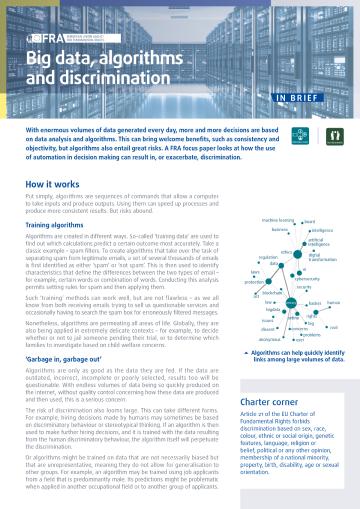
    With enormous volumes of data generated every day, more and more decisions are based on data analysis and algorithms. This can bring welcome benefits, such as consistency and objectivity, but algorithms also entail great risks. A FRA focus paper looks at how the use of automation in decision making can result in, or exacerbate, discrimination.
  • Report / Paper / Summary
    29
    August
    2018
    The founding treaties, the EU Charter of Fundamental Rights and secondary EU law all provide for EU citizens’ freedom to move and reside freely in any EU country of their choice. Growing numbers of citizens, and their family members, are making use of this freedom and related rights, such as the right not to be discriminated against based on nationality and the right to vote in certain elections in the host Member State. But making these rights a reality remains a challenge. This report presents an EU-wide, comparative overview of the application of the Free Movement Directive (2004/38/EC) across the 28 Member States based on a review of select case law at national level.
  • Report / Paper / Summary
    30
    May
    2018
    We live in a world of big data, where technological developments in the area of machine learning and artificial intelligence have changed the way we live. Decisions and processes concerning everyday life are increasingly automated, based on data. This affects fundamental rights in various ways. This focus paper specifically deals with discrimination, a fundamental rights area particularly affected by technological developments.
  • Report / Paper / Summary
    5
    February
    2018
    EU Member States’ legal and practical responses to migrants and refugees implicate several of their fundamental rights, as enshrined in the Charter of Fundamental Rights of the European Union (EU). The EU Agency for Fundamental Rights (FRA) has regularly reported on these issues since September 2015. This report highlights key trends and persistent concerns between October 2016 and December 2017. It focuses on five areas: access to territory, reception conditions, asylum procedures, unaccompanied children and immigration detention.
  • Easy-to-read report
    3
    January
    2018
    More than 20 million immigrants lived in the European Union in 2016. This means that 1 person in 25 was an immigrant. Having more immigrants and refugees makes it even more important for the governments to have plans to help them to integrate.