• Periodic updates / Series
    21
    July
    2026
    This is the second bulletin in FRA’s new quarterly series monitoring the situation of migrants, asylum seekers and refugees. It covers key developments and ongoing concerns from 1 April to 30 June 2026.

    Following regular reporting on fundamental rights issues related to migration and asylum from 2015 to 2023, FRA resumed the series in 2026 under the EU's 2024 Asylum and Migration Management Regulation, ahead of the June 2026 implementation of the EU Migration and Asylum Pact. The first bulletin, published in April 2026, covered developments from 1 January 2025 to 31 March 2026.
  • Handbook / Guide / Manual
    29
    June
    2026
    This guidance is for newly appointed guardians supporting a child who is applying for or has obtained international protection. It explains key terms, such as refugee status and subsidiary protection, as well as the legal framework for children’s rights in this context. The guidance also covers how to ensure the child’s participation and best interests during the asylum procedure. It is part of a series of practical tools developed by the European Union Agency for Asylum (EUAA) and the European Union Agency for Fundamental Rights (FRA) for guardians of unaccompanied children with international protection needs.
  • Fundamental Rights Report
    11
    June
    2026
    The Fundamental Rights Report: Challenges and Achievements in 2025 is FRA’s flagship annual publication. It provides an overview of the state of fundamental rights in the EU and highlights selected critical developments from 2025. This year, it focuses on four areas: rights protection in a rapidly changing digital environment; the housing crisis and rising homelessness rates; employment challenges for people from non-EU countries; and the implementation of the EU Charter of Fundamental Rights. The publication is a valuable resource for those seeking to stay informed about the EU’s shifting landscape of fundamental rights.
  • Periodic updates / Series
    21
    April
    2026
    From 2015 to 2023, FRA regularly published bulletins on fundamental rights issues related to migration and asylum. As part of the EU's 2024 Asylum and Migration Management Regulation, FRA is now restarting this reporting ahead of the June 2026 implementation of the EU Migration and Asylum Pact. This first bulletin in the new series takes stock of the situation of migrants, asylum seekers and refugees as of March 2026. It looks at key developments between January 2025 and the end of March 2026, as well as ongoing problems and new areas of concern.
  • Report / Paper / Summary
    14
    April
    2026
    In response to increased arrivals of asylum seekers, in 2015 the European Commission introduced the hotspot approach. Under this approach, the European Commission and EU agencies supported Greece and Italy in identifying, registering and fingerprinting newly arrived people. FRA regularly visited the initial reception facilities hosting them. This report looks back at the lessons learnt from 10 years of FRA visits. It identifies recurring risks to rights and highlights practical measures and promising practices to prevent or address them. These ‘lessons learnt’ can inform the implementation of the 2024 Pact on Migration and Asylum in line with the EU Charter of Fundamental Rights.
  • Report / Paper / Summary
    4
    December
    2025
    Artificial Intelligence comes with both benefits and risks. Safe AI use that accounts for fundamental rights is thus crucial. While the 2024 EU AI Act was a milestone in this regard, its broad definitions regarding AI systems and high-risk AI could introduce loopholes for fundamental rights compliance. This report offers an empirical basis for much-needed practical guidance on the Act’s implementation. Based on interviews with AI developers, sellers, and users, FRA addresses challenges of its use in critical domains, like asylum, education, and employment. Our findings help guide next steps in realising the AI Act’s potential to ensure responsible innovation.

  • Handbook / Guide / Manual
    8
    October
    2025
    The Entry/Exit System (EES), launching in 2025, will register non-EU nationals crossing the EU’s external borders. This FRA guidance supports managers overseeing the operation of the new system. It helps them to ensure compliance with EU fundamental rights. It outlines operational considerations: clear communication, dignified biometric data collection and data protection. It also addresses staff training needs. Based on fieldwork at 10 border crossing points in 6 Member States, the guidance will ensure rights are respected under the new system. A separate guidance publication for border guards accompanies this publication.
  • Handbook / Guide / Manual
    8
    October
    2025
    System EES (Entry/Exit System), który ruszy w 2025 roku, będzie rejestrował obywateli państw trzecich przekraczających zewnętrzne granice UE. Niniejsze wytyczne FRA mają wesprzeć kadrę zarządzającą odpowiedzialną za funkcjonowanie nowego systemu. Mają pomóc im zapewnić zgodność z unijną ochroną praw podstawowych. Przedstawiają kwestie operacyjne, takie jak jasna komunikacja, godne pobieranie danych biometrycznych oraz ochrona danych. Obejmują także potrzeby szkoleniowe personelu. Na podstawie badań terenowych przeprowadzonych w 10 przejściach granicznych w 6 państwach członkowskich, wytyczne te mają zagwarantować poszanowanie praw podstawowych w ramach nowego systemu. Oddzielna publikacja z wytycznymi dla funkcjonariuszy straży granicznej towarzyszy temu dokumentowi.
  • Opinion / Position Paper
    23
    July
    2025
    This position paper examines how the EU can counter the instrumentalisation of migrants while also upholding fundamental rights. Instrumentalisation refers to countries outside the EU using migration to exert political pressure. This position paper defines the phenomenon, provides examples, and outlines legal obligations under EU law. It provides legal analysis and warns that some responses risk undermining fundamental rights at the EU’s external borders, including the right to asylum. To counter instrumentalisation and uphold fundamental rights, the position paper proposes practical measures for Member States to take, such as sanctions, border controls, and cooperation with private operators.
  • Fundamental Rights Report
    10
    June
    2025
    The Fundamental Rights Report 2025 is the annual report of the European Union Agency for Fundamental Rights (FRA). It provides an overview of the state of fundamental rights in the EU and highlights selected critical developments and trends in 2024. The report covers issues such as inclusive elections, gender-based violence, and the implementation of the EU Charter of Fundamental Rights. It presents FRA’s opinions on these developments, setting out the actions that the EU and Member States should take. This annual publication is a valuable resource for those seeking to stay informed about the EU’s shifting landscape of fundamental rights.
  • Opinion / Position Paper
    6
    February
    2025
    This FRA Position Paper outlines the Agency’s position on the creation of 'return hubs' in non-EU countries for migrants who have been ordered to leave the EU. Considering the serious fundamental rights risks connected with running return hubs, this legal analysis presents the conditions that would have to be met for return hubs to respect fundamental rights and comply with EU law. These include setting up agreements with the host countries and creating independent human rights monitoring mechanisms. The position paper does not examine centres in third countries that process asylum applications.
  • Fundamental Rights Report
    5
    June
    2024
    FRA’s Fundamental Rights Report 2024 analyses the year’s developments in fundamental rights. It focuses on the most pressing fundamental rights concerns facing Europe in 2023: the cost-of-living crisis, rights concerns at the EU’s external borders and migration, and threats to democracy. Re-structured, this year’s new approach is a shorter and sharper analysis. It also presents FRA’s opinions on these developments, including a summary of the evidence supporting these opinions.
  • Report / Paper / Summary
    11
    July
    2023
    Across the world, human rights defenders protect and uphold human rights in some of the most challenging situations. In some countries they face worrying levels of threats and attacks, intimidation and harassment. This report outlines how human rights defenders can enter and stay in the EU when they need protection. It suggests how EU institutions and Member States could use the flexibility in existing legal provisions and provide shelter for defenders who seek protection.
  • Fundamental Rights Report
    8
    June
    2023
    Russia’s unprovoked war of aggression against Ukraine has resulted in massive internal and external population displacement. The European Union (EU) rapidly activated its Temporary Protection Directive for the first time since it was adopted in 2001. This entitled nearly 4 million people to legal residence and access to work, housing and legal assistance, education and healthcare.
  • Fundamental Rights Report
    8
    June
    2023
    La guerre d'agression non provoquée de la Russie contre l'Ukraine a entraîné des déplacements massifs de personnes à l'intérieur et à l'extérieur du pays. L'Union européenne (UE) a rapidement activé sa directive relative à la protection
    temporaire pour la première fois depuis son adoption en 2001. Cela a donné à près de 4 millions de personnes le droit à un séjour régulier et à un accès au travail, au logement, à l'assistance juridique, à l'éducation et aux soins de santé.
  • Fundamental Rights Report
    8
    June
    2023
    FRA’s Fundamental Rights Report 2023 reviews major developments in the field in 2022, identifying both achievements and areas of concern. It also presents FRA’s opinions on these developments, including a synopsis of the evidence supporting these opinions.
  • Periodic updates / Series
    30
    May
    2023
    Over the span of nearly eight years, there have been developments in showing respect for the human rights of those who arrive at the EU’s borders. Russia’s war of aggression against Ukraine has shown how a large and sudden influx of people can be managed effectively and respectfully. Notwithstanding the improvements, the growing number of people crossing or attempting to enter the EU pose a wide range of fundamental rights challenges.

    In this bulletin, FRA takes stock of concerns and improvements regarding the fundamental rights of migrants, asylum seekers and refugees. It highlights the EU Member States’ legal and practical responses. It identifies key trends, promising practices, long-standing and emerging patterns, and persistent concerns.
  • Periodic updates / Series
    21
    October
    2022
    The Russian invasion of Ukraine triggered solidarity from EU governments, local authorities and society as they welcomed more than 7 million people fleeing the aggression. The European Union’s rapid response, activating the EU Temporary Protection Directive, offered welcome relief and much-needed support to those in need. It allowed displaced persons the opportunity to quickly settle and to work, travel and access services across the EU. But other pressing human rights issues have come to the fore and remain high on the EU’s agenda, such as human trafficking, sexual and gender-based violence, hate crime and hate-fuelled disinformation.
  • Handbook / Guide / Manual
    14
    October
    2022
    Η παρακολούθηση της κατάστασης των θεμελιωδών δικαιωμάτων στα εξωτερικά σύνορα της ΕΕ θα πρέπει να είναι συστηματική και τακτική για μια σειρά δραστηριοτήτων διαχείρισης των συνόρων, όπως είναι η επιτήρηση των συνόρων, οι συλλήψεις στα χερσαία, θαλάσσια και εναέρια σύνορα, καθώς και η λειτουργία των μηχανισμών παραπομπής, ακόμη και σε περίπτωση μαζικών αφίξεων. Οι παρούσες γενικές κατευθυντήριες γραμμές έχουν ως στόχο να βοηθήσουν τα κράτη μέλη της ΕΕ να συγκροτήσουν εθνικούς ανεξάρτητους μηχανισμούς για την παρακολούθηση της συμμόρφωσης προς τα θεμελιώδη δικαιώματα στα εξωτερικά σύνορα της ΕΕ, σύμφωνα με την πρόταση κανονισμού για τον έλεγχο διαλογής που ανακοινώθηκε στις 23 Σεπτεμβρίου 2020 από την Ευρωπαϊκή Επιτροπή. Εκπονήθηκαν από τον Οργανισμό Θεμελιωδών Δικαιωμάτων της Ευρωπαϊκής Ένωσης κατόπιν αιτήματος της Επιτροπής.
  • Handbook / Guide / Manual
    14
    October
    2022
    ** As of 19 September 2024 a new version of this guidance has been issued. Please see the link below. **

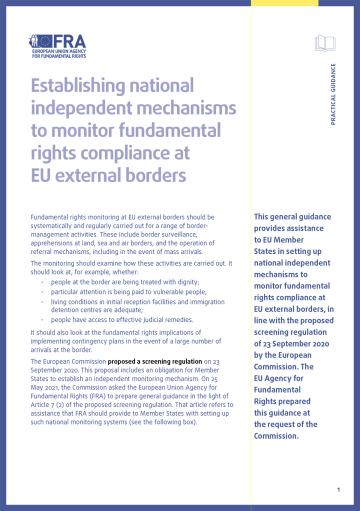
    Fundamental rights monitoring at EU external borders should be systematically and regularly carried out for a range of border management activities. These include border surveillance, apprehensions at land, sea and air borders, and the operation of referral mechanisms, including in the event of mass arrivals. This general guidance provides assistance to EU Member States in setting up national independent mechanisms to monitor fundamental rights compliance at EU external borders, in line with the proposed screening regulation of 23 September 2020 by the European Commission. The EU Agency for Fundamental Rights prepared this guidance at the request of the Commission.