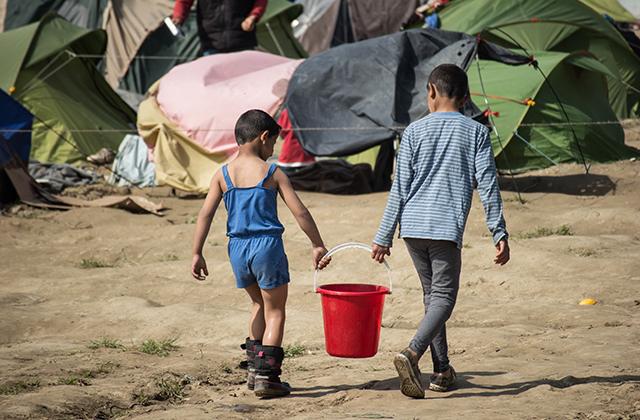
This note sets out human rights standards stemming from both the European Convention on Human Rights and European Union (EU) law that apply to effective remedies for human rights violations at borders, together with those on complaints mechanisms and investigations into complaints of rights violations at borders.
The Employers Sanctions Directive was primarily enacted to dissuade employers from recruiting migrants in an irregular situation, but it also contains provisions to protect workers. It facilitates access to justice for exploited workers and sets out workers’ rights to claim back payment of outstanding wages. The directive also contains provisions to enhance the effectiveness of labour inspections. This report describes how the 25 Member States bound by the directive have been implementing its protective provisions, focusing on the impact these provisions have on migrant workers in an irregular situation who are victims of exploitation and other labour
law violations.
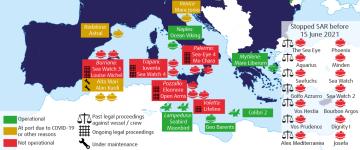
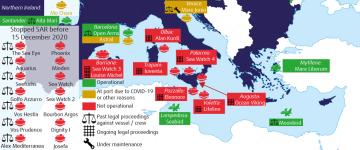
The International Organization for Migration estimates that about 813 people died or went missing crossing the Mediterranean Sea to reach Europe to escape war, persecution or to pursue a better life in 2021, up to 15 June. This is an average of almost five people per day. The EU Agency for Fundamental Rights (FRA) collects data on NGO ships involved in search and rescue in the Mediterranean, legal proceedings against them, as well as difficulties in disembarking migrants in safe ports.
Anul 2020 a adus atât progrese, cât și pași înapoi în
ceea ce privește protecția drepturilor fundamentale.
Documentul FRA Fundamental Rights Report 2021
(Raportul privind drepturile fundamentale 2021)
analizează evoluțiile majore din domeniu, reliefând
atât realizările, cât și problemele îngrijorătoare rămase
nesoluționate.
FRA’s Fundamental Rights Report 2021 reviews major developments in the field in 2020, identifying both achievements and areas of concern. It also presents FRA’s opinions on these developments, including a synopsis of the evidence supporting these opinions. This year’s focus chapter explores the impact of the COVID-19 pandemic on fundamental rights. The remaining chapters cover: the EU Charter of Fundamental Rights; equality and non-discrimination; racism, xenophobia and related intolerance; Roma equality and inclusion; asylum, borders and migration; information society, privacy and data protection; rights of the child; access to justice; and the implementation of the Convention on the Rights of Persons with Disabilities.
This focus looks at COVID-19’s impact on fundamental rights. It underscores that a human rights-based approach to tackling the pandemic requires balanced measures that are based on law, necessary, temporary and proportional. It also requires addressing the pandemic’s socio-economic impact, protecting the vulnerable and fighting racism.
This note outlines how to help ensure a dignified stay for third-country nationals who are apprehended or intercepted at external borders. Specifically, FRA identifies twelve points for protection-sensitive and fundamental rights-compliant planning and design of initial-reception facilities at such borders. These are based on the agency’s work at external borders, including data collection and research activities.
The EU Agency for Fundamental Rights has been regularly collecting data on asylum and migration since September 2015. This report focuses on the fundamental rights situation of people arriving in Member States and EU candidate countries particularly affected by migration. It addresses fundamental rights concerns between 1 October and 31 December 2020.
In 2020 (until 15 December), the International Organization for Migration estimated that about 1,054 people have died or gone missing while crossing the Mediterranean Sea to reach Europe to escape war or persecution or to pursue a better life. This is an average of almost three people per day. In the past years, a significant number of migrants in distress at sea have been rescued by civil society vessels deployed with a humanitarian mandate to reduce fatalities and bring rescued migrants to safety. Since 2018, however, national authorities initiated some 50 administrative and criminal proceedings against crew members or vessels, also seizing the latter. In some cases, rescue vessels were blocked in harbours due to flag issues or the inability to meet maritime safety-related and other technical requirements.
Handbook / Guide / Manual
17
December
2020
Finnish, Latvian and Romanian versions now available
Convenția Europeană a Drepturilor Omului și dreptul Uniunii Europene oferă un cadru din ce în ce mai important pentru protecția drepturilor străinilor. Legislația Uniunii Europene în materie de azil, frontiere și imigrație se dezvoltă rapid. Există o jurisprudență
impresionantă a Curții Europene a Drepturilor Omului referitoare în special la articolele 3, 5, 8 și 13 din Convenție. Curtea de Justiție a Uniunii Europene este din ce în ce mai solicitată să se pronunțe cu privire la interpretarea dispozițiilor dreptului
Uniunii Europene în acest domeniu. Cea de a treia ediție a acestui manual, actualizată până în iulie 2020, prezintă într-un mod accesibil această legislație a Uniunii Europene și corpusul de jurisprudență a celor două instanțe europene.


 Handbook / Guide / Manual9June2026
 Handbook / Guide / Manual8October2025
 Opinion / Position Paper23July2025