Victims of violent crime have various rights, including to protection and to access justice. But how are these rights playing out in practice? Are victims of violent crime properly seen, informed, empowered and heard? Do they tend to feel that justice has been done? Our four-part report series takes a closer look at these questions, based on interviews with victims, people working for victim support organisations, police officers, attorneys, prosecutors and judges.
The right to vote is at the heart of what it means to live in a democratic society. However, legislation sets out a number of restrictions on this right. With a view to the European Parliament elections in 2019, this paper presents developments in the situation of the right to vote for people deprived of legal capacity in the EU.
This report outlines the main findings of FRA’s second survey on Jewish people’s experiences with hate crime, discrimination and antisemitism in the European Union – the biggest survey of Jewish people ever conducted worldwide. Covering 12 EU Member States, the survey reached almost 16,500 individuals who identify as being Jewish. It follows up on the agency’s first survey, conducted in seven countries in 2012.
This Opinion by the European Union Agency for Fundamental Rights (FRA) aims to inform
the European Parliament’s position on the legislative proposal on the European Border and
Coast Guard (EBCG) presented by the European Commission on 12 September 2018.
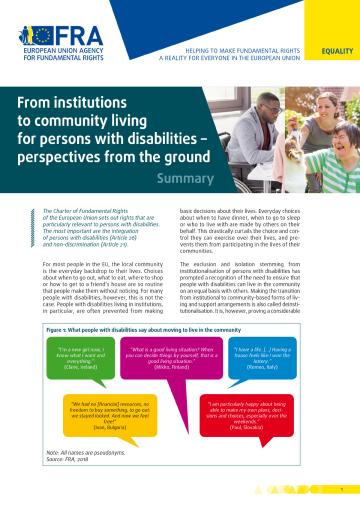
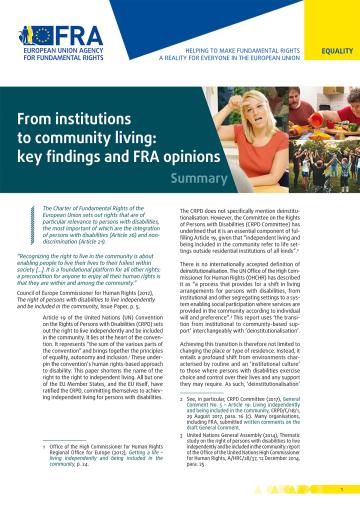
The Convention on the Rights of Persons with Disabilities commits both the EU and all of its Member States to realising the right of persons with disabilities to live independently in the community – which includes achieving deinstitutionalisation for those residing in institutional settings. But much remains to be done to make this a reality in practice. This report presents the main insights gained during fieldwork on the drivers of and barriers to deinstitutionalisation. Focusing on the local level, it gives voice to a diverse set of actors – most importantly, to people with disabilities themselves.
The European Union Agency for Fundamental Rights
(FRA) wanted to contribute to making steps to implement
deinstitutionalisation more effective, by capturing
concrete evidence of what is and what is
not working on the ground. To do this, the agency
conducted extensive fieldwork research in five EU
Member States at different stages of the deinstitutionalisation
process.
This summary report presents the key findings of
that fieldwork and the FRA opinions stemming from
them.
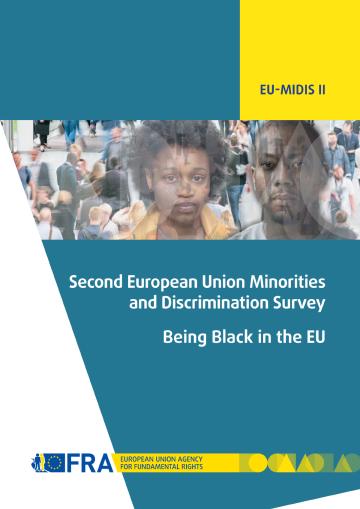
Almost twenty years after adoption of EU laws forbidding discrimination, people of African descent in the EU face widespread and entrenched prejudice and exclusion. This report outlines selected results from FRA's second large-scale EU-wide survey on migrants and minorities (EU-MIDIS II) carried out in 2016. It examines the experiences of almost 6,000 people of African descent in 12 EU Member States.
This note draws attention to the recent trend of criminalising search and rescue operations (SAR) in the Mediterranean Sea carried out by non-governmental organisations (NGOs) or other private entities. This includes seizing rescue vessels, as well as arrests for crew members, in some EU Member States. Most of such incidents concerned NGOs operating in the Central Mediterranean Sea.
With this Opinion, FRA aims to contribute to the European Parliament's own-initiative report on the “Implementation of the Charter of Fundamental Rights of the European Union in the EU institutional framework”, being prepared in the Parliament’s Committee for Constitutional Affairs (AFCO). The request aims at understanding the interaction between the Charter’s implementation at national and EU level, and whether there are “instruments, mechanisms and practices” available at EU level to assist Member States to better implement the Charter.
This Opinion by the European Union Agency for Fundamental Rights (FRA) aims to inform the European Parliament’s position concerning the legislative proposal for a Regulation on strengthening the security of identity cards of European Union (EU) citizens and of residence documents issued to EU citizens and their family members exercising their right of free movement. It focuses on the processing of biometric data and complements the opinion published by the European Data Protection Supervisor (EDPS).
The EU Return Directive (2008/115/EC) in Article 8 (6) introduced an important fundamental rights safeguard for third-country nationals ordered to leave the EU because they do not or no longer fulfil the conditions for entry and/or stay. According to the Directive, Member States must provide for an effective forced-return monitoring system.
European societies are not getting any younger! It is a simple truth we must face both about ourselves and Europe as a whole. In two generations, by 2080, those aged 65 or above will account for almost 30% of the European Union’s population.
The year 2017 brought both progress and setbacks in terms of rights protection. The European Pillar of Social Rights marked an important move towards a more ‘social Europe’. But, as experiences with the EU Charter of Fundamental Rights underscore, agreement on a text is merely a first step. Even in its eighth year as the EU's binding bill of rights, the Charter's potential was not fully exploited, highlighting the need to more actively promote its use.
EU Member States, and the EU itself have ratified
the CRPD, committing themselves to achieving independent
living for persons with disabilities. Doing so
requires a meaningful and sustainable shift from institutional
to community-based living arrangements. This
publication summarises the findings from the three
FRA reports focusing on different aspects of deinstitutionalisation.
The right to access justice and all other relevant procedural rights are not just rights in themselves; they also protect against violations of every other right. Respect for children’s rights in the area of justice is therefore essential. International treaties, the Charter of Fundamental Rights of the European Union, European Union (EU) secondary law, and national legislation provide a number of relevant rights.
This report outlines the fundamental rights implications of collecting, storing and using
biometric and other data in EU IT systems in the area of asylum and migration.
This report looks at what the EU and the 28 countries have agreed to do to move people with disabilities from living in institutions to living in their local community with support.