• Fundamental Rights Report
    8
    June
    2023
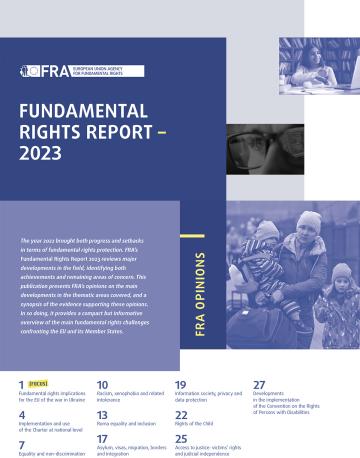
    Vuonna 2022 perusoikeuksien suojelussa tapahtui sekä edistystä että takaiskuja. Euroopan unionin perusoikeusviraston (FRA) vuoden 2023 perusoikeusraportissa tarkastellaan perusoikeuksien tilanteen kehitystä pääpiirteissään ja tuodaan esiin sekä saavutuksia että jäljellä olevia huolenaiheita. Julkaisussa on FRA:n lausuntoja pääasiallisesta kehityksestä käsitellyillä aihealueilla sekä yleiskatsaus lausuntojen perustana olevaan näyttöön.
  • Fundamental Rights Report
    8
    June
    2023
    L’année 2022 a été marquée à la fois par des avancées et des reculs en matière de protection des droits fondamentaux. Le Rapport sur les droits fondamentaux 2023 de l’Agence des droits fondamentaux de l’Union européenne (FRA) examine les principales évolutions dans ce domaine, en recensant les progrès accomplis et les sujets de préoccupation persistants. La présente publication expose les avis de la FRA sur les principales évolutions dans les domaines thématiques couverts ainsi qu’un résumé des éléments factuels qui étayent ces avis.
  • Fundamental Rights Report
    8
    June
    2023
    Tógadh céimeanna chun tosaigh agus céimeanna ar gcúl araon i ndáil le cosaint ceart bunúsach sa bhliain 2022. In Tuarascáil um Chearta Bunúsacha 2023 de chuid FRA, féachtar siar ar na mórfhorbairtí sa réimse agus sainaithnítear na héachtaí a bhí ann agus réimsí ar ábhair imní iad go fóill araon. San fhoilseachán seo, cuirtear i láthair tuairimí FRA faoi na príomhfhorbairtí sna réimsí téamacha a chumhdaítear agus déantar achoimre ar an bhfianaise a thacaíonn leis na tuairimí sin.
  • Fundamental Rights Report
    8
    June
    2023
    Godina 2022. donijela je i napredak i prepreke u pogledu zaštite temeljnih prava. U FRA-inu Izvješću o temeljnim pravima 2023. daje se pregled važnih promjena i postignuća u tom području te se ističu područja koja još izazivaju zabrinutost. U ovoj publikaciji navode se mišljenja FRA-e o glavnim promjenama u obuhvaćenim tematskim područjima te se ukratko iznose dokazi kojima se potkrjepljuju ta mišljenja. Na taj se način pruža sažet i informativan pregled glavnih pitanja povezanih s temeljnim pravima s kojima se suočavaju EU i njegove države članice.
  • Fundamental Rights Report
    8
    June
    2023
    A 2022-es év egyaránt hozott előrelépést és visszaesést az alapvető jogok védelme terén. Az FRA 2023. évi alapjogi jelentése áttekinti a terület legfontosabb fejleményeit, valamint meghatározza az elért eredményeket és a fennmaradó aggályos területeket. Ez a kiadvány bemutatja az FRA véleményét az érintett témakörök főbb fejleményeiről, valamint a véleményeket alátámasztó bizonyítékok összefoglalóját.
  • Fundamental Rights Report
    8
    June
    2023
    Il 2022 è stato caratterizzato sia da progressi sia da battute d’arresto in termini di tutela dei diritti fondamentali. Il Fundamental Rights Report 2023 (Relazione sui diritti fondamentali per il 2023) dell’Agenzia dell’Unione europea per i diritti fondamentali (FRA) fa il punto della situazione sui principali sviluppi in materia, individuando i risultati ottenuti e i settori che destano ancora preoccupazione.
  • Fundamental Rights Report
    8
    June
    2023
    Pagrindinių teisių apsaugos srityje 2022 m. būta ir sėkmės, ir nesėkmės. FRA 2023 m. pagrindinių teisių ataskaitoje apžvelgiami pagrindiniai pokyčiai pagrindinių teisių srityje, nurodant ir pasiekimus, ir sritis, keliančias nuolatinį susirūpinimą. Šiame leidinyje pateikiamos FRA išvados apie pagrindinius pokyčius atitinkamose teminėse srityse ir šias išvadas pagrindžiantys įrodymai.
  • Fundamental Rights Report
    8
    June
    2023
    Pamattiesību aizsardzības jomā 2022. gadā bija vērojami gan sasniegumi, gan neveiksmes. FRA 2023. gada ziņojumā par pamattiesībām aplūkoti galvenie jaunumi pamattiesību jomā, nosakot gan sasniegumus, gan jomas, kas aizvien rada bažas. Šajā publikācijā sniegti FRA atzinumi par galvenajiem jaunumiem attiecīgajās tematiskajās jomās un šos atzinumus pamatojošs pierādījumu apkopojums.
  • Periodic updates / Series
    30
    May
    2023
    Over the span of nearly eight years, there have been developments in showing respect for the human rights of those who arrive at the EU’s borders. Russia’s war of aggression against Ukraine has shown how a large and sudden influx of people can be managed effectively and respectfully. Notwithstanding the improvements, the growing number of people crossing or attempting to enter the EU pose a wide range of fundamental rights challenges.

    In this bulletin, FRA takes stock of concerns and improvements regarding the fundamental rights of migrants, asylum seekers and refugees. It highlights the EU Member States’ legal and practical responses. It identifies key trends, promising practices, long-standing and emerging patterns, and persistent concerns.
  • Report / Paper / Summary
    24
    May
    2023
    This report provides a partial update on the findings of the 2017 European Union Agency for Fundamental Rights (FRA) report Surveillance by intelligence services: Fundamental rights safeguards and remedies in the EU. It was prepared at the request of the European Parliament, which asked FRA to update its 2017 findings to support the work of its committee of inquiry to investigate the use of Pegasus and equivalent surveillance spyware (PEGA).
  • Handbook / Guide / Manual
    1
    March
    2023
    Το παρόν εγχειρίδιο έχει σχεδιαστεί με στόχο να συνδράμει φορείς, οργανισμούς και φυσικά πρόσωπα στην εκπαίδευση επιτρόπων ασυνόδευτων παιδιών ή στην εκπαίδευση εκπαιδευτών. Μπορεί να χρησιμοποιηθεί σε διάφορα πλαίσια κατάρτισης, όπως είναι η επαγγελματική και ακαδημαϊκή κατάρτιση, η πρακτική άσκηση και η συνεχής κατάρτιση. Το εγχειρίδιο βασίζεται στις αρχές των ανθρωπίνων και των θεμελιωδών δικαιωμάτων και στα πρότυπα δεοντολογίας, ενώ επίσης αναγνωρίζει ότι το παιδί και ο/η επίτροπος έχουν τις δικές τους προσωπικές ιστορίες, ικανότητες και δεξιότητες. Ενισχύει την αυτοπεποίθηση των επιτρόπων όσον αφορά την προώθηση των δικαιωμάτων και του συμφέροντος του παιδιού. Επιπλέον, τους/τις ενδυναμώνει προκειμένου να ενεργούν ανεξάρτητα και αμερόληπτα απέναντι σε διάφορους κρατικούς υπαλλήλους, παρόχους υπηρεσιών και μέλη της κοινότητας.
  • Handbook / Guide / Manual
    1
    March
    2023
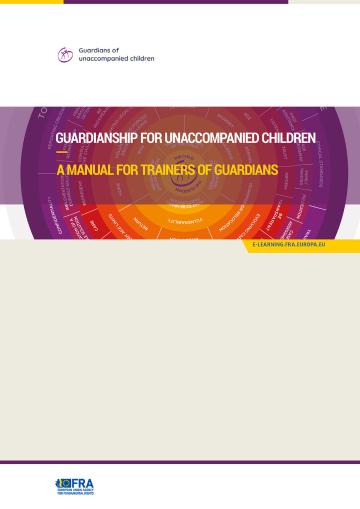
    This manual is designed to help institutions, organisations and individuals to train guardians of unaccompanied children or to deliver ‘train-the-trainers’ courses. It can be used in a range of training contexts, such as professional and academic training, on-the-job training and continuing training. The manual is based on human and fundamental rights principles and ethical standards and recognises that the child and the guardian have their own personal stories, resources and capacities. It enhances guardians’ confidence to promote the child’s rights and best interests. It also enhances their confidence to act independently and impartially in relation to different state
    officials, service providers and other community members.
  • Report / Paper / Summary
    27
    February
    2023
    FRA’s 2021 survey on Roma was conducted in Croatia, Czechia, Greece, Hungary, Italy, Portugal, Romania, and Spain, as well as in North Macedonia and Serbia. It includes interviews with more than 8,400 Roma, collecting information on more than 20,000 individuals living in their households. This technical report provides a detailed overview of the survey methodology used by FRA when collecting the survey data.
  • Report / Paper / Summary
    22
    February
    2023
    Directive 2012/29/EU represents a milestone in the development of victims’ rights. It establishes minimum standards for the rights, support and protection of victims of crime. It defines the scope of support services, guarantees the right to effective protection against secondary victimisation and comprehensively regulates the measures required for this purpose. This report covers three core components underpinning victims’ rights: support services, crime reporting, and protection from secondary and repeat victimisation. Examples highlight the relevant legal provisions in Member States and how specific rights under the Victims’ Rights Directive work in practice.
  • Periodic updates / Series
    13
    December
    2022
    National Human Rights Institutions (NHRIs) continue to play a key role in upholding fundamental rights. FRA keeps track of the accreditation status and the mandates of the NHRIs. In 2022, the NHRI in Cyprus was upgraded to an ‘A-status’ institution. In addition, the mandates of six NHRIs changed to include child protection or the protection of LGBTI people.
  • Report / Paper / Summary
    8
    December
    2022
    Artificial intelligence is everywhere and affects everyone – from deciding what content people see on their social media feeds to determining who will receive state benefits. AI technologies are typically based on algorithms that make predictions to support or even fully automate decision-making.
  • Report / Paper / Summary
    3
    November
    2022
    Antisemitic incidents and hate crimes violate fundamental rights, especially the right to human dignity, the right to equality of treatment and the freedom of thought, conscience and religion. This report provides an overview of available data on antisemitism as recorded by official and unofficial sources in the EU Member States and in Albania, North Macedonia and Serbia. The data provided by the countries are supplemented with information from international organisations.
  • Periodic updates / Series
    31
    October
    2022
    The table below gives an overview of certain key aspects in national legislation implementing the EU Temporary Protection Directive.
  • Report / Paper / Summary
    25
    October
    2022
    02 November 2022
    This report presents findings from FRA’s 2021 survey on Roma in Croatia, Czechia, Greece, Hungary, Italy, Portugal, Romania and Spain, as well as in North Macedonia and Serbia. The survey includes interviews with more than 8,400 Roma, collecting information on more than 20,000 individuals living in their households. By focusing on Roma, the survey provides unique data and information that are not available from European general population surveys, which do not disaggregate on grounds of ethnic origin. The findings present a bleak but familiar picture of exclusion, deprivation, discrimination and racism.

  • Periodic updates / Series
    21
    October
    2022
    The Russian invasion of Ukraine triggered solidarity from EU governments, local authorities and society as they welcomed more than 7 million people fleeing the aggression. The European Union’s rapid response, activating the EU Temporary Protection Directive, offered welcome relief and much-needed support to those in need. It allowed displaced persons the opportunity to quickly settle and to work, travel and access services across the EU. But other pressing human rights issues have come to the fore and remain high on the EU’s agenda, such as human trafficking, sexual and gender-based violence, hate crime and hate-fuelled disinformation.