Highlights

  • Report / Paper / Summary
    24
    Februar
    2026
    The start of Russia’s war of aggression against Ukraine on 24 February 2022 shocked the global community and gave rise to a
    series of urgent fundamental rights challenges across Europe. While much attention has focused on the scale of devastation and its wider impact on all Ukrainians, the war has also inflicted profound personal harm. This report sheds light on the violence, sexual harassment and exploitation experienced by women displaced from Ukraine. Drawing on a survey and in-depth interviews with women from Ukraine, the report documents the prevalence, forms and patterns of gender-based violence and sets out practical measures to improve safety, access to justice and support.
  • Video
    There are no truly safe spaces for women. At home, at work, in public or online, 1 in 3 women and girls have experienced some form of gender-based violence. This ranges from hate, harassment, abuse, to physical and sexual violence. Women are being silenced and harmed - online and offline - every day, as the EU gender-based survey findings show. But we have the tools to fight it. By preventing violence before it starts, by strengthen legal protection, by funding support services for victims and by training police and healthcare professionals.
  • Report / Paper / Summary
    13
    November
    2025
    FRA analysed 31 digital tools and systems across seven EU Member States, exploring potential positive and negative effects on victims, claimants and defendants. By identifying risks early, investing in skills and training, and embedding protections from the outset, policymakers and practitioners can build effective and inclusive justice systems. This report provides practical suggestions to help ensure that digitalised justice systems are accessible and deliver fair outcomes for all.
  • Seite
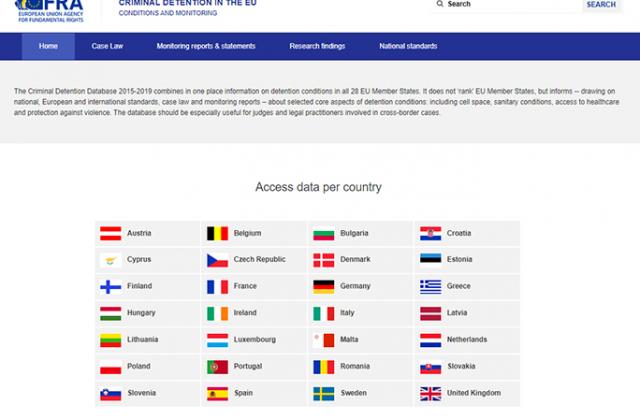
    The Criminal Detention Database 2015-2022 combines in one place information on detention conditions in all 27 EU Member States as well as the United Kingdom.
    Produkte
    Fundamental Rights Report 2019: In some Member States access to justice faces challenges. Judicial independence continues to cause
    concerns. Victims’ procedural rights need more effective implementation. Gaps in preventing
    violence against women and domestic violence remain.
    13
    Juni
    2019
    Der Leitfaden Kinder ohne elterliche Fürsorge, die in einem anderen EU-Mitgliedstaat als ihrem
    eigenen angetroffen werden hat das Ziel, die Handlungsfähigkeit aller im Bereich Kinderschutz
    tätigen Akteure zu stärken. Der Schutz dieser Mädchen und Jungen ist von höchster Bedeutung und
    stellt für die EU-Mitgliedstaaten eine Verpflichtung dar, die sich aus dem internationalen und dem
    europäischen Rechtsrahmen ableitet. Der vorliegende Leitfaden legt den Schwerpunkt auf Kinder,
    die Opfer von Menschenhandel geworden sind oder Gefahr laufen, dies zu werden, indem auf die
    Umsetzung der Ziele eingegangen wird, die in der Mitteilung der Kommission zur Berichterstattung
    über die Folgemaßnahmen zur Strategie der EU zur Beseitigung des Menschenhandels von
    2017 beschrieben wurden. Dabei werden ermittelte Muster beleuchtet, auch im Hinblick auf die
    geschlechtsspezifischen Besonderheiten von Straftaten.
    11
    Juni
    2019
    Algorithms used in machine learning systems and artificial intelligence (AI) can only be as good as the data used for their development. High quality data are essential for high quality algorithms. Yet, the call for high quality data in discussions around AI often remains without any further specifications and guidance as to what this actually means.
    6
    Juni
    2019
    How much progress can we expect in a decade? Various rights-related instruments had been in place for 10 years in 2018, prompting both sobering and encouraging reflection on this question.
    6
    Juni
    2019
    Das Jahr 2018 brachte in Bezug auf den Schutz der Grundrechte sowohl
    Fortschritte als auch Rückschritte. In ihrem Grundrechte-Bericht 2019
    untersucht die FRA wichtige Entwicklungen auf diesem Gebiet und zeigt sowohl
    Erfolge als auch Bereiche auf, in denen es immer noch Probleme gibt. Darüber
    hinaus äußert sich die FRA in dieser Veröffentlichung zu den wichtigsten
    Entwicklungen in den genannten Themenbereichen und gibt einen Überblick
    über die Informationen, die diesen Stellungnahmen zugrunde liegen.
    25
    April
    2019
    Victims of violent crime have various rights, including to protection and to access justice. But how are these rights playing out in practice? Are victims of violent crime properly seen, informed, empowered and heard? Do they tend to feel that justice has been done? Our four-part report series takes a closer look at these questions, based on interviews with victims, people working for victim support organisations, police officers, attorneys, prosecutors and judges.
    25
    April
    2019
    Victims of violent crime have various rights, including to protection and to access justice. But how are these rights playing out in practice? Are victims of violent crime properly seen, informed, empowered and heard? Do they tend to feel that justice has been done? Our four-part report series takes a closer look at these questions, based on interviews with victims, people working for victim support organisations, police officers, attorneys, prosecutors and judges.
    25
    April
    2019
    Victims of violent crime have various rights, including to protection and to access justice. But how are these rights playing out in practice? Are victims of violent crime properly seen, informed, empowered and heard? Do they tend to feel that justice has been done? Our four-part report series takes a closer look at these questions, based on interviews with victims, people working for victim support organisations, police officers, attorneys, prosecutors and judges.
    20
    Februar
    2019
    This Opinion aims to inform the European Parliament’s position on the legislative proposal for a Regulation on preventing the dissemination of terrorist content online, presented by the European Commission on 12 September 2018.
    5
    Dezember
    2018
    In diesem Handbuch wird erläutert, was Profiling ist, welcher Rechtsrahmen ihm zugrunde liegt und weshalb Profiling von rechtlicher Seite nicht nur die Grundrechte wahren muss, sondern auch von entscheidender Bedeutung für eine wirksame Polizeiarbeit und ein wirksames Grenzmanagement ist. Das Handbuch enthält außerdem praktische Anweisungen zur Vermeidung von unrechtmäßigem Profiling bei Einsätzen von Polizei und Grenzmanagement.
    26
    Oktober
    2018
    The EU Agency for Fundamental Rights’ 2018 Fundamental Rights Forum
    brought together more than 700 human rights champions at a time of
    widening social divisions and increasingly polarised politics across
    Europe.
    5
    September
    2018
    Severe labour exploitation is widespread across the European Union. While workplace inspections can help counter this phenomenon, they need to be strengthened to do so effectively. Based on interviews and focus group discussions with almost 240 exploited workers active in diverse economic sectors, this report provides important evidence on how unscrupulous employers manipulate and undermine inspections, and on what can be done to counteract such efforts.
    6
    September
    2018
    Workers are being severely exploited for their labour across the EU, and
    inspections are not effective at stopping this reality. Based on interviews with
    almost 240 workers – including non-EU citizens who came to the EU and
    EU nationals who moved to another EU country to work – a new FRA report
    outlines the problem and identifies ways to bolster inspections.
    6
    Juni
    2018
    The year 2017 brought both progress and setbacks in terms of rights protection. The European Pillar of Social Rights marked an important move towards a more ‘social Europe’. But, as experiences with the EU Charter of Fundamental Rights underscore, agreement on a text is merely a first step. Even in its eighth year as the EU's binding bill of rights, the Charter's potential was not fully exploited, highlighting the need to more actively promote its use.
    6
    Juni
    2018
    Das Jahr 2017 brachte in Bezug auf den Schutz der Grundrechte sowohl Fortschritte als auch
    Rückschritte. Der Grundrechte-Bericht 2018 der FRA bietet eine Zusammenfassung und Analyse
    der wichtigsten einschlägigen Entwicklungen in der EU zwischen Januar und Dezember
    2017 und präsentiert die diesbezüglichen Stellungnahmen der FRA.
    17
    Mai
    2018
    Zivilgesellschaftliche Organisationen in der Europäischen Union spielen bei der Förderung
    der Grundrechte eine entscheidende Rolle, doch gestaltet sich dies – aufgrund rechtlicher
    und praktischer Einschränkungen – für sie immer schwieriger. In der vorliegenden Zusammenfassung werden die
    wichtigsten Ergebnisse des Berichts und die Stellungnahmen
    der FRA zu den Fragen, die damit aufgeworfen
    werden, skizziert.
    9
    Mai
    2018
    Angesichts der wachsenden Bedrohungen durch Terrorismus, Cyber-Angriffe und ausgefeilte grenzüberschreitende kriminelle Netze ist die Arbeit der Nachrichtendienste dringlicher, vielschichtiger und internationaler geworden. Diese Arbeit kann einen starken Eingriff in die Grundrechte darstellen, und hierbei insbesondere in die Achtung der Privatsphäre und den Datenschutz. Obgleich der stetige technologische Fortschritt die Bedrohung eines solchen Eingriffs potentiell verschlimmert, kann das Missbrauchspotential durch wirksame Aufsicht und Rechtsbehelfe eingedämmt werden.
    25
    April
    2018
    This report outlines Member States’ approaches to age requirements and limits
    regarding child participation in judicial proceedings; procedural safeguards for, and rights of, children involved in criminal
    proceedings; as well as issues related to depriving children of their liberty.
    25
    April
    2018
    The right to access justice and all other relevant procedural rights are not just rights in themselves; they also protect against violations of every other right. Respect for children’s rights in the area of justice is therefore essential. International treaties, the Charter of Fundamental Rights of the European Union, European Union (EU) secondary law, and national legislation provide a number of relevant rights.