Teroristična dejanja resno ogrožajo življenje in varnost ljudi ter so obsežen varnostni izziv za države članice. Zakonodaja, politike in drugi ukrepi za boj proti terorizmu lahko obenem neposredno ali posredno močno omejujejo temeljne pravice ter lahko škodljivo vplivajo na posameznike, skupine in družbo kot celoto. V tem povzetku so predstavljene glavne ugotovitve Agencije Evropske unije za temeljne pravice (FRA) iz njenega poročila o Direktivi (EU) 2017/541 o boju proti terorizmu, ki je glavni instrument kazenskega prava na ravni EU na področju boja proti terorizmu.
Terrorism är ett allvarligt hot mot människors liv och trygghet och en svår säkerhetsutmaning för alla länder. Samtidigt kan lagstiftning om terrorismbekämpning, politik och andra åtgärder direkt eller indirekt medföra allvarliga begränsningar av de grundläggande rättigheterna och påverka individer, grupper och samhället som helhet negativt. I denna sammanfattning presenteras FRA:s viktigaste resultat i dess rapport om direktiv (EU) 2017/541 om bekämpande av terrorism, det viktigaste straffrättsliga instrumentet på EU-nivå på området terrorismbekämpning.
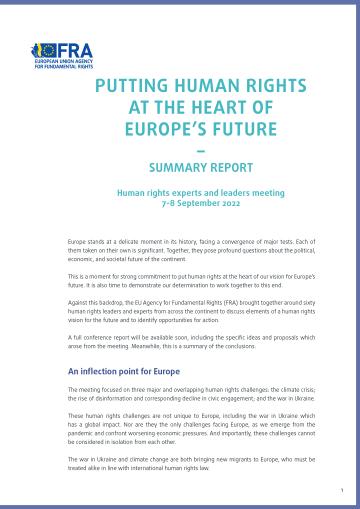
Europe stands at a delicate moment in its history, facing a convergence of major tests. Each of them taken on their own is significant. Together, they pose profound questions about the political, economic, and societal future of the continent. This is a moment for strong commitment to put human rights at the heart of our vision for Europe’s future. It is also time to demonstrate our determination to work together to this end. Against this backdrop, the EU Agency for Fundamental Rights (FRA) brought together around sixty human rights leaders and experts from across the continent to discuss elements of a human rights vision for the future and to identify opportunities for action. A full conference report will be available soon, including the specific ideas and proposals which arose from the meeting. Meanwhile, this is a summary of the conclusions.
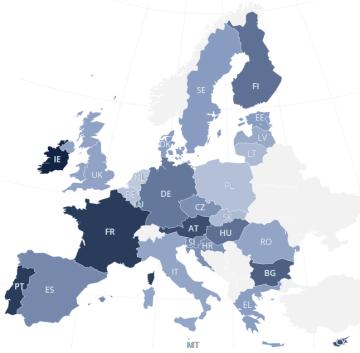
Since 2014, FRA has been publishing an annual update of the forced return monitoring systems EU Member States have set up under Article 8 (6) of the EU’s Return Directive (2008/115/EC). This overview describes different indicators for an effective forced return monitoring system. It includes the organisation responsible for monitoring forced return, the number of operations monitored in 2021, the phases of monitored return operations, the number of staff trained and working as monitors, and whether the monitoring body issued public reports about their monitoring.
On 7 May 2022, the EU Agency for Fundamental Rights (FRA) organised the fourth Fundamental Rights Dialogue – a live debate that gives young people an opportunity to voice their fundamental rights concerns and to discuss ways to solve them.
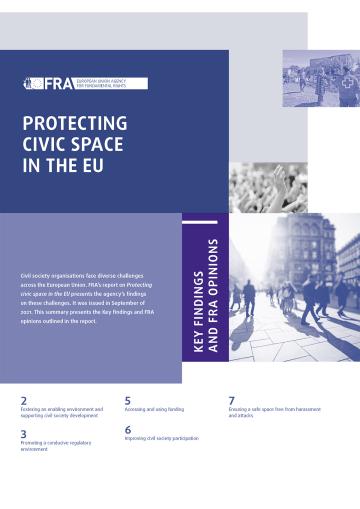
Civil society organisations face diverse challenges across the European Union. FRA’s report on Protecting civic space in the EU presents the agency’s findings on these challenges. It was issued in September of 2021. This summary presents the Key findings and FRA opinions outlined in the report.
Civil society is a key component of Europe’s fundamental rights architecture. From supporting people affected by the pandemic to helping those fleeing the war in Ukraine, civil society plays a crucial role in upholding people’s rights. In so doing, it contributes to a healthy rule of law culture. FRA’s civic space report provides an overview of the many ways in which civil society contributes to the checks and balances that underpin the rule of law.
In this vlog, FRA Director Michael O'Flaherty, points to the need to recommit to human rights, as evidenced by the wide-ranging impact of the Covid-19 pandemic. Here he refers to vaccine inequalities and the impact on marginalised communities, disadvantaged children and frontline workers. As he explains in this vlog, human rights can help fix and strengthen society so we are ready for the next pandemic.
Since September 2021, two National Human Rights Institutions (NHRIs) had a change in their accreditation status, one applied for accreditation and five have had a change in tasks covered by their mandates. This new 2022 update provides an overview of developments in the accreditation status and mandates of NHRIs from September 2021 to May 2022. It is a follow up of FRA’s 2020 report on ‘Strong and effective national human rights institutions – challenges, promising practices and opportunities’ and the September 2021 update. It covers the 27 EU Member States and three candidate countries (Albania, North Macedonia and Serbia).
Every child has a right to be protected even when they are accused or suspected of committing a crime. The basic principles of justice apply to adults and children alike. But children face specific obstacles during criminal proceedings, such as a lack of understandable information about their rights, limited legal support and poor treatment. The report looks at the practical implementation of Directive (EU) 2016/800 on procedural safeguards for children who are suspects or accused persons in criminal proceedings in nine Member States – Austria, Belgium, Bulgaria, Germany, Estonia, Italy, Malta, Poland and Portugal.
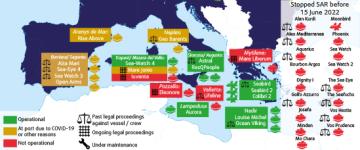
The EU Agency for Fundamental Rights (FRA) regularly collects data on the operations of NGO vessels involved in search and rescue in the Mediterranean. This includes any legal proceedings against them, as well as on any difficulties in disembarking migrants in safe ports. The International Organization for Migration estimates that from January to 15 June 2022 about 842 people died or went missing while crossing the Mediterranean Sea to reach Europe to escape war or persecution, or to pursue a better life. This is an average of five people per day.
FRA’s Fundamental Rights Report 2022 reviews major developments in the field in 2021, identifying both achievements and areas of concern. It also presents FRA’s opinions on these developments, including a synopsis of the evidence supporting these opinions.
This focus looks at the impact of the pandemic on social rights. It examines the measures in national recovery and resilience plans that address the social vulnerabilities among a variety of population groups in the EU, including women, children and young people in situations of vulnerability, people with disabilities, older people, Roma and people in precarious working conditions.
През 2021 г. отбелязахме както напредък, така и неуспехи по отношение на защитата на основните права. В Доклада относно основните права (2022 г.) на FRA е извършен преглед на важните развития в областта, като са посочени както постиженията, така и областите, които все още пораждат загриженост. В настоящата публикация са представени становищата на FRA относно основните промени в обхванатите тематични области и обзор на доказателствата в подкрепа на тези становища. По този начин е направен стегнат, но съдържателен преглед на основните предизвикателства в областта на основните права, пред които са изправени ЕС и държави членки.
Rok 2021 přinesl v oblasti ochrany základních práv pokrok i nezdary. Zpráva o základních právech 2022 agentury FRA přináší přehled hlavního vývoje v této oblasti a upozorňuje jak na úspěchy, tak na oblasti, které i nadále vzbuzují obavy. Tato publikace představuje stanoviska agentury FRA k hlavnímu vývoji v uvedených tematických oblastech a souhrn důkazů podporujících tato stanoviska. Poskytuje tak hutný, ale informativní přehled hlavních problémů, jimž EU a její členské státy čelí v oblasti základních práv.
I 2021 oplevede vi både fremgang og tilbagegang med hensyn til beskyttelsen af grundlæggende rettigheder. FRA’s rapport om grundlæggende rettigheder — 2022 gennemgår udviklingen på dette område og fastslår både, hvad der er opnået, og hvilke områder, der fortsat volder bekymring. Publikationen indeholder FRA’s udtalelser om udviklingen på de afdækkede emneområder og et sammendrag af den underliggende evidens for disse udtalelser. Den giver således en kompakt, men informativ oversigt over de vigtigste udfordringer, som EU og medlemsstaterne står over for med hensyn til grundlæggende rettigheder.
Das Jahr 2021 brachte in Bezug auf den Schutz der Grundrechte sowohl Fortschritte als auch Rückschritte. Der Grundrechte-Bericht 2022 der FRA untersucht maßgebliche Entwicklungen auf diesem Gebiet und zeigt sowohl Erfolge als auch verbleibende Problembereiche auf. Darüber hinaus enthält der Bericht die Stellungnahmen der FRA zu den wichtigsten Entwicklungen in den jeweiligen Themenbereichen und fasst die Informationen, die diesen Stellungnahmen zugrunde liegen, zusammen. Er bietet damit einen kompakten und informativen Überblick über die größten grundrechtlichen Herausforderungen, mit denen die EU und ihre Mitgliedstaaten konfrontiert sind.
Το 2021 σημειώθηκε πρόοδος, αλλά και οπισθοδρόμηση στην προστασία των θεμελιωδών δικαιωμάτων. Στην Έκθεση για τα Θεμελιώδη Δικαιώματα 2022 του FRA εξετάζονται οι σημαντικότερες εξελίξεις στον τομέα και προσδιορίζονται τόσο τα επιτεύγματα όσο και τα ζητήματα που εξακολουθούν να προκαλούν ανησυχία. Στην παρούσα έκδοση παρουσιάζονται οι γνώμες του FRA σχετικά με τις κυριότερες εξελίξεις στους εξεταζόμενους θεματικούς τομείς και συνοψίζεται η τεκμηρίωση στην οποία στηρίχθηκαν οι εν λόγω γνώμες. Με αυτόν τον τρόπο, παρέχεται συνοπτική και ταυτόχρονα κατατοπιστική επισκόπηση των βασικών προκλήσεων που αντιμετωπίζουν η ΕΕ και τα κράτη μέλη στον τομέα των θεμελιωδών δικαιωμάτων.
The year 2021 brought both progress and setbacks in terms of fundamental rights protection. FRA’s Fundamental Rights Report 2022 reviews major developments in the field, identifying both achievements and remaining areas of concern. This publication presents FRA’s opinions on the main developments in the thematic areas covered, and a synopsis of the evidence supporting these opinions.