• Report / Paper / Summary
    12
    September
    2019
    FRA’s second EU Minorities and Discrimination survey (EU-MIDIS II) collected information from over 25,000 respondents with different ethnic minority and immigrant backgrounds across all 28 EU Member States. The main findings from the survey, published in 2017, pointed to a number of differences in the way women and men with immigrant backgrounds across the European Union (EU) experience how their rights are respected. This report summarises some of the most relevant survey findings in this regard, which show the need for targeted, gender-sensitive measures that promote the integration of – specifically – women who are immigrants or descendants of immigrants.
  • Fundamental Rights Report
    6
    June
    2019
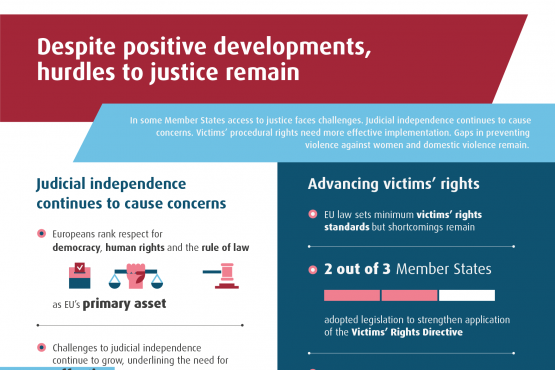
    How much progress can we expect in a decade? Various rights-related instruments had been in place for 10 years in 2018, prompting both sobering and encouraging reflection on this question.
  • Report / Paper / Summary
    25
    April
    2019
    Victims of violent crime have various rights, including to protection and to access justice. But how are these rights playing out in practice? Are victims of violent crime properly seen, informed, empowered and heard? Do they tend to feel that justice has been done? Our four-part report series takes a closer look at these questions, based on interviews with victims, people working for victim support organisations, police officers, attorneys, prosecutors and judges.
  • Report / Paper / Summary
    5
    April
    2019
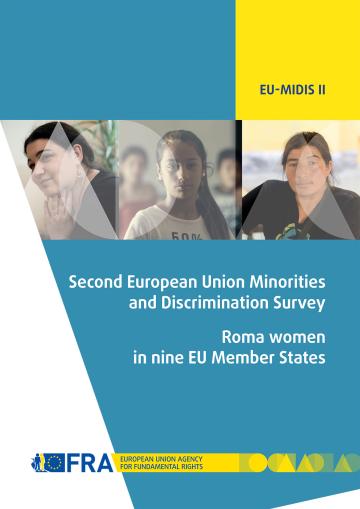
    Despite efforts by the European Union (EU) and its Member States to reduce gender inequalities among citizens of Roma origin, important gender differences persist. Drawing on FRA’s own EU-MIDIS II survey research in nine EU Member States this report highlights the position of Roma women in education, employment and health, as well as the extent to which they experience hate-motivated discrimination, harassment and physical violence.
  • Report / Paper / Summary
    15
    June
    2018
    The stories of the domestic workers FRA interviewed for this paper reveal appalling working conditions and fundamental rights abuses in private homes across the EU. These stories indicate that, seven years on from FRA’s first report on domestic workers in 2011, little has changed in terms of the risks and experiences of severe labour exploitation domestic workers in the EU face.
  • Fundamental Rights Report
    6
    June
    2018
    The year 2017 brought both progress and setbacks in terms of rights protection. The European Pillar of Social Rights marked an important move towards a more ‘social Europe’. But, as experiences with the EU Charter of Fundamental Rights underscore, agreement on a text is merely a first step. Even in its eighth year as the EU's binding bill of rights, the Charter's potential was not fully exploited, highlighting the need to more actively promote its use.
  • Report / Paper / Summary
    17
    May
    2018
    Организациите на гражданското общество в Европейския съюз имат ключова роля за насърчаването на основните права, но срещат нарастващи трудности в дейността си, дължащи се както на законодателни, така и на практически ограничения. Предизвикателства съществуват във всички държави — членки на ЕС, но техният характер и мащаб се различават. Обикновено липсват данни и проучвания, включително сравнителни изследвания, по този въпрос.
    С оглед на това, в доклада на FRA са разгледани различните видове и категории предизвикателства, пред които са изправени организациите на гражданското общество, извършващи дейност в областта на правата на човека в ЕС. Tова са представени обещаващи практики, които могат да се използват за противодействие на тези пораждащи загриженост процеси. Наред с това са представени обещаващи практики, които могат да се използват за противодействие на тези пораждащи загриженост процеси.

  • Report / Paper / Summary
    17
    May
    2018
    Organizace občanské společnosti v Evropské unii hrají klíčovou úlohu při prosazování základních práv, avšak tato činnost je pro ně stále obtížnější z důvodu právních i praktických
    omezení. Problémy existují ve všech členských státech EU, jejich přesná povaha a rozsah se však liší. Údaje a výzkum týkající se této problematiky, včetně srovnávacího výzkumu, obecně chybějí.
    Zpráva FRA se proto zabývá různými typy a podobami výzev, jimž organizace občanské společnosti působící v oblasti lidských práv v EU čelí. Poukazuje rovněž na slibné postupy,
    které by mohly tyto znepokojivé vzorce neutralizovat.
  • Report / Paper / Summary
    17
    May
    2018
    Civilsamfundsorganisationerne i EU spiller en afgørende rolle med hensyn til at fremme de grundlæggende rettigheder, men det er blevet sværere for dem at gøre det — på grund af
    både lovgivningsmæssige og praktiske begrænsninger. Der er udfordringer i alle EU-medlemsstaterne, men den nøjagtige art og omfanget af dem varierer. Data og forskning om
    denne problemstilling — herunder sammenlignende forskning — savnes generelt.
    FRA’s rapport ser derfor på de forskellige typer og mønstre af udfordringer, som civilsamfundsorganisationer, der arbejder for menneskerettigheder i EU, står over for. Den fremhæver også lovende praksis, som kan modvirke disse bekymrende mønstre.
  • Report / Paper / Summary
    17
    May
    2018
    Zivilgesellschaftliche Organisationen in der Europäischen Union spielen bei der Förderung
    der Grundrechte eine entscheidende Rolle, doch gestaltet sich dies – aufgrund rechtlicher
    und praktischer Einschränkungen – für sie immer schwieriger. In der vorliegenden Zusammenfassung werden die
    wichtigsten Ergebnisse des Berichts und die Stellungnahmen
    der FRA zu den Fragen, die damit aufgeworfen
    werden, skizziert.
  • Report / Paper / Summary
    17
    May
    2018
    Οι οργανώσεις της κοινωνίας των πολιτών στην Ευρωπαϊκή Ένωση διαδραματίζουν σημαντικό ρόλο στην προαγωγή των θεμελιωδών δικαιωμάτων, όμως νομικοί και πρακτικοί
    περιορισμοί δυσχεραίνουν την επίτευξη του στόχου αυτού. Μολονότι σε όλα τα κράτη μέλη της ΕΕ υφίστανται προκλήσεις, η ακριβής φύση και η έκτασή τους ποικίλλουν. Σε
    γενικές γραμμές, για το θέμα αυτό δεν υφίστανται επαρκή στοιχεία ούτε επαρκής έρευνα –περιλαμβανομένης της συγκριτικής έρευνας.
    Ως εκ τούτου, η έκθεση του FRA εξετάζει την τυπολογία και τα ιδιαίτερα χαρακτηριστικά των προκλήσεων που αντιμετωπίζουν οι οργανώσεις της κοινωνίας των πολιτών που δραστηριοποιούνται στον τομέα των ανθρωπίνων δικαιωμάτων στην ΕΕ. Επισημαίνει επίσης ελπιδοφόρες πρακτικές για την αντιμετώπιση των ανησυχητικών αυτών φαινομένων.
  • Report / Paper / Summary
    17
    May
    2018
    Civil society organisations in the European Union play a crucial role in promoting fundamental
    rights, but it has become harder for them do so – due to both legal and practical restrictions.
    This summary outlines the main
    findings and FRA’s opinions on the different
    types and patterns of challenges faced by civil society
    organisations across the EU,
  • Report / Paper / Summary
    17
    May
    2018
    Las organizaciones de la sociedad civil de la Unión Europea desempeñan un papel crucial en la promoción de los derechos fundamentales, pero les resulta más difícil hacerlo, debido
    a restricciones tanto jurídicas como prácticas. Si bien existen dificultades en todos los Estados miembros de la UE, difieren en su naturaleza exacta y su magnitud. Por lo general, se
    carece de datos e investigaciones sobre esta cuestión, incluida una investigación comparativa. El informe de la FRA analiza los distintos tipos y patrones que presentan las dificultades
    a las que se enfrentan las organizaciones de la sociedad civil que trabajan en el ámbito de los derechos humanos en la UE. También pone de relieve buenas prácticas que pueden contrarrestar estas tendencias preocupantes.
  • Report / Paper / Summary
    17
    May
    2018
    Euroopan unionin kansalaisjärjestöillä on olennaisen tärkeä tehtävä perusoikeuksien edistämisessä, mutta niiden tehtävä on vaikeutunut – sekä oikeudellisten että käytännön rajoitusten vuoksi. Kaikissa EU:n jäsenvaltioissa on haasteita, mutta niiden luonteessa ja laajuudessa on maakohtaisia eroja. Tästä aiheesta ei yleisesti ole tietoa eikä tutkimusta – ei myöskään vertailevaa tutkimusta.
    Siksi perusoikeusviraston raportissa tarkastellaan niiden haasteiden eri tyyppejä ja malleja, joita ihmisoikeuksien parissa työskentelevät kansalaisjärjestöt kohtaavat EU:ssa. Siinä esitellään myös lupaavia käytäntöjä, joilla näitä huolestuttavia malleja voidaan torjua.
  • Rapport / Publication / Résumé
    17
    May
    2018
    Au sein de l’Union européenne, les OSC jouent un rôle crucial dans la promotion des droits
    fondamentaux, mais il leur est désormais plus difficile d’assumer ce rôle en raison de restrictions
    d’ordre à la fois juridique et pratique.
    Le rapport de la l’Agence des droits fondamentaux de l’Union européenne (FRA) se penche
    par conséquent sur les différents types de difficultés rencontrées par les OSC actives dans
    le domaine des droits de l’homme au sein de l’Union européenne.