The Fundamental Rights Report 2025 is the annual report of the European Union Agency for Fundamental Rights (FRA). It provides an overview of the state of fundamental rights in the EU and highlights selected critical developments and trends in 2024. The report covers issues such as inclusive elections, gender-based violence, and the implementation of the EU Charter of Fundamental Rights. It presents FRA’s opinions on these developments, setting out the actions that the EU and Member States should take. This annual publication is a valuable resource for those seeking to stay informed about the EU’s shifting landscape of fundamental rights.
FRA’s Fundamental Rights Report 2024 analyses the year’s developments in fundamental rights. It focuses on the most pressing fundamental rights concerns facing Europe in 2023: the cost-of-living crisis, rights concerns at the EU’s external borders and migration, and threats to democracy. Re-structured, this year’s new approach is a shorter and sharper analysis. It also presents FRA’s opinions on these developments, including a summary of the evidence supporting these opinions.
Ahead of the EU elections, this report explores the political participation of people with disabilities. Although some Member States removed restrictions on the right to vote and to stand for elections, barriers still exist. This report is an update of new developments following FRA’s last report published in 2014. It sets out ways forward to ensure people with disabilities have equal opportunities, in line with the EU Charter of Fundamental Rights and the Convention on the Rights of Persons with Disabilities.
Europe’s ageing population is ever-increasing, and our societies are becoming more digitalised. Many public services are now available online, with many more services in the process of being digitalised. But the digitalisation of public services poses a risk of exclusion for older persons. In this new report, FRA explores the impact of digitalisation on the fundamental rights of older persons. The report maps the current legislation, policies and practices fostering digital inclusion. It provides an overview of the laws at the national level that provide for equal access to public services, both online and offline. The findings show how Member States safeguard older person’s rights to access services undergoing digitalisation. It outlines how Member States can support digital skills and ensure older people can fully participate in public life.
FRA’s Fundamental Rights Report 2023 reviews major developments in the field in 2022, identifying both achievements and areas of concern. It also presents FRA’s opinions on these developments, including a synopsis of the evidence supporting these opinions.
Η παρακολούθηση της κατάστασης των θεμελιωδών δικαιωμάτων στα εξωτερικά σύνορα της ΕΕ θα πρέπει να είναι συστηματική και τακτική για μια σειρά δραστηριοτήτων διαχείρισης των συνόρων, όπως είναι η επιτήρηση των συνόρων, οι συλλήψεις στα χερσαία, θαλάσσια και εναέρια σύνορα, καθώς και η λειτουργία των μηχανισμών παραπομπής, ακόμη και σε περίπτωση μαζικών αφίξεων. Οι παρούσες γενικές κατευθυντήριες γραμμές έχουν ως στόχο να βοηθήσουν τα κράτη μέλη της ΕΕ να συγκροτήσουν εθνικούς ανεξάρτητους μηχανισμούς για την παρακολούθηση της συμμόρφωσης προς τα θεμελιώδη δικαιώματα στα εξωτερικά σύνορα της ΕΕ, σύμφωνα με την πρόταση κανονισμού για τον έλεγχο διαλογής που ανακοινώθηκε στις 23 Σεπτεμβρίου 2020 από την Ευρωπαϊκή Επιτροπή. Εκπονήθηκαν από τον Οργανισμό Θεμελιωδών Δικαιωμάτων της Ευρωπαϊκής Ένωσης κατόπιν αιτήματος της Επιτροπής.
** As of 19 September 2024 a new version of this guidance has been issued. Please see the link below. **
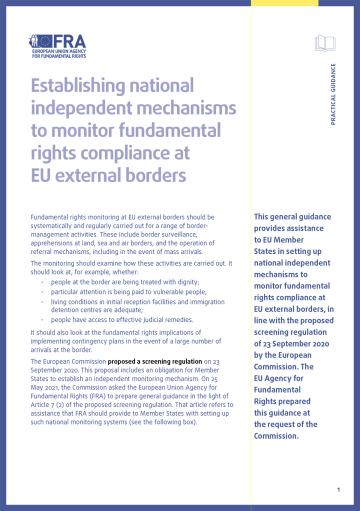
Fundamental rights monitoring at EU external borders should be systematically and regularly carried out for a range of border management activities. These include border surveillance, apprehensions at land, sea and air borders, and the operation of referral mechanisms, including in the event of mass arrivals. This general guidance provides assistance to EU Member States in setting up national independent mechanisms to monitor fundamental rights compliance at EU external borders, in line with the proposed screening regulation of 23 September 2020 by the European Commission. The EU Agency for Fundamental Rights prepared this guidance at the request of the Commission.
El control del respeto de los derechos fundamentales en las fronteras exteriores de la UE debe llevarse a cabo de forma sistemática y regular para determinadas actividades de gestión fronteriza. Estas actividades incluyen la vigilancia de fronteras, las detenciones en las fronteras terrestres, marítimas y aéreas, y el funcionamiento de los mecanismos de devolución, incluso en el caso de llegadas masivas. Esta guía general proporciona asistencia a los Estados miembros de la Unión Europea (UE) para crear mecanismos nacionales independientes con el fin de supervisar el cumplimiento de los derechos fundamentales en las fronteras exteriores de la UE, de acuerdo con la propuesta de reglamento de control de 23 de septiembre de 2020 de la Comisión Europea. La Agencia de Derechos Fundamentales de la UE elaboró esta guía a solicitud de la Comisión.
Perusoikeuksien toteutumista EU:n ulkorajoilla pitäisi seurata järjestelmällisesti ja säännöllisesti rajaturvallisuuden ylläpitämiseen liittyvissä eri toimissa. Näitä toimia ovat muun muassa rajavartiointi, kiinniottamiset maa-, meri- ja ilmarajoilla ja asianmukaiseen menettelyyn ohjaamista koskevan mekanismin käyttö, myös silloin, kun kyse on joukoittaisesta maahantulosta. Nämä yleiset ohjeet auttavat EU:n jäsenvaltioita perustamaan kansallisia riippumattomia mekanismeja perusoikeuksien noudattamisen seurantaan EU:n ulkorajoilla Euroopan komission 23. syyskuuta 2020 ehdottaman seulonta-asetuksen mukaisesti. EU:n perusoikeusvirasto laati nämä ohjeet komission pyynnöstä.
Praćenje poštovanja temeljnih prava na vanjskim granicama EU‑a trebalo bi se sustavno i redovno provoditi za široki raspon aktivnosti upravljanja granicama. Te aktivnosti obuhvaćaju nadzor granica, uhićenja na kopnenim, morskim i zračnim granicama te rad mehanizama za upućivanje, uključujući u slučaju masovnih dolazaka. Ovim općim smjernicama pruža se pomoć državama članicama EU‑a u uspostavi nacionalnih neovisnih mehanizama praćenja poštovanja temeljnih prava na vanjskim granicama EU‑a, u skladu s uredbom o dubinskoj provjeri koju je Europska komisija predložila 23. rujna 2020. Agencija Europske unije za temeljna prava izradila je ove smjernice na zahtjev Komisije.
Az alapjogok uniós külső határokon történő nyomon követésének szisztematikusnak és rendszeresnek kell lennie számos határigazgatási tevékenység tekintetében. E tevékenységek közé tartozik a határőrizet, a szárazföldi, tengeri és légi határokon történő őrizetbe vétel, valamint az áldozatkezelési mechanizmusok működtetése, többek között tömeges érkezések esetén is. Ez az általános iránymutatás segítséget nyújt az uniós tagállamok számára az alapjogok uniós külső határokon történő tiszteletben tartásának nyomon követésére szolgáló független nemzeti mechanizmusoknak az előszűrésről szóló rendeletre vonatkozó, 2020. szeptember 23-i európai bizottsági javaslattal összhangban történő létrehozásához. Az Európai Unió Alapjogi Ügynöksége a Bizottság kérésére készítette el ezt az iránymutatást.
Il monitoraggio dei diritti fondamentali alle frontiere esterne dell’UE dovrebbe essere effettuato sistematicamente e regolarmente per una serie di attività di gestione delle frontiere, tra cui la sorveglianza delle frontiere, i fermi alle frontiere terrestri, marittime e aeree e la gestione dei meccanismi di indirizzamento, anche in caso di arrivi di massa. I presenti orientamenti generali forniscono assistenza agli Stati membri dell’Unione europea (UE) ai fini dell’istituzione di meccanismi nazionali indipendenti tesi a monitorare il rispetto dei diritti fondamentali alle frontiere esterne dell’UE, in linea con la proposta di regolamento sugli accertamenti presentata dalla Commissione europea il 23 settembre 2020. L’Agenzia dell’Unione europea per i diritti fondamentali ha elaborato i presenti orientamenti su richiesta della Commissione.
Monitorowanie praw podstawowych na granicach zewnętrznych UE powinno być prowadzone systematycznie i regularnie w odniesieniu do szeregu działań związanych z zarządzaniem granicami. Należą do nich: ochrona granicy, zatrzymania na granicach lądowych, morskich i powietrznych oraz funkcjonowanie mechanizmów ukierunkowanej pomocy, także w przypadku masowego napływu. Niniejsze ogólne wytyczne stanowią pomoc dla państw członkowskich w tworzeniu niezależnych krajowych mechanizmów monitorowania przestrzegania praw podstawowych na granicach zewnętrznych UE, zgodnie z proponowanym przez Komisję Europejską rozporządzeniem w sprawie kontroli przesiewowej z dnia 23 września 2020 r. Agencja Praw Podstawowych Unii Europejskiej przygotowała niniejsze wytyczne na wniosek Komisji.
This report outlines to what extent legal aid is available to those held in pre-removal detention in the 27 EU Member States, and in North Macedonia and Serbia, during procedures related to their return. These involve decisions on return, on detention pending removal, the removal itself and on bans on entry. The report also examines when people are entitled to free legal aid and how this aid is funded, as well as who provides representation and various factors that limit the scope of legal aid.
This note sets out human rights standards stemming from both the European Convention on Human Rights and European Union (EU) law that apply to effective remedies for human rights violations at borders, together with those on complaints mechanisms and investigations into complaints of rights violations at borders.
La présente note passe en revue les normes relatives aux droits de l'homme qui découlent de la Convention européenne des droits de l'homme et du droit de l’Union européenne (UE) et qui régissent les recours effectifs contre les violations des droits de l'homme aux frontières, les mécanismes de plainte et les enquêtes sur les plaintes concernant des violations des droits aux frontières.
Artificial intelligence (AI) already plays a role in deciding what unemployment benefits someone gets, where a burglary is likely to take place, whether someone is at risk of cancer, or who sees that catchy advertisement for low mortgage rates. Its use keeps growing, presenting seemingly endless possibilities. But we need to make sure to fully uphold fundamental rights standards when using AI. This report presents concrete examples of how companies and public administrations in the EU are using, or trying to use, AI. It focuses on four core areas – social benefits, predictive policing, health services and targeted advertising.
V tem poročilu so predstavljeni konkretni primeri, kako podjetja in javne uprave v Evropski uniji (EU) uporabljajo ali poskušajo uporabljati umetno inteligenco. Obravnavane so možne posledice za temeljne pravice, prav tako je prikazano, ali uporabniki umetne inteligence upoštevajo pravice in na kakšen način.
As we enter the second half of 2020, the constraints on our daily lives brought about by the Coronavirus pandemic have become a firm reality. New local lockdowns and the reintroduction of restrictive measures prompted by fresh outbreaks of the virus are a stark reminder that COVID-19 continues to shape our lives – and our enjoyment of fundamental rights – in profound ways. There is compelling evidence of how the pandemic has exacerbated existing challenges in our societies. This FRA Bulletin outlines some of the measures EU Member States adopted to safely reopen their societies and economies while continuing to mitigate the spread of COVID-19. It highlights the impact these measures may have on civil, political and socioeconomic rights.
Настоящото ръководство е предназначено за служителите по управление на границите в държавите — членки на Европейския съюз, които работят на оперативно ниво. То има за цел да подпомогне ежедневната им работа по прилагането на гаранциите за основните права, предвидени в Кодекса на шенгенските граници (Регламент (ЕС) № 2016/399), и свързаните с него законодателни актове.