Jazyk
English
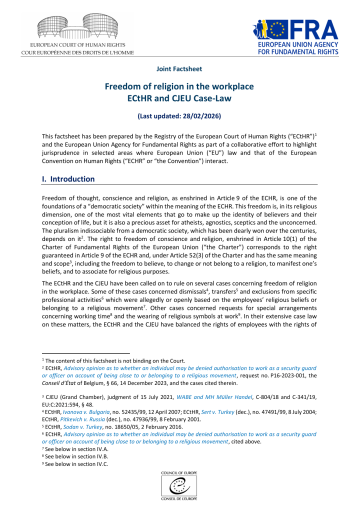
Freedom of thought, conscience and religion, as enshrined in Article 9 of the ECHR, is one of the foundations of a “democratic society” within the meaning of the ECHR. This freedom is, in its religious dimension, one of the most vital elements that go to make up the identity of believers and their conception of life, but it is also a precious asset for atheists, agnostics, sceptics and the unconcerned. The pluralism indissociable from a democratic society, which has been dearly won over the centuries, depends on it.
The right to freedom of conscience and religion, enshrined in Article 10(1) of the Charter of Fundamental Rights of the European Union (“the Charter”) corresponds to the right guaranteed in Article 9 of the ECHR and, under Article 52(3) of the Charter and has the same meaning and scope, including the freedom to believe, to change or not belong to a religion, to manifest one’s beliefs, and to associate for religious purposes.