Den europæiske lovgivning om ikke-forskelsbehandling, som består af EU’s direktiver om ikkeforskelsbehandling og artikel 14 i den europæiske menneskerettighedskonvention (EMRK) samt protokol nr. 12 hertil, forbyder forskelsbehandling i en række sammenhænge og af en række årsager. I denne håndbog ser vi på EU-lovgivningen om ikke-forskelsbehandling i henhold til disse to kilder som komplementære systemer, idet de vil blive brugt i flæng, hvis de overlapper hinanden, mens evt. forskelle vil blive fremhævet.
Η ευρωπαϊκή νομοθεσία κατά των διακρίσεων, η οποία αποτελείται ειδικότερα από τις οδηγίες
της ΕΕ κατά των διακρίσεων, καθώς και από το άρθρο 14 και το δωδέκατο πρωτόκολλο της
Ευρωπαϊκής Σύμβασης των Δικαιωμάτων του Ανθρώπου απαγορεύει τις διακρίσεις σε διάφορους
τομείς και για διάφορους λόγους. Το παρόν εγχειρίδιο εξετάζει την ευρωπαϊκή νομοθεσία κατά
των διακρίσεων, όπως αυτή απορρέει από τις δύο αυτές πηγές που λειτουργούν συμπληρωματικά
μεταξύ τους, παραπέμποντας αδιακρίτως και στις δύο όποτε αυτές αλληλοεπικαλύπτονται,
επισημαίνοντας, όμως, ταυτόχρονα, τυχόν διαφορές τους.
European non-discrimination law, as constituted in particular by the EU non-discrimination directives, and Article 14 of and Protocol 12 to the European Convention on Human Rights, prohibits discrimination across a range of contexts and grounds. This handbook examines European non-discrimination law stemming from these two sources as complementary systems, drawing on them interchangeably to the extent that they overlap, while highlighting differences where these exist.
Diskrimineerimine eri kontekstides ja alustel on keelatud Euroopa võrdse kohtlemise õigusega, mille moodustavad ELi võrdse kohtlemise direktiivid ning Euroopa inimõiguste ja põhivabaduste kaitse konventsiooni artikkel 14 ja konventsiooni protokoll nr 12. Käesolevas käsiraamatus vaadeldakse nendest kahest allikast lähtuvaid Euroopa võrdse kohtlemise õigusnorme üksteist täiendavate süsteemidena, tuginedes neile vaheldumisi ja rõhutades samas ka erinevusi (kui neid esineb).
U skladu s europskim antidiskriminacijskim pravom, kako je utemeljeno direktivama EU‑a
o suzbijanju diskriminacije te člankom 14. i Protokolom br. 12. Europske konvencije o ljudskim
pravima, zabranjuje se diskriminacija u nizu različitih okolnosti i na temelju različitih osnova. U ovom
se priručniku razmatra europsko antidiskriminacijsko pravo koje proizlazi iz tih dvaju izvora kao
komplementarnih sustava, pri čemu se naizmjenično poziva na njih ako se oni podudaraju odnosno
ističu se razlike između tih izvora ako one postoje.
Az európai megkülönböztetésmentességi jog, amelyet elsősorban a megkülönböztetésmentességről szóló uniós irányelvek, valamint az emberi jogok és alapvető szabadságok védelméről szóló európai egyezmény (EJEE) 14. cikke és 12. jegyzőkönyve alkot, különféle összefüggésekben tiltja a különböző okok alapján történő megkülönböztetést. Ez a kézikönyv az ebből a két, egymást kiegészítő rendszerként működő forrásból származó európai megkülönböztetésmentességi jogot vizsgálja meg; ennek során átfedések esetén rámutat felcserélhetőségükre, ugyanakkor felhívja a figyelmet az esetenként előforduló különbségekre is.
Pagal Europos nediskriminavimo teisę, kurią sudaro pirmiausia ES nediskriminavimo direktyvos ir
Žmogaus teisių ir pagrindinių laisvų apsaugos konvencijos 14 straipsnis bei Protokolas Nr. 12,
draudžiama diskriminuoti įvairiomis aplinkybėmis ir įvairiais pagrindais. Šiame vadove iš šių dviejų
šaltinių kilusi Europos nediskriminavimo teisė nagrinėjama kaip viena kitą papildančios sistemos;
jomis pakaitomis remiamasi – tiek, kiek jos sutampa, ir atkreipiamas dėmesys į skirtumus, jei jų
yra.
Id-dritt Ewropew tan-nondiskriminazzjoni, kif ikkostitwit b’mod partikolari mid-direttivi tal-UE dwar in-nondiskriminazzjoni, u l-Artikolu 14 u l-Protokoll 12 tal-Konvenzjoni Ewropea dwar id-Drittijiet tal-Bniedem, jipprojbixxi d-diskriminazzjoni f’firxa ta’ kuntesti u raġunijiet. Dan il-manwal jeżamina d-dritt Ewropew tan-nondiskriminazzjoni li jirriżulta minn dawn iż-żewġ sorsi bħala sistemi
komplementari, u jużahom b’mod interkambjabbli sal-punt li jikkoinċidu, filwaqt li jenfasizza d-differenzi fejn dawn jeżistu.
Het Europese non-discriminatierecht, dat met name wordt gevormd door de EU-richtlijnen inzake non-discriminatie en door artikel 14 van en protocol 12 bij het Europese Verdrag tot bescherming van de rechten van de mens, verbiedt discriminatie op basis van diverse contexten en gronden. Dit handboek onderzoekt het Europees non-discriminatierecht dat voortvloeit uit deze twee complementaire bronnen, en maakt daarbij geen onderscheid tussen beide, tenzij daar waar ze van elkaar afwijken.
A legislação europeia antidiscriminação, constituída, em particular, pelas diretivas da UE em matéria
de não discriminação, pelo artigo 14.o da Convenção Europeia dos Direitos do Homem e pelo
Protocolo n.o 12 a esta convenção, proíbe a discriminação em diversos contextos e com base em
diversos motivos. O presente manual examina a legislação europeia neste domínio, tal como
decorre dessas duas fontes, remetendo indiferenciadamente para um ou outro destes sistemas
jurídicos complementares nas situações em que os mesmos se sobrepõem, ou assinalando as
diferenças onde estas existem.
Európske antidiskriminačné právo ustanovené antidiskriminačnými smernicami EÚ, ako aj článkom
14 Európskeho dohovoru Rady Európy o ochrane ľudských práv a základných slobôd a jeho protokolu
č. 12 zakazuje diskrimináciu v celom rade súvislostí a na základe rozmanitých dôvodov. V tejto
príručke sa skúma európske antidiskriminačné právo prameniace z týchto dvoch zdrojov ako
komplementárnych systémov, pričom sa z nich striedavo vychádza v rozsahu, v akom sa prekrývajú,
a zdôrazňujú sa prípadné rozdiely.
Evropsko protidiskriminacijsko pravo, kot ga določajo zlasti protidiskriminacijske direktive Evropske
unije, člen 14 Evropske konvencije o človekovih pravicah in 12. Protokol k tej konvenciji, prepoveduje
diskriminacijo na različnih področjih in zaradi različnih razlogov. Ta priročnik pojasnjuje evropsko
protidiskriminacijsko pravo, kot izhaja iz navedenih dveh komplementarnih sistemov. Izmenjuje
navaja področja, kjer se ureditvi vsebinsko prekrivata, in izpostavlja razlike med njima.
In view of the increasing numbers of refugees, asylum seekers and migrants entering the EU, the EU Agency for Fundamental Rights has been collecting relevant data since September 2015. These focus on the fundamental rights situation of people arriving in Member States particularly affected by large migration movements. The countries covered are: Austria, Bulgaria, Croatia, Denmark, Finland, France, Germany, Greece, Hungary, Italy, the Netherlands, Poland, Spain and Sweden.
FRA’s Second European Union Minorities and Discrimination Survey surveys around 26,000 individuals from different ethnic minority and immigrant backgrounds across all 28 EU Member States. This technical report presents a detailed overview of the research methods used by FRA when collecting the survey data.
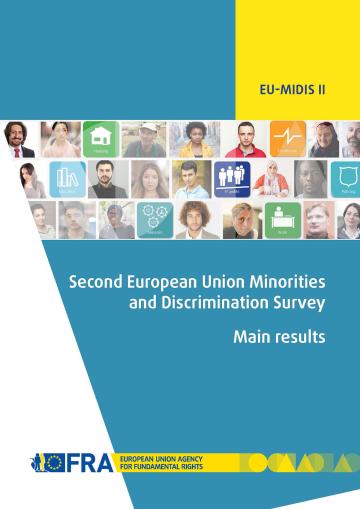
Seventeen years after adoption of EU laws that forbid discrimination, immigrants, descendants of immigrants, and minority ethnic groups continue to face widespread discrimination across the EU and in all areas of life – most often when seeking employment. For many, discrimination is a recurring experience. This is just one of the findings of FRA’s second European Union Minorities and Discrimination Survey (EU-MIDIS II), which collected information from over 25,500 respondents with different ethnic minority and immigrant backgrounds across all 28 EU Member States.
This survey involved interviews with 25,515 people with different ethnic minority and immigrant backgrounds across 28 EU countries. It explores issues concerning discrimination as well as experiences of harassment, hate-motivated violence and discriminatory profiling.
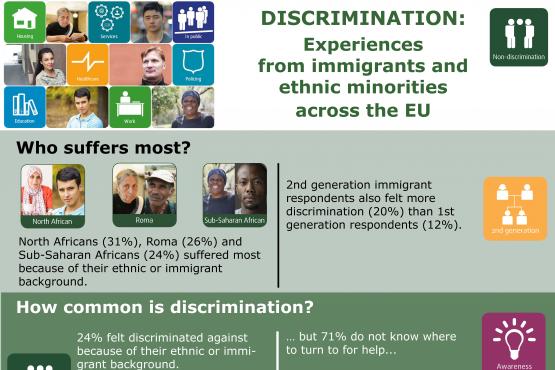
This infographic illustrates the main experiences immigrants and ethnic minorities across the EU have when it comes to discrimination. It draws from the findings from FRA's EU-MIDIS II survey.
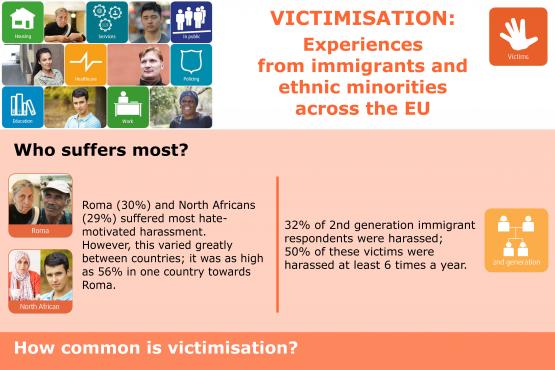
This infographic illustrates the main experiences immigrants and ethnic minorities across the EU have when it comes to victimisation. It draws from the findings from FRA's EU-MIDIS II survey.
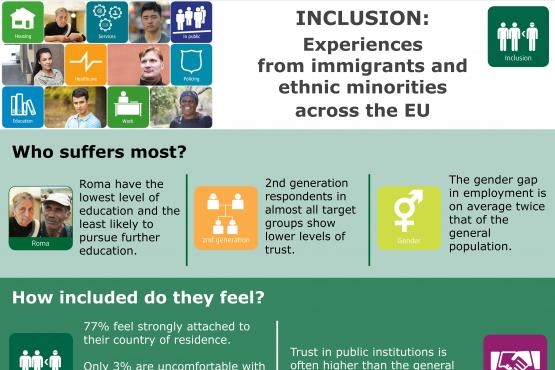
This infographic illustrates the main experiences immigrants and ethnic minorities across the EU have when it comes to inclusion. It draws from the findings from FRA's EU-MIDIS II survey.