Systems

Гражданско общество

    Продукти

    Publications and Data

    Displaying results 11 - 20 of 31
    Periodic updates / Series
    19
    June
    2019
    In 2018, some 2,299 people are estimated to have died or gone missing at sea while crossing the sea to reach Europe to escape war or persecution or to pursue a better life. This is on average more than six people per day. Before mid-2017, a significant share of migrants in distress at sea have been rescued by civil society vessels deployed with a humanitarian mandate to reduce fatalities and bring rescued migrants to safety. In 2018, however, authorities in some Member States viewed civil society-deployed rescue vessels with hostility. As a reaction, they seized rescue vessels, arrested crew members, and initiated legal procedures against them (more than a dozen altogether). In some cases, rescue vessels were blocked in harbours due to flag issues.

    Report / Paper / Summary
    12
    June
    2019
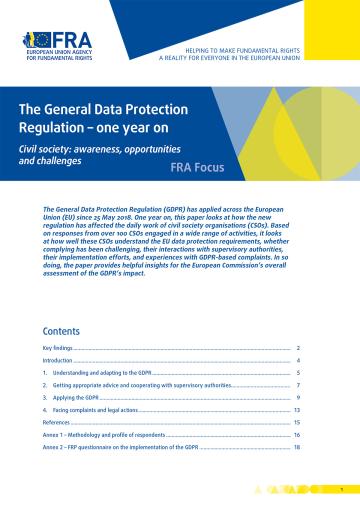
    The General Data Protection Regulation (GDPR) has applied across the European Union (EU) since 25 May 2018. One year on, this paper looks at how the new regulation has affected the daily work of civil society organisations (CSOs).
    Report / Paper / Summary
    26
    November
    2018
    Civil society organisations play a critical role in democracies, and the importance of their work is widely recognised in international legal and policy documents. However, they face many obstacles when it comes to their day-to-day work. Based on the results of an online consultation with FRA's civil society network, the Fundamental Rights Platform (FRP), in September 2018, this paper complements the January 2018 report.
    Report / Paper / Summary
    1
    October
    2018
    This note draws attention to the recent trend of criminalising search and rescue operations (SAR) in the Mediterranean Sea carried out by non-governmental organisations (NGOs) or other private entities. This includes seizing rescue vessels, as well as arrests for crew members, in some EU Member States. Most of such incidents concerned NGOs operating in the Central Mediterranean Sea.
    Report / Paper / Summary
    21
    June
    2018
    Across the European Union, people face hatred because of their skin colour, ethnicity, religion, gender or sexuality. In response, the EU and its Member States have introduced laws against hate crime and support services for victims. But these will only fulfil their potential if victims report hate-motivated harassment and violence to the police, and if police officers record such incidents as hate crimes. This report provides rich and detailed information on hate crime recording and data collection systems across the EU, including any systemic cooperation with civil society.
    Report / Paper / Summary
    18
    January
    2018
    Civil society organisations in the European Union play a crucial role in promoting fundamental rights, but it has become harder for them to do so – due to both legal and practical restrictions. This report looks at the different types and patterns of challenges faced by civil society organisations working on human rights in the EU.
    Report / Paper / Summary
    18
    January
    2018
    Organizace občanské společnosti v Evropské unii hrají klíčovou úlohu při prosazování základních práv, avšak tato činnost je pro ně stále obtížnější z důvodu právních i praktických
    omezení. Problémy existují ve všech členských státech EU, jejich přesná povaha a rozsah se však liší. Údaje a výzkum týkající se této problematiky, včetně srovnávacího výzkumu,
    obecně chybějí.
    Zpráva FRA se proto zabývá různými typy a podobami výzev, jimž organizace občanské společnosti působící v oblasti lidských práv v EU čelí.
    Report / Paper / Summary
    18
    January
    2018
    Civilsamfundsorganisationerne i EU spiller en afgørende rolle med hensyn til at fremme de grundlæggende rettigheder, men det er blevet sværere for dem at gøre det — på grund af
    både lovgivningsmæssige og praktiske begrænsninger. Der er udfordringer i alle EU-medlemsstaterne, men den nøjagtige art og omfanget af dem varierer. Data og forskning om
    denne problemstilling — herunder sammenlignende forskning — savnes generelt.
    FRA’s rapport ser derfor på de forskellige typer og mønstre af udfordringer, som civilsamfundsorganisationer, der arbejder for menneskerettigheder i EU, står over for.
    Report / Paper / Summary
    18
    January
    2018
    Zivilgesellschaftliche Organisationen in der Europäischen Union spielen bei der Förderung der Grundrechte eine entscheidende Rolle, doch gestaltet sich dies – aufgrund rechtlicher
    und praktischer Einschränkungen – für sie immer schwieriger. Zwar stehen alle EU-Mitgliedstaaten vor Herausforderungen, doch sind diese hinsichtlich ihrer Art und ihres Ausmaßes
    ganz unterschiedlich. Generell fehlen zu diesem Thema Daten und Forschungsarbeiten – einschließlich der vergleichenden Forschung. Der Bericht der FRA befasst sich daher mit den unterschiedlichen Arten und Tendenzen der Herausforderungen, vor denen in der EU tätige zivilgesellschaftliche Menschenrechtsorganisationen stehen.
    Report / Paper / Summary
    18
    January
    2018
    Euroopa Liidu kodanikuühiskonna organisatsioonidel on oluline roll põhiõiguste edendamisel, kuid nii õiguslike kui ka praktiliste piirangute tõttu on neil seda üha raskem teha. Probleemid esinevad kõigis ELi liikmesriikides, ehkki nende olemus ja ulatus on erinev. Selle valdkonna andmed ja teadusuuringud – ka võrdlevad teadusuuringud – on üldiselt puudulikud.
    Seepärast käsitleb FRA aruanne ELi inimõiguste valdkonnas tegutsevate kodanikuühiskonna organisatsioonide ees seisvate probleemide eri liike ja trende.