Justice

Правосъдие, права на жертвите и съдебно сътрудничество

<p>Your access to justice is a fundamental right. It is central to making your other rights a reality.</p>
<p>It protects rights of the individual. It puts right civil wrongs. It holds power to account. We shine a light on obstacles to access to justice. And we give evidence-based advice on overcoming them.</p>

Highlights

    Продукти

    Publications and Data

    Displaying results 111 - 120 of 136
    Report / Paper / Summary
    18
    June
    2013
    This year’s summary of the FRA Annual report – Highlights 2012 – puts the spotlight on key legal and policy developments in the field of fundamental rights in 2012.
    Fundamental Rights Report
    18
    June
    2013
    Against a backdrop of rising unemployment and increased deprivation, this FRA Annual report closely examines the situation of those, such as children, who are vulnerable to budget cuts, impacting important fields such as education, healthcare and social services. It looks at the discrimination that Roma continue to face and the mainstreaming of elements of extremist ideology in political and public discourse. It considers the impact the crises have had on the basic principle of the rule of law, as well as stepped up EU Member State efforts to ensure trust in justice systems.
    Opinion / Position Paper
    10
    December
    2012
    In relation to the European Commission proposal for a Directive on the freezing and confiscation of proceeds of crime in the European Union, the European Parliament requested advice from FRA on the extent to which confiscation of proceeds of crime could go without breaching fundamental rights.
    In brief / Factsheet
    6
    December
    2012
    The European Union (EU) and its Member States have undertaken many legislative and non-legislative initiatives in recent years to improve the situation of victims of crime, while work to promote the rights of victims is still ongoing. Some of the key concerns in the field include the role of the victim in criminal proceedings and facilitating access to criminal justice systems: in other words, ensuring that victims are recognised as persons with rights. These rights should be respected and safeguarded by the criminal justice system.
    Report / Paper / Summary
    6
    December
    2012
    The principle of non-discrimination is firmly established in European Union (EU) legislation and includes provisions relating to access to justice. This report examines the process of seeking redress in cases of discrimination. It provides a detailed analysis of what the EU Member State bodies that deal with cases of discrimination do to support possible victims of discrimination and to offer them redress. It examines the factors obstructing effective remedies, such as the complexity of the complaints system, which discourage people from bringing cases and reinforce victims’ feelings of helplessness
    In brief / Factsheet
    December
    2012
    The principle of non-discrimination is firmly established in European Union (EU) legislation and includes provisions relating to access to justice. This factsheet provides an overview of the policy context and key issues from the FRA report on 'Access to justice in cases of discrimination in the EU – Steps to further equality'
    In brief / Factsheet
    27
    November
    2012
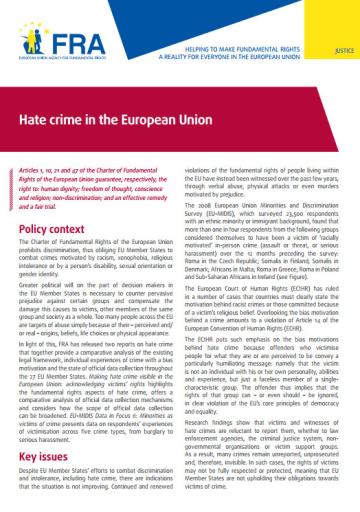
    Despite EU Member States’ efforts to combat discrimination and intolerance, including hate crime, there are indications that the situation is not improving. Continued and renewed violations of the fundamental rights of people living within the EU have instead been witnessed over the past few years, through verbal abuse, physical attacks or even murders motivated by prejudice.
    Report / Paper / Summary
    27
    November
    2012
    Discrimination and intolerance persist in the European Union (EU) despite the best efforts of Member States to root them out, FRA research shows. Verbal abuse, physical attacks and murders motivated by prejudice target EU society in all its diversity, from visible minorities to those with disabilities. This FRA report is designed to help the EU and its Member States to tackle these fundamental rights violations both by making them more visible and bringing perpetrators to account.
    Report / Paper / Summary
    27
    November
    2012
    This EU-MIDIS Data in focus report 6 presents data on respondents’ experiences of victimisation across five crime types: theft of or from a vehicle; burglary or attempted burglary; theft of personal property not involving force or threat (personal theft); assault or threat; and serious harassment. The European Union Minorities and Discrimination Survey (EU-MIDIS) is the first EU-wide survey to ask 23,500 individuals with an ethnic and minority background about their experiences of discrimination and criminal victimisation in everyday life.